
“Does coffee raise your cholesterol” has a frustrating answer if you ask it the way people usually ask it, because the honest reply is “it depends what you put the water through.” Coffee beans contain a pair of oily compounds that raise LDL cholesterol, and whether they end up in your mug is decided almost entirely by one piece of equipment: the filter. A paper filter catches them. A metal mesh, a boiling pot, or a Turkish cezve does not.
This page walks through the trial evidence on that split, what the numbers actually look like, why a 2015 Italian espresso study complicates the tidy version of the story, and how to adjust your routine without giving up the brewing methods you like. It is a sourced explainer, not medical advice. If you have high cholesterol, take a statin, or have been told to watch your lipids, treat everything here as a list of questions for your own clinician.
The compounds: cafestol and kahweol
The cholesterol-raising factors in coffee have been known for decades. A 1997 review in the Annual Review of Nutrition by Urgert and Katan describes them as the diterpene lipids cafestol and kahweol, which together make up about 1 percent of the weight of a coffee bean. The same review explains the filter effect in one sentence: diterpenes are extracted by hot water but are retained by a paper filter. That explains why filtered coffee does not affect cholesterol, whereas Scandinavian boiled coffee, cafetiere (French press) coffee, and Turkish coffee do.
Notice what that sentence leaves out. It is not about caffeine, roast level, bean origin, or how many cups you drink. The mechanism is about oil. Diterpenes are fat-soluble compounds that dissolve into hot water and sit in the cup alongside the fine particles and oils that a paper filter would have trapped.
A 2016 analysis of diterpene esters in different coffee brews gives a feel for how wide the spread is. Across classical brewing methods it measured total cafestol esters ranging from 5 to 232 mg/L, and found that boiled coffee had the highest diterpene ester content while filtered and instant brews showed the lowest. Harvard Health, summarizing the brewing literature, puts the same idea in plain terms: a cup of unfiltered coffee contains about 30 times more diterpenes than a cup of filtered coffee.
What the trials found
Two meta-analyses of randomized controlled trials, more than a decade apart, point the same direction.
The 2001 meta-analysis: filtered versus unfiltered
Jee and colleagues pooled 14 published trials of coffee consumption. They found a dose-response relationship between coffee intake and both total and LDL cholesterol (p < 0.01). Increases in serum lipids were greater in studies of patients who already had hyperlipidemia, and in trials of caffeinated or boiled coffee. The line that matters most for brewing is this one: trials using filtered coffee demonstrated very little increase in serum cholesterol, and the authors concluded that unfiltered, but not filtered, coffee increases serum levels of total and LDL cholesterol.
The 2012 meta-analysis: the size of the effect
Cai and colleagues pooled twelve trials with a total of 1,017 subjects, all conducted in Western countries. On average, drinking coffee for 45 days was associated with:
- An increase of 8.1 mg/dL in total cholesterol
- An increase of 5.4 mg/dL in LDL cholesterol
The increase in total cholesterol was greater in trials where the treatment group drank unfiltered or caffeinated coffee. People with hyperlipidemia were more sensitive to the effect, and a meta-regression found a positive dose-response relationship between how much coffee people drank and the rise in total cholesterol, LDL, and triglycerides.
Keep the scale in view. An average LDL rise of 5.4 mg/dL is a small shift for a typical adult. For someone sitting at an LDL of 130 mg/dL, it works out to roughly 4 percent. It is an average across trials that mixed filtered and unfiltered coffee, so it understates what a heavy unfiltered-only habit might do and overstates what a paper-filter habit does. It also comes from short trials, around 45 days on average, which cannot say what happens over decades.
Does it show up in heart outcomes? The Norwegian cohort
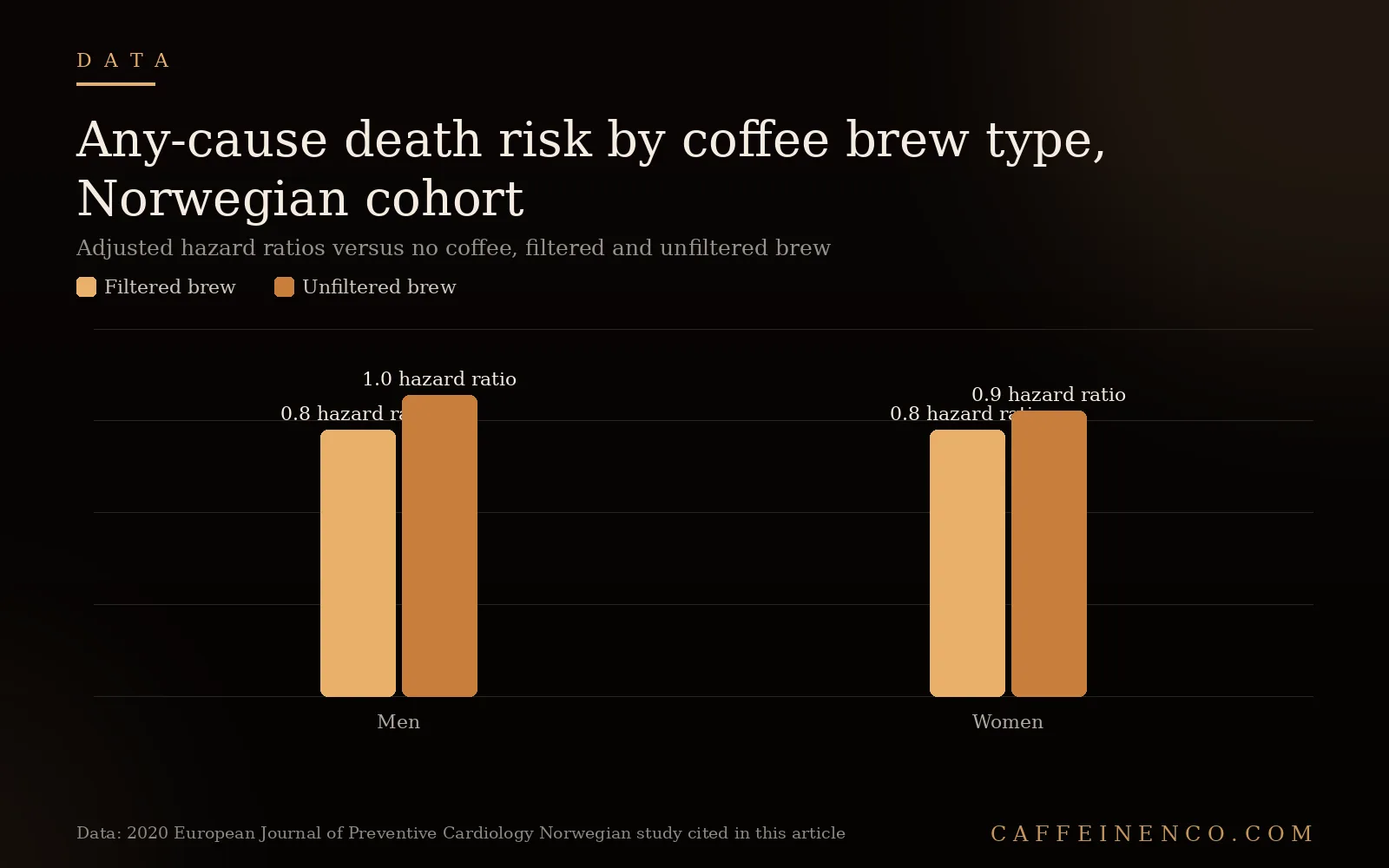
Cholesterol is a marker, not the outcome people care about. A 2020 study in the European Journal of Preventive Cardiology followed 508,747 Norwegians aged 20 to 79 for an average of 20 years, and tracked deaths against which type of coffee they drank. During follow-up there were 46,341 deaths from any cause and 12,621 from cardiovascular disease.
Compared with people who drank no coffee, the adjusted hazard ratios for death from any cause were:
| Group | Filtered brew | Unfiltered brew |
|---|---|---|
| Men | 0.85 | 0.96 |
| Women | 0.85 | 0.91 |
The authors concluded that unfiltered brew was associated with higher mortality than filtered brew, and that filtered brew was associated with lower mortality than no coffee at all. The most pronounced effects appeared in heavy unfiltered drinkers: ischemic heart disease and cardiovascular risk were raised when total cholesterol was left out of the statistical model, which is what you would expect if cholesterol sits on the path between unfiltered coffee and heart disease. Among people aged 60 and over, the hazard ratio for cardiovascular death for unfiltered brew versus no coffee was 1.19 (95% CI 1.00 to 1.41) for men and 0.98 for women.
Two honest caveats. First, this is observational data, so it shows association, not proof. People who drink boiled coffee in Norway differ from filter drinkers in other ways. Second, the unfiltered numbers are not a disaster: they sit at 0.91 to 0.96 for any-cause death, close to abstaining, while the filtered numbers show a clear benefit. The gap between the two columns is the story, not an alarming absolute risk.
The espresso wrinkle
A tidy “unfiltered is bad” story would predict that espresso, which is also unfiltered, behaves like French press. The evidence is messier, and it is worth knowing before you repeat the simple version to anyone.
The 2015 EPICOR study followed 12,800 men and 30,449 women in Italy for about 10.9 years. Drinking Italian-style coffee (espresso and moka pot) was associated with higher coronary heart disease risk: adjusted hazard ratios of 1.18 for 1 to 2 cups a day, 1.37 for more than 2 to 4 cups, and 1.52 for more than 4 cups, compared with under 1 cup. But in a random sub-cohort of 1,472 people, plasma triglycerides and total, LDL and HDL cholesterol did not vary significantly with coffee consumption. The authors concluded that the adverse association appears unrelated to the lipid profile.
Read that carefully. It does not say espresso is cholesterol-neutral for everyone, and it does not say it is safe. It says that in one large cohort, the cholesterol pathway did not explain the heart-disease signal. It is a reminder that the diterpene story is well supported for boiled and French press coffee but should not be mechanically extended to every unfiltered method. Espresso uses a small volume of water over a short contact time, so a single shot carries far less liquid than a full mug of French press, though this site has not found a source measuring diterpenes per shot, so treat that as reasoning, not a finding. For how much caffeine and volume is in a shot, see the espresso shot caffeine breakdown.
Method by method: where each brew lands
This table reflects the filter logic from the Urgert and Katan review and the 2016 brew analysis. It is a guide to the direction of the effect, not a measurement of your own cup.
| Brew method | Passes through paper? | What the evidence supports |
|---|---|---|
| Drip, pour-over, Chemex, Kalita | Yes | Filtered: little effect on cholesterol in trials |
| Instant | Not applicable | Lowest diterpene content in the 2016 brew analysis, alongside filtered |
| French press | No (metal mesh) | Named alongside boiled and Turkish coffee as raising cholesterol |
| Boiled or percolated | No | Highest diterpene ester content in the 2016 analysis |
| Turkish | No | Named as raising cholesterol |
| Espresso and moka pot | No (metal basket) | Mixed: heart-disease association in Italian cohort, no lipid change |
| AeroPress with paper filter | Yes | Paper-filtered, so the filter logic applies |
If you want the brewing detail behind any of these, the site has ratio and grind guides for French press, Turkish coffee, the moka pot, and drip coffee.
Worked example: a four-cup French press habit
Take someone who drinks four mugs of French press a day and has just been told their LDL is borderline. Here is a sensible way to use the evidence, step by step.
- Identify the filter, not the cup count. Four mugs of paper-filtered coffee and four mugs of French press are different exposures. The research suggests the second is the one to look at.
- Swap the daily brew first. Move the weekday cups to a paper-filtered method such as a pour-over or drip machine. Keep the French press for weekends if you like it. Harvard Health’s piece on brewing makes the same point: filtering the coffee, rather than boiling the grounds and drinking the water, was better for health.
- If you love the French press body, add a paper step. Pouring pressed coffee through a paper filter into a second vessel is a common trick, though no source in this article measured how much diterpene it removes, so treat it as a reasonable but unverified workaround. The site’s guide to a cleaner French press cup covers the technique and the grind adjustments that reduce silt.
- Recheck your numbers on your own schedule. The trials averaged 45 days. If you change brewing method, a lipid panel a couple of months later with your clinician will show whether the swap did anything for you specifically.
- Do not change other things at the same time if you want to know what worked. Swapping coffee, starting a new medication, and overhauling your diet in the same week makes the result unreadable.
Choosing a filtered setup
If you are moving away from unfiltered coffee, the equipment is simple and cheap. A basic drip machine or pour-over cone plus a pack of paper filters is all it takes. You can browse drip coffee makers at 1st in Coffee or paper coffee filters on Amazon, and the filter size you need depends on the brewer you own or choose. Nothing in the evidence says a pricier brewer lowers cholesterol more than a cheap one, since the paper is doing the work.
What this does not tell you
Because it is easy to over-read cholesterol research, here are the limits plainly.
- It does not say coffee is bad for the heart. The Norwegian cohort found filtered coffee associated with lower mortality than no coffee. For related findings on another cardiovascular marker, see the site’s coffee and blood pressure breakdown.
- It does not say decaf solves the problem. The cholesterol-raising compounds are diterpenes, not caffeine, so decaf made in a French press still carries them. The Cai analysis did find larger total cholesterol increases in trials using caffeinated coffee, so the picture is not completely clean, but filtering is the lever with the strongest support. Decaf caffeine levels are covered in the decaf caffeine content guide.
- It does not cover what you add to the cup. Cream, butter, and coconut oil bring saturated fat of their own. The site’s bulletproof coffee explainer looks at that separately.
- It does not replace advice from your clinician. People with hyperlipidemia were more sensitive to coffee’s effect in the pooled trials, which is a reason to ask, not a reason to guess.
Common mistakes
Assuming all coffee raises cholesterol is the first mistake; paper-filtered coffee showed very little effect in the trials, and the effect lives in the unfiltered brews. Blaming caffeine is the second; the culprits are cafestol and kahweol, which are oils, not stimulants. Treating a 5.4 mg/dL average LDL rise as a prediction for your own body is the third; individual responses vary, and people with high lipids were more sensitive in the pooled data. Extending the French press finding to espresso without checking is the fourth; the one large Italian espresso cohort found no lipid change, even though it found a heart-disease association. Making several lifestyle changes at once and crediting the coffee swap is the fifth. And the last is dropping coffee altogether when a filter swap would do, given the Norwegian result that filtered coffee drinkers had lower mortality than non-drinkers.
Common questions
Does coffee raise cholesterol? Some does and some does not. Unfiltered coffee such as French press, boiled, and Turkish coffee carries cafestol and kahweol, which raise total and LDL cholesterol. Paper-filtered coffee showed very little increase in the trials pooled by Jee and colleagues in 2001. A 2012 meta-analysis of 12 trials found an average rise of 5.4 mg/dL in LDL after about 45 days of drinking coffee, larger with unfiltered coffee.
Does a paper filter really remove the cholesterol-raising compounds? According to the Urgert and Katan review, diterpenes are extracted by hot water but are retained by a paper filter, which is why filtered coffee does not affect cholesterol. Harvard Health reports roughly 30 times more diterpenes in a cup of unfiltered coffee than in a cup of filtered coffee.
Is French press coffee bad for my cholesterol? It is one of the brews named in the research as raising cholesterol, so if you drink several mugs a day and your LDL is a concern, it is the first thing to change. Occasional French press is a different exposure from a daily four-cup habit.
What about espresso and moka pot coffee? The evidence is mixed. A 2015 Italian cohort of about 43,000 people found higher coronary heart disease risk with more than 2 cups a day of Italian-style coffee, but no significant change in cholesterol levels in a sub-cohort, so the researchers concluded the effect was unrelated to lipids.
Does decaf raise cholesterol? The compounds responsible are diterpenes, which are not caffeine, so decaf brewed unfiltered still contains them. Filtering is the factor with the strongest support.
How many cups of coffee a day is too many for cholesterol? No trial gives a single safe number. Harvard Health suggests limiting intake to less than five cups a day on average and using a filter. People with high cholesterol should ask their own clinician for a personal limit.
Does instant coffee affect cholesterol? The 2016 brew analysis found instant brews had among the lowest diterpene ester levels, similar to filtered coffee. For the caffeine side, see the instant coffee caffeine breakdown.
For more sourced breakdowns like this one, delivered weekly, subscribe to The Sunday Pour.
Sources & data
- PubMed: Urgert and Katan, The Cholesterol-Raising Factor From Coffee Beans (Annual Review of Nutrition, 1997)
- PubMed: Jee et al., Coffee Consumption and Serum Lipids: A Meta-Analysis of Randomized Controlled Clinical Trials (2001)
- PubMed: Cai et al., The Effect of Coffee Consumption on Serum Lipids: A Meta-Analysis of Randomized Controlled Trials (2012)
- PubMed: Coffee Consumption and Mortality From Cardiovascular Diseases and Total Mortality: Does the Brewing Method Matter? (European Journal of Preventive Cardiology, 2020)
- PMC: Espresso Coffee Consumption and Risk of Coronary Heart Disease in a Large Italian Cohort (2015)
- PMC: Variability of Some Diterpene Esters in Coffee Beverages as Influenced by Brewing Procedures (2016)
- Harvard Health Publishing: What's the Healthiest Way to Brew Coffee?