
“Does coffee raise your blood pressure” sounds like a yes or no question, and both answers are defensible depending on which study someone quotes at you. A single dose of caffeine reliably pushes blood pressure up within the hour, a lab finding that shows up again and again in controlled trials. Yet a 2023 analysis pooling 463,973 people found that habitual coffee drinkers are not, on the whole, more likely to develop hypertension than people who skip it, and some of that data even points toward a small protective association. Both things are true at once, and the gap between them comes down to tolerance, dose, and one specific group of people for whom the acute effect genuinely does matter. This site’s own coffee and cortisol breakdown already covers a similar acute-versus-chronic split for caffeine’s effect on stress hormones; this page walks through the same kind of split for blood pressure specifically, with the real numbers behind each side.
The acute spike: what a single cup actually does
A 2011 systematic review and meta-analysis in the American Journal of Clinical Nutrition, led by Arthur Eumann Mesas, pooled five controlled trials testing 200 to 300mg of caffeine, roughly two to three cups of filter coffee using this site’s own 96mg per 8-ounce cup figure. The pooled result was a mean increase of 8.1 mmHg in systolic blood pressure and 5.7 mmHg in diastolic blood pressure. The rise showed up within the first hour after intake and lasted three hours or longer before fading.
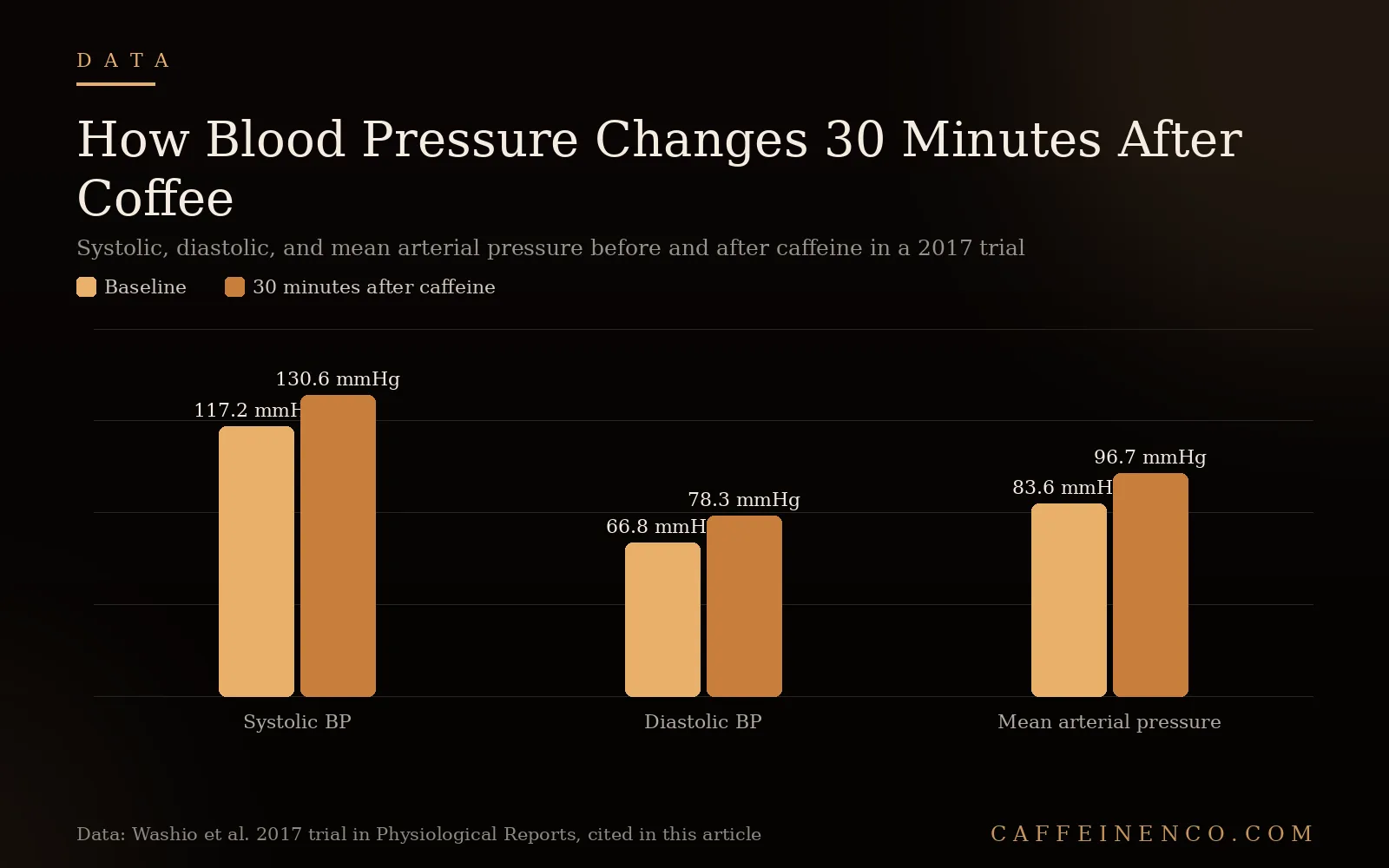
A smaller 2017 trial in Physiological Reports, led by Washio and colleagues, measured the same kind of spike with tighter time resolution. Ten healthy young men drank 250mL of coffee containing about 150mg of caffeine, roughly the amount in a strong cup and a half, after a caffeine-free placebo session on a separate day. At 30 minutes post-intake, systolic blood pressure rose from a baseline of 117.2 mmHg to 130.6 mmHg, and diastolic rose from 66.8 mmHg to 78.3 mmHg, both statistically significant changes. Mean arterial pressure climbed from 83.6 to 96.7 mmHg over the same window. The researchers also measured arterial stiffness directly and found it increased alongside the blood pressure rise, consistent with caffeine’s known effect of blocking adenosine receptors, the same mechanism this site’s coffee and anxiety piece covers for its effect on mood. One genuinely reassuring detail buried in that same trial: despite the systemic stiffening, blood flow pulsatility in the middle cerebral artery showed no measurable difference between the coffee and placebo conditions, meaning the acute spike did not translate into the kind of pulsatile stress on brain blood vessels that would raise more serious concern.
Mayo Clinic’s own explanation of the mechanism behind this short-term rise offers two competing theories rather than a single settled answer: caffeine may block a hormone that normally helps keep arteries widened, or it may prompt the adrenal glands to release more adrenaline, which itself raises blood pressure. Either mechanism produces the same practical result, a real, measurable, but time-limited increase.
Why habitual drinkers barely feel it: tolerance and the long-term numbers

The acute trials above almost all tested people who were not caffeine-naive but were caffeine-abstinent going into the session, which matters, because the long-term picture looks meaningfully different. Mayo Clinic states plainly that people who regularly drink caffeine develop a tolerance to it, and as a result, caffeine “doesn’t have a long-term effect on blood pressure and is not linked with a higher risk” of hypertension in habitual drinkers.
The largest recent test of that claim is a 2023 systematic review and meta-analysis in Nutrients, led by Fahimeh Haghighatdoost, which pooled 25 observational studies, 12 cohort studies and 13 cross-sectional studies, covering 463,973 total participants. The cohort data, generally considered the stronger evidence for a long-term outcome like hypertension, found a pooled risk ratio of 0.93 comparing the highest coffee intake group to the lowest, a 7% reduction in hypertension risk, with low heterogeneity across studies (I squared of 22.3%). The cross-sectional data found an even larger 21% reduction (odds ratio 0.79), though with more inconsistency between individual studies (I squared of 63.2%).
| Study design | Pooled effect (highest vs lowest coffee intake) | What it means |
|---|---|---|
| Cohort studies (12 studies) | RR 0.93 (95% CI: 0.88, 0.97) | 7% lower hypertension risk, low heterogeneity |
| Cross-sectional studies (13 studies) | OR 0.79 (95% CI: 0.72, 0.87) | 21% lower hypertension risk, higher heterogeneity |
Two details in that same analysis keep the finding honest rather than overstated. First, the relationship was non-linear: the authors specifically note that coffee intake below three cups a day did not meaningfully lower hypertension risk, so the modest protective signal is concentrated among heavier habitual drinkers, not casual ones. Second, the effect varied by region, appearing strongest in United States cohort studies while essentially disappearing in cohorts from Europe and Asia, a gap the authors attribute to differences in study characteristics rather than a single clean biological explanation. The honest summary is not “coffee prevents high blood pressure.” It is that regular coffee drinking, once tolerance sets in, does not appear to raise long-term hypertension risk the way the acute lab data might suggest, and in some populations the association trends slightly the other way.
The real exception: people with severe hypertension
The tolerance story above comes with one documented exception, and it matters enough to be its own section rather than a footnote. The Japan Collaborative Cohort Study followed more than 18,600 men and women, ages 40 to 79, from 1988 to 1990 through 2009, tracking 842 cardiovascular-related deaths along the way. Reported by the American Heart Association, the analysis found that among participants with severe hypertension, blood pressure of 160/100 mmHg or higher, drinking two or more cups of coffee a day was associated with roughly double the risk of cardiovascular death compared with non-coffee-drinkers at the same blood pressure level.
| Blood pressure level | Coffee intake | Cardiovascular death risk |
|---|---|---|
| Severe hypertension (160/100 mmHg or higher) | 2 or more cups/day | About double the risk vs. non-drinkers |
| Severe hypertension (160/100 mmHg or higher) | 1 cup/day | No increased risk |
| Any blood pressure level | Green tea, any amount | No increased risk |
Critically, one cup a day was not associated with any increased risk at any blood pressure level, and green tea, which also contains caffeine, showed no increased risk regardless of amount at any blood pressure level either, a detail that points toward something in coffee beyond caffeine alone interacting with the risk, or possibly a dose threshold specific to coffee’s typical serving size. The study’s own explanation for the pattern is straightforward: “because people with severe hypertension are more susceptible to the effects of caffeine, caffeine’s harmful effects may outweigh its protective effects.” The researchers were upfront about real limitations too: intake was self-reported, blood pressure was measured only once rather than tracked over time, and the observational design cannot establish that coffee itself caused the additional deaths rather than simply correlating with them. Still, this is the one place in the literature where the acute-spike mechanism and a real-world health outcome line up in the same direction, and it applies specifically to people already in the most severe hypertension category, not to elevated or stage 1 hypertension broadly.
Caffeine and blood pressure medications: what else stacks the risk
Coffee itself is only part of the picture for anyone managing blood pressure with medication or over-the-counter drugs. Both pseudoephedrine and ephedrine, the stimulant decongestants found in many cold and allergy medications, raise blood pressure and heart rate through a mechanism that overlaps with caffeine’s own effect, and combining either one with caffeine can amplify the increase, according to drug interaction data from Drugs.com. The practical result of stacking the two is not usually dangerous for someone with normal blood pressure taking a single dose, but it can mean a more noticeable jump in heart rate, jitteriness, or headache, and the interaction is worth flagging to a doctor or pharmacist for anyone already on blood pressure medication or managing hypertension, rather than assuming a decongestant and a cup of coffee are unrelated.
For most people who already have high blood pressure and already drink caffeine regularly, Mayo Clinic’s own guidance is reassuring rather than restrictive: there is generally no need to cut caffeine out, though it is still worth confirming with a healthcare professional given individual circumstances. For anyone without high blood pressure, the FDA’s general guidance, cited by Mayo Clinic, puts the safe ceiling at about 400mg a day for most healthy adults, the same 400mg threshold this site’s coffee and anxiety piece covers for a completely different reason.
Worked example: checking where you personally land
- Calculate your daily caffeine total using this site’s own per-serving figures: about 96mg per 8-ounce cup of filter coffee, about 63mg per espresso shot. Three cups of filter coffee works out to roughly 288mg, close to the 300mg ceiling the Mesas meta-analysis flags for hypertensive patients specifically.
- Check whether you know your actual blood pressure category, not just whether you feel fine. The severe-hypertension risk finding above only applies at 160/100 mmHg or higher, a category most people have not measured themselves into without a doctor’s reading, so this step matters more than any caffeine math.
- If you fall into the severe hypertension category, the Japan Collaborative Cohort data points toward keeping coffee to one cup a day rather than two or more, since that was the specific threshold where the doubled cardiovascular death risk appeared.
- If your blood pressure is normal or only mildly elevated, Mayo Clinic’s own guidance and the 463,973-person Haghighatdoost meta-analysis both suggest your regular coffee habit is not the thing to worry about, and the tolerance most habitual drinkers build means the acute lab-measured spike is not representative of your day-to-day baseline.
- Account for anything else that raises blood pressure the same way, including pseudoephedrine-based decongestants, before assuming a rough day is caffeine alone.
- If cutting back still feels worth testing personally, a decaf coffee selection from 1st in Coffee or the same category on Amazon removes most of the caffeine variable while keeping the ritual. This site’s own decaf coffee caffeine content breakdown has the real per-cup range, 2 to 15mg, for planning around it.
Common mistakes
Treating a single acute lab finding as proof that coffee causes chronic high blood pressure is the most common mistake, and it is the one this entire body of research argues against directly: the Mesas meta-analysis measured a real, time-limited spike, not a lasting condition, and the much larger Haghighatdoost meta-analysis found no such long-term risk in 463,973 people. Assuming the severe-hypertension finding applies to anyone with slightly elevated readings is the second mistake; the doubled cardiovascular death risk in the Japan Collaborative Cohort Study specifically required blood pressure of 160/100 mmHg or higher, a narrow and severe category. Ignoring the three-cup threshold in the Nutrients meta-analysis is the third mistake, since the modest protective association there did not appear at all below three cups a day, so light drinkers should not expect the same signal heavier habitual drinkers showed. Forgetting that tolerance takes regular exposure to build is the fourth mistake; someone who normally avoids caffeine and then has a large dose before a blood pressure check may see a genuinely elevated reading that does not reflect their usual baseline. Overlooking decongestants and other stimulant medications while blaming coffee alone for a jittery, high-reading day is the fifth mistake, since pseudoephedrine and ephedrine both compound caffeine’s same blood-pressure-raising mechanism.
Common questions
Does coffee raise blood pressure? Yes, acutely. A meta-analysis of five controlled trials found 200 to 300mg of caffeine raised systolic blood pressure by about 8 mmHg and diastolic by about 6 mmHg within an hour, lasting three or more hours. That acute effect does not translate into a higher long-term hypertension risk for most habitual drinkers.
Does drinking coffee every day cause high blood pressure long-term? The best current evidence says no. A 2023 meta-analysis of 463,973 people found regular coffee drinkers were not more likely to develop hypertension than non-drinkers, and heavier habitual intake, three or more cups a day, was associated with a modest reduction in risk in the pooled data.
Is coffee dangerous for people who already have high blood pressure? For most people with high blood pressure, Mayo Clinic’s guidance is that there is generally no need to cut caffeine if you already drink it regularly, though it is worth confirming with a doctor. The one documented exception is severe hypertension, 160/100 mmHg or higher, where a large cohort study found two or more cups a day was linked to roughly double the cardiovascular death risk compared with one cup or none.
Why doesn’t coffee raise blood pressure long-term if it raises it acutely? Tolerance. Mayo Clinic states that people who drink caffeine regularly develop a tolerance to its blood-pressure effect, which is why the same 8 over 6 mmHg spike seen in caffeine-abstinent lab participants does not show up as a lasting elevation in people’s everyday baseline readings.
How much coffee is safe if I have high blood pressure? The Mesas meta-analysis specifically advises hypertensive patients to keep caffeine under 300mg a day, roughly three cups of filter coffee using this site’s own per-cup figures. Anyone in the severe hypertension category specifically should note the Japan Collaborative Cohort Study’s one-cup-a-day threshold, where risk did not increase, versus two or more cups, where it did.
Can medications make coffee’s effect on blood pressure worse? Yes. Pseudoephedrine and ephedrine, common stimulant decongestants, raise blood pressure and heart rate through an overlapping mechanism with caffeine, and combining either with coffee can amplify the increase. Anyone on blood pressure medication should flag the combination with a doctor or pharmacist rather than assuming the two are unrelated.
For more sourced breakdowns like this one, delivered weekly, subscribe to The Sunday Pour.
Sources & data
- American Journal of Clinical Nutrition, via PubMed: Mesas et al., The Effect of Coffee on Blood Pressure and Cardiovascular Disease in Hypertensive Individuals, A Systematic Review and Meta-Analysis
- Nutrients, via PMC: Haghighatdoost et al., Coffee Consumption and Risk of Hypertension in Adults, Systematic Review and Meta-Analysis
- American Heart Association: People With Very High Blood Pressure May Want to Go Easy on the Coffee
- Mayo Clinic: Caffeine, How Does It Affect Blood Pressure?
- Physiological Reports, via PMC: Washio et al., Acute Impact of Drinking Coffee on the Cerebral and Systemic Vasculature
- Drugs.com: Caffeine and Pseudoephedrine Drug Interactions