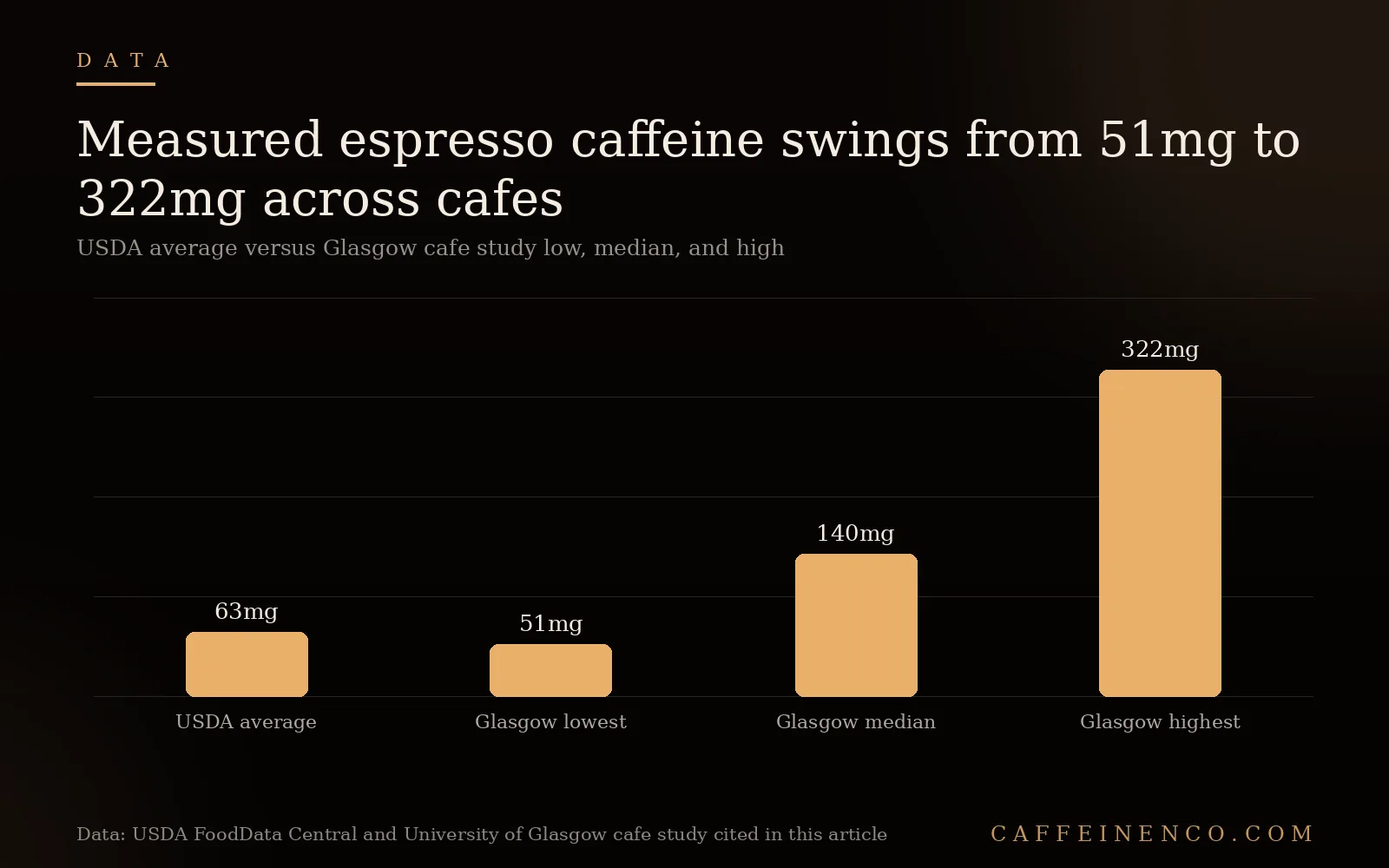
Search for the caffeine content of a shot of espresso and you will land on the same number almost everywhere: 63mg. It shows up in nutrition apps, barista training slides, and a thousand blog posts, usually stated as flatly as a boiling point. It is not a boiling point. It is one measurement of one product, and the moment you look at what actually gets pulled in real cafes, the number stops holding still. A peer-reviewed study that bought espresso from 20 different coffee shops found servings ranging from 51mg to 322mg, a six-fold spread, from cafes operating a few streets apart. Neither figure is wrong. They are answering different questions, and most of the confusion around espresso caffeine comes from treating a single data point as a law.
Where the 63mg figure actually comes from
The number traces to the USDA FoodData Central database, specifically the entry for “Beverages, coffee, brewed, espresso, restaurant-prepared,” listed under FDC ID 171891. That entry states 212mg of caffeine per 100 grams of brewed espresso. A single shot is conventionally about 1 fluid ounce, roughly 30 grams of liquid, so 212mg times 0.3 works out to about 63.6mg, which is where the commonly quoted 63mg comes from. It is a legitimate, government-tested figure. It is also, by definition, a single averaged sample of one product category, not a survey of what every machine in every cafe actually pours. Treating it as universal is the same mistake as assuming every 12oz drip coffee has exactly the caffeine content printed on one chain’s nutrition page.
What happens when someone actually measures cafe shots
In 2012, researchers at the University of Glasgow published exactly that kind of survey in the journal Food and Function. They bought single-shot espresso from 20 different outlets in the west end of Glasgow and measured caffeine content directly using HPLC, the same analytical chemistry method used in pharmaceutical testing. The results were not close to uniform. Serving sizes ranged from 23ml to 70ml, and caffeine content ranged from 51mg (a Starbucks shot, 27ml) up to 322mg (a shot from Pattiserie Francoise, 52ml), a six-fold difference between the lowest and highest cafe. The median across all 20 shops was 140mg from a median 43ml serving, more than double the commonly quoted 63mg figure. The researchers noted this directly: the widely cited assumption that a strong cup of coffee contains around 50mg of caffeine, repeated from an earlier industry review, does not hold up against what cafes are actually pouring.
This is not unique to espresso. An earlier study published in the Journal of Analytical Toxicology tested brewed specialty coffee from cafes and found caffeine content per 16oz serving ranging from 58mg to 259mg, with a mean of 188mg. The same researchers also retested one outlet’s regular brewed coffee across six consecutive days and recorded caffeine readings that varied from 259mg to 564mg for what was nominally the same drink. Variability is not an espresso quirk. It shows up wherever a human being, not a fixed industrial recipe, is deciding how much ground coffee goes into the basket or the hopper.
A single shot is not what most people are actually served
Part of why per-shot numbers mislead is that a genuine single shot is now a minority order. Modern specialty cafes overwhelmingly default to the doppio, the double shot, when a customer simply asks for “an espresso,” and many specialty menus do not list a single shot at all. The Specialty Coffee Association’s own writing on espresso describes the double shot as the standard modern reference point, typically built from about 18 to 20 grams of ground coffee to produce roughly 36 to 40 grams of liquid espresso, a brew ratio of about 1 to 2 by weight. If a shop is quietly serving doubles by default while every published caffeine chart quotes a single, every number on that chart needs to be mentally doubled before it means anything for what actually lands in your cup. A “63mg espresso” ordered at a typical specialty counter today is much more likely to be a 120 to 130mg pour, simply because two shots went into the cup instead of one.
The variables that actually move the number
Six factors explain most of the gap between the USDA figure and the Glasgow range, and none of them are exotic.
Dose. The single largest driver, according to the Glasgow researchers, is simply how many grams of ground coffee go into the portafilter. A shop dosing 14 grams and a shop dosing 20 grams for what both call “a shot” are not comparable products, and dose is set by a human barista, not a fixed standard.
Roast level and the density myth. Caffeine is a heat-stable molecule and survives roasting well; per bean, or per gram, a light roast and a dark roast contain close to the same amount. The myth persists because dark roast beans lose more moisture and mass during roasting and become measurably less dense. If coffee is dosed by volume, a scoop of dark roast contains fewer actual grams of coffee than the same scoop of light roast, and therefore less total caffeine per scoop, purely because there is physically less coffee in that scoop. Dose by weight, which is standard specialty practice, and the roast-level difference in caffeine mostly disappears.
Robusta versus arabica. Arabica dominates specialty coffee, but many espresso blends include some robusta for crema and body. Peer-reviewed research on caffeine metabolism in the two species confirms that caffeine accumulation runs meaningfully higher in Coffea canephora, the robusta species, than in Coffea arabica. Industry figures commonly put robusta at roughly double arabica’s caffeine content by dry weight, though exact percentages vary by cultivar and growing conditions, so that “roughly double” should be read as a directional rule of thumb rather than a precise conversion factor.
Grind and extraction yield. A finer grind slows water flow and increases contact time, generally pulling more solubles, including caffeine, into the cup for a given dose and time. The Specialty Coffee Association’s gold-cup guidance targets an extraction yield of 18 to 22 percent for balanced flavor, but that target is calibrated for taste, not caffeine specifically. Caffeine is highly soluble and extracts early and quickly, so under- or over-extraction changes bitterness and body far more predictably than it changes total caffeine.
Shot volume. A ristretto (a short, restricted pour) and a lungo (a long, stretched pour) can come from an identical dose of the same beans, yet the lungo generally carries somewhat more total caffeine simply because more water passed through the same puck for longer, continuing to dissolve additional soluble compounds. Volume and concentration move in different directions here: the ristretto is more concentrated per milliliter, the lungo has more total milligrams in the cup.
Espresso versus drip, cup for cup
This is the comparison most readers actually want, and it runs against intuition. Ounce for ounce, espresso is dramatically more concentrated than drip coffee. Mayo Clinic’s published caffeine reference lists roughly 63mg for a 1oz espresso against roughly 96mg for an 8oz cup of brewed coffee, which puts espresso at somewhere around 63mg per ounce compared to roughly 12mg per ounce for drip. Espresso wins that comparison by a wide margin.
But almost nobody drinks a 1oz cup of drip coffee, and almost nobody drinks an 8oz single espresso. Compare realistic servings instead: an 8oz drip coffee at roughly 96mg comfortably beats a single 1oz espresso shot at roughly 63mg on total caffeine, even though the espresso is more than five times as concentrated by volume. A double shot, at somewhere around 120 to 130mg using the USDA baseline (and potentially much higher using the Glasgow cafe data), does overtake a standard 8oz drip cup. But a full 12 to 16oz mug of drip coffee, which is what most people actually pour at home or order at a counter, typically still contains more total caffeine than a double espresso, because drip coffee’s lower concentration is more than offset by its much larger serving size. Espresso hits harder and faster because you drink 63mg in roughly two seconds instead of sipping 96mg over fifteen minutes, which is a real and noticeable difference in how the caffeine feels. It is not the same as containing more caffeine.
The reconciliation table
| Source | Type | Serving | Caffeine | Notes |
|---|---|---|---|---|
| USDA FoodData Central | Lab-tested average | 1 fl oz (about 30g) | 63mg | Derived from 212mg per 100g on file for FDC ID 171891 |
| Glasgow cafe study, lowest | HPLC-measured, single cafe | 27ml | 51mg | Lowest of 20 cafes sampled |
| Glasgow cafe study, median | HPLC-measured, 20 cafes | 43ml | 140mg | Median of the full sample |
| Glasgow cafe study, highest | HPLC-measured, single cafe | 52ml | 322mg | Highest of 20 cafes sampled |
| Typical specialty double shot | Ratio-derived from USDA baseline | About 2 fl oz (36 to 40g) | 120 to 130mg | Assumes USDA single-shot concentration, doubled |
| Drip coffee, 8oz | Mayo Clinic reference | 8 fl oz | 96mg | For direct comparison to a single espresso shot |
Your defensible working range
If you want one number to plan around, there is not a single honest one, but there is a defensible range. A genuine single shot, prepared close to specialty norms, most plausibly falls somewhere between 50mg and 90mg, consistent with both the USDA figure and the lower half of the Glasgow cafe data. Because most counters default to a double, what you are actually handed when you order “an espresso” is more realistically in the 100mg to 180mg range, and at some cafes, on some days, meaningfully higher than that. If you need a precise number for your own health reasons rather than a general estimate, the only reliable route is asking the cafe directly how many grams they dose per shot, since that single variable explains more of the spread than everything else on this page combined.
Common questions
Is the 63mg espresso figure wrong? No, it is accurate for what it measures: USDA’s own lab-tested average for a 1 fluid ounce serving of restaurant-prepared espresso. It becomes misleading only when it gets treated as a fixed constant rather than one data point in a range that peer-reviewed cafe sampling has shown to run six-fold wider.
Does a darker roast really have less caffeine? Per gram, no, caffeine survives roasting and stays close to constant across roast levels. The confusion comes from volume-based dosing: dark roast beans are less dense, so a fixed scoop holds fewer grams of coffee, and therefore less caffeine, than the same scoop of a lighter roast. Dosing by weight removes the difference almost entirely.
Why does my local cafe’s espresso hit so much harder than another one? Most likely because of dose and shot count rather than the beans themselves. A cafe dosing 20 grams for a double, extracted efficiently, can plausibly deliver two to three times the caffeine of a cafe dosing a lighter single shot, even using beans from the same roaster.
Want to run your own numbers across drinks and serving sizes rather than rely on a single average? Try the caffeine calculator. For a similar reconciliation of conflicting sourced figures in a different drink, see the piece on cold brew caffeine content.
Sources & data
- USDA FoodData Central: Beverages, coffee, brewed, espresso, restaurant-prepared (FDC ID 171891)
- Crozier, Stalmach and Lean, Food and Function: Espresso Coffees, Caffeine and Chlorogenic Acid Intake
- McCusker, Goldberger and Cone, Journal of Analytical Toxicology: Caffeine Content of Specialty Coffees
- Mayo Clinic: Caffeine Content for Coffee, Tea, Soda and More
- Specialty Coffee Association: Defining the Ever-Changing Espresso
- Perrois et al., Planta: Differential Regulation of Caffeine Metabolism in Coffea arabica and Coffea canephora