
Gout is one of the few common conditions where the usual coffee advice flips. Many health pages tell people with a medical condition to cut back. For gout, the best-known studies point the other way: heavy coffee drinkers developed it less often. That sounds like a green light, and it is not quite one.
This page goes through the two pieces of research most often cited, a large prospective study of men published in 2007 and a pooled analysis from 2016, and then looks at what the NHS says about gout itself. It is an explainer about published research, not medical advice. If you have had a sudden, painful, swollen joint, the NHS says to see a GP, and nothing here replaces that.
The short version
- A 12-year study of 45,869 men with no history of gout recorded 757 new cases. Men drinking 4 to 5 cups a day had a relative risk of 0.60 against non-drinkers, and men drinking 6 or more cups had 0.41.
- Decaffeinated coffee also showed a link: 1 to 3 cups a day had a relative risk of 0.67.
- Total caffeine from all sources and tea were not associated with gout risk in that study, which hints that something in coffee other than caffeine may matter. That is a hypothesis, not a finding.
- A 2016 meta-analysis of 11 observational studies found a pooled relative risk of 0.43 for gout in the highest coffee group versus the lowest.
- The same meta-analysis found no significant difference in serum uric acid or in hyperuricaemia between high and low coffee drinkers.
- All of this is observational. None of it shows that starting to drink coffee prevents gout, and none of it tests coffee as a treatment for people who already have it.
What gout is, briefly
The NHS describes gout as being caused by having too much uric acid in the blood, which can lead to crystals forming around the joints and causing pain. The classic symptoms it lists are sudden severe pain in a joint, usually the big toe, and hot, swollen, red skin over the affected joint.
The NHS also lists things that can provoke attacks, including drinking too much alcohol, eating large meals, dehydration, joint injury, an illness that causes a high temperature, and certain medicines. Its drink advice is to drink plenty of fluids to avoid dehydration, to avoid lots of sugary drinks and snacks, and to keep to no more than 14 units of alcohol a week with some alcohol-free days. Coffee is not mentioned anywhere on that page, so the NHS neither recommends it nor warns against it.
That silence matters. The research below is real, but a major public health body has not turned it into advice.
The 2007 study of 45,869 men
Choi, Willett and Curhan published their analysis in Arthritis & Rheumatism in 2007. It followed 45,869 men with no history of gout at the start for 12 years and recorded 757 confirmed new cases. The researchers compared gout rates across intake levels.
The coffee numbers
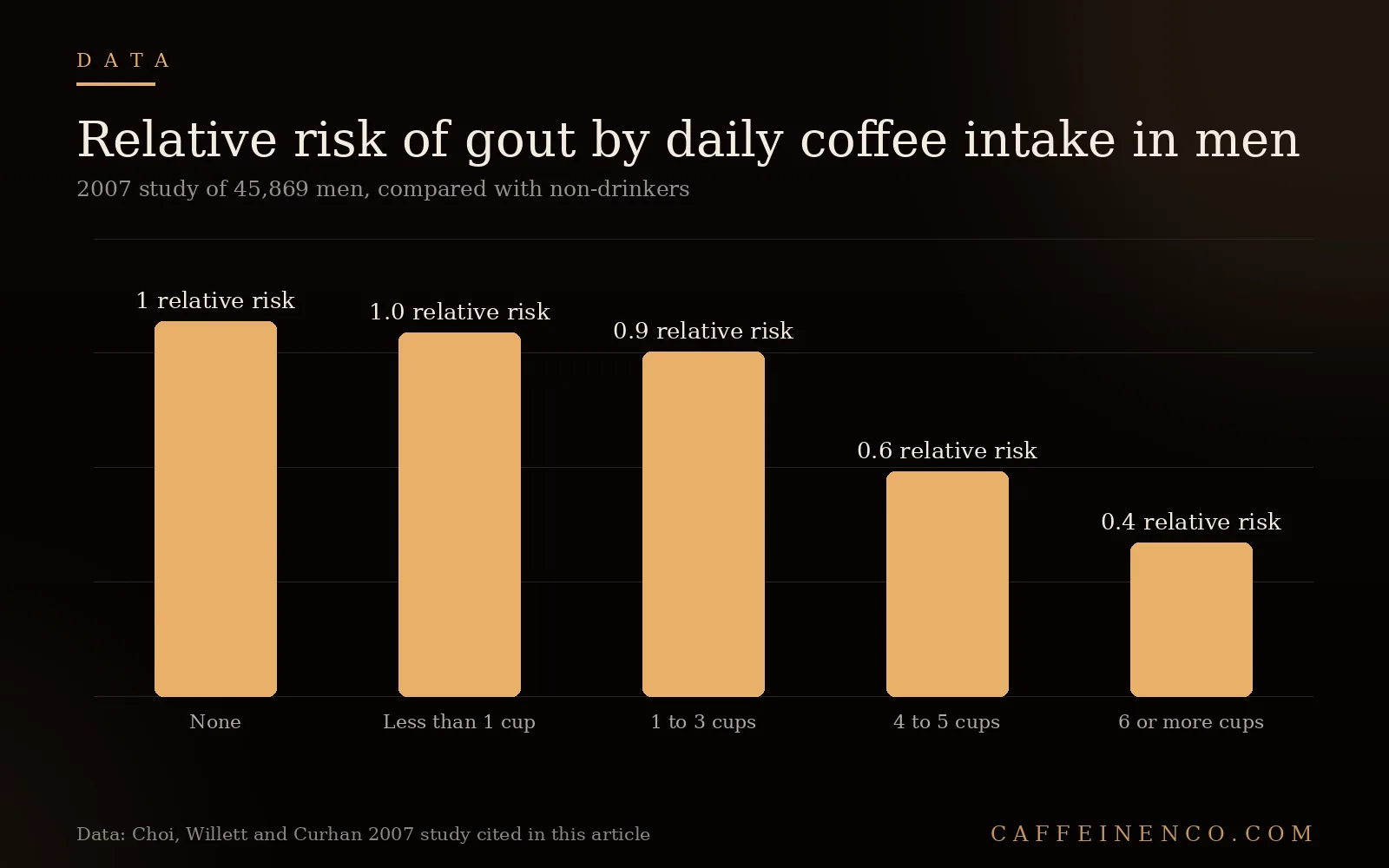
| Coffee per day | Relative risk of gout (vs none) |
|---|---|
| None | 1.00 (baseline) |
| Less than 1 cup | 0.97 |
| 1 to 3 cups | 0.92 |
| 4 to 5 cups | 0.60 (95% CI 0.41 to 0.87) |
| 6 or more cups | 0.41 (95% CI 0.19 to 0.88) |
Two things stand out. The drop is not a smooth slope. Low and moderate intake barely moved the numbers, and the large reductions only appear at 4 cups a day and above. And the confidence interval for the 6-cup group is wide (0.19 to 0.88), because few men drank that much. The point estimate is striking, but the uncertainty around it is large.
The decaf and caffeine numbers
Decaffeinated coffee showed a smaller but still visible link. Men drinking 1 to 3 cups of decaf a day had a relative risk of 0.67 (95% CI 0.54 to 0.82), and those drinking 4 or more cups had 0.73, though that interval (0.46 to 1.17) includes no effect. For less than 1 cup, the figure was 0.83.
The study also reported that total caffeine intake and tea intake were not associated with gout risk. Put together with the decaf result, the authors’ data suggest caffeine is not the active ingredient. Our decaf coffee caffeine content guide explains why decaf still contains a little caffeine, but the amount is far too small to explain a result like this, so the finding is genuinely about something else in the cup. The abstract we reviewed does not name what that something is, so we will not guess.
What the authors concluded
The authors wrote that the prospective data suggest long-term coffee consumption is associated with a lower risk of incident gout. Note the word “associated.” The study cannot rule out that heavy coffee drinkers differ from non-drinkers in other ways, such as diet, alcohol, weight or medication, even after statistical adjustment.
It also only included men over 40, so it says nothing direct about women or about the general population.
The 2016 meta-analysis
The review was published in BMJ Open in 2016. They pooled 11 observational studies: six cross-sectional, three cohort and two case-control. They looked at three outcomes.
| Outcome | Result for highest vs lowest coffee intake |
|---|---|
| Gout | Relative risk 0.43 (95% CI 0.31 to 0.59), a significant inverse association |
| Hyperuricaemia (high blood uric acid) | Odds ratio 0.84 (95% CI 0.65 to 1.09), not significant |
| Serum uric acid level | Standardised mean difference -0.09 (95% CI -0.23 to 0.05), not significant |
The surprising row is the second one. If coffee protected against gout simply by lowering uric acid, you would expect the uric acid numbers to move too. In this pooled analysis they did not, at least not by a statistically significant amount. So the gout signal and the uric acid signal do not line up neatly, which leaves the mechanism unexplained.
The authors concluded that there was insufficient evidence linking coffee to a lower risk of hyperuricaemia, while the gout association was potentially real. They also pointed to the small number of studies and called for more prospective research and randomised controlled trials. That second request is the key one: randomised trials of coffee and gout have not been done in the material we reviewed.
A worked example: reading a relative risk
Relative risks are easy to misread, so here is the arithmetic. This is an illustration with a hypothetical baseline, not a figure from either study.
Step 1: pick a baseline. Suppose, hypothetically, that 2 in 100 men who drink no coffee develop gout over 12 years.
Step 2: apply the ratio. A relative risk of 0.60 means the comparable group would have 0.60 times as many cases: 1.2 in 100.
Step 3: see the absolute change. That is a drop of 0.8 cases per 100 men, not 40 per 100. The “40 percent lower” headline refers to the ratio, while the absolute change is much smaller because gout is uncommon in the first place.
Step 4: check the real crude rate. In the 2007 cohort, 757 cases among 45,869 men is about 1.65 percent over 12 years, which we calculated ourselves from the two reported numbers. That is overall, not per coffee group, and it is close to the hypothetical 2 percent we used. It shows why the absolute difference is modest even where the relative reduction looks large.
Step 5: remember what the number is not. It compares groups of people who chose their own coffee habits. It does not predict what would happen to you if you added four cups to your day.
Why you should not start drinking coffee for gout
There are good reasons to be cautious about turning these findings into a habit.
- Association is not causation. Observational studies compare people who already differ in many ways. A randomised trial is the test that would settle it, and the 2016 authors asked for one.
- The big effects need a lot of coffee. The strong reductions in the 2007 study start at 4 cups a day. For many people that is a lot of caffeine, and our coffee and heart health and coffee and blood pressure guides cover what heavy intake can mean for the heart. Our coffee and anxiety page covers the jitters side.
- Decaf appears to share part of the link. If the pattern is real, it does not require high caffeine, so there is no obvious reason to chase a caffeine dose.
- The evidence is thin outside men. The best prospective data we reviewed are from men over 40.
- It does not replace treatment or the other triggers. The NHS puts alcohol, large meals and dehydration on its list of triggers. Coffee is not a counterweight to those.
What to do with this if you have gout or are at risk

Treat it as reassurance rather than a prescription. If you already drink coffee and have gout or a family history of it, the research gives no reason to quit on its account. If you do not drink coffee, it gives no reason to start.
The practical advice from the NHS stands regardless: drink plenty of fluids, limit sugary drinks and alcohol, and see your GP if symptoms start or your usual treatment is not working. If you take gout medication, ask your doctor or pharmacist about your own situation, including caffeine.
Related reading on the site: our coffee and diabetes guide covers another metabolic condition with its own observational research, and coffee and kidney health covers a related organ, with the usual advice to follow your own doctor’s guidance on intake. Our coffee and cholesterol page explains why the brew method can matter as much as the number of cups.
Practical takeaways
- Do not start coffee as a gout treatment. The evidence is observational and no randomised trial of coffee for gout was found in the sources we reviewed.
- Know the numbers. In the 2007 men’s study, risk was 0.60 at 4 to 5 cups a day and 0.41 at 6 or more, with wide uncertainty at the top.
- Do not credit caffeine. Total caffeine was not linked to gout risk, and decaf showed a link at 1 to 3 cups.
- Do not expect your uric acid test to change. The pooled analysis found no significant difference in serum uric acid.
- Watch the real triggers. The NHS lists alcohol, large meals, dehydration, joint injury and some medicines.
- Get symptoms checked. Sudden severe joint pain is a reason to see a GP.
Common mistakes
Reading “59 percent lower” as a promise. News coverage of the 2007 study rounded the 6-cup figure into a headline. The underlying interval runs from 81 percent lower to 12 percent lower.
Assuming caffeine is the protective part. The study found no link with total caffeine, and decaf showed one.
Treating a relative risk as an absolute one. A 40 percent relative reduction on a small baseline is a small absolute change.
Ignoring the rest of the day’s drinks. The NHS flags dehydration and sugary drinks, which is about the whole pattern, not one cup.
Stopping medication or ignoring a flare. None of this research tested coffee against treatment.
Common questions
Does coffee cause gout? The studies we reviewed point the opposite way: higher coffee intake was associated with a lower risk of developing gout. Association is not proof, and the NHS does not list coffee among its gout triggers.
Does coffee prevent gout? It is linked with lower risk in observational data, but no randomised trial in our sources tests prevention. The 2016 meta-analysis called for more prospective research and randomised controlled trials.
How many cups of coffee a day were linked to lower gout risk? In the 2007 men’s study the clear reductions appeared at 4 to 5 cups a day (relative risk 0.60) and 6 or more (0.41). One to three cups showed a relative risk of 0.92.
Does decaf coffee help with gout? In the same study, 1 to 3 cups of decaf a day had a relative risk of 0.67. That suggests caffeine is not the whole story, but it is still an association.
Does coffee lower uric acid? The 2016 pooled analysis found no significant difference in serum uric acid or hyperuricaemia between the highest and lowest coffee groups, even though it found a lower gout risk.
Is coffee safe during a gout flare? The NHS page does not mention coffee, and we did not find a study of coffee during flares. Fluids matter during a flare according to the NHS, and your GP or pharmacist can advise on your own case.
Does this apply to women? The 2007 study was of men over 40. The meta-analysis pooled mixed studies, but the best prospective data we reviewed are from men, so be careful about applying the numbers to women.
Sources & data
- Choi HK, Willett W, Curhan G: Coffee consumption and risk of incident gout in men, a prospective study (Arthritis & Rheumatism, 2007; PubMed 17530645)
- Is coffee consumption associated with a lower risk of hyperuricaemia or gout? A systematic review and meta-analysis (BMJ Open, 2016; PubMed 27401353)
- NHS: Gout (causes, triggers, drinking and diet advice)