
Most coffee-and-health questions get a hedged answer because the studies behind them are observational and tangled up with lifestyle. The kidney question is a little different. One of the main studies used genetics instead of questionnaires, which sidesteps a good part of the usual confounding. Its answer was a modest protective signal for chronic kidney disease (CKD), and two pooled analyses of conventional studies point the same way.
This page walks through those numbers, explains what the genetic method can and cannot tell you, and covers the separate and more practical question for people who already have kidney disease: whether coffee is safe in their diet. It is a sourced explainer, not medical advice. If you have reduced kidney function, are on dialysis, or take medication that affects your kidneys, treat everything below as a list of questions for your nephrologist or GP.
The short version
- A 2019 genetic study in the American Journal of Kidney Diseases, using UK Biobank data from 227,666 people, linked each extra cup of coffee a day to a lower risk of CKD stages G3 to G5 (odds ratio 0.84) and of albuminuria (odds ratio 0.81), plus higher kidney filtration.
- A 2020 meta-analysis of 12 studies and 505,841 people found coffee drinkers had a lower risk of CKD (relative risk 0.86), of end-stage kidney disease (hazard ratio 0.82) and of CKD-related death (hazard ratio 0.72).
- Commentators called the genetic effect size surprisingly large and flagged limits in how CKD was defined.
- For people who already have CKD, the National Kidney Foundation says coffee is an acceptable drink in moderation, with potassium, blood pressure and fluid allowance as the things to watch.
- Nothing here shows that coffee protects your kidneys, and nothing here is a reason to start drinking it.
First, what the kidney numbers mean
Two measurements appear throughout the research, and the headline figures make more sense once you know them.
eGFR (estimated glomerular filtration rate) is a calculated estimate of how well the kidneys filter blood. Lower is worse. The studies below define CKD stages G3 to G5 as an eGFR under 60 mL/min/1.73 m2, which is the usual cut-off for reduced function.
Albuminuria means protein, specifically albumin, leaking into the urine. It is an early sign of kidney damage and can show up even while eGFR still looks acceptable.
So when a study says coffee was linked to “less albuminuria” and “higher eGFR,” it is describing two different views of the same organ: damage markers on one side and filtering capacity on the other.
The 2019 genetic study: how it worked
The key paper is “Coffee Consumption and Kidney Function: A Mendelian Randomization Study” by Oliver Kennedy and colleagues, published in the American Journal of Kidney Diseases in December 2019.
Mendelian randomization sounds technical but the logic is simple. Everyone inherits a random assortment of gene variants, and some variants nudge people to drink slightly more or less coffee. Because those variants are handed out at conception, they are not affected by income, smoking, diet or health awareness. If people who are genetically inclined to drink more coffee also have better kidney outcomes, that is harder to blame on lifestyle than the same pattern in a food questionnaire.
As described by the AJKD Blog commentary and Healio, the team:
- Ran a genome-wide scan on UK Biobank participants (227,666 people for the coffee analysis) and found 2,126 gene variants associated with coffee consumption.
- Narrowed those to 25 independent variants that were also available in a separate kidney dataset, the CKDGen Consortium.
- Tested whether the genetically predicted coffee drinkers had different kidney outcomes. According to the AJKD abstract as summarised in search results, the CKDGen data covered 133,814 participants of mostly European ancestry, including 12,385 CKD cases.
- Checked for pleiotropy, which is when a gene variant affects the kidneys directly rather than through coffee.
The results
For each additional cup of coffee per day, the study reported:
| Outcome | Odds ratio | 95% confidence interval |
|---|---|---|
| CKD stages G3 to G5 | 0.84 | 0.72 to 0.98 |
| Albuminuria | 0.81 | 0.67 to 0.97 |
| eGFR | Higher | Direction reported, not quantified in the sources used here |
An odds ratio of 0.84 means roughly 16 percent lower odds of CKD stages G3 to G5 per extra daily cup, and 0.81 means about 19 percent lower odds of albuminuria. Both intervals sit just under 1.0 (the upper bounds are 0.98 and 0.97), with p-values of 0.03 and 0.02. That is statistically significant, but only just. A slightly different dataset could easily have pushed those intervals across 1.0.
The National Kidney Foundation’s press release on the paper described the result as lower CKD incidence, higher eGFR and lower urine protein for people with higher genetically predicted coffee intake. The authors proposed two pathways, as Healio reports: non-caffeine compounds such as chlorogenic acid and diterpenes might reduce inflammation and oxidative stress, and caffeine’s blocking of adenosine receptors might prevent eGFR decline.
What the commentary says to be careful about
A published commentary on the paper at the AJKD Blog raised several cautions that are worth keeping next to the headline figures.
- The phenotype is blunt. CKD in the kidney dataset was often diagnosed from a single eGFR reading, with no follow-up to confirm it was persistent or to track progression.
- The effect looks too big. The commentary said the size of the effect seemed suspiciously large and raised the possibility of “winner’s curse,” the tendency of a first strong result to overestimate the true effect. Real effects found in follow-up work are often smaller.
- Open questions remain. It is unclear which types of coffee matter, and which causes of CKD might benefit.
The authors made similar admissions. The National Kidney Foundation release notes that future research needs to establish whether a maximum beneficial threshold exists and whether the type of coffee, such as espresso versus instant, makes a difference. In other words, there is no tested answer to “how much” or “what kind.”
The conventional studies: a pooled analysis
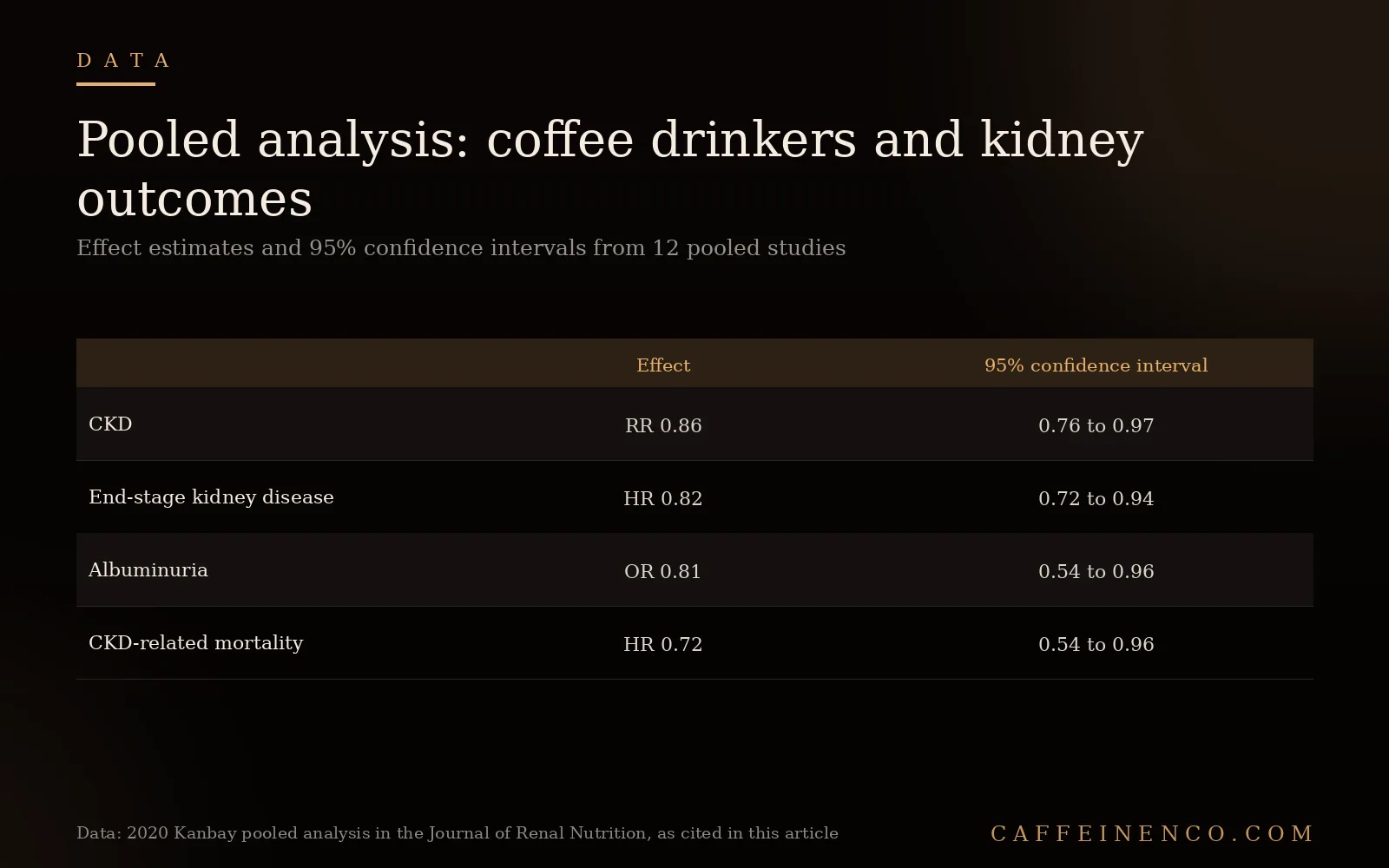
The genetic study did not appear from nowhere. Earlier observational studies had already hinted at a link, and in 2020 Mehmet Kanbay and colleagues pooled them in the Journal of Renal Nutrition. As reported by Healio, the analysis included seven cohort studies and five cross-sectional studies covering 505,841 people.
| Outcome | Effect | 95% confidence interval |
|---|---|---|
| CKD | RR 0.86 | 0.76 to 0.97 |
| End-stage kidney disease | HR 0.82 | 0.72 to 0.94 |
| Albuminuria | OR 0.81 | 0.54 to 0.96 |
| CKD-related mortality | HR 0.72 | 0.54 to 0.96 |
People who drank two or more cups per day had a lower risk than those who drank one or fewer. The authors acknowledged quality variation between the included studies and called for well-designed prospective studies.
Two things stand out. First, the pooled CKD figure (0.86) is close to the genetic figure (0.84), which is reassuring because the two methods have different weaknesses. Second, every confidence interval here also hugs the 1.0 line from below. The pattern is consistent, but none of these estimates is dramatic.
Why the observational studies are hard to trust on their own
Healio quotes the 2019 authors on exactly this point: older studies “are at high risk for confounding because people with CKD risk factors, including high body mass index, hypertension and smoking, tend to drink more coffee.” That would, if anything, bias the results against coffee, which is part of why the favourable signal is interesting. But confounding can run in the other direction too. People who are already ill, or whose doctors have told them to cut back on fluids or caffeine, may drink less coffee, which would make non-drinkers look unhealthier. This is called reverse causation, and it is one reason the genetic design was attractive in the first place.
Putting the evidence in proportion
Here is a fair reading of everything above.
- Several independent lines of evidence point in one direction: higher coffee intake is associated with somewhat lower CKD risk.
- The effect sizes are modest, the intervals are close to no effect, and the genetic estimate may be inflated.
- The research does not identify a best dose, a best brew method, or a best type of coffee.
- It does not show that adding coffee reverses or slows kidney damage in someone who already has it.
That fits the pattern across the rest of this site’s “caffeine and your body” pages. The coffee and liver health guide shows a similar consistent-but-observational picture, and the coffee and diabetes guide matters here because diabetes and high blood pressure are two of the leading drivers of kidney disease, so any effect of coffee on those conditions is relevant too.
If you already have kidney disease: is coffee safe?

This is a different question from risk, and the National Kidney Foundation addresses it directly in its page “Coffee and Kidney Disease: Is it Safe?”
Its main points:
- Coffee is acceptable in moderation. The page says coffee is an acceptable beverage for kidney disease and, in moderation, poses little risk.
- Potassium. An 8 oz cup of black coffee has 116 mg of potassium and is considered a low-potassium food. Three to four cups a day is considered high in potassium and could raise levels, and the foundation says fewer than three cups a day is generally considered safe.
- Additions change the picture. An 8 oz café latte without flavoured syrup has 183 mg of phosphorus and 328 mg of potassium, so milk-based drinks are a very different proposition from black coffee.
- Blood pressure. Caffeine causes a short, sudden rise in blood pressure, and people struggling with blood pressure control may need to drink fewer than three cups a day.
- Fluid allowance. Coffee counts as fluid. If you are on a restricted fluid diet, it comes out of your daily allowance.
The blood pressure point connects to a question many readers have. Our coffee and blood pressure guide covers the short-term spike and the long-term evidence in detail, which is worth reading alongside this section if hypertension is part of your kidney picture.
Worked example: what a day of coffee adds up to
Say someone with CKD has been told to watch potassium and has a fluid allowance of 1.5 litres a day. They like coffee and want to know what it costs. Using only the figures the National Kidney Foundation published, the arithmetic looks like this:
- Two black coffees (8 oz each). 2 x 116 mg is 232 mg of potassium, and about 480 mL of the allowance (8 oz is roughly 240 mL).
- Four black coffees. 4 x 116 mg is 464 mg, and about 960 mL, which is well over half of a 1.5 litre allowance.
- Two café lattes (8 oz each, no syrup). 2 x 328 mg is 656 mg of potassium and 2 x 183 mg is 366 mg of phosphorus, from just two small drinks.
- Four lattes. 4 x 328 mg is 1,312 mg of potassium, which is a very different load than four black coffees at 464 mg.
The takeaway is not that anyone should hit a number. It is that for a person with CKD, the cup size and what goes in it can matter more than whether it is coffee at all. Those totals are simple multiplication of the published per-cup figures, not individual advice, and your own potassium and phosphorus targets come from your care team and your blood tests.
Common mistakes
The first mistake is reading an odds ratio of 0.84 as a personal 16 percent drop in risk if you add a cup. It is a population estimate from a genetic model. The second is treating the genetic result as settled proof when the confidence interval nearly touches 1.0 and commentators suspect it is overstated. The third is applying a study of disease risk to a diagnosis you already have: none of these studies tested coffee as a treatment. The fourth is ignoring what goes in the cup, since sugar-heavy and milk-heavy drinks are a different thing from black coffee, especially for potassium and phosphorus. The fifth is forgetting that coffee is fluid on a restricted-fluid plan. And the sixth is boosting your intake for kidney reasons when sleep, anxiety or pregnancy might be better reasons to hold back.
Common questions
Is coffee good for your kidneys? Studies link it to somewhat lower CKD risk. A 2019 genetic study found 16 percent lower odds of CKD stages G3 to G5 per extra daily cup, and a 2020 pooled analysis found a 14 percent lower risk (relative risk 0.86). These are associations with modest effect sizes, not proof of protection.
How many cups a day are linked to lower CKD risk? The 2020 meta-analysis found people who drank two or more cups a day had lower risk than those drinking one or fewer. The 2019 authors said it remains unknown whether a maximum beneficial threshold exists.
Does the type of coffee matter? Nobody knows yet. The National Kidney Foundation’s summary of the 2019 study lists whether espresso versus instant makes a difference as a question for future research.
Can I drink coffee if I have chronic kidney disease? The National Kidney Foundation says coffee is an acceptable beverage in moderation and generally considers fewer than three cups a day safe, with potassium, blood pressure and fluid limits as the things to monitor. Your own nephrologist or dietitian should set your personal limit.
How much potassium is in a cup of coffee? The foundation lists 116 mg in an 8 oz cup of black coffee, which counts as low-potassium. An 8 oz café latte without syrup is listed at 328 mg of potassium and 183 mg of phosphorus.
Does coffee raise blood pressure, and does that matter for the kidneys? Caffeine causes a short, sudden blood pressure increase, according to the foundation, so people with poorly controlled blood pressure may need to drink fewer than three cups a day. Our coffee and blood pressure guide covers the longer-term picture.
Does coffee count toward a fluid restriction? Yes. The foundation says coffee counts as fluid and should be included in your daily allowance if you are on a restricted fluid diet.
Should I start drinking coffee to protect my kidneys? No study supports that. The authors of the genetic study framed their work as a reason for further research, and the effect may be overestimated. If you already drink coffee and enjoy it, the evidence is reassuring, but it is not a prescription.
Sources & data
- National Kidney Foundation: Popular Beverage Protects Against Kidney Disease (press release on Kennedy et al., American Journal of Kidney Diseases, December 2019)
- Healio Nephrology: Coffee may reduce risk for kidney disease (11 December 2019)
- AJKD Blog: Coffee Consumption and Kidney Function (commentary on the Mendelian randomization study, 4 June 2020)
- Healio Nephrology: Drinking coffee associated with lower risk for chronic kidney disease (Kanbay et al., Journal of Renal Nutrition meta-analysis, 11 November 2020)
- National Kidney Foundation: Coffee and Kidney Disease: Is it Safe?