
Few coffee-and-health questions have a more consistent answer than this one: across many large studies, people who drink coffee have less cirrhosis, less chronic liver disease, and fewer liver cancers than people who do not. The consistency is real. What is less settled is why, how much of the effect is the coffee itself, and what any of it means for a particular person who already has a liver condition.
This page lays out the numbers from the main studies, flags the results that are weaker than the headlines suggest, and turns them into a practical routine. It is a sourced explainer, not medical advice. If you have liver disease, take medication that affects your liver, or drink alcohol heavily, treat what follows as a list of questions for your own doctor.
The short version
- A 2016 meta-analysis of nine studies and over 430,000 participants linked each extra two cups a day to a 44 percent lower risk of cirrhosis.
- A 2021 UK Biobank analysis of roughly 495,000 people found coffee drinkers had about a 21 percent lower risk of chronic liver disease and about half the risk of dying from it.
- The liver cancer result is real in pooled analyses but is not significant in the UK Biobank cohort on its own.
- Decaf, instant and ground coffee all showed similar associations.
- All of this is observational. It shows a pattern, not proof that coffee protects the liver.
Cirrhosis: the strongest signal
Cirrhosis is advanced scarring of the liver. It is where the most consistent evidence sits.
The 2016 meta-analysis by Kennedy and colleagues, published in Alimentary Pharmacology & Therapeutics, pooled studies covering 1,990 cirrhosis cases among more than 430,000 participants. Its headline finding, as reported by NutraIngredients, was that an additional two cups of coffee a day was linked with a 44 percent reduction in developing cirrhosis and a 50 percent reduction in death from the disease.
Two details are worth keeping next to that number. First, the authors stopped short of recommending that anyone drink more coffee, writing that the wider effects need to be considered. Second, the pooled studies were observational, so people who drank more coffee may have differed from those who drank none in ways the statistics could not fully remove.
A number to read carefully
“44 percent per two cups” is a dose-response slope, not a promise that your risk falls by 44 percent if you add two cups. The slope was estimated across populations that included heavy drinkers of alcohol, people with hepatitis, and people with fatty liver. The average effect across such groups does not tell you what happens in someone whose cirrhosis risk is already very low, or very high for a different reason.
Fibrosis and the enzyme markers
Fibrosis is the earlier scarring stage. A 2017 review in the World Journal of Hepatology by Heath and colleagues collected the evidence and reported that drinking at least two cups of coffee a day was associated with less advanced fibrosis, with advanced fibrosis becoming less frequent as intake rose. The same review notes inverse associations between coffee and the standard blood markers doctors use to flag liver stress: AST, ALT, GGT and alkaline phosphatase, across several populations.
That last point matters for interpretation. If a blood test shows lower liver enzymes in coffee drinkers, it fits the broader picture, but it does not by itself show that the liver is healthier in a lasting way. The review also lists the limits plainly: confounding is a concern, the mechanisms are unclear despite consistent associations, and the evidence specific to non-alcoholic fatty liver disease is limited.
Chronic liver disease: the UK Biobank result
The most recent large dataset comes from UK Biobank. Kennedy and colleagues published an analysis in BMC Public Health in June 2021 covering roughly 495,000 participants followed for a median of 10.7 years, with electronic linkage to hospital, death and cancer records.
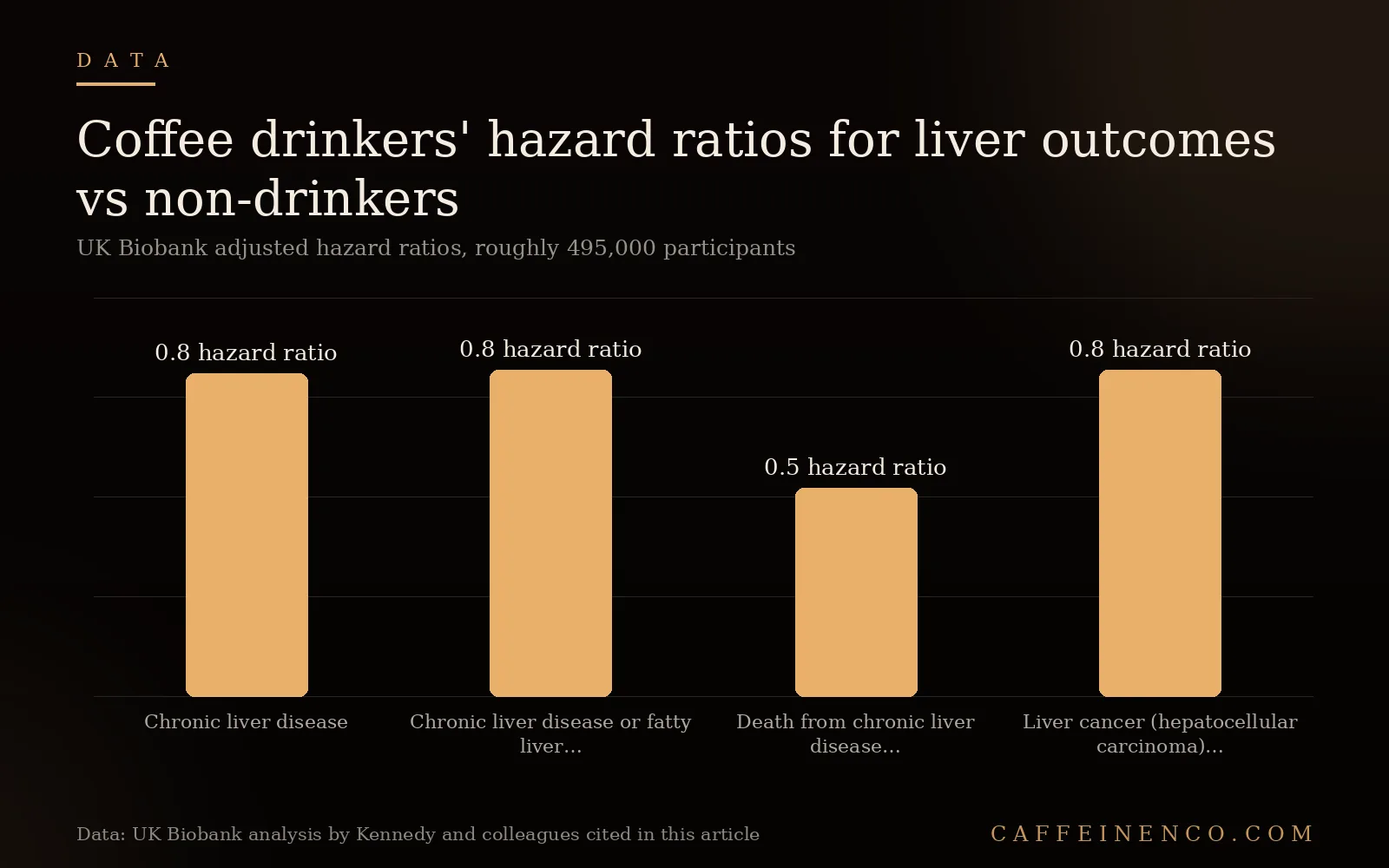
Compared with non-drinkers, coffee drinkers had these adjusted hazard ratios, as listed by UK Biobank:
| Outcome | Hazard ratio vs non-drinkers | 95% CI |
|---|---|---|
| Chronic liver disease | 0.79 | 0.72 to 0.86 |
| Chronic liver disease or fatty liver | 0.80 | 0.75 to 0.86 |
| Death from chronic liver disease | 0.51 | 0.39 to 0.67 |
| Liver cancer (hepatocellular carcinoma) | 0.80 | 0.54 to 1.19 |
A hazard ratio of 0.79 means about a 21 percent lower rate, and 0.51 means roughly half the rate of death from chronic liver disease. The study counted about 3,600 chronic liver disease cases, 301 of them deaths, and 5,439 fatty liver cases.
The bottom row deserves attention. The liver cancer hazard ratio of 0.80 has a confidence interval running from 0.54 to 1.19, which includes 1.0, so this cohort alone cannot say coffee lowers liver cancer risk. Only 184 liver cancers were recorded, which is simply too few events to be precise. The cancer evidence comes from pooled analyses instead, covered next.
Does the type of coffee matter?
The UK Biobank authors reported that decaffeinated, instant and ground coffee each showed associations similar to all types combined. The largest benefit appeared in ground coffee drinkers. The authors suggested ground coffee contains more of the compounds kahweol and cafestol, which have been protective against liver disease in animal work. Southampton’s summary says three to four cups a day showed the maximum benefit.
That decaf result is useful. It suggests caffeine is not the only active ingredient, which fits the mechanisms proposed in the 2017 review: diterpenes such as kahweol and cafestol, polyphenols, and possibly caffeine’s effect on the fibrosis pathway. If you avoid caffeine, the data does not say you are excluded from any association. For the caffeine side of that choice, see the decaf caffeine content guide.
One caution from the same 2017 review: it notes that regular coffee showed benefits in the studies it described while espresso did not, which suggests preparation might matter. That is a single observation, not an established rule, so do not read it as a reason to avoid or favor any brew method.
Liver cancer: pooled results
For hepatocellular carcinoma, the 2017 meta-analysis in BMJ Open by Kennedy and colleagues is the key reference. As summarized in its abstract, it pooled 18 cohort studies (2,272,642 participants and 2,905 cases) plus 8 case-control studies, and found an extra two cups a day associated with a 35 percent lower risk (RR 0.65, 95% CI 0.59 to 0.72). Caffeinated coffee showed a 27 percent reduction and decaffeinated coffee a 14 percent reduction in that analysis.
The 2017 World Journal of Hepatology review gathers older estimates in the same direction, such as a 43 percent reduced risk with two cups and a 40 percent reduction with one to three cups. These figures vary between analyses, which is normal, and the direction is consistent even though the UK Biobank cohort alone could not confirm it.
Why might coffee help? The proposed mechanisms
Nobody has a settled answer. The 2017 review lists several candidates:
- Kahweol and cafestol: diterpenes that activate detoxifying enzymes and showed hepatoprotective effects against toxins in animal models.
- Polyphenols: antioxidants that may reduce liver stress.
- The fibrosis pathway: caffeine may inhibit transforming growth factor-beta, which would limit the cells that lay down scar tissue.
- Hepatitis C: in cell cultures, caffeic acid and caffeine inhibited viral load. Among hepatitis C patients, those drinking three or more cups a day had a reported 53 percent lower risk of liver disease progression.
The Kennedy 2016 authors add that coffee may suppress oxidative stress and that laboratory work has shown constituents of coffee inhibiting hepatitis B and C viruses. All of these are plausible and none is proven in people.
Notice the tension with another corner of this site. Cafestol is the same compound that raises LDL cholesterol in unfiltered coffee. If you are weighing both, the coffee and cholesterol guide explains why paper-filtered brews sidestep that problem, and the UK Biobank hint that ground coffee did best does not require you to drink unfiltered coffee.
Worked example: reading your own habit against the data
Say someone drinks one cup of instant coffee on weekdays, has no known liver condition, and wonders whether to change anything.
- Count cups honestly. One cup on five days a week averages about 0.7 cups a day, below the range where the studies saw the largest differences.
- Check the direction, not the dose. The research does not give a threshold below which coffee has no association, only that more cups were associated with lower risk up to roughly three to four a day in UK Biobank.
- Look at the rest of the day. The data cannot say whether a higher coffee habit helps if it comes with poor sleep or anxiety. The site’s pieces on coffee and anxiety and caffeine withdrawal cover those costs.
- Do not treat coffee as a liver treatment. For someone with a known liver condition, the dose, timing and anything else going on is a question for a hepatologist or GP.
Where coffee and the liver connect to other health topics
The liver finding sits inside a wider pattern. The 2016 authors single out the inverse association between coffee, caffeinated or decaf, and type 2 diabetes, which matters because fatty liver and diabetes often travel together. The site’s coffee and diabetes guide covers that side, and the coffee and dementia guide looks at another long-term association. Reading them together is more honest than treating any one number as the whole story.
What this evidence does not tell you
- It does not prove cause. Every study above is observational. Coffee drinkers may differ in diet, income, alcohol use or health awareness. The 2017 review notes one study where coffee drinkers actually had higher smoking and alcohol rates, which argues against simple confounding, but it does not eliminate it.
- It does not say coffee reverses damage. Associations with lower rates of disease are not evidence that coffee heals an already scarred liver.
- It does not apply equally everywhere. The UK Biobank authors note that coffee intake was measured only once at enrollment, and the cohort was mostly white and relatively affluent.
- It does not cover what goes in the cup. Sugar-heavy coffee drinks add a different load, and the studies measured coffee, not syrup.
- It does not replace medical advice. People with cirrhosis, hepatitis or liver-affecting medication should not change their intake based on a blog post.
Common mistakes
The first mistake is reading “44 percent lower risk” as a personal guarantee; it is an average slope across mixed populations. The second is treating the UK Biobank liver cancer figure as proof when its confidence interval crosses 1. The third is assuming caffeine is the active ingredient, when decaf showed similar associations. The fourth is raising your intake sharply on the strength of these studies, since the authors themselves declined to recommend that. The fifth is overlooking the alcohol question: coffee does not cancel out heavy drinking, and nothing here says it does. And the last is skipping a conversation with a doctor if you already have abnormal liver tests.
Common questions
Is coffee good for your liver? In large observational studies, coffee drinkers had lower rates of cirrhosis and chronic liver disease. A 2016 meta-analysis linked each extra two cups a day to a 44 percent lower cirrhosis risk, and UK Biobank found about a 21 percent lower chronic liver disease risk. That is an association, not proof of protection.
How many cups a day are linked to the best results? Southampton’s summary of the UK Biobank study says three to four cups a day showed the maximum benefit. That is where the data peaked, not a target, and the authors did not recommend increasing intake.
Does decaf coffee protect the liver too? The UK Biobank analysis found decaffeinated coffee associations similar to those for all coffee types combined. The 2017 liver cancer meta-analysis found a smaller reduction for decaf (14 percent) than for caffeinated coffee (27 percent) per two cups.
Does coffee lower liver cancer risk? Pooled analyses say yes: a 2017 BMJ Open meta-analysis found a 35 percent lower risk per extra two cups. The UK Biobank cohort alone had a hazard ratio of 0.80 with a wide interval that included no effect, so the single-cohort evidence is weaker than the pooled evidence.
Can coffee reverse fatty liver or cirrhosis? There is no evidence in these sources that it does. The studies compare disease rates, not recovery. If you have either condition, your clinician manages treatment.
Does coffee affect liver enzyme tests? Several studies reviewed in the World Journal of Hepatology found coffee intake inversely associated with AST, ALT, GGT and alkaline phosphatase. If you are about to have a blood test, ask your doctor whether anything about your usual routine matters.
Is it safe to drink more coffee for my liver? The study authors declined to recommend increasing consumption, noting that wider effects need considering. Sleep, anxiety, blood pressure and pregnancy are all separate concerns. Ask your doctor before changing your habit for health reasons.
Sources & data
- University of Southampton: Drinking any type of coffee associated with reduced risk of chronic liver disease (BMC Public Health, 22 June 2021)
- UK Biobank: All coffee types decrease the risk of adverse clinical outcomes in chronic liver disease (Kennedy et al., BMC Public Health, 2021)
- NutraIngredients: Coffee consumption may help curb cirrhosis (Kennedy et al., Alimentary Pharmacology & Therapeutics, 2016)
- World Journal of Hepatology: Heath et al., Coffee and liver disease review (2017, vol 9, issue 15)
- PubMed: Kennedy et al., coffee and hepatocellular carcinoma, dose-response meta-analysis (BMJ Open, 2017)