“Does coffee cause anxiety” gets asked as if it has a yes or no answer, but the real research answers a different, more useful question: at what dose, and for whom. A 2024 meta-analysis pooling 546 people found that caffeine’s anxiety effect is not one fixed number, it roughly quadruples once daily intake crosses 400mg. Separately, caffeine at high doses reliably triggers panic attacks in people with panic disorder in a controlled lab setting, yet a newer trial using a single realistic everyday dose found no meaningful difference between panic disorder patients and healthy people at all. Those two findings are not a contradiction, they are the same dose-response pattern showing up twice. This site’s own coffee before a workout breakdown already covers one genetic reason caffeine hits some people harder than others; this page covers the anxiety-specific version of that same question, with the actual numbers behind it.
The dose-response curve: why the anxiety effect depends on how much, not just whether
Liu and colleagues’ 2024 meta-analysis in Frontiers in Psychology pooled 8 studies and 546 healthy participants, 7 randomized controlled trials and one cross-sectional study, and found that “caffeine consumption significantly increased the risk of anxiety compared with the control group,” with an overall standardized mean difference (SMD) of 0.94, a large effect by conventional statistical standards. But the pooled number hides a much sharper split once the studies are separated by dose. Below 400mg, the effect size was 0.61, a moderate increase. At 400mg or more, it jumped to 2.86, a severe, highly significant increase, nearly five times larger than the low-dose figure.
| Caffeine dose | Pooled effect size (SMD) | What it means |
|---|---|---|
| Below 400mg/day | 0.61 | Moderate increase in anxiety symptoms |
| 400mg/day or more | 2.86 | Severe, highly significant increase |
The authors’ own conclusion tracks the FDA’s existing general guidance rather than inventing a new number: keep total caffeine intake under 400mg a day. What the meta-analysis adds is evidence that 400mg is not just a vague safety ceiling, it is close to the exact point where caffeine’s relationship with anxiety symptoms stops being modest and starts being severe. Using this site’s own figures, roughly 96mg per 8-ounce cup of filter coffee documented in the Americano vs long black comparison, 400mg works out to about four cups in a day, or a little over six 63mg espresso shots.
Panic disorder and caffeine: a real, well-documented trigger, at a specific dose
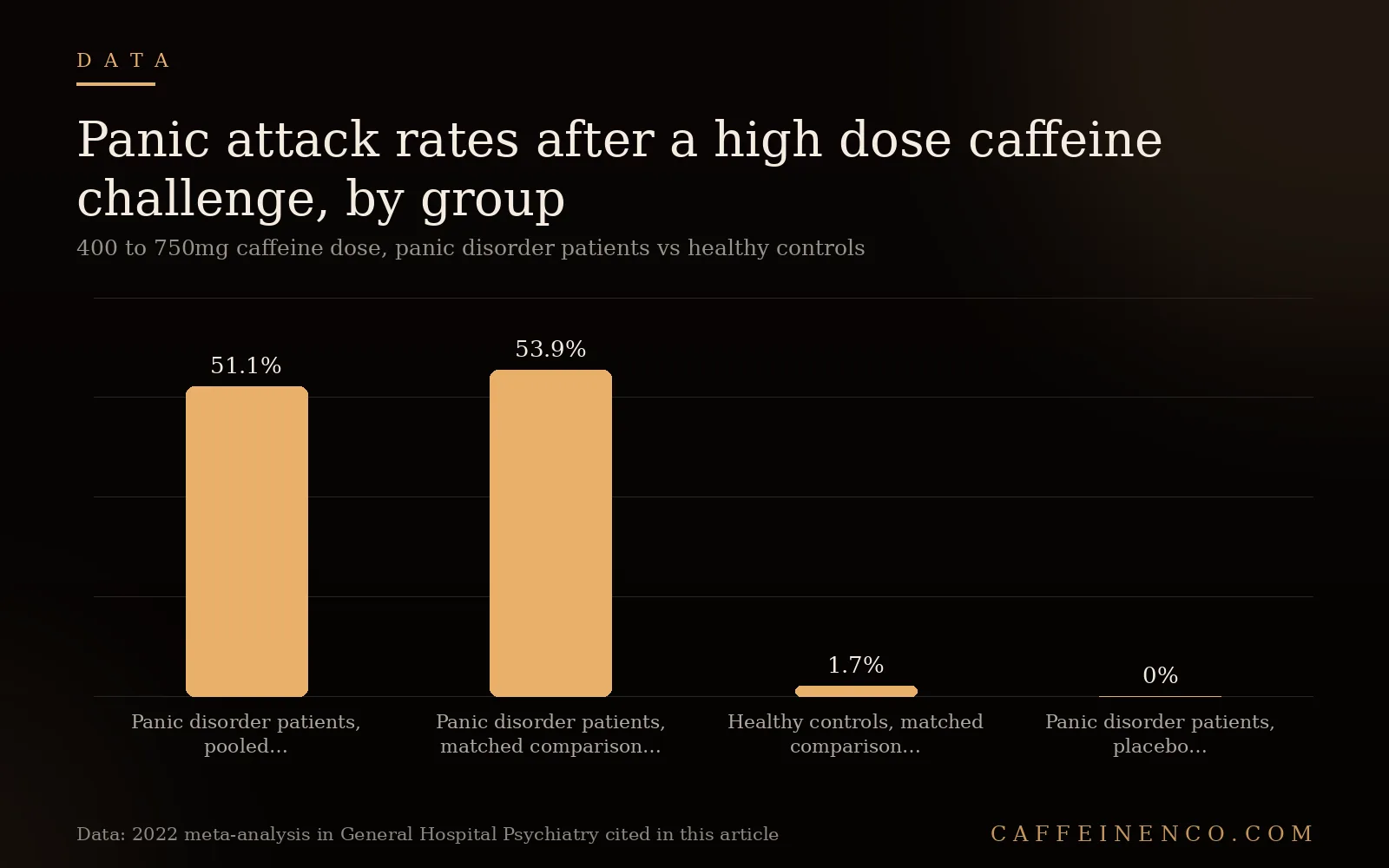
The clearest evidence that caffeine can cause genuine anxiety symptoms, not just correlate with them, comes from caffeine challenge research in people already diagnosed with panic disorder. A 2022 systematic review and meta-analysis in General Hospital Psychiatry pooled placebo-controlled studies using doses of 400 to 750mg, roughly four to eight cups of brewed coffee in one sitting, and found that 51.1% of panic disorder patients had a panic attack after caffeine, compared with 0% after placebo. A narrower comparison across six of those studies, 128 patients against 115 healthy controls given the identical dose, found panic attacks in 53.9% of patients versus just 1.7% of healthy controls.
| Group | Dose | Panic attack rate |
|---|---|---|
| Panic disorder patients (pooled, caffeine) | 400 to 750mg | 51.1% |
| Panic disorder patients (caffeine, matched comparison) | 400 to 750mg | 53.9% |
| Healthy controls (same matched comparison) | 400 to 750mg | 1.7% |
| Panic disorder patients (placebo) | None | 0% |
That gap, more than 50% versus under 2%, is one of the most specific, reproducible findings in this entire body of research: caffeine at a high dose does not just make anxious people feel worse in a general sense, it reliably discriminates a diagnosed panic disorder from a healthy nervous system in a controlled lab setting. The review’s authors note the dose range tested was narrow, 400 to 750mg, which matters for the next section: nearly all of this evidence comes from doses well above what most people drink in a normal day, not from a single realistic cup.
But at an everyday dose, even panic disorder patients showed no clear extra risk
A 2025 randomized, placebo-controlled crossover trial published in the Journal of Psychopharmacology closed exactly that gap by testing a single, realistic dose, 150mg, roughly a cup and a half of brewed coffee or two espresso shots, in 29 people with panic disorder and 53 healthy controls. The result cuts directly against the high-dose research above: the trial found “no support for an effect of 150 mg caffeine on change in subjective anxiety from baseline to rest,” with no meaningful difference between the panic disorder group and healthy controls. Across the entire trial, only one panic attack occurred, in a single patient during an emotionally provocative task, not the roughly 1-in-2 rate the 400 to 750mg challenge studies produced.
Caffeine did do something measurable in both groups at this lower dose: it increased skin conductance response, a physiological marker of arousal, to neutral and emotional images alike, and it increased “costly avoidance behavior,” meaning participants in both groups became more likely to avoid an unpleasant image even when it cost them a reward for doing so. Neither effect was stronger in the panic disorder group than in healthy controls. The researchers’ own conclusion is a direct, useful reconciliation of the two dose ranges: recommendations to avoid caffeine entirely for panic disorder patients “should be based on higher doses,” not on a single normal-sized cup. Read together with the challenge research above, the honest picture is a real dose threshold, not a blanket caffeine-and-anxiety link: high, concentrated doses reliably provoke panic disorder patients in a lab, while an ordinary cup does not appear to, at least in this trial’s sample size.
Why the same cup hits some people harder: the ADORA2A gene
Dose is not the only variable. This site’s own pre-workout caffeine breakdown already covers how the CYP1A2 gene changes how fast someone metabolizes caffeine; a separate gene, ADORA2A, changes how anxious a given dose actually makes someone feel. Caffeine works by blocking adenosine receptors in the brain, and a 2008 study published in Neuropsychopharmacology by Childs and colleagues tested a range of caffeine doses against variation in the ADORA2A and DRD2 genes. At a 150mg dose, the same everyday amount as the 2025 panic disorder trial above, the researchers found a significant association between several ADORA2A variants (including rs5751876) and self-reported anxiety after caffeine, with people carrying the more sensitive TT genotype at that location reporting a noticeably larger anxiety increase than people carrying the CC genotype. The study also found a clean dose pattern across the full sample: the lowest dose tested did not meaningfully raise anxiety ratings, while the highest dose raised them in most participants, a genetic version of the same threshold effect the population-level meta-analysis found above.
The practical takeaway is the same one this site’s workout piece reaches for CYP1A2: two people can drink an identical 150mg cup and have genuinely different, physiologically real experiences, one barely noticing it, the other feeling distinctly on edge, without either one imagining the effect or being unusually dramatic about it.
When caffeine crosses into a diagnosable problem
Most people who feel a bit jittery after a strong coffee are not dealing with a clinical issue, but caffeine-related anxiety is common enough, and severe enough in a subset of users, that it has its own diagnostic category. A 2020 study in the Journal of Caffeine and Adenosine Research surveyed 1,006 US adults against the proposed DSM-5 criteria for caffeine use disorder, persistent desire or failed attempts to cut down, continued use despite ongoing physical or psychological problems, and withdrawal symptoms or using caffeine specifically to relieve them. Roughly 8% of the sample met all three criteria. Among that group, the single most common psychological problem caused or worsened by caffeine was anxiety, reported by 25%, and that group scored significantly higher on anxiety, depression, and stress overall than caffeine consumers who did not meet the criteria.
NCBI’s own StatPearls clinical reference on caffeine-related disorders puts a number on where symptoms tend to escalate: total daily intake up to about 400mg, roughly four cups of coffee, ten cans of cola, or two energy drinks, is generally considered safe, while research on acute higher doses found that a 500mg dose produced measurably more tension, nervousness, anxiety, irritability, nausea, palpitations, and restlessness than lower doses tested in the same study. That 400 to 500mg range lines up closely with the Frontiers meta-analysis’s own severe-effect threshold above, three independently sourced lines of evidence converging on roughly the same number rather than three unrelated guesses.
Worked example: testing whether caffeine is actually your anxiety trigger
- Track your normal intake and symptoms for three or four days first, noting your usual daily total in cups or shots and rating any jitteriness, racing heart, or free-floating worry on a simple 1-to-5 scale each afternoon, before changing anything.
- Calculate your rough daily mg total using this site’s own per-serving figures: about 96mg per 8-ounce cup of filter coffee, about 63mg per espresso shot. If your daily total is already north of 400mg, that alone puts you inside the meta-analysis’s severe-effect zone regardless of how you feel about any single cup.
- Cut your total dose to under 200mg a day for four or five days, roughly two cups of filter coffee or three espresso shots, a level below both the Frontiers low-dose threshold and the 150mg dose the panic disorder trial found made no measurable difference.
- Rate the same symptoms on the same 1-to-5 scale during the reduced-dose period. A clear drop points to caffeine as a real contributor for you personally; almost every source in this article agrees that response varies enough by dose and genetics that a personal test is more informative than a population average.
- If your symptoms track your last cup of the day rather than your total intake, the timing may matter more than the amount; caffeine’s half-life means a late-afternoon cup is still partly active at bedtime, which can look like daytime anxiety but is really sleep disruption in disguise.
- If cutting back helps but you would rather not give up the ritual entirely, a decaf coffee selection from 1st in Coffee keeps the flavor while removing most of the variable this whole guide is about, or you can browse the same category on Amazon. This site’s own decaf caffeine content breakdown documents the real range, 2 to 15mg per cup, for anyone deciding how far to dial it back.
Common mistakes
Treating “does coffee cause anxiety” as a single yes-or-no question is the most common mistake, and it is the one this entire body of research argues against directly: the Frontiers meta-analysis found a moderate effect below 400mg and a severe one above it, not one fixed answer. Assuming the panic disorder challenge research applies to a normal cup of coffee is the second mistake; those studies used 400 to 750mg, four to eight cups in one sitting, and the 2025 trial using a single realistic 150mg dose found no clear extra risk for panic disorder patients at that level. Ignoring genetics is the third mistake; the ADORA2A research shows the same 150mg dose produces a measurably larger anxiety response in people with a specific gene variant, which is a physiological difference, not a personality trait. Blaming caffeine in general when the real driver is total daily load is the fourth mistake, since three separate sources in this article, the Frontiers meta-analysis, the acute-dose research cited by StatPearls, and Mayo Clinic’s own guidance, converge on roughly the same 400 to 500mg range as where risk climbs sharply. Assuming any anxiety after coffee means a diagnosable disorder is the fifth mistake; the caffeine use disorder study found only about 8% of a large US sample met the proposed clinical criteria, so an occasional jittery afternoon is common and not automatically a sign of caffeine use disorder.
Common questions
Does coffee actually cause anxiety, or is that a myth? It is a real, dose-dependent effect, not a myth and not a fixed rule either. A 2024 meta-analysis of 546 people found a moderate anxiety effect (SMD 0.61) below 400mg of caffeine a day and a severe one (SMD 2.86) at or above it, meaning the honest answer depends heavily on how much you actually drink.
How much caffeine is too much for anxiety? Roughly 400mg a day is where the evidence shifts most sharply, per the Frontiers meta-analysis, and StatPearls’ own clinical reference cites the same approximate ceiling, about four cups of coffee, before symptoms like nervousness and tension become more likely. Mayo Clinic’s general 400mg-a-day guidance lines up with the same figure.
Can coffee trigger a panic attack? At a high dose, yes, and reliably so in people with diagnosed panic disorder specifically. A 2022 meta-analysis found panic attack rates of 51 to 54% in panic disorder patients given 400 to 750mg of caffeine in controlled trials, versus under 2% in healthy controls given the same dose. A 2025 trial using a single realistic 150mg dose found essentially no elevated panic attack rate at that lower level.
Why does coffee make some people more anxious than others? Genetics play a measurable role. A 2008 study found that a specific variant in the ADORA2A gene, the receptor caffeine blocks in the brain, was linked to a significantly larger self-reported anxiety increase after a 150mg dose, the same dose level covered in the 2025 panic disorder trial above. This site’s own coffee before a workout piece covers a related gene, CYP1A2, that changes how fast caffeine is metabolized in the first place.
Is caffeine-induced anxiety a real diagnosis? It functions as one in practice. A 2020 study screening 1,006 US adults against proposed caffeine use disorder criteria found about 8% met all three, and among that group, anxiety was the single most common psychological problem caused or worsened by caffeine, reported by 25%.
If coffee makes me anxious, do I have to give it up completely? Not necessarily. The 2025 trial’s own conclusion was that caffeine abstinence advice for panic disorder should be based on higher doses, not ordinary ones, and this site’s own worked example above walks through testing your personal dose threshold before assuming total elimination is the only fix. A decaf switch is also a real middle option if a personal test shows caffeine itself, not just the ritual, is the driver.
For more sourced breakdowns like this one, delivered weekly, subscribe to The Sunday Pour.
Sources & data
- Frontiers in Psychology: Liu et al., Caffeine Intake and Anxiety, A Meta-Analysis
- General Hospital Psychiatry: Effects of Caffeine on Anxiety and Panic Attacks in Patients With Panic Disorder, A Systematic Review and Meta-Analysis
- Journal of Psychopharmacology, via PMC: Hoppe et al., Acute Effects of 150 mg Caffeine on Anxiety in Panic Disorder and Healthy Controls
- Neuropsychopharmacology: Childs et al., Association Between ADORA2A and DRD2 Polymorphisms and Caffeine-Induced Anxiety
- NCBI Bookshelf, StatPearls: Caffeine Withdrawal
- Journal of Caffeine and Adenosine Research, via PMC: Sweeney et al., Prevalence and Correlates of Caffeine Use Disorder Symptoms Among a United States Sample
- Mayo Clinic: Caffeine, How Much Is Too Much?