Three black coffees, built from two different starting points, get treated as interchangeable on most menus: Americano, Long Black, and plain filter or drip coffee. Two of them, the Americano and the Long Black, use the exact same ingredients in the exact same amounts, espresso and hot water, and still taste different enough that baristas insist they are not the same drink. The third, filter coffee, never touches an espresso machine at all. This site’s own espresso dose ratio guide covers the 18g to 36g shot all three espresso-based comparisons on this page start from, and the caffeine in an espresso shot breakdown covers why that shot’s caffeine content varies so much cafe to cafe. This page covers what changes once that shot meets hot water, or gets skipped for a filter basket entirely.
Americano vs Long Black: same ingredients, reversed order
The entire difference between these two drinks comes down to which liquid hits the cup first, according to Hoxton Coffee’s side-by-side breakdown. An Americano is built by pouring “the espresso first, followed by the water,” while a Long Black reverses that sequence entirely: “hot water first and the espresso added on top.” Same shot, same water volume, same cup in most cafes, opposite pour order, and Hoxton Coffee is specific that this single variable changes both the look and the taste of the finished drink.
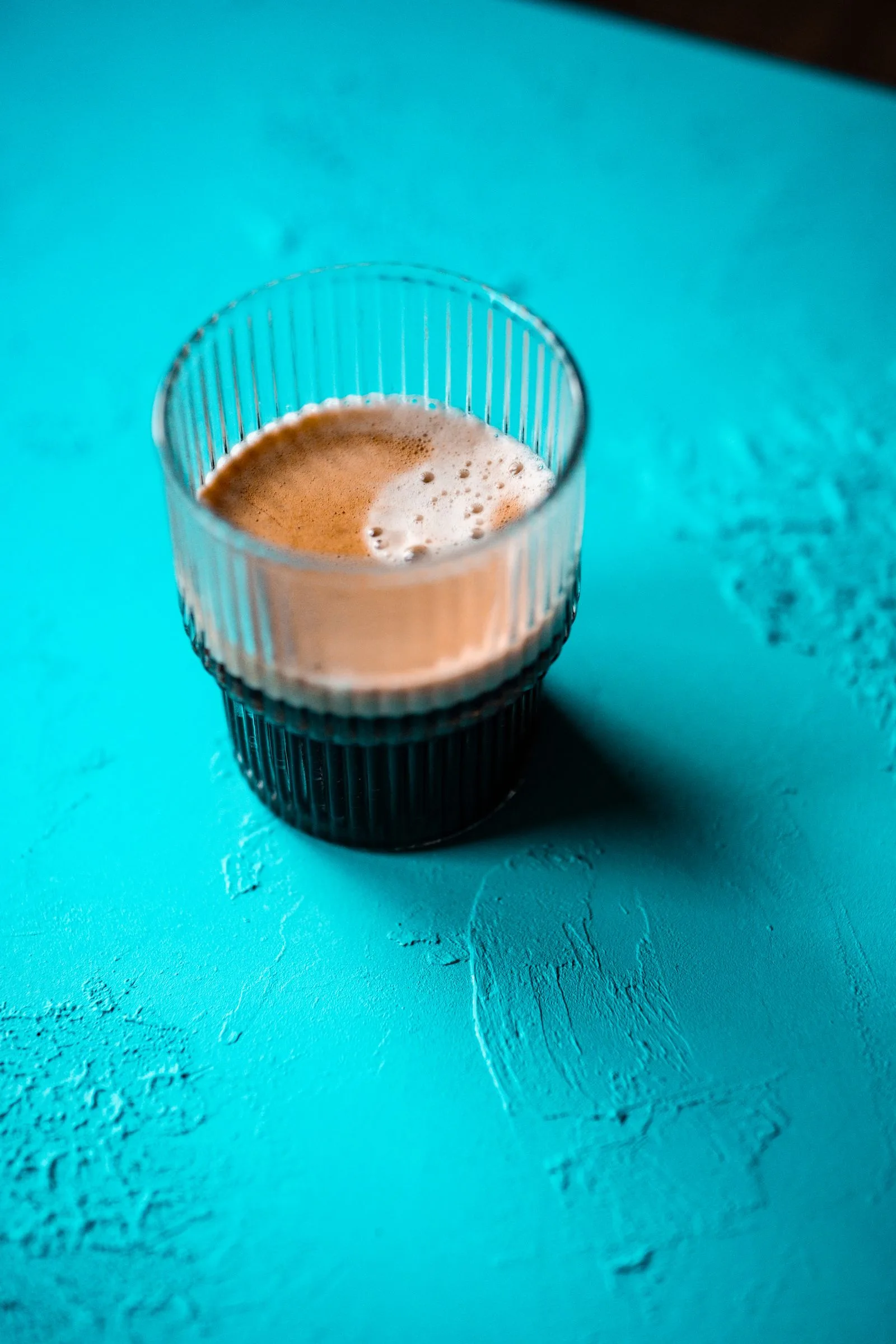
The visible difference is crema. Pouring water onto a finished shot in the Americano method dilutes and breaks up the thin layer of golden-brown foam an espresso machine produces, leaving what Hoxton Coffee describes as a “paler crema layer in the middle” rather than an intact cap. Building a Long Black in reverse, pouring the shot on top of water that is already in the cup, leaves “most of the crema from the espresso delicately balanced on the top,” fully intact rather than disturbed by the pour. If you have ever ordered what you thought was the same black coffee twice and noticed one had a visible tan-colored foam layer and the other did not, the pour order is almost certainly why.
That same pour order changes the taste, and not in the direction most people would guess. Hoxton Coffee states plainly that “the long black always feels a little stronger, even though we’re using the exact same volume of espresso,” attributing it to the fact that “the two layers are more separate, so the long black is bolder.” The Americano, by contrast, comes out smoother and more evenly diluted, described as carrying “all the sweetness and full-bodied taste of trademark espresso, but with the bitterness scaled back.” Identical ingredients, identical ratio, and the two drinks still land differently on the tongue purely because of which one hit the cup first.
Where each drink actually comes from
The names carry real geography, not just menu branding. Hoxton Coffee traces the Americano back to Italy, where “Italians created this universal coffee to cater to the tastes of American tourists, hence the name,” diluting a shot down toward the strength of American-style drip coffee for visitors who found straight espresso too intense. The Long Black has a different, more contested home: Hoxton Coffee places its origin in “Australia or New Zealand, depending on who you ask,” a rivalry both countries’ coffee scenes still argue about, born out of flat white and long black culture rather than the espresso-bar tradition that produced the Americano.
Bringing in the third option: filter coffee
Filter coffee is a structurally different drink from both of the above, not a third variation on the same recipe. Majesty Coffee’s comparison is direct about the mechanics: an Americano is an “espresso shot(s) diluted with hot water,” typically built at “a 1:2 ratio, for each shot of espresso, double the amount of hot water added,” while filter coffee is made by pouring “hot water over ground coffee beans placed in a filter,” using a drip machine, a pour-over dripper, a French press, or an AeroPress rather than a pressurized espresso machine at all. No pump, no 9 bars of pressure, no crema of any kind. Majesty Coffee states the difference outright: “crema is not present in filter coffee,” full stop, regardless of how the water is poured.
That mechanical difference carries through to flavor. Majesty Coffee describes the Americano as running “toasty, nutty, or chocolatey” with a “pronounced, rich” aroma and a “bold, smooth, and robust flavor,” a profile inherited directly from the espresso shot underneath the added water. Filter coffee instead tends toward “fruity or floral notes” with a “subtle, delicate” aroma, a “smoother, milder finish,” and, per the same source, “a more acidic taste profile” than an Americano typically shows. Neither is more correct; they are extracted through entirely different physics, pressure versus gravity, and the flavor compounds that come through track that difference closely.
The caffeine comparison, with real ranges
Caffeine numbers are the one place worth being careful about cherry-picking a single figure, because Majesty Coffee’s own comparison piece is not internally consistent on this point. The same article states caffeine content for an 8oz cup of filter coffee as three different ranges in three different sections, “150 to 210mg,” “95 to 200mg,” and “172 to 223mg,” and gives two different figures for a double-shot Americano, “about 136mg” in two places and “94 to 150mg” in a third. None of those is more authoritative than the others within the source itself, so treating any single one as the definitive number would just be picking a favorite among contradictions.
What holds up better is the range this site’s own caffeine in an espresso shot breakdown already documents from a single, traceable source: a single shot at about 63mg, the USDA lab-tested average, and a typical double shot, what an Americano or Long Black actually uses, at roughly 120 to 130mg using that same USDA baseline. For filter coffee, Mayo Clinic’s reference table puts a standard 8oz cup at about 96mg.
Lined up against each other at realistic serving sizes, an 8oz filter coffee at roughly 96mg does not clearly beat a double-shot Americano at roughly 120 to 130mg; if anything, the espresso-based drink edges ahead at that specific comparison. Filter coffee only pulls back in front once the serving size grows: a 12 to 16oz mug, which is what most people actually order or pour at home, comfortably outweighs a double shot on total caffeine simply because of volume. Serving size, not brewing method, is doing most of the work here.
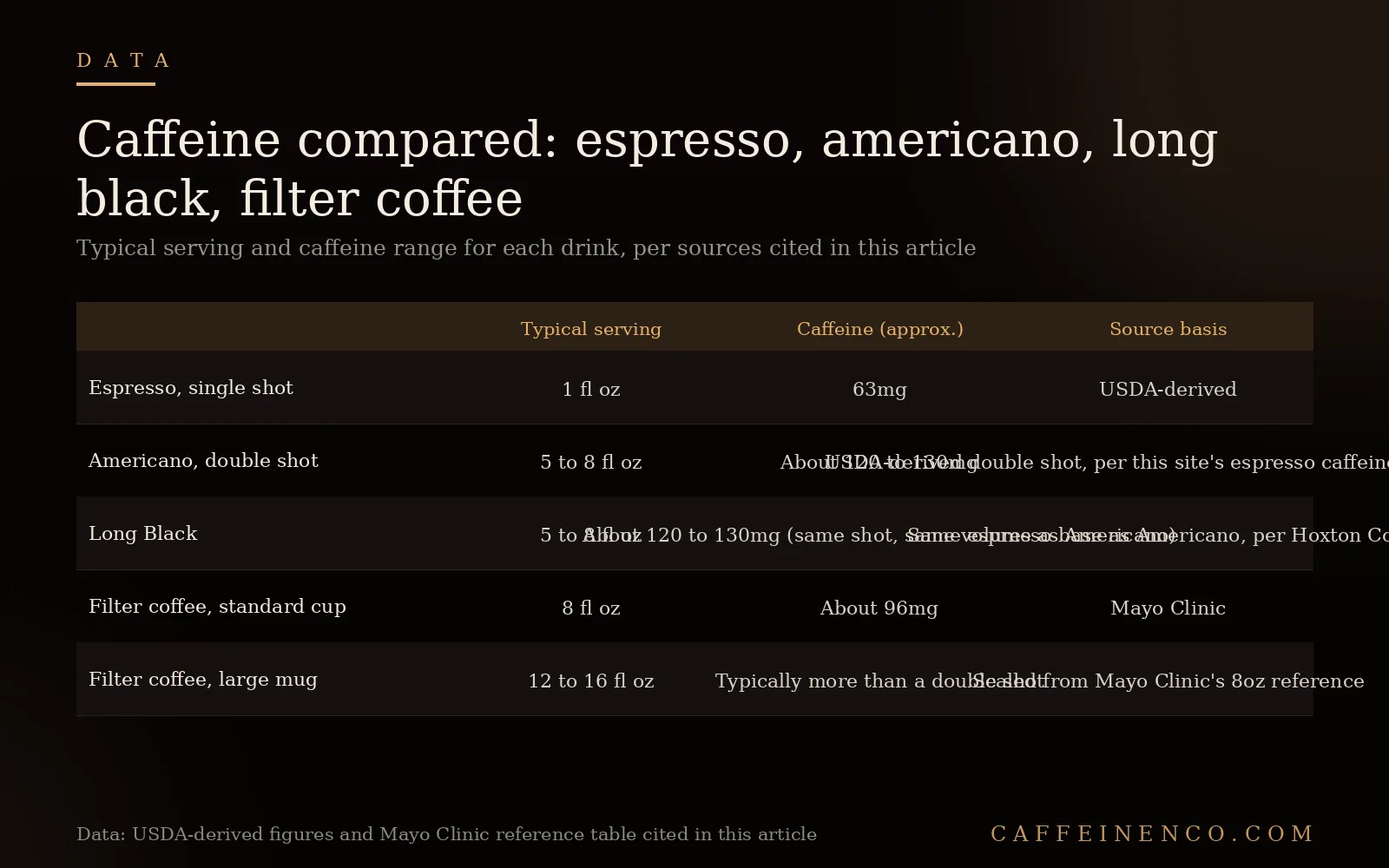
| Drink | Typical serving | Caffeine (approx.) | Source basis |
|---|---|---|---|
| Espresso, single shot | 1 fl oz | 63mg | USDA-derived |
| Americano, double shot | 5 to 8 fl oz | About 120 to 130mg | USDA-derived double shot, per this site’s espresso caffeine breakdown |
| Long Black | 5 to 8 fl oz | About 120 to 130mg (same shot, same volume as Americano) | Same espresso base as Americano, per Hoxton Coffee |
| Filter coffee, standard cup | 8 fl oz | About 96mg | Mayo Clinic |
| Filter coffee, large mug | 12 to 16 fl oz | Typically more than a double shot | Scaled from Mayo Clinic’s 8oz reference |
The Long Black is not a separate line item on any caffeine chart because it is not a separate drink from a milligram standpoint; it uses the identical espresso shot and water volume as an Americano, just poured in reverse. This site’s own Dunkin’ coffee caffeine content breakdown already shows a related pattern in a real menu, an Americano built on two shots regardless of size, carrying more total caffeine than a same-size Latte built on fewer shots for smaller cups. The lesson repeats here: pour order changes crema and taste, not the caffeine total, and shot count and serving size matter more than which black-coffee format you actually ordered.
Worked example: choosing between the three
- Want the boldest, most espresso-forward black coffee, crema and all? Order a Long Black. Same ingredients as an Americano, but the reversed pour keeps the crema intact and, per Hoxton Coffee, produces a drink that “always feels a little stronger” even at an identical shot count.
- Want that same espresso base but smoother and less intense? Order an Americano. Pouring water first over the shot mutes the bitterness, per Hoxton Coffee, at the cost of a mostly-dissolved crema layer.
- Want the most caffeine per cup without ordering a double shot of anything? Order a full-size mug of filter coffee rather than a standard 8oz cup; a 12 to 16oz mug outpaces a double-shot Americano’s roughly 120 to 130mg, while a standard 8oz cup, at roughly 96mg, actually runs a bit behind it.
- Want the lighter, fruitier flavor profile rather than a toasty, chocolatey one? Order filter coffee again; Majesty Coffee attributes that brighter, more acidic profile specifically to the gravity-brew method rather than anything achievable through an espresso machine.
- Building any of these at home rather than ordering one? A prosumer machine from 1st in Coffee’s espresso range handles both the Americano and Long Black pour orders equally well since the shot itself does not change, or you can browse the same category on Amazon.
Common mistakes
Assuming an Americano and a Long Black are the same drink under two names is the most common mistake; they use identical ingredients but Hoxton Coffee is specific that the reversed pour order changes both the crema and the perceived boldness of the finished cup. Assuming filter coffee automatically wins the caffeine comparison is the second mistake; at a standard 8oz serving, filter coffee’s roughly 96mg (Mayo Clinic) does not clearly outrun a double-shot Americano’s roughly 120 to 130mg (USDA-derived), and filter coffee only pulls ahead once the mug gets bigger than a standard cup. Treating filter coffee as just “an Americano without the machine” is the third mistake; it is brewed at atmospheric pressure rather than the roughly 9 bars an espresso machine applies, which is also why, per Majesty Coffee, “crema is not present in filter coffee” under any circumstances. Assuming the Long Black is a separate line item on a caffeine chart is the fourth mistake; it shares the exact same shot and water volume as an Americano, so any per-drink caffeine figure for one applies to the other.
Common questions
What is the actual difference between an Americano and a Long Black? Pour order. An Americano is built espresso first, then hot water, per Hoxton Coffee, which dilutes and breaks up the crema. A Long Black reverses that, water first, then espresso on top, which keeps the crema intact and produces what Hoxton Coffee describes as a bolder, stronger-feeling cup from the identical ingredients.
Does a Long Black have more caffeine than an Americano? No. Both use the same espresso shot and the same water volume; only the pour order changes. Any caffeine difference reported anywhere between the two would come from shot count or cup size, not from which liquid was poured first.
Is filter coffee stronger than an Americano? In caffeine terms, it depends on serving size. A standard 8oz filter coffee, about 96mg per Mayo Clinic’s reference, actually runs a bit behind a double-shot Americano’s roughly 120 to 130mg. A larger 12 to 16oz mug, closer to how most people actually drink filter coffee, comfortably pulls ahead. In flavor terms “stronger” is the wrong frame entirely, since filter coffee trends fruitier and lighter while an Americano trends toastier and bolder, per Majesty Coffee’s comparison.
Why does my Americano not have any crema? Because pouring hot water directly onto a finished espresso shot dilutes and disperses the thin crema layer, per Hoxton Coffee, leaving at most a pale, broken layer rather than an intact cap. A Long Black, built with the same ingredients but the reverse pour order, keeps that crema layer visible on top.
Where does the name “Americano” actually come from? Italy, according to Hoxton Coffee, where the drink was created to suit American tourists who found straight espresso too intense, diluting a shot toward the strength profile of the drip coffee they were used to at home.
Where does the name “Long Black” come from? Australia or New Zealand, per Hoxton Coffee, though which country actually invented it remains a genuinely contested claim between the two coffee cultures.
For more sourced brewing breakdowns like this one, delivered weekly, subscribe to The Sunday Pour.