Every AeroPress guide eventually reaches the same fork: do you brew it the way the instructions show, with the filter cap on and the chamber sitting on your mug, or do you flip it upside down first? The internet treats this as a personality test. It is actually a narrow, mechanical question about one thing: what the water does during the minute or two before you press. Get that clear and the choice mostly makes itself.
This site already has a full guide to AeroPress ratio and grind size. That post covers how much coffee and water to use. This one covers the decision it leaves open: standard or inverted, what each really changes in the cup, what the manufacturer says about it, and what the last two World AeroPress Champions did. The finals are on December 6, 2026 in Mexico City, so it is a good moment to understand the question before the next set of winning recipes lands.
The one difference that matters: when the water can leave
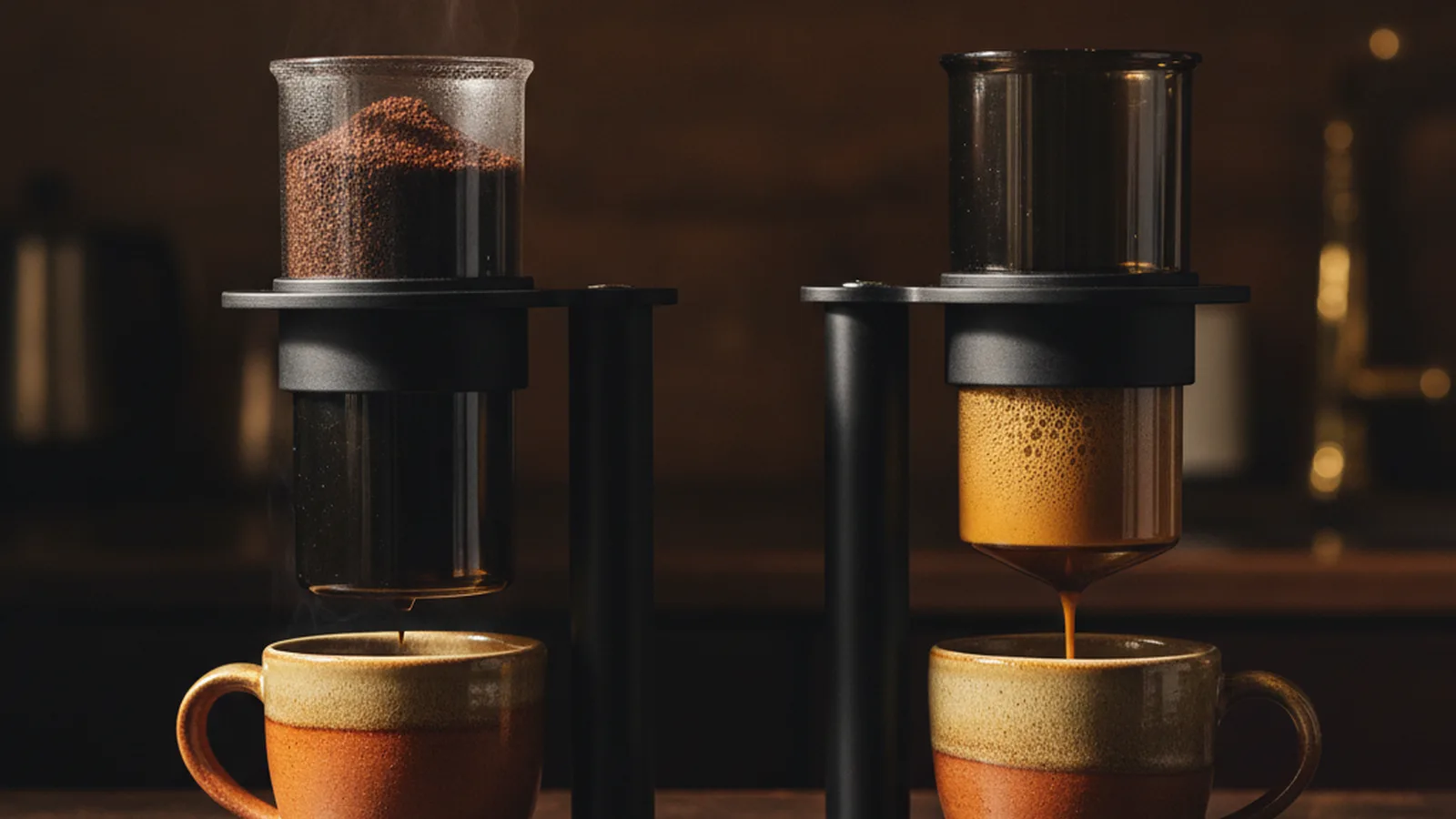
In the standard (upright) method, the filter cap is screwed on the bottom of the chamber before you add anything. The moment you pour water onto the grounds, gravity starts pulling liquid through the paper filter and into your mug. In the inverted method, you set the plunger in the chamber, flip the whole thing so the plunger is at the bottom, and brew with the open end up. Nothing can leave until you screw on the filter cap, flip it back, and press.
That is the whole mechanical difference. Everything else people say about the two methods follows from it:
- Standard: filtration starts immediately. Some of the water is already passing through the coffee while you are still pouring and stirring, so the effective steep time is a little shorter and a little less controlled than your timer says.
- Inverted: the full charge of water stays in contact with every ground for exactly as long as you decide. It is a true immersion brew until the moment you press.
AeroPress itself describes the reasons people choose inversion in its own FAQ: “to prevent premature drip-through of their coffee, to give them complete control over longer steep times, and to allow them to use coarser grind sizes.” The same page also tells you how much drip-through to expect in a normal upright brew: it is normal for “about 2-3%” of the liquid to run through before you stir and press, even with a medium-fine grind.
How much is 2 to 3 percent, really?
Take a 225 g water charge, the amount in one of the standard recipes below. Two to three percent of that is roughly 4.5 to 6.8 g of water leaving early (that is simple arithmetic on AeroPress’s percentage, not a measured result). For a short steep with a medium-fine grind, that is small, and most people will not taste it. It starts to matter when you combine a longer steep with a finer grind, because the early drip then represents a bigger chunk of the coffee’s total contact time. That is the situation inversion was invented to solve.
What each method does to the cup
Two of the sources used for this guide describe the taste difference in nearly the same words. The Way to Coffee, which prints a standard and an inverted recipe side by side, says the standard method “can often lead to a cleaner, crisper cup due to less steeping time, while the inverted method generally allows for a fuller immersion, potentially creating a more robust and complex flavor.” I Need Coffee, a tutorial for the inverted method, credits it with a richer taste because “all the coffee grounds will contact the water,” enabling full or total immersion.
Put plainly:
| Standard (upright) | Inverted | |
|---|---|---|
| Water leaves the chamber | Immediately, slowly | Only when you flip and press |
| Steep time control | Approximate | Exact |
| Typical cup character | Cleaner, crisper | Fuller, more immersion-like |
| Main failure point | Too much early drip with a fine grind | The flip |
| Spill risk | Low | Higher |
| Official AeroPress position | The method in the instructions | “Strongly discourage” |
Treat the “cleaner vs fuller” line as a tendency, not a law. Grind size, water temperature, filter type and dose can swamp the effect of orientation. If you change two of those at once while switching methods, you will not know what caused the difference.
The flip: the real risk, stated plainly
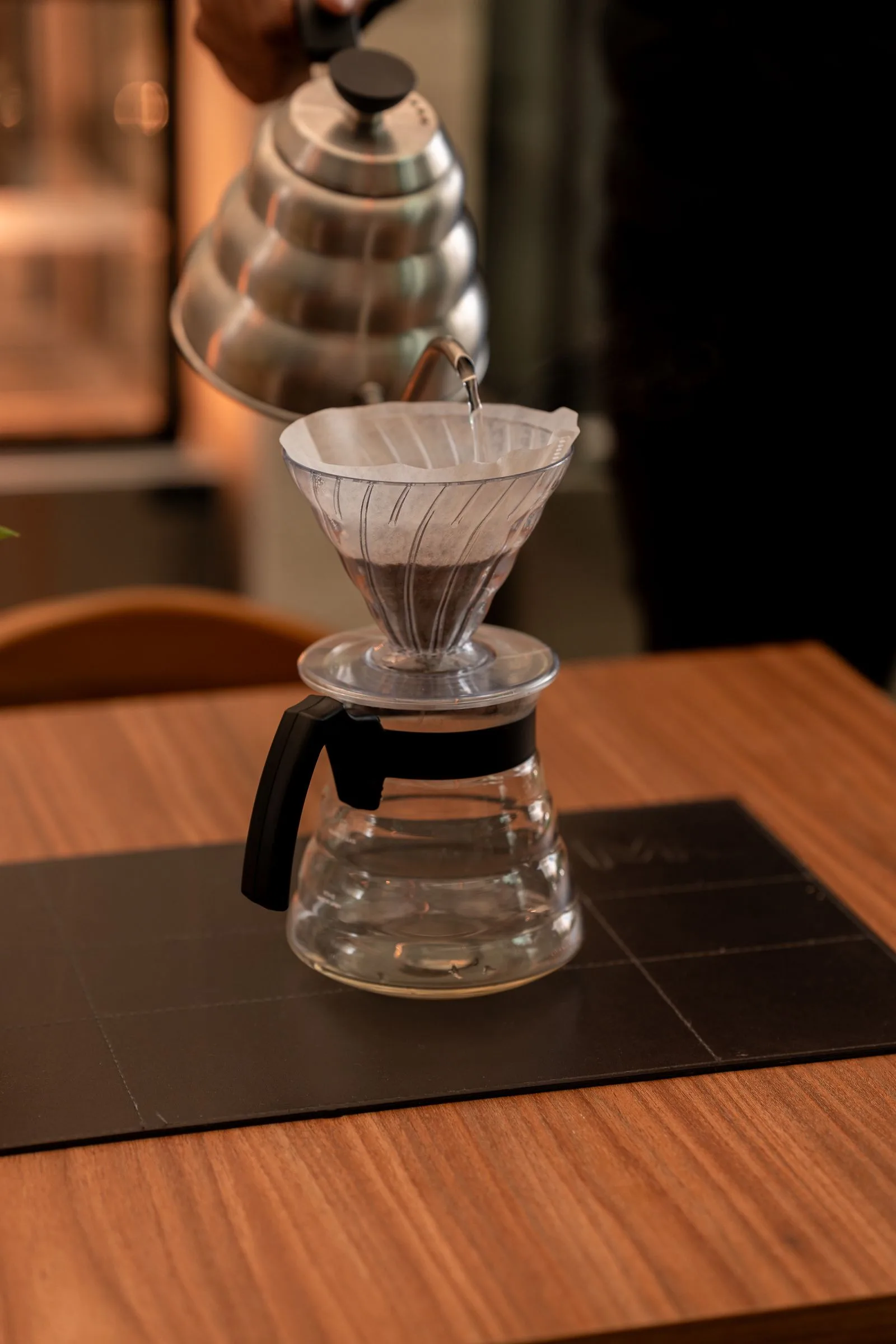
The inverted method has exactly one step that can go badly wrong, and I Need Coffee names it: “The only way to mess up the inverted method is to lose control during the flip.” You are turning a chamber full of near-boiling water and wet grounds upside down over a mug while the plunger seal is the only thing holding it together.
AeroPress’s own FAQ is blunt about this. Its safety notice says the inverted method “can cause the coffee maker to be less stable and prone to mishaps that expose the user to potential burns from hot liquid,” and that the company strongly discourages it “because it is less stable and therefore prone to tipping over.” That is the manufacturer’s position, and it is worth knowing before you read any tutorial that treats inversion as the default. Nothing here is a reason to avoid it entirely, since competition brewers use it constantly, but it is a reason to do it deliberately.
If you do brew inverted, the practical safeguards from the tutorials are simple:
- Seat the plunger only a short way into the chamber, so the stack sits low and stable. I Need Coffee suggests placing the plunger’s stopper at the middle of the number 4 mark or lower.
- Put the AeroPress on a flat, dry, uncluttered surface, away from the edge.
- Rinse the paper filter in the cap before you start, so the cap goes on quickly at the end.
- Flip with both chambers held together, over a mug that is already in place, in one smooth motion. Do not hesitate halfway.
- Use a mug that is wide enough to catch the plunger and any dribble.
The third option the manufacturer points to
AeroPress does not just discourage inversion; it offers an alternative for the same goals. The FAQ recommends a Flow Control Filter Cap (or the Stainless Steel Flow Control Cap) for “precision brewing,” saying it “allows you to eliminate drip-through, extend your brew time for as long as you want, and use whatever grind size you prefer.”
That is the same list of benefits people cite for inverting, without the flip. It is worth knowing that this option exists, because it reframes the question. You are not choosing between “easy but imprecise” and “precise but risky.” There is a third path, upright with a flow control cap, that targets the same problem. If you want to try it, a flow control filter cap for the AeroPress is a small accessory rather than a new brewer.
What the champions actually use
If inversion were strictly better, every recent winner would use it. They do not. The World AeroPress Championship publishes each winning recipe, and the last two winners are a clean illustration.
2024: George Stanica, Romania, inverted
The 2024 winning recipe is listed as “Position: Inverted.” The published details:
- Dose: 18 g of washed Ethiopian Guji coffee, ground on a Comandante C40 at 58 clicks (listed as 870 microns), 1 rinsed Aesir filter.
- Water: a mix diluted to about 85-90 ppm, at 96 C for extraction.
- Method: place the AeroPress inverted around the 4th mark, add the coffee, pour about 50 g of water, let it bloom for about 30 seconds, pour another 50 g, stir lightly in a north-south-east-west motion for 10 seconds, then cap and begin gently removing air at 1:20. At 1:35, start pressing and press gently until you have about 76 to 79 g of output, in 30 to 40 seconds. Dilute afterwards with warm water to a total of 130 to 135 g, and add another 20 to 30 g of room temperature low-mineral water.
He also adds a note worth keeping: “this method was tailored for this specific coffee and roast, so adapt based on your palate!”
2025: Nemo Pop, Australia, upright
The 2025 winning recipe is listed as “Position: Upright.” The published details:
- Dose: 18 g of washed Ecuadorian Sidra, ground on a Comandante Trailmaster with Tigershark burrs at 31 clicks and sifted at 200 microns.
- Equipment: a Flow Control Filter Cap and 2 paper filters.
- Water: 84 C for brewing, with bypass water at 50 C.
- Method: pour 70 g of bypass water into the carafe, place the AeroPress on top, add the ground coffee, pour 100 g of brewing water, stir at 25 seconds, start gently pressing at 50 seconds for about 20 seconds, serve.
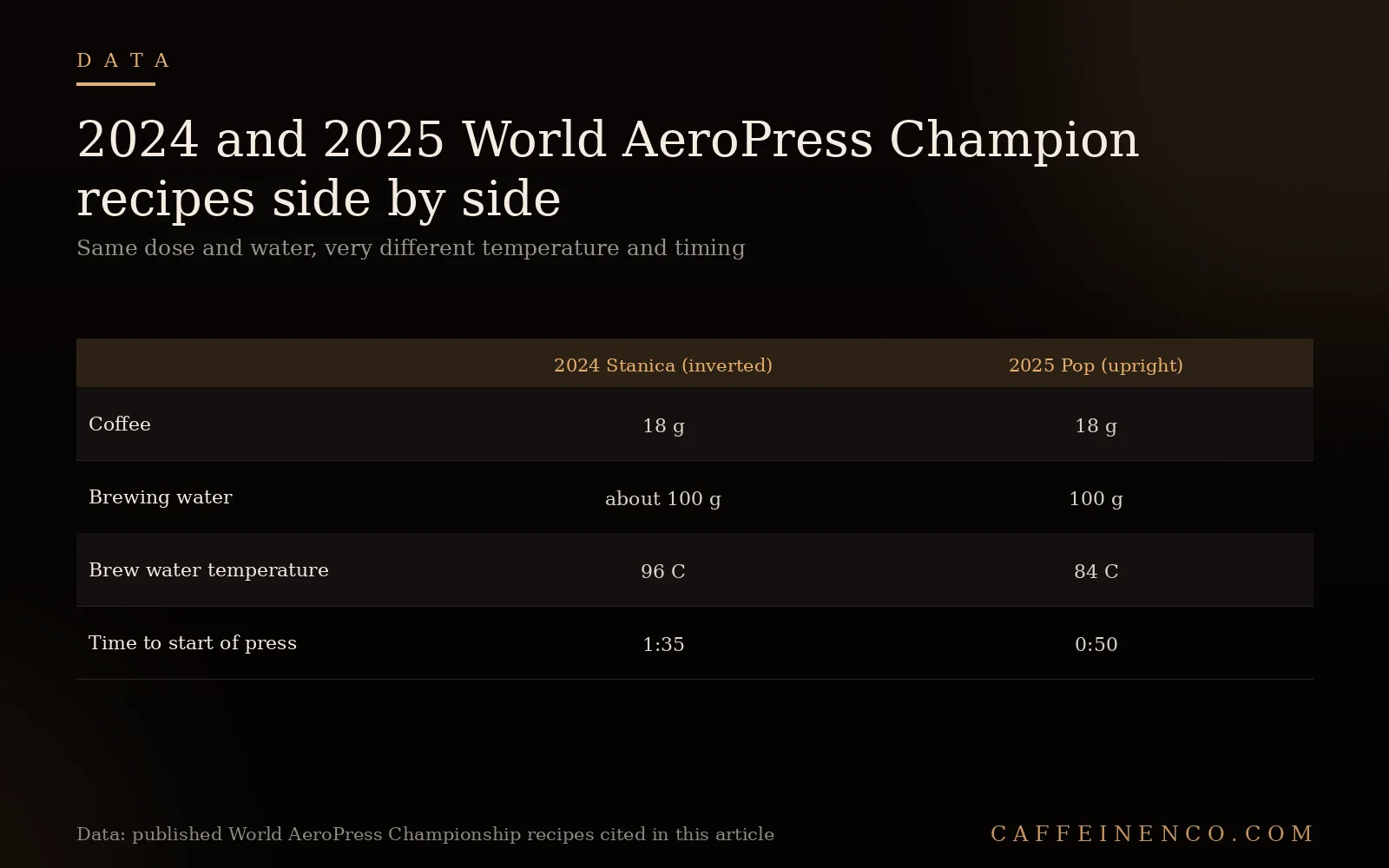
So the 2024 champion went inverted with a long, controlled steep, and the 2025 champion went upright with a flow control cap and a short, fast brew. Both used 18 g of coffee and about 100 g of brewing water, and both added bypass water. The method is a tool for the recipe, not a ranking.
Their numbers side by side
Using the published figures:
| 2024 Stanica | 2025 Pop | |
|---|---|---|
| Orientation | Inverted | Upright, flow control cap |
| Coffee | 18 g | 18 g |
| Brewing water | about 100 g | 100 g |
| Brewing ratio | about 1:5.6 | about 1:5.6 |
| Brew water temperature | 96 C | 84 C |
| Time to start of press | 1:35 | 0:50 |
| Press length | 30 to 40 s | about 20 s |
The ratios are my own arithmetic from the published doses, not figures the champions stated. The point is how similar the strong, concentrated brewing ratio is and how different the timing and temperature are. Both brewed a concentrate and added bypass water, which is why competition recipes look so unlike a mug-sized home brew.
Home-style recipes for each method
Competition recipes are tuned for a specific coffee, a judge’s palate and a five-minute window. For everyday brewing, the two recipes printed on The Way to Coffee are a more realistic starting point, because they were written to be repeated.
Standard, from two-time Finnish Barista Champion Jarno Perakyla: 15.3 g of coffee, 225 ml of water, a grind “a bit finer than you’d do for a V60,” a total time of 1:30. Stir three times back and forth at the start, again at 1:00, then press gently from 1:00 to 1:30. That is a ratio of roughly 1:14.7, my arithmetic from the published numbers.
Inverted, from 2015 German AeroPress Champion Mateusz Petlinski: 30 g of coffee, 120 ml of water plus 120 ml of bypass water (240 ml total), 93 C, a “coarse filter grind,” using 2 filters, for a total of 2:15 with a gentle 30-second stir and a 30-second press after 45 seconds of settling. That works out to a total ratio of 1:8, again my arithmetic.
If you want a plain inverted routine that does not need a scale full of recipes, the I Need Coffee tutorial is simple: one scoop (17 g), water cooled for 20 to 30 seconds after boiling, add the water and stir, flip at 60 to 90 seconds, press slowly for about 20 seconds, then dilute with about half again as much hot water or pour over ice.
Worked example: same coffee, both methods
Here is a controlled way to find out which you prefer, built from the sources above. The point is to change only orientation.
- Fix the variables. Use 15 g of coffee, ground medium-fine, and 225 g of water at the same temperature both times. Weigh everything. If you need help picking a temperature, the water temperature guide covers the range, and a variable temperature kettle from 1st in Coffee’s kettle range or on Amazon makes holding it repeatable.
- Brew 1, standard. Cap on, chamber on the mug, pour, stir three times, steep to 1:30 total, press gently over 30 seconds.
- Brew 2, inverted. Plunger in at a low position, chamber up, same dose and water, stir, steep to 1:30, cap on, flip over the mug, press gently over 30 seconds.
- Taste both while warm, then again as they cool. Note body, clarity and finish in one sentence each. Differences that survive the cooling are the real ones.
- Then change one more variable. If the inverted cup is fuller but a bit heavy, go slightly coarser or shorten the steep. If the standard cup is clean but thin, go slightly finer. Our coffee grind size chart helps you move in steps.
With a short steep and a medium-fine grind, expect the difference to be modest. It tends to grow with longer steeps and finer grinds, the situation the 2 to 3 percent drip-through figure points to.
Which method fits which cup
A short decision guide:
- You want the simplest, safest routine for a weekday mug: standard. It is the manufacturer’s recommended method, has the lowest spill risk, and a medium-fine grind with a one-to-two-minute steep loses little to early drip.
- You want a fuller cup or a long steep with a finer grind: inverted, with care, or upright with a flow control cap if the flip puts you off.
- You are brewing a concentrate to dilute: either works. The champions above both did, and your ratio calculator can check the maths when you dilute.
- You brew with kids or a crowded counter nearby: standard, for the safety reason in the manufacturer’s notice.
- You are chasing a competition recipe: follow the recipe’s position exactly, since it was tuned around it.
Troubleshooting each method
The most common complaints map onto the sections above. If your inverted cup tastes sour and thin, it is usually under-extracted, so go finer or steep longer, as covered in why coffee tastes sour. If it is harsh and heavy, it is probably over-extracted, which why coffee tastes bitter walks through. If the standard cup tastes weak and the grounds look pale, a lot of water may be running through early, so grind finer or move to a flow control cap. If the press feels stuck, AeroPress’s own FAQ suggests pressing half an inch, holding for a few seconds and repeating, or using a coarser, medium-fine grind where a small amount drips through before pressing and a slow, gentle press takes 20 to 40 seconds.
Common mistakes
Changing orientation, grind, temperature and ratio all at once, then crediting the flip for the result, is the first mistake. Treating the inverted method as the “pro” one is the second; the 2025 champion brewed upright. Flipping a tall stack of plunger and water is the third; seat the plunger low and stay in control. Skipping the filter rinse is the fourth, because a slow cap fit at the end of an inverted brew invites a leak. Ignoring the manufacturer’s safety notice is the fifth, whatever your tutorial says. Copying a competition recipe for a different coffee is the last, since the 2024 champion himself says his was tailored to one coffee.
Common questions
What is the difference between inverted and standard AeroPress? In the standard method the filter cap is on from the start and liquid begins passing through the coffee as soon as you pour. In the inverted method the AeroPress is flipped so the plunger is at the bottom, the water cannot leave, and you cap and flip it only when the steep is finished.
Does the inverted method taste better? It tends to taste different rather than better. Two sources describe the standard method as cleaner and crisper, and the inverted method as fuller and more immersion-like. Grind, temperature and dose can change the result as much as orientation.
Is the inverted AeroPress method safe? It carries more risk of spills. AeroPress’s own FAQ says it “strongly discourage[s]” the method because it is less stable and prone to tipping over and exposing the user to hot liquid. Seat the plunger low, use a flat surface and flip over a mug in one steady motion.
What do World AeroPress Champions use? Both. The 2024 winner, George Stanica, brewed inverted. The 2025 winner, Nemo Pop, brewed upright with a Flow Control Filter Cap.
How much coffee drips through in the standard method? AeroPress says about 2 to 3 percent of the liquid is normal with a medium-fine grind before you stir and press. Much more than that suggests the grind is too coarse.
Can I get the benefits of inverting without flipping? AeroPress’s suggested route is a Flow Control Filter Cap, which it says lets you eliminate drip-through, extend your brew time as long as you want and use any grind size you prefer.
When is the World AeroPress Championship final? The World Final is on December 6, 2026 in Mexico City, according to the championship’s own site.
For more brewing comparisons like this one, delivered weekly, subscribe to The Sunday Pour.
Sources & data
- AeroPress FAQ: why do people use the inverted method (official guidance, drip-through figure and safety notice)
- I Need Coffee: Upside Down AeroPress Coffee Brewing Tutorial (inverted steps, flip timing, failure point)
- The Way to Coffee: AeroPress Brew Guide (side-by-side standard and inverted competition-style recipes)
- World AeroPress Championship: 1st, Nemo Pop, Australia (2025), upright recipe
- World AeroPress Championship: 1st, George Stanica, Romania (2024), inverted recipe
- World AeroPress Championship: World Final, December 6th, 2026, Mexico City