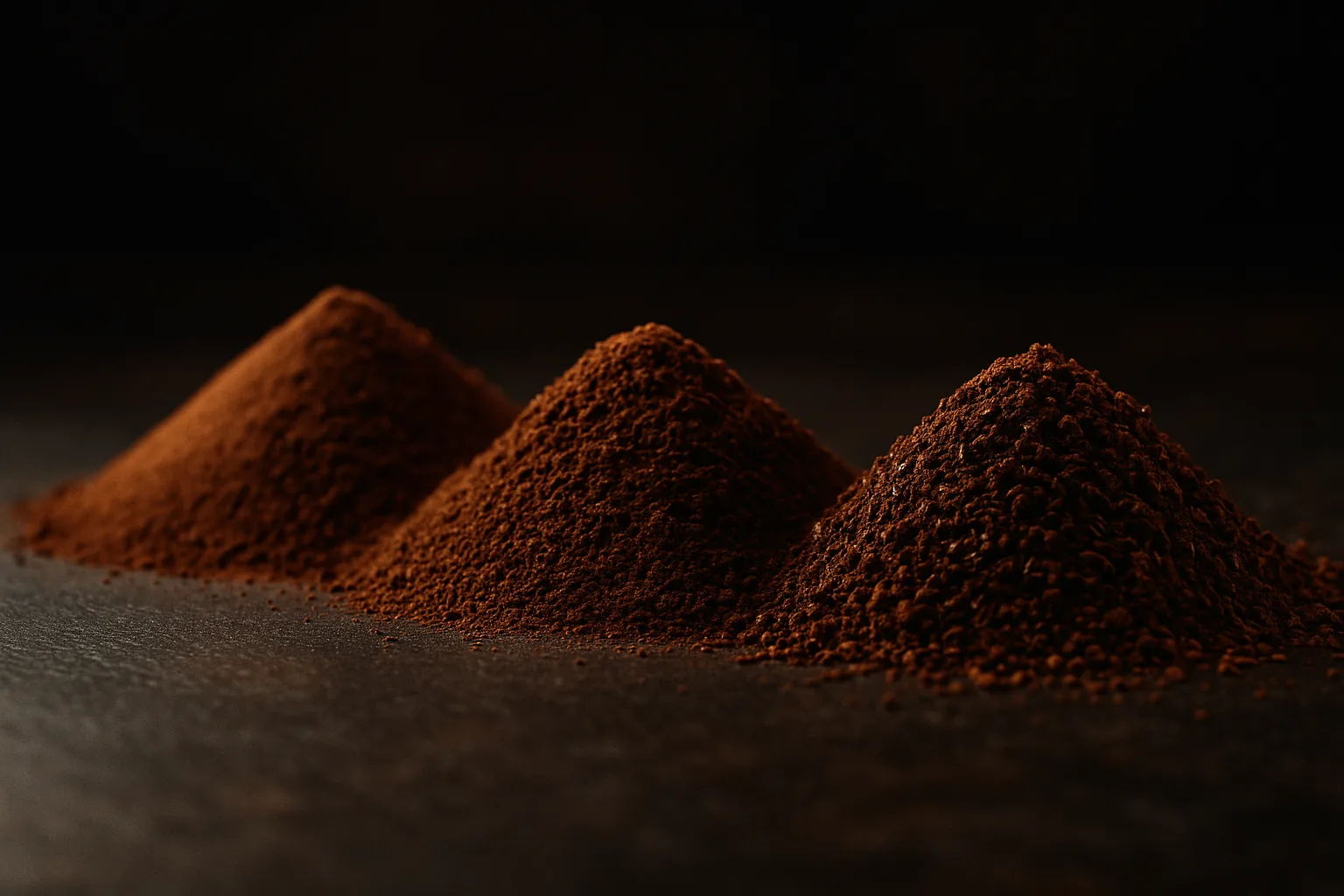
Grind size charts are everywhere, and most of them quietly disagree with each other by 20 to 40 percent on the same brew method while presenting a single confident number, as if a micron figure were a fixed constant rather than the midpoint of a range that depends on the grinder that produced it. This page exists to be the one you bookmark instead: a full reference table across every common method, built by cross-checking multiple published charts rather than inventing a tidy consensus, plus the two caveats almost every other chart leaves out. First, a micron figure describes an average or a target zone, not a promise, because no grinder on earth produces particles of a single uniform size. Second, “18” on your grinder and “18” on your neighbour’s grinder are not the same grind, even if both dials go up to 40 and both machines are burr grinders from a reputable brand.
Why the micron numbers are approximate
Every batch of ground coffee is a distribution, not a point. Grind a bag of beans on any home grinder and you get a bell curve of particle sizes: a cluster around your target size, a tail of fine dust below it, and a scatter of larger fragments above it. Coffee researchers describe this with two numbers that matter more than the single “grind size” figure most charts publish: D50, the median particle size where half the grounds are smaller and half are larger, and the shape of the tails around it. Two grinders can share the same D50 and taste completely different because one has a tight, tall curve and the other has a wide, flat one full of fines and boulders.
That is also why published charts disagree with each other on the same method. Cross-referencing several independent grind size charts for this piece: French press lands anywhere from about 690 to 1,300 microns depending on the source, cold brew ranges from roughly 800 to 1,500 microns, and even espresso, the most tightly studied brew method in coffee, is quoted as 180 to 380 microns by one chart and 200 to 400 by another. None of these sources is wrong. They are each reporting the D50 zone of a grinder or a brewing tradition that isn’t identical to anyone else’s, rounded to a clean-looking number for publication. Treat every range below as a starting zone to taste from, not a setting to copy exactly.
Why grinder settings do not transfer between machines
This is the caveat most charts skip entirely: a micron number is a measurement of the coffee that comes out, not an instruction you can dial in directly, because grind dials are not standardised across brands or even across units of the same model. Research on the Mahlkönig EK43, one of the most consistent commercial grinders sold, found that four well-aligned units at the same cupping setting still varied by close to 1.5 percent in how much coffee passed a reference sieve, a small number in isolation but proof that even identical, professionally maintained machines are not perfectly interchangeable. The same research surveyed cupping grind settings at five specialty roasters and found that none of them matched the Specialty Coffee Association’s own cupping specification, despite all of them nominally aiming for it, because the SCA standard (coffee ground so that 70 to 75 percent passes a US 20 mesh sieve, roughly 841 microns) leaves enough room for interpretation that real roasters land all over the map. If professionals running commercial gear cannot agree on one number for one method, a home grinder’s click “18” copied from a stranger’s blog post is a starting guess at best.
The practical result: use the micron figures below to understand relative texture (finer than table salt, coarser than sand) and to sanity-check a recipe, not as a setting you punch into your own grinder and expect to match someone else’s cup.
The reference table
Micron ranges are compiled from multiple published grind charts and rounded to reflect where those sources overlap. Where sources disagreed by a wide margin, the note beneath the table names which chart reported which number.
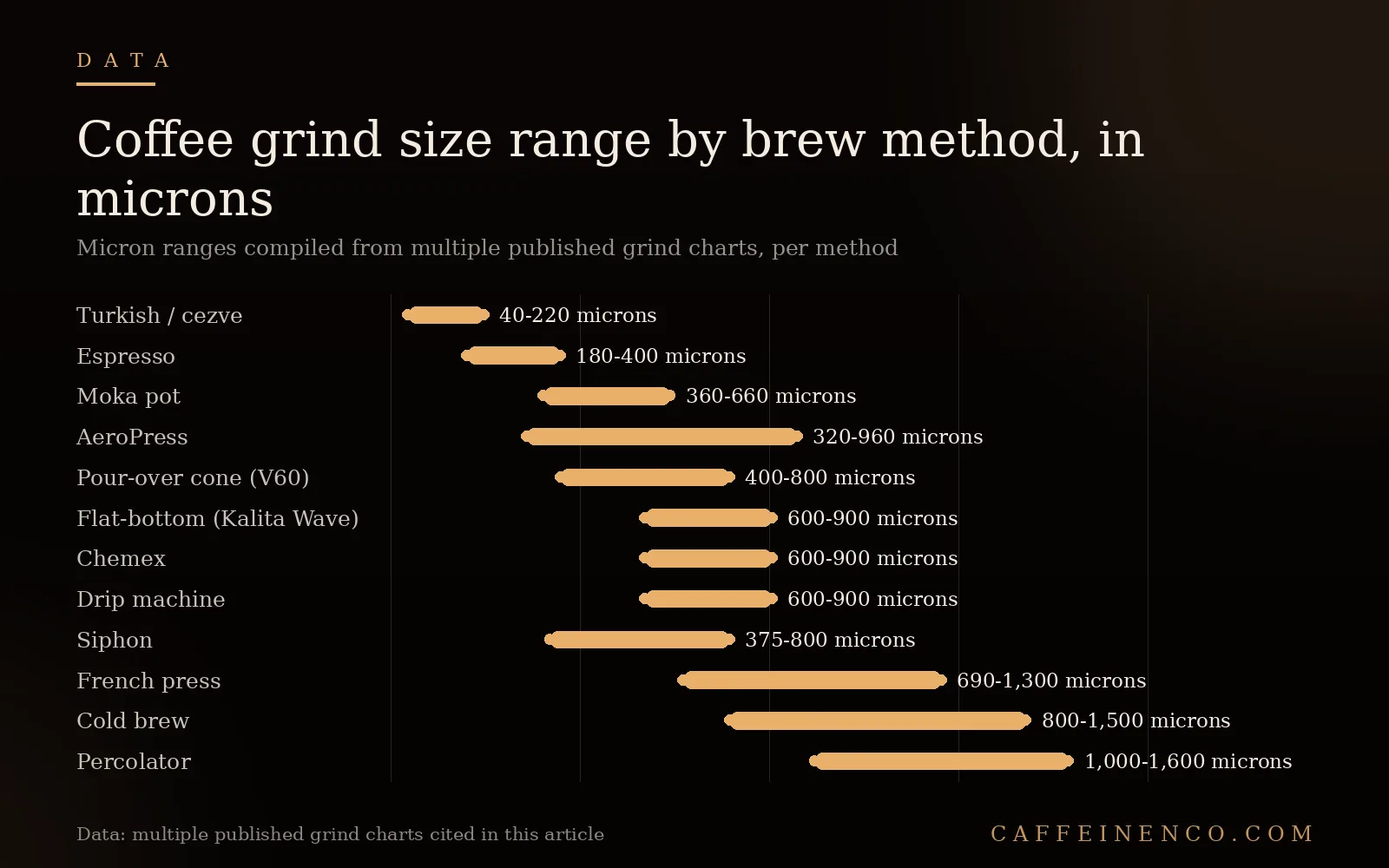
| Method | Micron range | Texture you can feel | Typical brew time |
|---|---|---|---|
| Turkish / cezve | 40 to 220 microns | Flour or powdered sugar, almost no grit between your fingers | 3 to 5 minutes, simmered and served unfiltered |
| Espresso | 180 to 400 microns | Powdered sugar to fine table salt | 25 to 35 seconds |
| Moka pot | 360 to 660 microns | Fine sand, distinctly coarser than espresso | 4 to 6 minutes on the stovetop |
| AeroPress | 320 to 960 microns | Fine sand through medium, depending on recipe | 1 to 4 minutes total |
| Pour-over cone (V60 style) | 400 to 800 microns | Table salt | 2:30 to 4:00 |
| Flat-bottom (Kalita Wave style) | 600 to 900 microns | Medium sand, coarser than a V60 grind | 3:00 to 4:30 |
| Chemex | 600 to 900 microns | Coarse sand, similar to kosher salt | 3:30 to 4:30 |
| Drip machine (auto-drip, flat basket) | 600 to 900 microns | Medium sand | 4 to 6 minutes per cycle |
| Siphon | 375 to 800 microns | Medium-fine, between a V60 and a Chemex grind | 2:30 to 3:30 total, including vacuum draw |
| French press | 690 to 1,300 microns | Coarse, like breadcrumbs or sea salt | 4:00 steep |
| Cold brew | 800 to 1,500 microns | Raw sugar to peppercorn | 12 to 24 hour steep |
| Percolator | 1,000 to 1,600 microns | Coarse sea salt to rock salt | 7 to 10 minute percolation cycle |
AeroPress deserves its own note, because its wide range is not a measurement failure, it is the method’s actual flexibility. A fast, near-espresso recipe brewed in 1 to 2 minutes calls for the fine end of that range, close to moka pot territory. The standard and inverted methods most people use, with a 1:30 to 2:00 total brew, sit in the middle at a fine-to-medium grind. A longer, cold-brew-style AeroPress steep of 3 to 4 minutes can push toward the coarse end near pour-over territory. The device tolerates almost the entire chart because immersion time, not just grind size, is doing a share of the extraction work.
Where the published numbers genuinely disagree
Three methods are worth flagging by name rather than smoothing over. French press: I’m Not a Barista and Honest Coffee Guide both publish ranges, but one centres around 1,000 to 1,200 microns and the other stretches down to 690 microns and up to 1,300, a gap wide enough to span from “coarse sand” to “small pebbles.” Cold brew shows the same pattern, with one chart’s floor sitting at 800 microns and another’s ceiling reaching 1,500. Percolator is the least standardised of all twelve methods here: it barely appears on major grind charts at all, and the clearest guidance available treats it as sharing the coarse end of the French press zone, described qualitatively as “coarse sea salt to rock salt” rather than pinned to a tight, tested range. Espresso, by contrast, is comparatively well agreed upon within about 20 microns across sources, likely because it is the method most professionals actually measure with lab equipment rather than describe by eye. When a chart, including this one, gives you a single clean number for a method like cold brew or percolator, treat it as a rounded midpoint of genuinely conflicting published data, not a laboratory result.
Particle size distribution and fines
“Grind size” as a single number hides the more useful picture, which is the full distribution of particle sizes in a dose, and specifically the fines: the fraction of particles well below your target size. Fines matter disproportionately because they carry far more surface area per gram than larger particles, so they extract almost immediately, often finishing well before the bulk of the grind has released its share of soluble flavour. A dose with a large fines fraction tends to taste more bitter and can clog paper filters or an espresso puck, slowing flow and sometimes causing channeling, where water finds a low-resistance path through the puck instead of passing evenly through it.
An analysis covering 300 particle size distributions across 24 espresso grinders used the fraction of fines by volume at a fixed 340-micron reference point as a way to compare grinders on equal footing, since nominal grind settings could not be compared directly across brands. That research also found that grinders producing a tighter, more unimodal distribution, meaning most particles clustered close to one target size with few extreme outliers, paradoxically needed to be dialed toward a higher fines percentage during espresso setup than grinders with messier distributions, a counterintuitive result the analysis itself flagged as not fully explained. The broader point holds regardless: two grinders set to produce the “same” micron target on paper can hand you two different populations of actual particles, and taste will follow the real distribution, not the label on the dial.
Why “espresso fine” is not the same coffee on every grinder
This is the gap most charts never mention. A cheap grinder set to what its dial calls “espresso” and a well-aligned conical or flat burr grinder set to the same nominal micron target are not producing the same coffee, even when a laser particle analyser reports a similar median size for both. Comparisons of burr and blade grinding mechanisms found burr grinders holding somewhere around 45 to 55 percent of total grounds within the target size band, with the rest split between fines and larger fragments, while a blade grinder, which cuts by chance impact rather than a fixed gap, tends to produce a bimodal spread: a spike of very fine dust from particles caught directly under the blade sitting alongside a spike of coarse fragments that barely got hit at all, with comparatively little coffee actually landing in the middle target zone. A budget burr grinder with worn or misaligned burrs can land somewhere between those two pictures: burr-ground, but with a wider, sloppier spread than a well-aligned unit produces. The upshot is that “grind finer” or “grind to 300 microns” is not a fully portable instruction. The same nominal number from a rough grinder delivers more fines, more boulders, and a harder-to-predict cup than the same number from a well-maintained one.
Burr vs blade, briefly
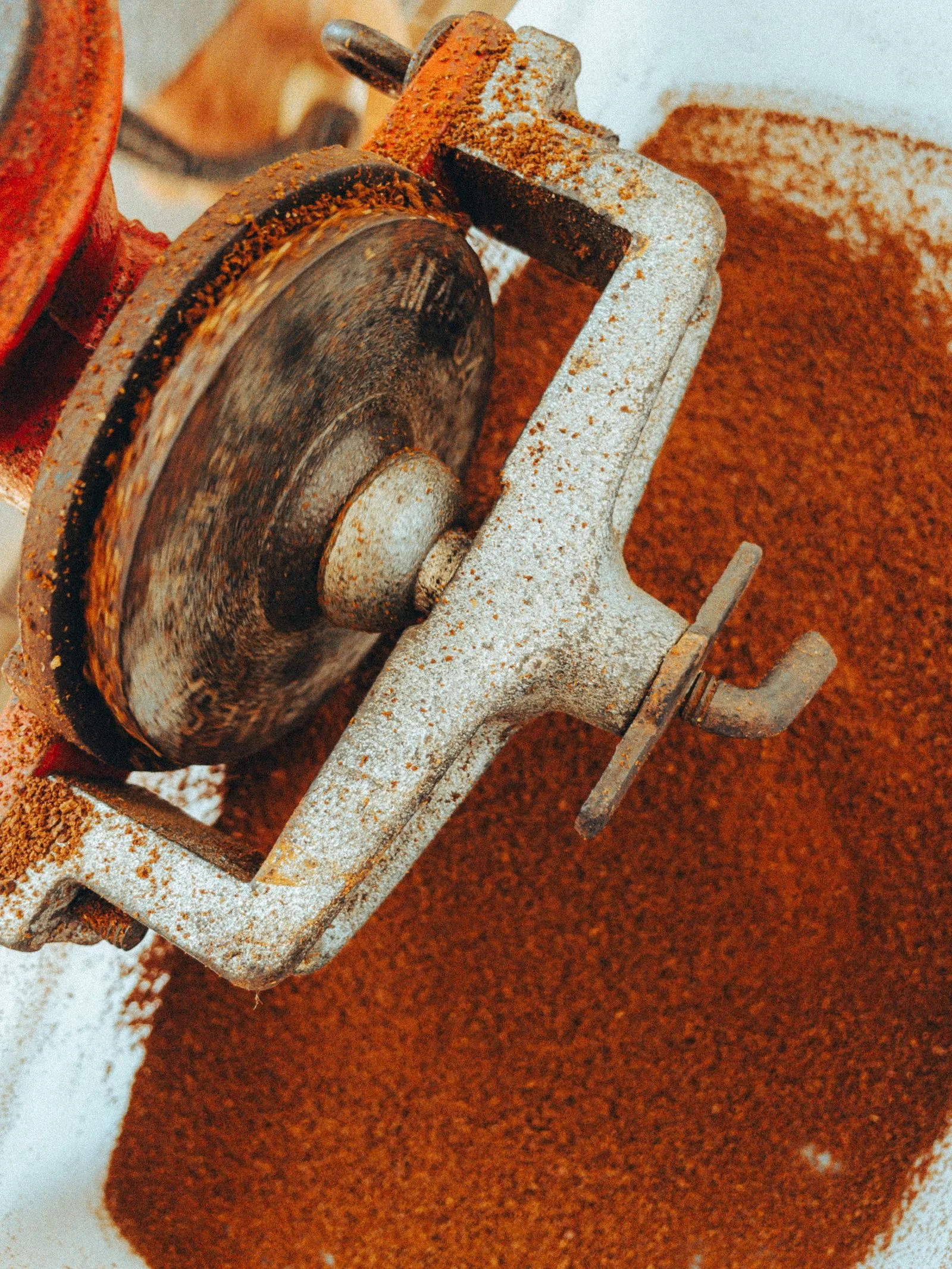
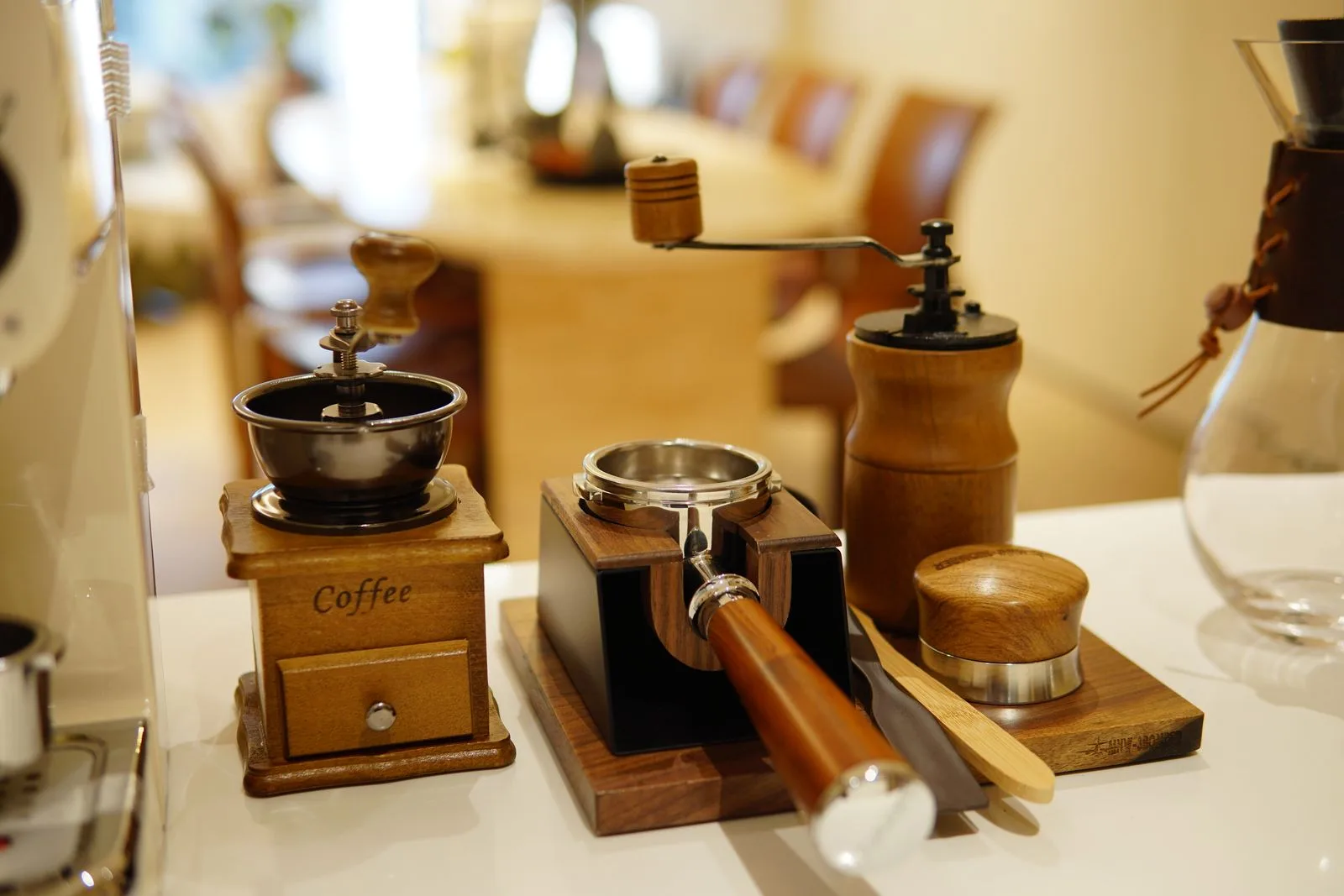
Burr grinders crush coffee between two fixed, shaped surfaces set to a consistent gap, which is what makes a repeatable target size possible at all. Blade grinders chop coffee with a spinning propeller and produce size purely as a function of how long you run the motor and how the grounds happen to tumble past the blade, which is why they cannot reliably hit any of the ranges in the table above, especially the tighter ones like espresso or moka pot. If a chart, a recipe, or a brew guide gives you a specific micron target, that number assumes a burr grinder. On a blade grinder, aim for the coarser, more forgiving end of a method’s range (French press and cold brew tolerate blade grinding far better than espresso or a V60 ever will) and expect more inconsistency between batches regardless of how carefully you time the grind.
Dialing in by taste, not by number
Once a grinder is set somewhere in the right zone for a method, the fastest way to refine it is tasting, not chasing a more precise micron figure. A cup that tastes sharp, sour, or thin, especially one where the flavour fades fast, is usually under-extracted: grind finer in small steps and keep every other variable (dose, water temperature, brew time) fixed so the change in flavour can only be attributed to grind. A cup that tastes flat, harsh, or bitter, particularly with a lingering dry or ashy finish, is usually over-extracted: grind coarser. If a cup manages to taste sour and bitter at once, that is often a sign of uneven extraction rather than a grind size problem outright, meaning some particles are under-extracting while others over-extract in the same brew, which points toward inconsistent technique (uneven pour pattern, poor agitation, an unevenly distributed espresso puck) rather than the dial itself. Adjust one variable at a time, taste, and treat every number on this page, including the ones in the table, as the starting zone for that process rather than the destination.
Common questions
Why do micron charts disagree so much on the same method? Mostly because each chart reflects a different grinder, a different sieve or laser measurement method, or a rounded average pulled from a slightly different brewing tradition. A French press ground on a high-end conical burr grinder and one ground on a basic blade grinder can both be called “French press grind” while sitting at genuinely different points on the micron scale.
Can I use one micron number across every grinder I own? No. Treat a micron figure as a description of the coffee you want to end up with, then find the dial position on each specific grinder that gets you there by tasting, since the dial numbers themselves carry no shared meaning between brands or even between two units of the same model.
Does a more expensive grinder guarantee a tighter particle size distribution? Not automatically. Published particle size distribution research on 24 espresso grinders found cost was not a clean predictor of distribution quality on its own; burr geometry, alignment, and how the grinder was dialed in mattered more than price alone.
What is the single most useful thing to know from a chart like this? Relative position matters more than the exact micron number. Knowing that a Chemex grind should feel distinctly coarser than a V60 grind, and that a moka pot grind should feel finer than a French press grind, will get you further than memorising any one figure to the nearest ten microns.
For dialing in caffeine alongside grind, the caffeine calculator covers dose and strength the way this page covers texture. For the brewing side of each method in the table, the brew guides break down ratios and timing method by method, including espresso, pour-over, Chemex and V60 pours, cold brew, French press, AeroPress, and moka pot. If your grind is already close to the numbers above and the cup still isn’t right, the troubleshooting pieces go deeper on individual symptoms: a stalled, slow-draining pour-over, a muddy French press, bitter moka pot coffee, and cold brew that tastes woody or sour.
Sources & data
- Royal Coffee: Grinder Alignment, An Evaluation of Consistency, Cupping Settings, and the Impact of Roast Degree
- Coffee ad Astra: What I Learned From Analyzing 300 Particle Size Distributions for 24 Espresso Grinders
- I'm Not a Barista: Coffee Grind Size Chart
- JayArr Coffee: Coffee Grind Size, Micron Chart with Grinder Settings
- Honest Coffee Guide: Coffee Grind Size Chart
- Coffee & Tea Culture: Best Grind Size for a Percolator
- Headcount Coffee: Blade vs Burr Grinders and Their Impact on Extraction