Search “coffee and depression” and you will find two kinds of pages. One says coffee protects your mood. The other says caffeine feeds low mood and anxiety. The published research is more careful than either headline, and a little less exciting. Large observational studies do find that people who drink more coffee are less likely to be diagnosed with depression. They also come with limits that matter, and none of them shows that coffee treats or prevents the condition.
This page goes through the three pieces of research most often cited: a 10-year study of 50,739 women published in 2011, and two meta-analyses from 2016. It then covers what the NHS says about depression itself. It is an explainer about published research, not medical advice. If low mood is persistent, it is worth seeing a GP, and nothing on this page replaces that conversation.
The short version
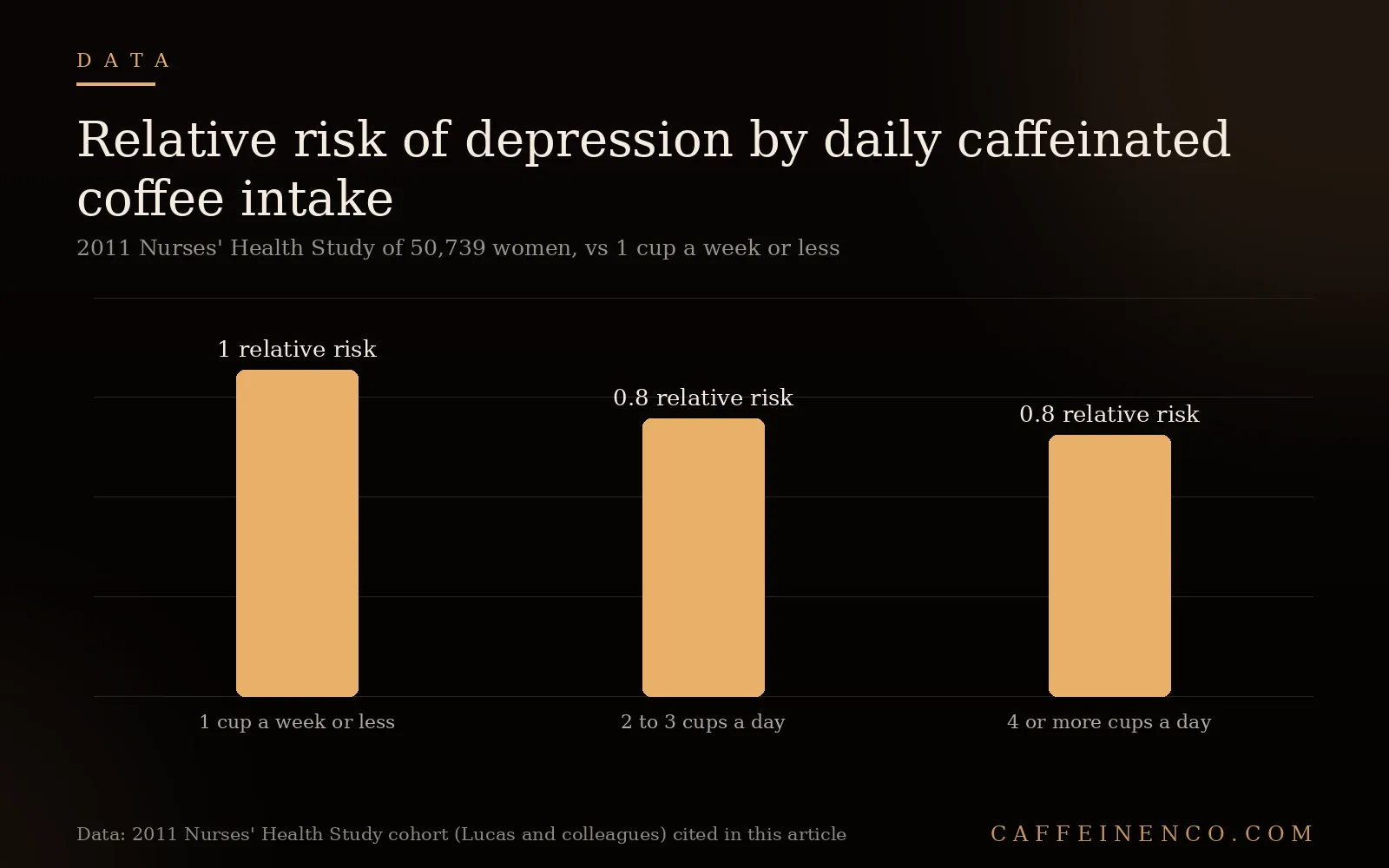
- In a 10-year study of 50,739 US nurses with no depression at the start, women drinking 4 or more cups of caffeinated coffee a day had a relative risk of depression of 0.80 compared with those drinking a cup or less per week.
- Decaffeinated coffee showed no significant association with depression in that study.
- A 2016 meta-analysis of seven studies and 330,677 participants found a pooled relative risk of 0.757 for the highest coffee group versus the lowest, with risk falling 8% per cup per day in a linear dose-response model.
- A second 2016 meta-analysis of 12 studies and 346,913 people found a similar pooled relative risk of 0.76, but a J-shaped curve with the strongest effect at about 400 mL of coffee a day.
- All of this is observational. The authors themselves warn that it cannot prove cause and effect, and that people who are already low in mood may cut back on coffee, which would produce the same pattern in reverse.
What depression is, briefly
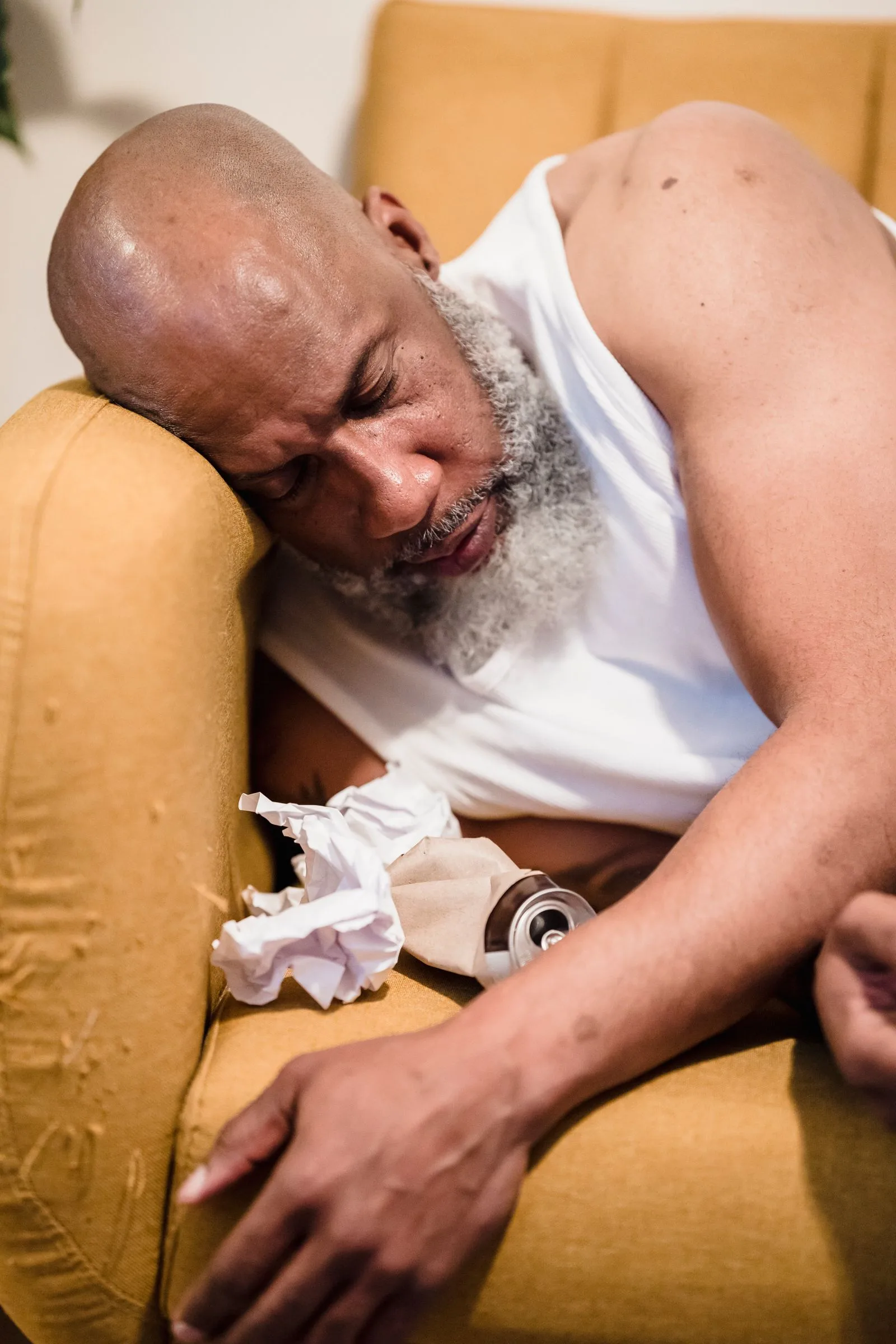
The NHS describes depression as more than feeling unhappy or fed up for a few days. It is a low mood that lasts for weeks or months and affects daily life. The symptoms it lists range from persistent sadness and hopelessness to losing interest in things you used to enjoy, and can include physical signs such as constant tiredness, poor sleep, changes in appetite, and aches and pains.
On treatment, the NHS says it usually involves a combination of lifestyle changes, talking therapies such as cognitive behavioural therapy, and medicines, with the mix depending on severity. Mild depression may be handled with watchful waiting and self-help; moderate to severe depression often combines talking therapy with antidepressants. The NHS overview does not mention coffee or caffeine at all, which tells you where the research sits: interesting, but not yet part of any treatment guidance.
If you are in crisis or having thoughts of harming yourself, contact your local emergency number or a crisis line rather than reading further. Coffee is not relevant to that situation.
The 2011 study of 50,739 women
The study most often quoted was led by Michel Lucas and colleagues at the Harvard T.H. Chan School of Public Health and published in Archives of Internal Medicine in 2011. It used the Nurses’ Health Study, a long-running cohort. The women were on average 63 years old and free of depression in 1996. They were followed for 10 years, during which 2,607 new cases of depression were identified among 50,739 women.
The coffee numbers
Relative risks below are for caffeinated coffee compared with women who drank one cup a week or less.
| Caffeinated coffee | Relative risk of depression |
|---|---|
| 1 cup a week or less | 1.00 (baseline) |
| 2 to 3 cups a day | 0.85 |
| 4 or more cups a day | 0.80 |
The lower risk appears at higher intakes and tops out at about a 20% lower relative risk for four or more cups a day. This is a modest association rather than a dramatic one.
The caffeine and decaf numbers
The researchers also grouped women by total caffeine intake from all sources. Women in the top group, 550 mg a day or more, had a relative risk of 0.80 against women in the bottom group at under 100 mg a day.
For decaffeinated coffee, the paper reports no significant association with depression. Harvard’s news release also noted that tea, soft drinks and chocolate showed no protective link. That pattern is why the authors suggested caffeine might play a role. It is a hypothesis; a cohort study cannot test a mechanism. Our decaf coffee caffeine content guide explains how much caffeine decaf still carries, which is small but not zero.
What the authors cautioned
The paper lists its own limits: the design is observational and so cannot establish causation, reverse causation is possible because depressed people might drink less coffee, depression can be under-diagnosed and under-treated, and diet questionnaires contain measurement error. The senior author, Alberto Ascherio, was quoted by Harvard as saying more research is needed before they could recommend that women drink more coffee.
It is also a cohort of older female nurses in the US. It says nothing direct about men, young adults or other countries.
The two 2016 meta-analyses
A meta-analysis pools the results of several studies. Two were published in 2016 and reached similar headline numbers by slightly different routes.
Wang and colleagues, 2016
Wang, Shen, Wu and Zhang pooled observational studies. For coffee they pooled seven studies covering 330,677 participants, and for caffeine eight studies covering 38,223 participants.
| Analysis | Pooled relative risk (95% CI), highest vs lowest intake |
|---|---|
| Coffee and depression | 0.757 (0.624 to 0.917) |
| Caffeine and depression | 0.721 (0.522 to 0.997) |
Their dose-response model for coffee was linear: risk of depression fell by 8% (relative risk 0.92, 95% CI 0.87 to 0.97) for each additional cup per day. For caffeine the relationship was nonlinear, with protective effects appearing when intake was above 68 mg a day and below 509 mg a day.
Grosso and colleagues, 2016
Grosso, Micek, Castellano, Pajak and Galvano ran a separate systematic review, pooling 12 studies and 23 datasets covering 346,913 individuals and 8,146 cases of depression. The pooled relative risk for coffee, higher versus lower intake, was 0.76 (95% CI 0.64 to 0.91), almost identical to Wang’s.
Where they differ is the shape of the curve. Grosso’s dose-response analysis suggested a nonlinear, J-shaped relationship with the peak protective effect at about 400 mL of coffee a day. The tea result was borderline and not significant, and for caffeine the significant results came only from the prospective studies.
Two groups reading overlapping evidence and getting a straight line in one case and a J-curve in the other is itself a useful reminder. The dose-response shape is not settled.
A worked example: turning “8% per cup” into something concrete
The linear model gives an easy calculation, but it comes with a warning that you are extrapolating beyond what any one study measured.
Step 1: take the per-cup ratio. Wang’s pooled estimate is a relative risk of 0.92 for each extra cup a day.
Step 2: compound it. For three cups a day, 0.92 x 0.92 x 0.92 is about 0.78. That is our own arithmetic on their model, not a number they reported for three cups, but it lands close to the pooled highest-versus-lowest figure of 0.757.
Step 3: add a baseline. Suppose, hypothetically, that 5 in 100 people in a low-coffee group are diagnosed with depression over a decade. A relative risk of 0.78 would mean about 3.9 in 100, a difference of roughly 1 person per 100. The relative reduction sounds large, and the absolute difference is much smaller.
Step 4: remember what it is not. These are comparisons between groups of people who chose their own habits. They do not predict what would happen to you if you added three cups to your day.
Why this does not mean you should drink coffee for your mood
There are good reasons for caution before turning these findings into a routine.
- Association is not causation. People with depression often sleep badly, lose appetite and withdraw socially, and may drink less coffee as a result. That reverse pattern alone could produce a lower depression rate among heavy drinkers. The 2011 authors raise it themselves.
- The effect is modest and sits on a wide range of uncertainty. The Wang interval runs from 0.62 to 0.92 and the Grosso interval from 0.64 to 0.91.
- The studies are mostly of ordinary drinkers. Neither review tested coffee as a treatment in people who have depression.
- Caffeine has costs for some people. Sleep, anxiety and heart rhythm are all common reasons people cut back. Our coffee and sleep and coffee and anxiety guides cover the downside, and poor sleep is itself a symptom the NHS lists for depression.
- Stopping can feel like low mood. If you already drink a lot and cut back suddenly, the withdrawal period can include low mood and irritability. See our caffeine withdrawal symptoms timeline before making a big change.
What to do with this if you are depressed or worried about it

Treat the research as background, not a plan. If you already drink coffee and it suits you, these studies give no reason to quit on mood grounds. If you do not drink coffee, they give no reason to start.
If you think you may be depressed, the NHS advice is to see a GP, because the sooner you do, the sooner treatment can begin. If you take antidepressants or other medication, ask your doctor or pharmacist about caffeine in your own case. Our coffee and ADHD guide takes the same approach to another condition where people ask whether coffee helps or hurts: read the evidence, then check with the person treating you.
Practical takeaways
- Do not use coffee as a treatment. No trial in the sources we reviewed tested coffee for depression.
- Know the numbers. Pooled relative risks are about 0.76 for higher versus lower coffee intake in both 2016 meta-analyses, and 0.80 for 4 or more cups in the 2011 women’s study.
- Know the shape is disputed. One review found a straight line (8% per cup), the other a J-curve peaking near 400 mL a day.
- Do not assume caffeine is the whole story, or none of it. The 2011 study found a link for caffeinated and not decaf coffee, while Grosso found caffeine significant only in prospective studies.
- Watch for reverse causation. Low mood can lead to drinking less coffee.
- Get symptoms checked. Low mood that persists is a reason to see a GP.
Common mistakes
Reading “20% lower” as a 20-point drop. It is a relative reduction on a baseline that is small to begin with.
Treating the 2011 study as proof for everyone. It followed older US nurses, all women.
Assuming more is always better. Grosso’s J-shaped result peaked near 400 mL a day, and the 2011 study’s caffeine data came with a baseline of under 100 mg for the comparison group.
Ignoring sleep. A cup that costs you a night’s sleep may do more harm to your mood than the association gains.
Quitting or starting medication-related changes on your own. Talk to your GP first.
Common questions
Does coffee cause depression? The large studies we reviewed point the other way: higher coffee intake was associated with a lower risk of a depression diagnosis. That is not proof of protection, and caffeine can worsen sleep and anxiety for some people.
Does coffee help with depression? Not as a treatment, as far as the sources we reviewed show. They are observational studies of risk in people who were not depressed at the start, not trials in people receiving care.
How many cups of coffee a day were linked to lower depression risk? In the 2011 study, relative risk was 0.85 at 2 to 3 cups a day and 0.80 at 4 or more, against women drinking one cup a week or less. One 2016 meta-analysis found 8% lower risk per cup, and the other found the strongest effect near 400 mL a day.
Does decaf coffee help with depression? In the 2011 women’s study, decaffeinated coffee showed no significant association. That is one cohort, so it is a signal, not a rule.
Is black coffee better than coffee with milk and sugar for depression? None of the studies we reviewed compared black coffee with sweetened or milky coffee, so we cannot say.
Should I stop coffee if I feel depressed? The NHS depression overview does not tell people to stop coffee. If caffeine is wrecking your sleep or making you anxious, it is reasonable to discuss cutting back with your GP, and to do so gradually.
Does this apply to men? The 2011 study was women only. The meta-analyses pooled mixed populations, but we did not review sex-specific results, so be careful about applying the numbers to yourself.
Sources & data
- Lucas M, Mirzaei F, Pan A, et al.: Coffee, caffeine, and risk of depression among women (Archives of Internal Medicine, 2011; 171(17):1571-1578)
- Wang L, Shen X, Wu Y, Zhang D: Coffee and caffeine consumption and depression, a meta-analysis of observational studies (Australian and New Zealand Journal of Psychiatry, 2016; PubMed 26339067)
- Grosso G, Micek A, Castellano S, Pajak A, Galvano F: Coffee, tea, caffeine and risk of depression, a systematic review and dose-response meta-analysis of observational studies (Molecular Nutrition & Food Research, 2016; 60(1):223-234)
- Harvard T.H. Chan School of Public Health: news release on coffee and depression in women
- NHS: Depression in adults (overview, symptoms and treatment)