
Few coffee questions come with as much personal stake as this one. People with ADHD, and parents of kids with ADHD, regularly report that a cup of coffee seems to calm the noise rather than amplify it. It is an appealing idea: ADHD is treated with stimulant medication, caffeine is a stimulant, so surely a mug of the cheap, legal one must do something similar.
The research is more cautious than the anecdotes. The best human evidence we could find is a 2023 systematic review of randomized trials in children, and it did not find that caffeine beat placebo. The more encouraging findings come from animal studies, which are a long way from a verdict on your morning flat white. This page walks through exactly what each body of evidence measured, what it can and cannot tell you, and how to think about caffeine if you have ADHD. It is an explainer, not medical advice, and it is not a reason to change or skip prescribed treatment.
The short version
- A 2023 systematic review and meta-analysis found seven randomized trials of caffeine versus placebo in children aged 5 to 15, covering 104 patients in total.
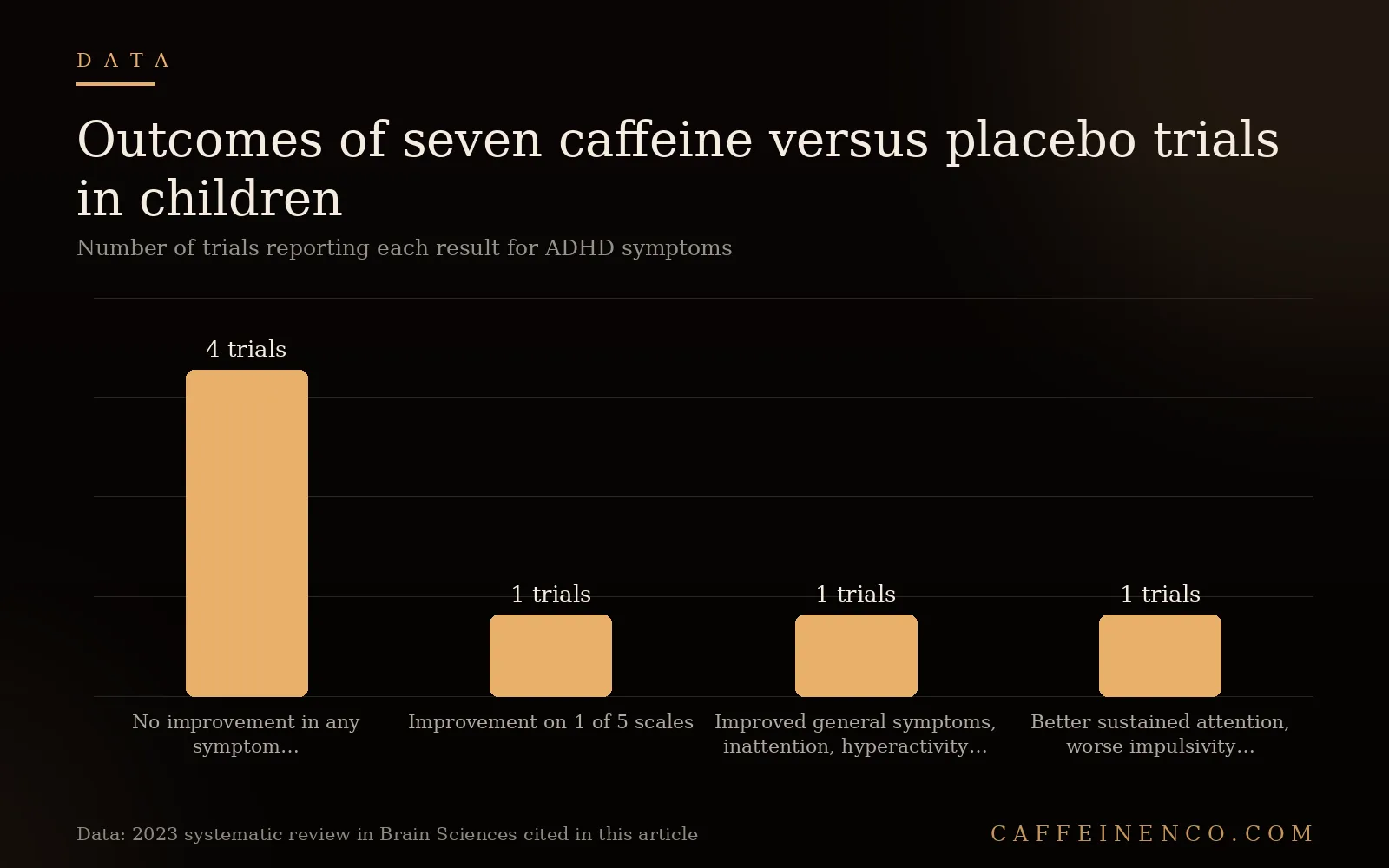
- Four of those seven trials reported no improvement in any ADHD symptom. Pooled across the four trials that could be combined (76 children), the standardized mean difference for general ADHD symptoms was -0.12 with a 95 percent confidence interval of -0.44 to 0.20. That is statistically no difference from placebo.
- The review’s own conclusion: overall, the evidence suggests no significant benefit of caffeine over placebo in children with ADHD.
- A 2022 systematic review of animal studies found caffeine improved attention, learning and memory, but its effect on hyperactivity and impulsivity was contradictory.
- We found no randomized trial evidence on adults in the sources checked for this page, so nothing here answers “does my coffee help my adult ADHD.”
- Caffeine is not a substitute for ADHD treatment, and if you take stimulant medication, how much caffeine you add is a conversation for your prescriber.
Why the idea is plausible in the first place

The reason people expect caffeine to help is not silly. The 2022 animal review describes ADHD as involving irregularities mainly in dopamine and norepinephrine circuits within the prefrontal cortex, the front part of the brain involved in planning and attention. The same paper notes that ADHD medication carries controversial side effects, which is part of why researchers have looked for alternative or complementary approaches.
Caffeine works through a different route from prescription stimulants. It blocks adenosine receptors, the system that builds up “sleep pressure” over the day, rather than acting directly on dopamine and norepinephrine release. That difference matters. Two things can both feel “alerting” and still be pharmacologically unrelated, and the fact that a substance makes you feel awake says little about whether it fixes the specific attention difficulties of ADHD. Feeling awake and being able to sustain focus on a dull task are not the same thing.
That is the gap the trials try to close. They give caffeine or a placebo to people with ADHD and then measure symptoms on rating scales or attention tasks.
What the human trials found
The key paper is “Effects of Caffeine on Main Symptoms in Children with ADHD: A Systematic Review and Meta-Analysis of Randomized Trials,” published in Brain Sciences in 2023. The authors searched PubMed, Embase and the Cochrane database for randomized controlled trials comparing caffeine with placebo in children, looking at overall ADHD symptoms, inattention, hyperactivity and impulsivity.
Here is how the seven trials broke down, according to the abstract:
| Outcome across trials | Number of trials |
|---|---|
| No improvement in any ADHD symptom versus placebo | 4 |
| Improvement on 1 of 5 scales applied | 1 |
| Significant improvement in general symptoms, inattention and hyperactivity | 1 |
| Improvement in sustained attention but a worsening of impulsivity | 1 |
Four studies, with 76 children between them, were similar enough to pool. For overall ADHD symptoms the pooled result was a standardized mean difference of -0.12 (95 percent confidence interval -0.44 to 0.20, p = 0.45, I-squared 0 percent). The abstract’s conclusion is plain: the totality of the evidence suggests no significant benefit of caffeine over placebo.
How to read that result
A few things are worth keeping in mind, because a flat “no effect” headline can overstate or understate what this tells you.
The sample is small. 104 children across seven trials, and only 76 in the pooled analysis, is not a lot. The confidence interval runs from -0.44 to 0.20, so it is consistent with a modest benefit, no benefit, or a small harm. “No significant benefit” is not the same as “proven useless.” It means these trials could not detect one.
The trials disagree with each other. One reported a broad improvement. One reported better sustained attention but worse impulsivity. Four reported nothing. When individual studies point different directions and the pooled number sits near zero, the honest reading is “no reliable signal,” not “it works for some kids.”
These are children. The age range was 5 to 15. We cannot translate the result to an adult with ADHD who drinks two coffees before a work meeting. Adults metabolise caffeine differently from children, drink it in different amounts, and are measured with different tools.
We do not have the details we would like. Dose and formulation matter in any caffeine trial: a capsule of a set milligram amount is not a flat white. The abstract does not report them, and this page does not guess.
What the animal studies add
The 2022 paper in Nutrients is a PRISMA-style systematic review of publications up to 1 September 2021, covering caffeine in animal models of ADHD. Its abstract reports that caffeine treatment increased attention and improved learning, memory and olfactory discrimination, without altering blood pressure and body weight, and that these results were supported at the neuronal and molecular level.
Two cautions come straight from the same abstract. First, the role of caffeine in hyperactivity and impulsivity was described as contradictory, “raising discrepancies that require further clarification.” Second, the authors framed their results as strengthening a hypothesis, that the cognitive effects seen in animals might translate to human ADHD, particularly during adolescence. A hypothesis is not a finding. A researcher quoted in coverage of the paper by Technology Networks put the practical point this way: if hyperactivity or impulsivity symptoms are present, we must be more cautious, and caffeine looks more suited to purely attentional problems than to ADHD as a whole.
Put the two bodies of evidence side by side and you get a coherent, if unsatisfying, picture. Animal models show a signal on attention. The children’s trials, which are the ones that matter for people, have not shown that signal reliably. Both agree that impulsivity and hyperactivity are the weak spots.
Why coffee can feel like it helps even when trials say it does not

The sample of 104 children says nothing about how you feel after a cup. A few ordinary explanations can account for the common experience of “coffee helps my focus” without caffeine treating ADHD at all.
- Fixing withdrawal. If you drink coffee daily, your first cup partly reverses the mild fog of overnight caffeine withdrawal. That feels like a boost but is closer to returning to baseline. Our caffeine withdrawal timeline lays out how quickly those symptoms begin.
- Ritual and structure. A routine that starts the workday, with a warm drink and a set time, can help anyone settle into a task. That is the routine working, not the caffeine.
- General alertness. Plenty of people without ADHD feel sharper on caffeine. Alertness helps with boring tasks whatever the underlying cause of distraction.
- Expectation. Expecting a drink to help can change how you rate your own focus, which is why trials compare caffeine against a placebo.
None of this means your experience is imaginary. It means a good morning on coffee is not, by itself, evidence that caffeine is treating the condition.
Caffeine, ADHD medication and sleep
If you take prescription stimulant medication, this is the part that matters most in practice. We could not verify a primary source for the size of any interaction between caffeine and a specific ADHD drug while researching this page, so we are not going to quote a figure.
What can be said from the sources we did check:
- MedlinePlus lists “difficulty falling asleep or staying asleep” among side effects of methylphenidate.
- Caffeine also disturbs sleep for many people when taken late in the day.
Two substances that each can interfere with sleep are a reasonable thing to ask a prescriber about. It is a sensible question to take to an appointment: “How much coffee is okay with my medication, and what time should I stop?” Our coffee and anxiety guide covers the dose-response research on jitters and nervousness, which is the other side effect people on stimulants often want to keep an eye on.
A worked example: counting your actual caffeine
Whatever the research says, you can only make an informed choice if you know how much you are actually taking. Estimates vary a lot, and cafe drinks can differ widely from home brews. The caffeine in an espresso shot guide shows that cafe-measured shots ranged from 51 mg to 322 mg in one 20-cafe survey, a six-fold spread.
Here is a simple way to run your own audit for a week.
- List every caffeinated item for three ordinary days. Include coffee, tea, energy drinks, cola, pre-workout and caffeinated medication. Note the time of each.
- Look up each one. Use a chain’s published figure where there is one, and treat home-brewed coffee as a rough range, not a precise number.
- Add up the daily total and note the time of the last caffeine. Write down the hour, not just the amount.
- Rate your focus and your sleep each evening. A one-to-five score is fine. You are looking for patterns, such as “focus is worse on days with four cups” or “sleep is worse when the last cup is after 2 pm.”
- Change one thing for a week. Move the last cup earlier, or drop one cup, and compare. Changing several things at once tells you nothing.
This is a personal experiment, not a diagnosis, but it turns a vague hunch into data. If you decide to share it with a doctor, a three-day log is more useful than a general impression.
Decaf is not a separate answer
None of the sources we checked tested decaf in ADHD, so this page cannot say whether decaf has any effect on symptoms. If you want to know how much caffeine decaf still carries, our decaf coffee caffeine content guide covers that.
Practical takeaways
For adults and parents weighing this up, the evidence supports a modest stance.
- Do not treat coffee as ADHD treatment. The best randomized evidence in children found no significant benefit over placebo, and the confidence interval was wide.
- Do not feel guilty for liking it either. Nothing in these sources shows that a moderate cup is harmful in ADHD. They simply do not show that it helps the condition.
- Watch sleep first. Poor sleep makes attention worse for almost everyone, and stimulant medication plus late caffeine is the combination most likely to push sleep the wrong way.
- Be cautious with children. The trials involved children under study conditions, and nothing here is guidance for giving caffeine to a child. A paediatrician decides that.
- Tell your prescriber how much you drink. It is the easiest piece of information to leave out and one of the most useful to have.
Common questions
Does coffee help ADHD? The best human evidence we found, a 2023 meta-analysis of seven randomized trials in 104 children, found no significant benefit of caffeine over placebo. Some individual trials reported improvements, but they disagreed with each other.
Why does coffee seem to calm some people with ADHD? The trials do not explain it, and we found no source that does. Plausible everyday explanations include relief from caffeine withdrawal, the routine of a morning cup, and general alertness, but these are possibilities, not findings from the studies cited here.
Is caffeine like ADHD medication? Not in how it works. Caffeine blocks adenosine receptors, whereas ADHD is described in the animal review as involving dopamine and norepinephrine circuits in the prefrontal cortex. Similar feelings of alertness do not mean the same mechanism or the same benefit.
Did the animal studies show caffeine helps ADHD? They showed improved attention, learning and memory in animal models, but the effects on hyperactivity and impulsivity were contradictory. The authors describe their results as supporting a hypothesis that needs testing in people.
Can I drink coffee while taking ADHD medication? That depends on the medication, your dose and your sleep, and we could not verify a source for a specific interaction. Ask your prescriber how much caffeine is reasonable and when to stop for the day. MedlinePlus lists trouble falling or staying asleep as a methylphenidate side effect, which is one reason timing matters.
Is there any research on adults? We did not find randomized trial evidence in adults in the sources used for this page, so we make no claim about it.
Should I give my child coffee for ADHD? No source here supports that. The child trials were run under study conditions, and the combined result showed no significant benefit. Talk to your child’s paediatrician before changing anything.
Does stopping coffee make ADHD worse? Nothing we checked tests that. Quitting daily caffeine can cause temporary withdrawal symptoms, covered in our caffeine withdrawal timeline, which can be confused with a change in focus. Our coffee and cortisol guide covers another part of how caffeine affects the body’s stress response.
Sources & data
- Effects of Caffeine on Main Symptoms in Children with ADHD: A Systematic Review and Meta-Analysis of Randomized Trials (Brain Sciences, 2023; PubMed 37759905)
- Effects of Caffeine Consumption on Attention Deficit Hyperactivity Disorder (ADHD) Treatment: A Systematic Review of Animal Studies (Nutrients, 2022; PubMed 35215389)
- Technology Networks: Could Caffeine Help To Alleviate Some Symptoms of ADHD? (coverage of the 2022 animal review)
- MedlinePlus: Methylphenidate