
For decades the standard advice for anyone with a fluttery chest was “cut the coffee.” It sounds so obviously right that it rarely got questioned. Then researchers started testing it, and the results were not what the advice predicted. In a randomised trial published in late 2025, people with atrial fibrillation who were told to keep drinking coffee relapsed less often than people told to give it up.
That does not mean coffee is a heart medicine, and it does not mean your own palpitations are imaginary. This page walks through what the best available studies actually measured: the trial, two large UK cohorts, a meta-analysis of more than a million people, and the cautious advice from the British Heart Foundation. It is an explainer about published research, not medical advice, and it cannot tell you whether a symptom you have is safe.
Two neighbouring pages cover related ground. Our coffee and blood pressure guide explains the short-term pressure spike a cup can cause, and our coffee and cholesterol guide explains the brewing-method catch that matters for your arteries. This one stays with rhythm, heart rate and overall heart disease risk.
The short version
- In the DECAF trial (200 adults with persistent atrial fibrillation or flutter, mean age 69, scheduled for cardioversion), 47 percent of the coffee group had a recurrence over six months versus 64 percent of the abstinence group. Hazard ratio 0.61, 95 percent confidence interval 0.42 to 0.89.
- In a UK Biobank analysis of 386,258 people, each additional daily cup was associated with a 3 percent lower risk of incident arrhythmia (hazard ratio 0.97, interval 0.96 to 0.98).
- A 2014 meta-analysis of 36 studies and 1,279,804 participants found the lowest cardiovascular risk at about 3 to 5 cups a day (relative risk 0.85 at 3.5 cups) and no raised risk at heavy intake.
- A 2022 analysis of 449,563 UK Biobank participants found ground and instant coffee, but not decaf, was linked to lower arrhythmia risk, while all three coffee types were linked to lower cardiovascular disease.
- The British Heart Foundation says up to 400 mg of caffeine a day, around 4 to 5 cups of tea or coffee, is generally considered safe for most adults, and that sensitive people who get palpitations may want to cut down or switch to decaf.
- Almost all of this is observational, apart from one open-label trial. Association is not proof, and individual sensitivity varies widely.
Why “coffee is bad for the heart” stuck around
The belief has a real basis. Caffeine is a stimulant. It blocks adenosine receptors, and in the short term it can nudge your pulse and your blood pressure up. Anyone who has felt their heart thump after a strong espresso on an empty stomach has direct evidence of that, and it is a common reason people say coffee “gives” them palpitations.
The step that studies challenged is the jump from “a cup can make my heart feel different” to “regular coffee damages my heart or causes dangerous rhythm problems.” A feeling and a disease outcome are different measurements. The research below is mostly about the second one: what happens to groups of people over months and years, not what one person notices in the hour after a cup.
The DECAF trial: the first randomised test
Most coffee and health research is observational, which means people who drink coffee are compared with people who do not, and the two groups differ in many other ways. A randomised trial is the cleaner design, and the DECAF trial is the first of its kind for atrial fibrillation (AF) that we found.
What the trial did
The trial, published in JAMA in November 2025, enrolled 200 adults from five hospitals in the United States, Canada and Australia. All were current or recent coffee drinkers with persistent AF, or atrial flutter with a history of AF, and all were planned for an electrical cardioversion, the procedure that resets the rhythm. Mean age was 69, and 71 percent were men.
After the procedure, patients were randomised one to one. One group was encouraged to drink at least one cup of caffeinated coffee a day. The other was asked to abstain from coffee and caffeinated products. Both were followed for six months.
What it found
| Group | Participants | Recurrence of AF or flutter |
|---|---|---|
| Caffeinated coffee (averaging about 1 cup a day) | 100 | 47 percent |
| Coffee and caffeine abstinence | 100 | 64 percent |
The hazard ratio was 0.61 (95 percent interval 0.42 to 0.89, P = 0.01), a 39 percent lower hazard of recurrence in the coffee group. The authors’ conclusion was cautious: allocation to caffeinated coffee averaging one cup a day was associated with less recurrence than abstinence.
How to read it
Three limits keep this from being a green light for everyone.
First, it was open-label. Patients knew which group they were in, which can influence behaviour and how symptoms are reported. Second, the people enrolled were mostly older men who already drank coffee, so it says little about younger people, women, or people who do not drink coffee. Third, the coffee group averaged about one cup a day. The trial did not test five cups, and it tells you nothing about energy drinks or high-dose caffeine products.
What the result does do is remove the assumption that quitting coffee is automatically protective for someone with AF. If you have AF, whether to drink coffee is a question for the cardiologist who knows your case. We would not use this trial to override that advice in either direction.
The big UK cohorts: palpitations versus actual arrhythmias
The 2021 JAMA Internal Medicine study
Kim and colleagues used the UK Biobank. They analysed 386,258 people (mean age 56, 52.3 percent women) with no prior arrhythmia exclusions applied, followed for a mean of 4.5 years. In that time 16,979 developed an incident arrhythmia.
Each additional cup of habitual coffee a day was associated with a 3 percent lower risk of incident arrhythmia overall (hazard ratio 0.97). Atrial fibrillation or flutter showed the same 3 percent reduction, and supraventricular tachycardia a 4 percent reduction (hazard ratio 0.96, interval 0.94 to 0.99).
The study also used Mendelian randomization, which uses genes that affect how fast people metabolise caffeine as a natural experiment. That analysis found no evidence supporting a causal link between caffeine and arrhythmias. The authors concluded that common prohibitions against caffeine to reduce arrhythmia risk are likely unwarranted. They also acknowledged that only a randomised trial could show clear effects of coffee, which is precisely the gap the DECAF trial later started to fill.
The 2022 coffee-subtypes analysis
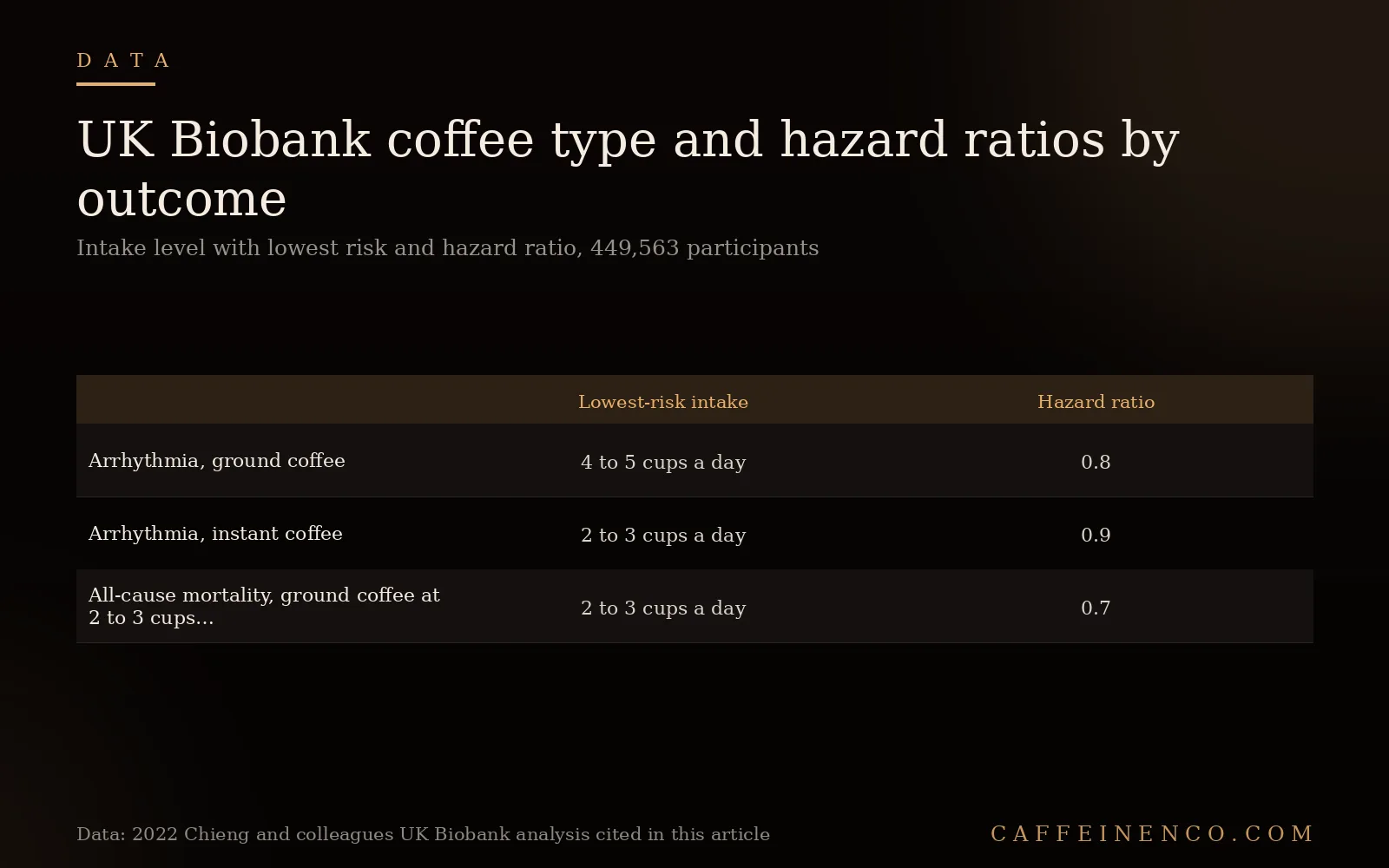
Chieng and colleagues, in the European Journal of Preventive Cardiology, followed 449,563 UK Biobank participants (median age 58, 55.3 percent women) for about 12.5 years. They split coffee into decaffeinated, ground and instant, and into categories from none to more than five cups a day.
| Outcome | Finding |
|---|---|
| Arrhythmia, ground coffee | Lowest risk at 4 to 5 cups a day (hazard ratio 0.83, interval 0.76 to 0.91) |
| Arrhythmia, instant coffee | Lowest risk at 2 to 3 cups a day (hazard ratio 0.88, interval 0.85 to 0.92) |
| Arrhythmia, decaf | No significant reduction |
| Cardiovascular disease | Reduced with all three types, lowest at 2 to 3 cups a day |
| All-cause mortality, ground coffee at 2 to 3 cups | Hazard ratio 0.73 (interval 0.69 to 0.78) |
The decaf row is the interesting one. If the arrhythmia link appears for ground and instant but not decaf, caffeine or something that travels with it may be involved, though this study cannot say so. At the same time, decaf still showed lower cardiovascular disease and mortality, so the broader heart association is not simply about caffeine. Our decaf coffee caffeine content guide explains why decaf is not caffeine-free.
Why these cohorts do not settle it
Both studies are observational. People who drink coffee may differ in diet, exercise, income and smoking. Coffee intake was self-reported at one point in time and may have changed over the follow-up. And the cohorts ran on a population that was mostly middle-aged and older, living in the UK, which is not everyone. The authors of the first study said as much, which is why it is fair to treat these as consistent signals rather than proof.
Heart disease: the dose-response curve

Ding and colleagues pooled 36 prospective cohort studies in Circulation in 2014: 1,279,804 participants and 36,352 cases of cardiovascular disease. They found a nonlinear relationship, shaped like a shallow U.
Compared with the lowest-intake category (a median of zero cups a day), the relative risk of cardiovascular disease was 0.85 (95 percent interval 0.80 to 0.90) at a median of 3.5 cups a day. At 5 or more cups the relative risk was 0.95 (interval 0.87 to 1.03), which is statistically indistinguishable from no difference. The authors summarised it as moderate intake being inversely associated with risk, the lowest risk at 3 to 5 cups a day, and heavy intake not being associated with elevated risk.
This is a pooled estimate across studies that measured coffee differently, in different countries, and often did not separate filtered from boiled coffee. That last point matters, because brewing method changes how much cholesterol-raising oil ends up in the cup. We cover it in detail on the coffee and cholesterol page, so if you drink unfiltered coffee daily and have a cholesterol concern, read that one next.
What the British Heart Foundation says
The BHF’s “ask the expert” answer on caffeine is the sort of practical position you can act on. The main points are:
- Up to 400 mg of caffeine a day, around 4 to 5 cups of tea or coffee, is generally considered safe for most adults.
- Research suggests 400 mg or less a day should not affect heart rhythm, though some people may notice palpitations from higher intake.
- Caffeine-sensitive people may notice their heart rate rise slightly. If so, it may be worth cutting down or switching to decaf.
- Pregnant people should limit intake to 200 mg a day or less.
- People with high blood pressure should talk to their doctor.
- People with AF should pay attention to their own response, because sensitivity varies widely.
The BHF also cites the DECAF result, noting that participants asked to drink at least a cup of caffeinated coffee a day for six months were less likely to have another AF episode than those asked to avoid caffeine.
A worked example: finding your own palpitation threshold
The population data say moderate coffee is not a rhythm hazard on average. Your pulse does not care about averages. Here is a simple way to find out where you personally sit. It is our suggestion for organising a self-check, not a protocol from a trial, and it is not a substitute for medical review.
Step 1: count your real caffeine. Using the 96 mg per 8-ounce filter cup figure we cite in our americano versus long black versus filter coffee comparison, a 16-ounce mug is roughly 190 mg. Two of those already come close to the 400 mg BHF line. Add tea, cola and any energy drinks. Our caffeine in an espresso shot guide shows how much shots vary.
Step 2: log for a week. Write down each caffeinated drink with the time, and any episode of racing, skipping or pounding heartbeat with the time and what you were doing. Add sleep, stress and alcohol. Palpitations at 3 pm after a night of poor sleep are not the same signal as palpitations ten minutes after an espresso on an empty stomach.
Step 3: change one variable. Hold your total steady and move the timing, or hold your timing and drop a cup. If you are cutting hard, expect headaches at first, which our caffeine withdrawal timeline explains, and do not confuse those with a heart symptom.
Step 4: look for a pattern. If episodes cluster after a certain amount, or only on days you skipped breakfast, that is a useful note to take to a doctor. If they show up regardless of coffee, coffee may not be the cause and you should have them checked.
When not to experiment at home
Chest pain, fainting, breathlessness, or palpitations with dizziness are not a coffee-diary matter. Get them assessed promptly. A first episode of palpitations is also worth a conversation with a doctor, whatever you suspect caused it.
Practical takeaways
- Moderate coffee is not an established threat to a healthy heart. The cohorts and the meta-analysis point the other way, with all the observational caveats.
- If you have AF, ask your cardiologist rather than quitting by default. The DECAF trial found fewer recurrences in people told to keep drinking a cup a day, but it was small and open-label.
- Sensitivity is personal. Palpitations after a cup are a real signal for you even if the population data are reassuring.
- Count all caffeine, not just coffee. The 400 mg figure covers tea, cola and energy drinks too.
- Mind the brew. Unfiltered methods change the cholesterol picture, as covered in our cholesterol guide.
- Blood pressure is a separate question. See our coffee and blood pressure guide for the acute spike and who should be careful.
Common mistakes
Treating an association as a prescription. A lower risk in drinkers does not mean you should start drinking coffee for your heart. These studies do not support that.
Reading the DECAF trial as “caffeine cures AF.” It compared one cup a day with total abstinence in older, mostly male patients after cardioversion. That is all it shows.
Ignoring the rest of the day’s caffeine. Pre-workout powders, energy drinks and tea add up. A sensitive heart does not distinguish the source.
Quitting abruptly and blaming the heart. Withdrawal headaches and fatigue can feel alarming, but they are a separate effect.
Assuming decaf is neutral. The 2022 UK Biobank analysis found decaf was not associated with lower arrhythmia risk, though it was still associated with lower cardiovascular disease and mortality.
Common questions
Does coffee cause heart palpitations? It can for some people. Caffeine is a stimulant, and the BHF notes that sensitive people may feel their heart rate rise slightly and may want to cut down or switch to decaf. At the population level, though, the large UK Biobank analyses did not find coffee drinkers more likely to develop arrhythmias.
Is coffee bad for atrial fibrillation? The one randomised trial we found, DECAF, found the opposite for people with persistent AF after cardioversion: 47 percent recurrence with about a cup a day versus 64 percent with abstinence. It was open-label and small, so talk to your own cardiologist.
How much coffee is too much for your heart? The BHF treats up to 400 mg of caffeine a day, around 4 to 5 cups of tea or coffee, as generally safe for most adults. The 2014 meta-analysis found no raised cardiovascular risk even at five or more cups. Your own tolerance may sit lower.
Does coffee raise your heart rate? It can raise it slightly in sensitive people, according to the BHF. We did not find a study in these sources that quantified the average rise, so we are not giving a number.
Is coffee good for your heart? Observational data link moderate intake with lower cardiovascular disease risk, with the lowest risk around 3 to 5 cups a day in the 2014 meta-analysis. That is an association, not proof of benefit, and it does not apply equally to everyone.
Is decaf better for the heart? Not necessarily. In the 2022 analysis, decaf was linked to lower cardiovascular disease and mortality but not to lower arrhythmia risk. If caffeine makes you feel palpitations, decaf is still a reasonable personal choice, as the BHF suggests.
Can coffee affect blood pressure? Yes, in the short term. That is a separate topic with its own evidence, covered in our coffee and blood pressure guide.
Should I stop coffee if I have heart disease? Ask your doctor. The BHF advises that people with high blood pressure should talk to their doctor and that people with AF should monitor how they respond. This page cannot give you an individual limit.
Sources & data
- DECAF investigators: Caffeinated Coffee Consumption or Abstinence to Reduce Atrial Fibrillation, the DECAF Randomized Clinical Trial (JAMA, published online November 2025; PubMed 41206802)
- Kim EJ et al.: Coffee Consumption and Incident Tachyarrhythmias, Reported Behavior, Mendelian Randomization, and Their Interactions (JAMA Internal Medicine, 2021; PubMed 34279564)
- Ding M et al.: Long-term coffee consumption and risk of cardiovascular disease, a systematic review and dose-response meta-analysis of prospective cohort studies (Circulation, 2014; PubMed 24201300)
- Chieng D et al.: The impact of coffee subtypes on incident cardiovascular disease, arrhythmias, and mortality, long-term outcomes from the UK Biobank (European Journal of Preventive Cardiology, 2022)
- British Heart Foundation: How much caffeine is OK? (Heart Matters, ask the expert)