Search “Japanese iced coffee ratio” and the numbers scatter in a way that looks careless until you see the pattern. One widely cited recipe collection puts a V60 version at 1:18, a Chemex version at 1:17, an AeroPress version at roughly 1:20, and in the same breath says to brew “only a 1:10 ratio of coffee to poured water.” Those are not four guides disagreeing. They are two different measurements of the same cup, the ratio counting only the hot water poured through the grounds versus the ratio counting the hot water and the ice sitting in the carafe together. This site has a dedicated ratio and grind guide for V60 pour-over, Chemex, Kalita Wave, and AeroPress brewed hot, but nothing yet on the specific technique of brewing any of those same drippers directly over ice, despite it being one of the most searched iced coffee methods there is. Here is the real ratio split, the grind, the method, and how it differs by dripper.
The ratio: two honest numbers, not a disagreement

The confusion starts because a Japanese iced coffee recipe has three ingredients, not two: coffee, hot water, and ice, and a ratio can be built from either of two of those three. Count only the hot water that actually passes through the grounds, and the ratio lands close to 1:10 across every dripper. Count the hot water and the ice together, since the ice is going to melt into the cup and become part of what you drink, and the ratio stretches out to somewhere between 1:15 and 1:20 depending on the dripper and the recipe.
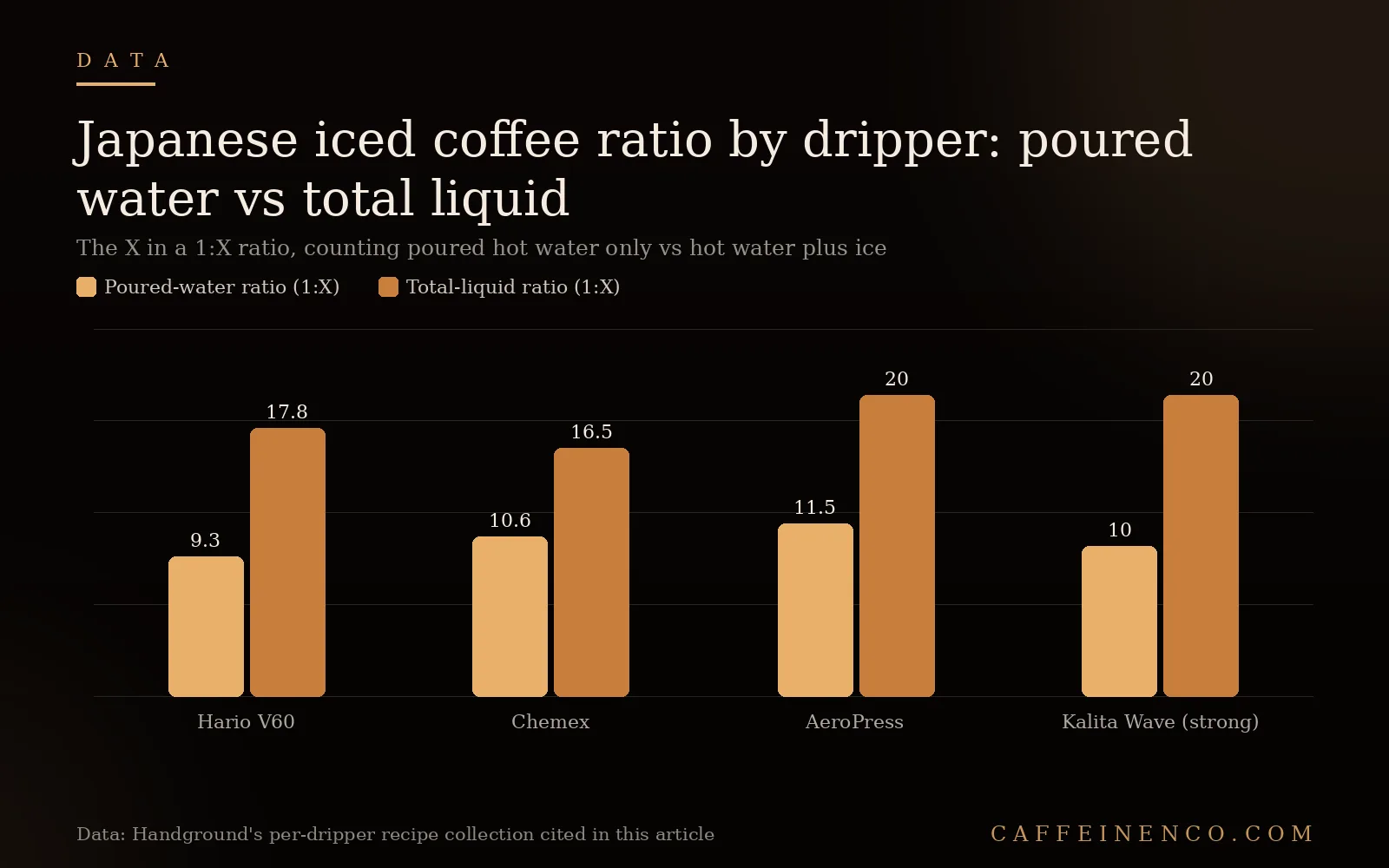
Per Handground’s own recipe collection, four dripper-specific recipes make the pattern clear when the grams are laid out side by side:
| Dripper | Coffee | Hot water poured | Ice | Poured-water ratio | Total-liquid ratio |
|---|---|---|---|---|---|
| Hario V60 | 22g | 205g | 187g | About 1:9.3 | About 1:17.8 |
| Chemex | 40g | 422g | 239g | About 1:10.6 | About 1:16.5 |
| AeroPress | 19.8g | 228g | 167g | About 1:11.5 | About 1:20 |
| Kalita Wave (strong recipe) | 25g | 250g | 250g | 1:10 | 1:20 |
The explanation for why the poured-water number runs so much tighter than the total-liquid number comes from two outside baristas featured in Handground’s recipe roundup, not from Handground’s own editorial voice. Tito Pena of The Wydown Coffee Bar puts it directly: “you are basically trying to dissolve the same amount of coffee as you would when brewing hot coffee but with only 2/3 the amount of water.” Dustin Thomas of Steadfast Coffee adds the ratio implication, in a quote originally about a Chemex specifically: “you will only brew a 1:10 ratio of coffee to poured water… because you have water in the chemex already as ice and will add more later.” The same math holds across every dripper, not just the Chemex Thomas was describing, which the per-dripper table above confirms. In other words, the hot water alone has to do the full job of extracting the coffee in roughly two-thirds the usual volume, which is why it is measured and poured at a noticeably stronger ratio than a same-size hot cup would use, before the ice dilutes it back down to a normal drinking strength.
Two other independently published recipes confirm the total-liquid side of that split sits in the same 1:15 to 1:20 neighborhood. Complete Home Barista’s recipe uses 30 grams of coffee, 240 grams of hot water, and 240 grams of ice, a 1:16 total-liquid ratio with an even 50/50 split between hot water and ice. BuzzFeed’s recipe, built around the same Japanese technique, uses 36 grams of coffee, 275 grams of hot water, and 250 grams of ice, which works out to about 1:14.6, close enough to the 1:15 figure the recipe itself states to count as agreement. Complete Home Barista’s 1:16 and BuzzFeed’s roughly 1:14.6 both run close to, though a touch stronger than, the 1:16.5-to-1:20 range Handground’s own per-dripper table produces once you count the ice, the same general total-liquid pattern even though the exact numbers do not stack perfectly on top of each other.
| If you are measuring… | Use this ratio |
|---|---|
| Only the hot water poured through the grounds | About 1:10 |
| Hot water and ice together (what actually ends up in the cup) | 1:15 to 1:20, dripper dependent |
Start at 1:10 for the water you pour, and let the ice you have already placed in the carafe handle the rest of the dilution. That single rule reconciles every number in this section.
The grind: finer than the same dripper brewed hot
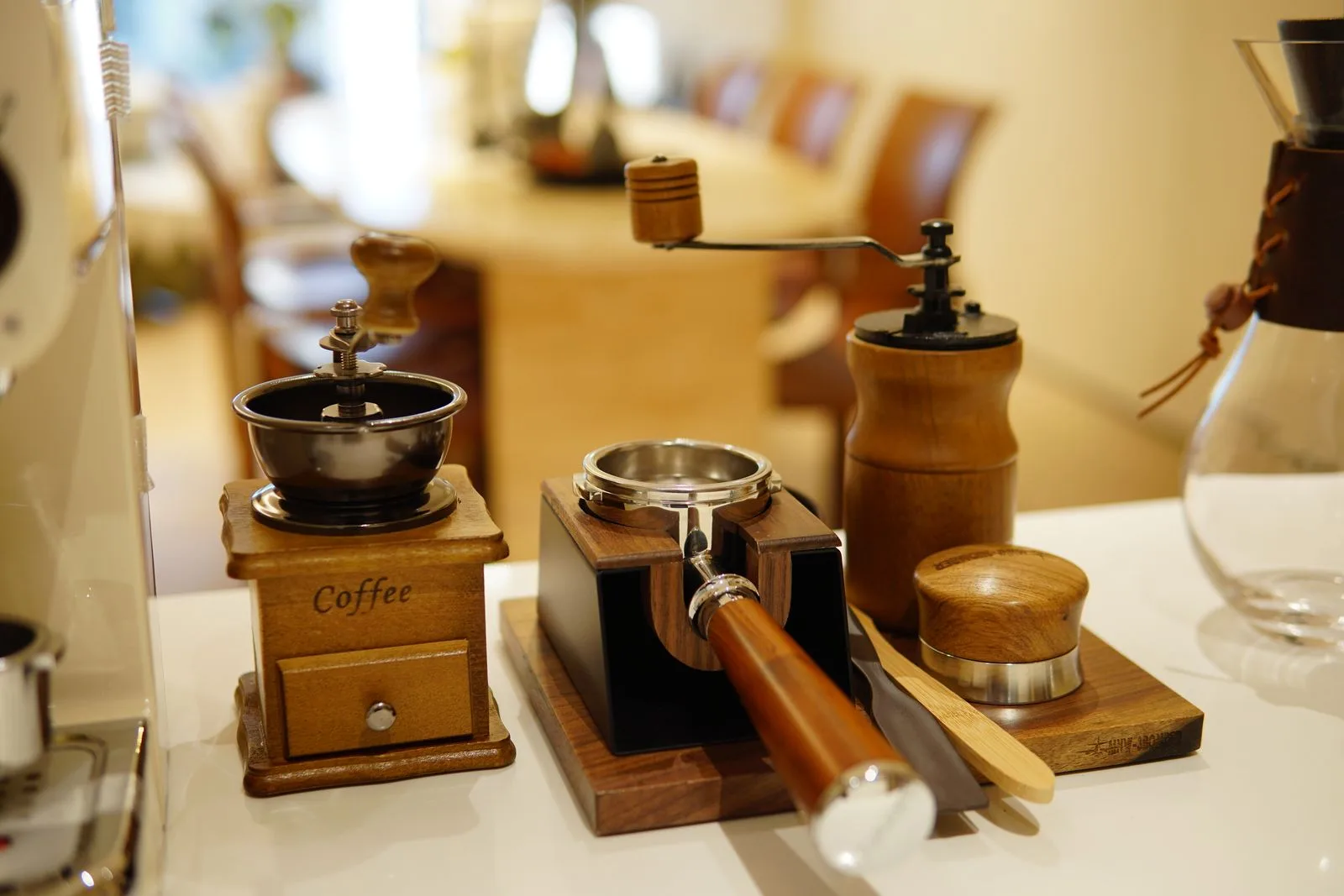
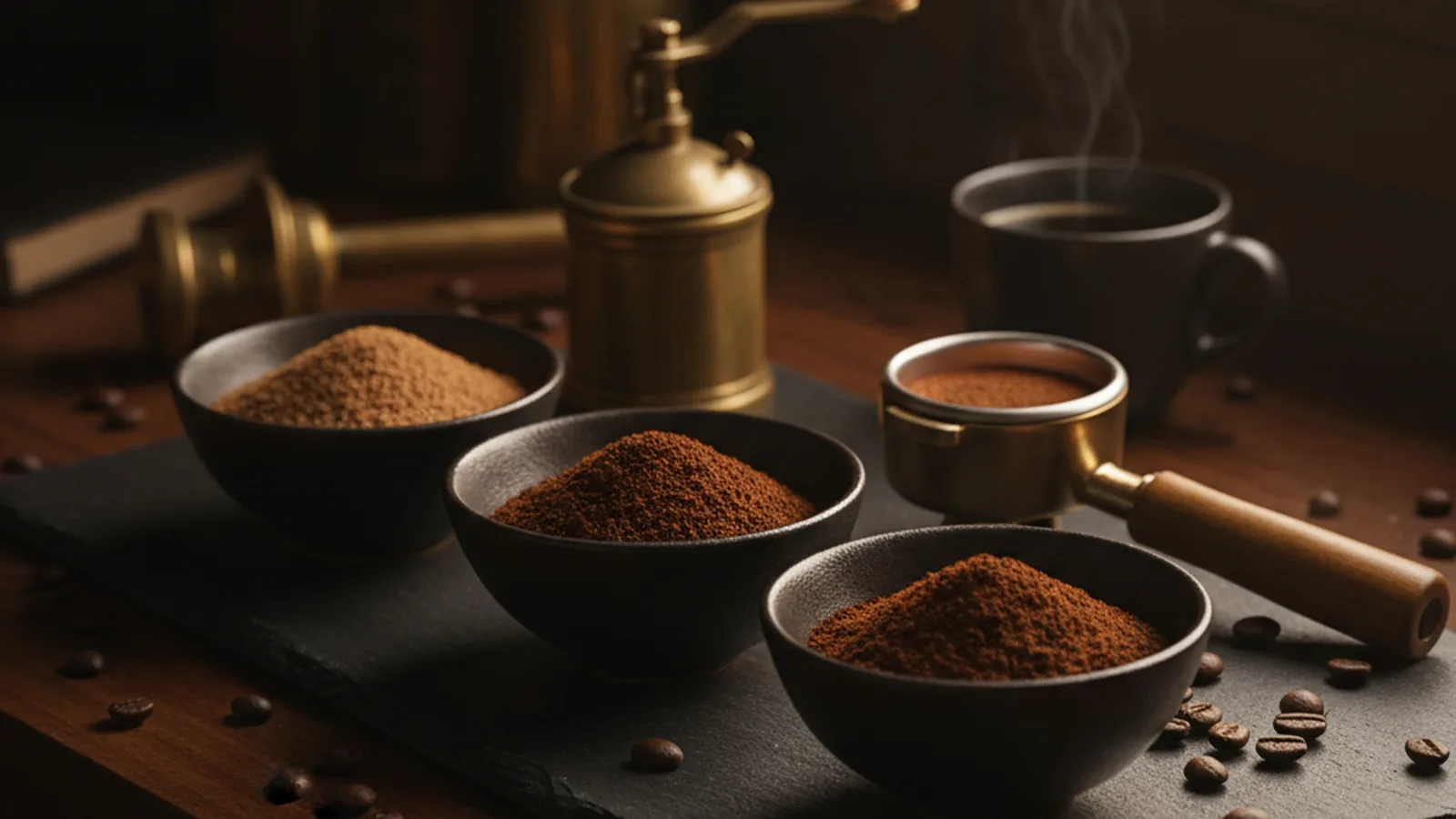
Because the hot water pour is concentrated into roughly two-thirds the usual volume, it needs more surface area to extract fully in the same contact time, which means a finer grind than the identical dripper brewed as a normal hot cup. Handground’s own recipes make the adjustment explicit by dripper: the V60 and AeroPress recipes both call for “Setting 3.5” on a Handground grinder, described as medium, while the Chemex recipe steps up to “Setting 4.5,” and the Kalita Wave strong recipe goes to “Setting 5.5,” described as medium-coarse. Complete Home Barista describes the same pattern in plain language rather than a grinder’s click settings: a V60 wants a grind “like kosher salt,” finer than the “rough sand” texture its own guide calls for on a Chemex.
The ordering matches what this site’s own hot-brew guides already document: the V60 guide calls for a medium-fine grind, and the Chemex guide calls for medium-coarse because of its thicker filter paper. Japanese iced coffee keeps that same relative ordering between drippers, just shifted a half-step finer across the board to compensate for the reduced pour volume. If the cup tastes thin or sour, grind finer first rather than reaching for more coffee. If it tastes bitter or the drawdown drags well past the times below, go coarser.
A burr grinder that holds a consistent setting matters more here than on most methods on this site, since the whole technique depends on a stronger-than-usual pour extracting fully in a short window, and a blade grinder’s uneven mix of fine dust and coarse chunks makes that inconsistent from cup to cup. The same grinder category is also available on Amazon.
Where the method actually comes from
Japanese iced coffee is not the same thing as Kyoto-style cold drip, even though both are Japanese and both involve ice or cold water somewhere in the process, and the two get mixed up constantly. Per CrowdRoaster’s own explainer, Kyoto coffee is “extracted over several hours at room temperature using a special glass brewer,” and is “known for its unique mellow flavor and rich, full-bodied taste,” a method that originated in Kyoto after World War II. Japanese iced coffee, the flash-brew technique this guide covers, works differently: hot water poured directly over ice, finished in a few minutes rather than hours.
The route this flash-brew style took to American specialty coffee traces to one specific account, though it is not independently confirmed. Per CrowdRoaster, which itself attributes the claim to BuzzFeed, “Counter Culture Coffee” is credited with bringing the technique to the United States, and BuzzFeed’s own reporting adds the specific detail while hedging it as unverified: “the technique supposedly made its way to the US in the late ’90s after Counter Culture’s coffee director took a trip to Japan.” The same BuzzFeed piece notes just how mainstream the method already is in Japan itself: “7-Elevens in Japan serve their iced coffee this way, letting customers grab a premeasured cup of ice for freshly brewed coffee to be dripped directly into.” That is a useful detail for calibrating expectations. This is not a niche specialty-coffee technique in its country of origin. It is convenience-store-counter ordinary, which tracks with how simple the actual method turns out to be once the ratio math above is sorted out.
Worked example: brewing your first cup
- Weigh your ice directly into the serving vessel first, before anything else. Complete Home Barista’s method uses 240g of ice for a 30g dose; scale proportionally for a smaller or larger cup using the 1:16 total-liquid ratio as your target.
- Set your dripper on top of the ice-filled vessel and rinse the paper filter with hot water to clear papery taste and preheat the cone, the same first step this site’s other pour-over guides use.
- Grind your coffee one step finer than you would for the same dripper brewed hot. For a V60, that means finer than this site’s own medium-fine V60 setting, closer to a kosher-salt texture per Complete Home Barista.
- Add the grounds and tare the scale to zero.
- Bloom with a small pour, roughly double the coffee weight in hot water (95 to 100 degrees Celsius, just off the boil), and let it sit 30 to 45 seconds to let trapped gas escape.
- Pour the remaining hot water in the ratio from the table above, aiming for about 1:10 against your coffee weight for the water you pour, not counting the ice already waiting below. For 22 grams of coffee, that is roughly 205 grams of hot water total, per Handground’s own V60 recipe.
- Let the dripper fully drain. Total time varies by dripper rather than landing on one fixed number: Handground’s own V60 recipe this worked example follows finishes around 2:45, with AeroPress around 2:06, Chemex around 3:45, and Kalita Wave’s strong recipe around 4:00, per each dripper’s own sourced recipe.
- Remove the dripper and swirl the vessel gently to mix the hot concentrate with the now-melting ice into one evenly chilled cup.
- If you are shopping for a dedicated iced-coffee setup, 1st in Coffee’s coffee maker range and pour-over drippers on Amazon both carry V60, Chemex, and Kalita Wave options, any of which work with the method above.
Which dripper to use: V60, Chemex, AeroPress, or Kalita Wave
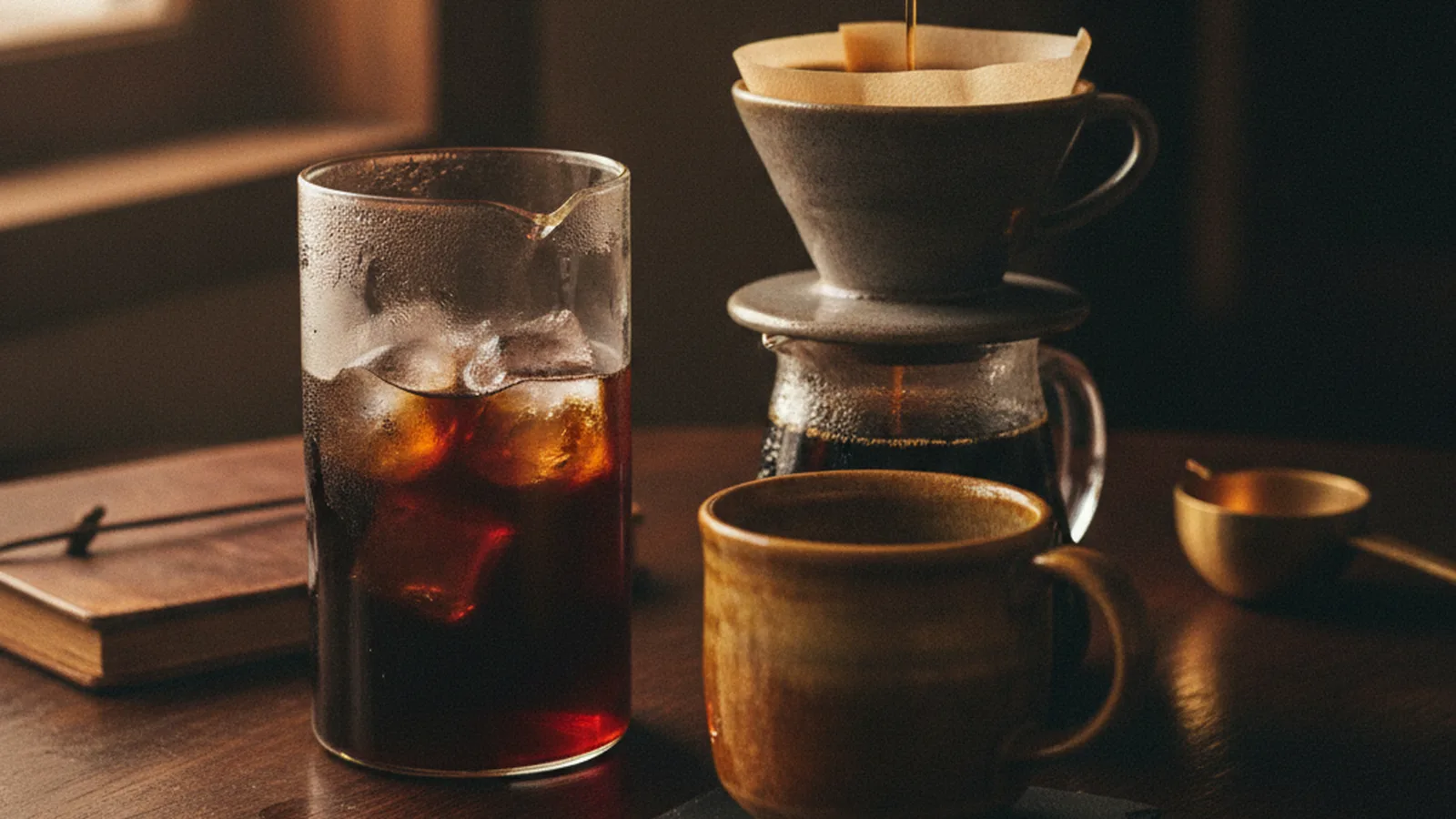
The ratio table earlier in this guide already shows the practical difference between drippers, but it is worth stating plainly: any of the four works, and the choice comes down to the same tradeoffs this site’s own hot-brew guides already document, just carried over into the iced version. The V60’s continuous pour and medium-fine grind produce the brightest, most clarity-forward cup, which is why specialty cafes default to it for iced single origins. The Chemex’s thicker filter and coarser medium-coarse grind, per this site’s own Chemex guide, strip out more oils and fine sediment, producing a cleaner but slightly less textured iced cup. The Kalita Wave’s flat bed, covered in this site’s Kalita Wave guide, drains more evenly with less pouring technique required, which carries over directly into the iced version since an uneven pour matters just as much when ice is sitting underneath. The AeroPress, normally the most flexible method on this site per the AeroPress guide, works for Japanese iced coffee too, though the specific Handground recipe this guide’s numbers are drawn from uses the inverted method: brew upside down as usual, then at the 1:45 mark flip the AeroPress onto the ice-filled vessel and plunge for 20 to 30 seconds, stopping as soon as it starts to hiss, rather than a standard upright pour-through.
Japanese iced coffee vs cold brew: not the same drink
The two methods get confused constantly because both end up in a glass of ice, but they work in opposite directions. This site’s own cold brew ratio guide documents a roughly 1:8 concentrate ratio steeped cold for 12 to 24 hours, then diluted after the fact, a slow extraction that never touches hot water at all. Japanese iced coffee does the opposite: a fast, hot extraction, finished in a few minutes depending on the dripper, that gets chilled instantly by the ice rather than steeped slowly into it. The flavor difference follows directly from that mechanical difference. Cold extraction pulls fewer bitter compounds and less acidity over its long steep, producing the smoother, lower-acid cup this site’s cold brew guide describes. Hot flash-brewing pulls the same bright, aromatic compounds a hot pour-over would, then locks them in before they have time to fade, producing a cup closer in character to a chilled version of a normal pour-over than to cold brew’s mellower profile. Neither method is a substandard shortcut for the other; they are built to taste different on purpose.
Where this ratio sits against other methods on this site
| Method | Typical ratio | Style |
|---|---|---|
| Japanese iced coffee, poured water only | About 1:10 | Hot, flash-chilled over ice |
| Japanese iced coffee, total liquid | 1:15 to 1:20 | Hot, flash-chilled over ice |
| V60 pour-over, hot | 1:16 to 1:17 | Hot, continuous pour |
| Chemex, hot | 1:16 | Hot, continuous pour |
| Kalita Wave, hot | 1:16 | Hot, continuous pour |
| Cold brew concentrate | 1:8 | Cold steep, 12 to 24 hours |
The total-liquid ratio for Japanese iced coffee lands close to its hot-brewed counterparts, which makes sense since the finished cup is meant to taste like a chilled version of the same drink, not a different style of coffee entirely. For a quick way to scale any of these ratios to your own cup size, this site’s Brew Ratio Calculator covers the hot-brew side of that table directly; for the Japanese iced method specifically, start from the 1:10 poured-water figure above and let your pre-measured ice handle the rest.
Common mistakes
Measuring the ice and hot water together as one combined pour is the most common mistake, and it is an easy one to make if you are used to this site’s other pour-over guides, where there is only one liquid to measure. Weigh the ice into the serving vessel first, separately, before you ever start timing the hot water pour. Using the same grind setting as the identical dripper brewed hot is the second mistake; every sourced recipe here steps the grind finer to compensate for the roughly one-third reduction in pour volume, and skipping that adjustment produces a thin, underextracted cup. Confusing this method with cold brew is the third mistake, since the two use opposite extraction mechanisms, a fast hot pour here versus a slow cold steep there, and swapping one method’s ratio onto the other produces a cup nothing like what either technique is supposed to taste like. Pouring the hot water at a normal hot-brew ratio instead of the stronger roughly 1:10 figure is the fourth mistake; at a standard 1:16 pour, the ice has nothing concentrated enough to dilute, and the finished cup comes out weak and watery once it melts in.
Common questions
What is the correct ratio for Japanese iced coffee? It depends which part you are measuring. Count only the hot water poured through the grounds and the ratio runs close to 1:10, per Handground’s own per-dripper recipes. Count the hot water and the ice together, since the ice becomes part of the finished drink, and the ratio runs 1:15 to 1:20 depending on the dripper, per Handground, Complete Home Barista, and BuzzFeed’s independently published recipes.
What grind size should I use for Japanese iced coffee? Finer than the identical dripper brewed hot. Handground’s own recipes step a V60 and AeroPress to a medium grind setting, a Chemex slightly coarser, and a Kalita Wave’s strong recipe to medium-coarse, the same relative ordering this site’s own hot-brew guides for V60 and Chemex already use, just shifted a half-step finer across the board.
Is Japanese iced coffee the same as cold brew? No. Cold brew, covered in this site’s own cold brew ratio guide, steeps coarse grounds in cold water for 12 to 24 hours at roughly a 1:8 concentrate ratio. Japanese iced coffee brews hot in a few minutes, depending on the dripper, and chills instantly over ice, producing a brighter, more aromatic cup closer in character to a chilled pour-over than to cold brew’s smoother, lower-acid profile.
Which dripper is best for Japanese iced coffee? Any of the standard pour-over drippers work. A V60 produces the brightest, clearest cup; a Chemex strips out more oils for an even cleaner result; a Kalita Wave’s flat bed is the most forgiving to pour evenly; an AeroPress works too, using Handground’s inverted method, brewed upside down and then flipped and plunged into the ice-filled vessel for the final 20 to 30 seconds. The ratio and grind differ slightly by dripper, detailed in the table earlier in this guide.
Where did Japanese iced coffee actually come from? It is a Japanese flash-brew technique distinct from the slower Kyoto-style cold drip method, and per CrowdRoaster and BuzzFeed’s reporting, it reached the United States in the late 1990s after Counter Culture Coffee’s coffee director visited Japan and brought the method back. In Japan itself, it is common enough that 7-Eleven convenience stores serve iced coffee brewed this way at the counter.
How long does Japanese iced coffee take to brew? It depends on the dripper rather than landing on a single number. Handground’s own sourced recipes range from about 2:06 for an AeroPress up to 4:00 for a Kalita Wave’s strong recipe, with this guide’s V60 example around 2:45 and Chemex around 3:45; Complete Home Barista’s method finishes in about 3:00 to 3:30. Even at the slow end, it is still one of the fastest iced coffee methods that involves an actual hot extraction rather than just pouring hot coffee over ice after the fact.
For more sourced brewing breakdowns like this one, delivered weekly, subscribe to The Sunday Pour.
Sources & data
- Complete Home Barista: Japanese Iced Coffee Method, Ratios, Recipe, and Flash Brew Guide
- Handground: The Complete Guide to Japanese Iced Coffee
- BuzzFeed: This Japanese-Inspired Method For Truly Flawless, 5-Minute Iced Coffee Is My Newest Obsession
- CrowdRoaster: What Is Kyoto Coffee? Japanese Iced Coffee Brewing Method Gaining Attention in the West