A Chemex looks like the simplest brewer on the shelf: one piece of glass, one paper filter, no plastic cone or metal mesh to clean. That simplicity is deceptive. The filter alone is different enough from a standard pour-over cone that using a V60 ratio or a V60 grind on a Chemex produces a noticeably worse cup, too weak if the grind is too fine and the filter clogs, too thin and fast if the grind matches a coarser method entirely. Two independently published brewing guides checked for this piece, from Bean Box and Equator Coffees, converge tightly on both numbers, which makes the Chemex one of the more settled ratio questions on this site once you know where to look.
The one-piece design and the thick filter

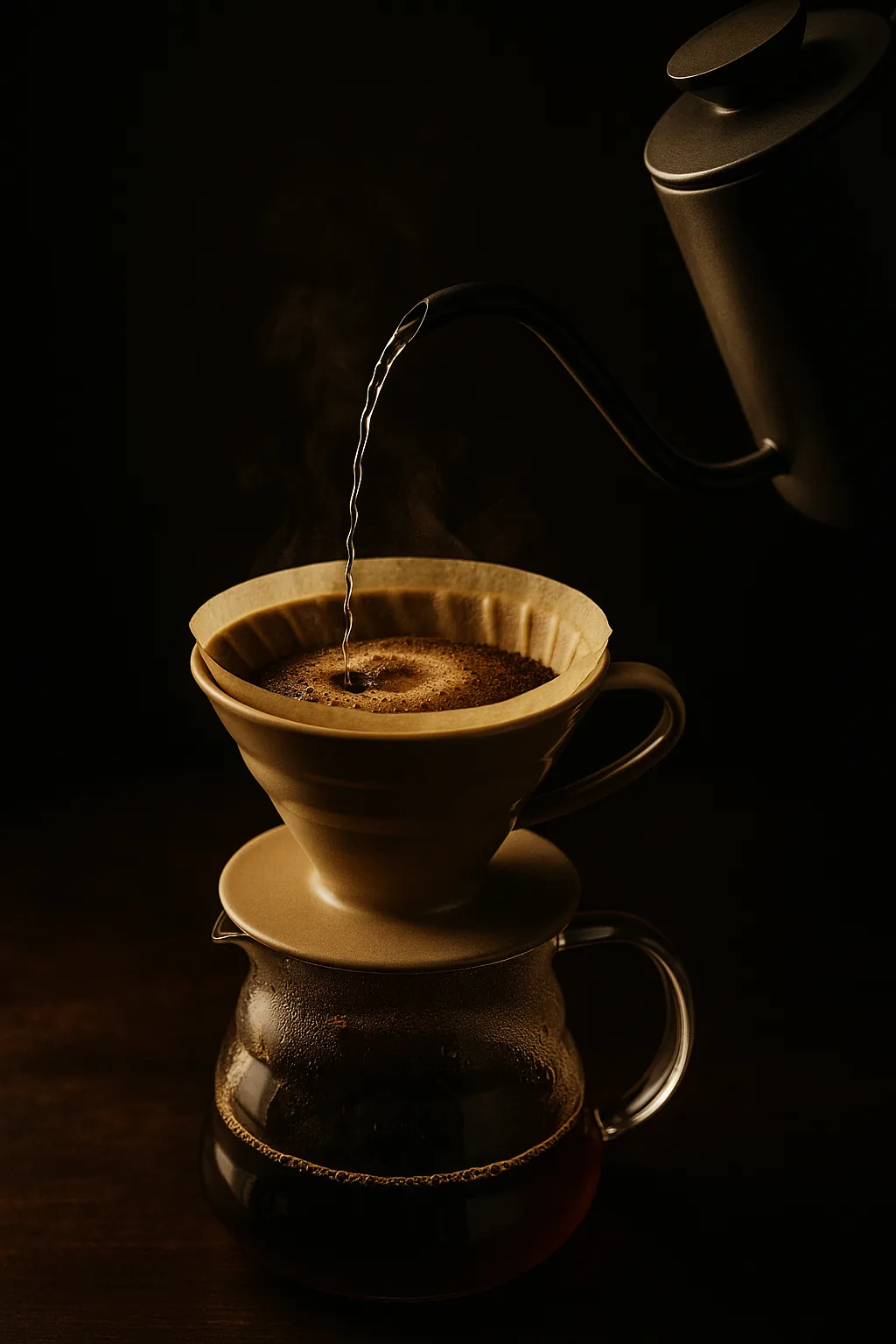
Most pour-over methods split the job between a dripper and a separate carafe. The Chemex does not: it is a single hourglass-shaped vessel, filter and carafe in one piece, held with a wood collar around the pinch point. The filter itself is the part that actually changes the brewing math. Bean Box is direct about the mechanism: grind too fine and it will “clog the thick filter and turn bitter,” while too coarse “runs fast and weak.” Chemex’s bonded paper filters are noticeably heavier than a standard V60 or Kalita filter, which means they trap more fine particles and sediment, but they also slow water down more on their own before the grind size even enters the equation. That is the entire reason a Chemex needs a coarser grind than most other pour-over methods to hit a similar brew time.
If you are shopping for one, a classic Chemex pour-over glass coffee maker is the standard 6-cup size both sourced guides below scale their recipes from, and the bonded filters it requires are sold separately and specific to the brand, a standard V60 or basket filter will not seat or filter correctly in one.
The ratio: 1:16, reconciled
Both sourced guides state the same ratio outright, using two different batch sizes. Bean Box recommends “1:16 by weight,” giving “about 42g coffee to 680g water for a full carafe,” scaling down to 30g and 500g for a smaller pour. Equator Coffees states its own recipe as “45g coffee to 720g water,” which by itself works out to a ratio of exactly 1:16. Run the math on Bean Box’s numbers too: 680 divided by 42 comes out to roughly 1:16.2, close enough to round to the same figure Equator states directly. Two brewing guides, written independently, using two different dose sizes for a full carafe, land on the same 1:16 ratio.
That matches what this site’s own coffee to water ratio chart already lists for Chemex, grouped there with V60 pour-over at 1:16 across three reference dose sizes. It also happens to be identical to this site’s Kalita Wave ratio, even though the two methods use very different filter designs to get there, a coincidence worth knowing if you already have one method’s ratio memorized and are trying a Chemex for the first time.
Ratio by cup size, in grams
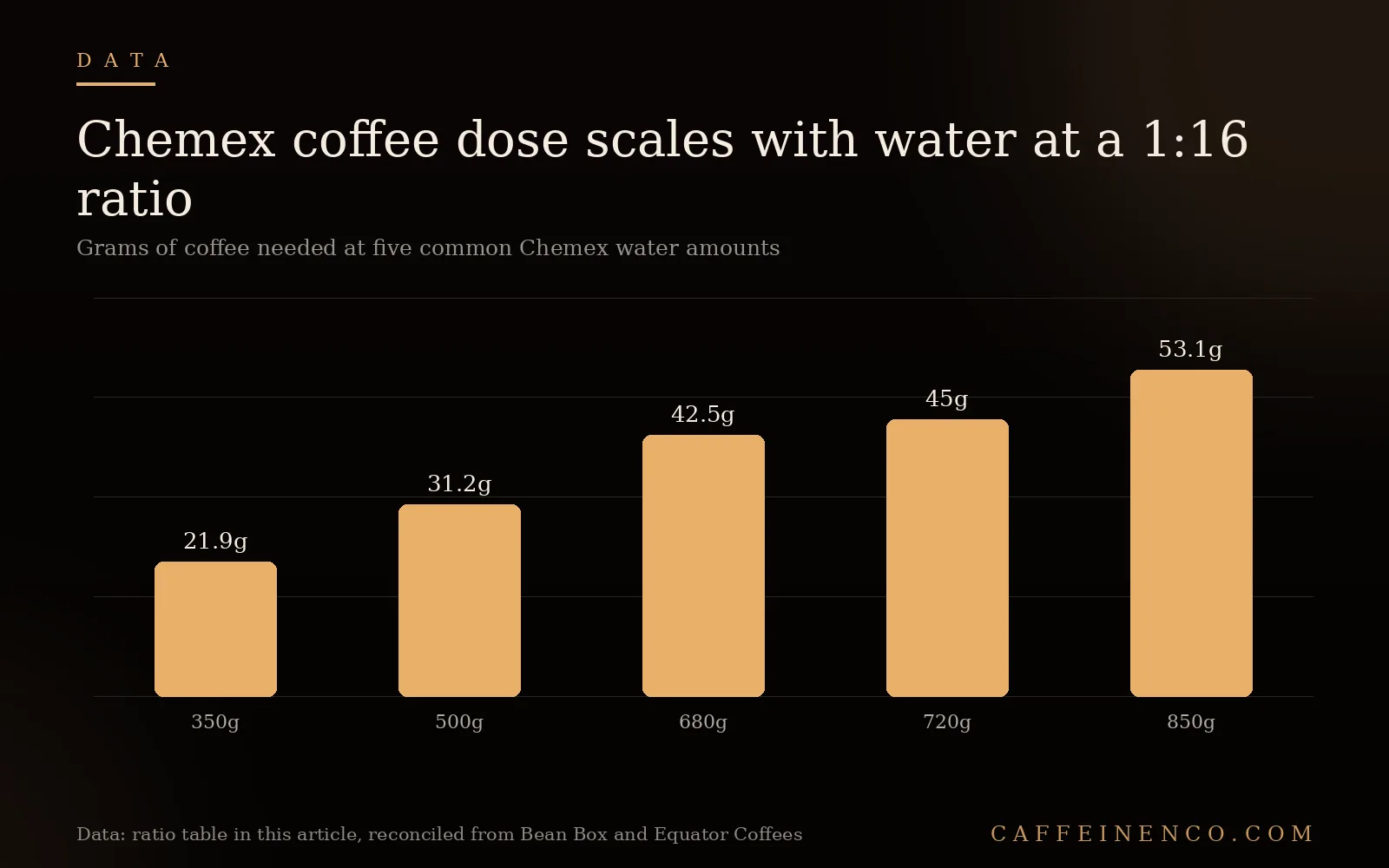
Scaling 1:16 to any carafe size is one division: take your water weight and divide by 16 to get the coffee dose.
| Water | Coffee at 1:16 |
|---|---|
| 350g (small pour, roughly 2 cups) | 21.9g |
| 500g (Bean Box’s smaller batch) | 31.25g |
| 680g (Bean Box’s full carafe) | 42.5g |
| 720g (Equator’s full carafe) | 45g |
| 850g (large 8-cup Chemex, roughly full) | 53.1g |
If you prefer a stronger or lighter cup than the sourced 1:16 default, this site’s other ratio guides treat that as a small, deliberate shift rather than guesswork: move toward 1:15 for more body, 1:17 for a lighter cup, and change only that one number between brews so you can tell what actually moved the result.
The grind: medium-coarse, and why it has to be
Both sourced guides agree on the texture, though they describe it slightly differently. Bean Box calls for grounds “medium-coarse, like table salt.” Equator Coffees specifies a “medium-coarse grind” at “the center point on most grinders,” without a specific texture comparison. This site’s own grind size chart places Chemex in a 600 to 900 micron band and describes the same texture as “coarse sand, similar to kosher salt,” a slightly coarser-sounding comparison than Bean Box’s table salt. Read together, the honest range sits between table salt and kosher salt, distinctly coarser than a standard drip or V60 grind, and noticeably finer than a French press.
The reason the grind has to land in that specific window comes back to the filter. Grind finer than that band and the thick bonded paper adds enough of its own resistance on top of the tighter grounds that water backs up, over-extracts, and the total brew time can blow well past the guides’ stated window. Grind coarser and water races through both the loose bed and the already-fast-draining filter, finishing under-extracted and thin even at a correct 1:16 dose. A conical burr grinder with a wide coarse range makes it far easier to land inside this specific band consistently than a blade grinder, which tends to produce an uneven mix of dust and chunks that a Chemex’s thick filter will treat very differently depending on which grain size any given part of the bed happens to be.
How to brew it, step by step
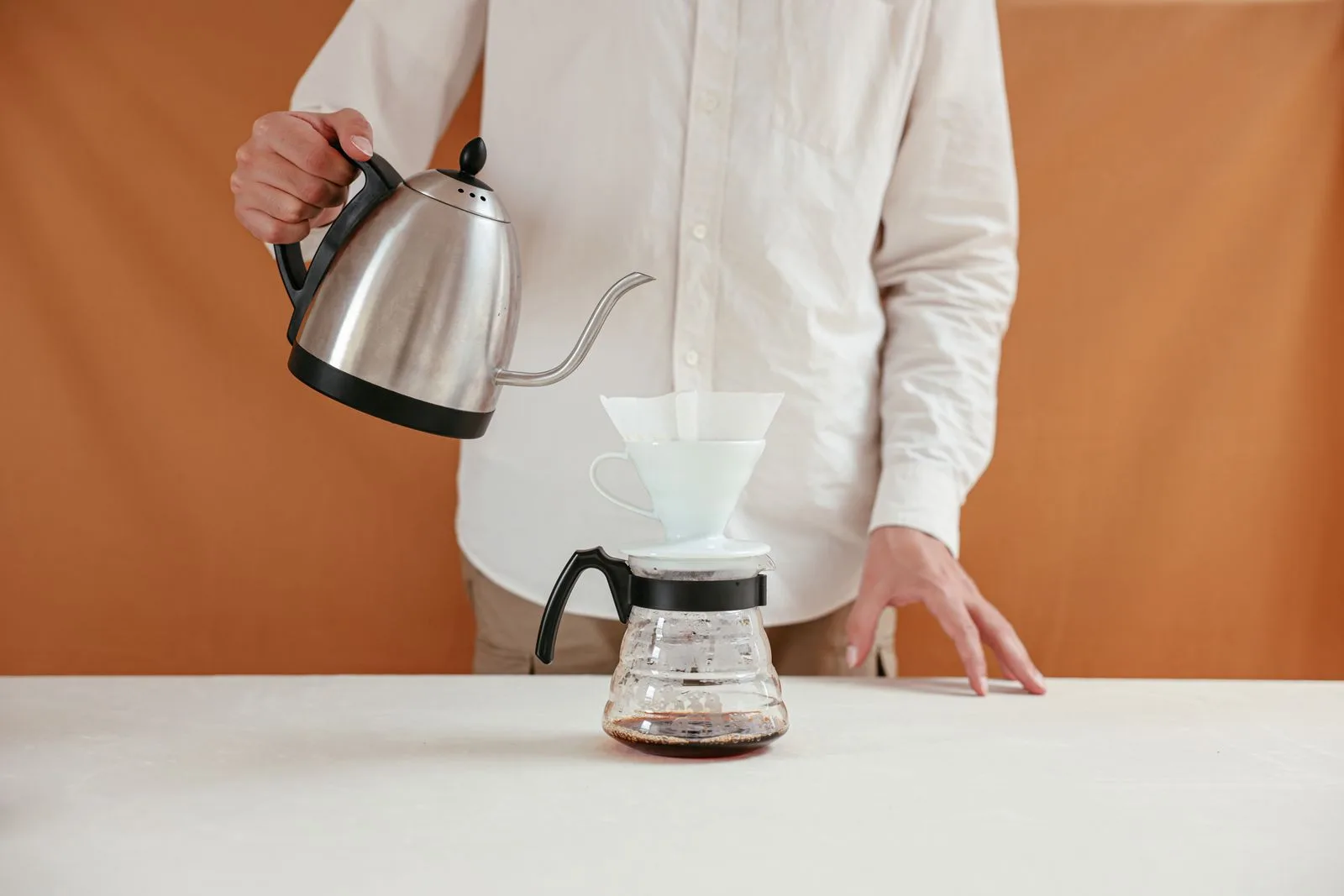
Equator Coffees lays out a fully timed routine built around its 45g to 720g dose, useful here since it gives concrete gram checkpoints rather than a vague pour description.
- Heat water to about 200 to 205F, just off a full boil. Both sourced guides land in this same narrow window, Bean Box states “about 200F,” Equator states “205,” close enough that either end of the range works.
- Fold and rinse the filter. Bean Box notes the filter folds into a cone with three layers on the spout side; rinse it with hot water first to remove the papery taste and warm the glass before adding grounds.
- Grind 45 grams medium-coarse and add it to the rinsed filter, leveling the bed.
- Bloom with 90 grams of water, starting your timer as you pour. Both guides describe the bloom pour as roughly twice the coffee’s weight, Bean Box’s 42g dose gets about 80g of bloom water, Equator’s 45g dose gets 90g, the same doubling rule scaled to two different doses. Let it sit 30 to 45 seconds while it degasses.
- Pour in stages to your target weight. Equator’s routine adds water in three roughly equal pours, at 0:30, 1:30, and 2:30, reaching 300g, 510g, and the full 720g. Bean Box describes the same idea more loosely, two or three slow, concentric pours, keeping the water level about an inch above the grounds.
- Let it finish draining. Total time from first pour to the last drip should land around 4 to 5 minutes per both sourced guides, though this site’s own grind chart lists a slightly tighter 3:30 to 4:30 window for the same method, so treat anything roughly between 3:30 and 5:00 as normal rather than chasing one exact number.
- Remove the filter and serve directly from the carafe. No transfer needed, which is one of the few genuine conveniences the one-piece design buys you over a separate dripper and carafe setup.
How Chemex’s ratio compares to other methods on this site
At 1:16, Chemex sits in the same spot as this site’s Kalita Wave ratio, both landing on a single, tightly reconciled number rather than a wide strength range. It is lighter than French press’s 1:12 to 1:17 range and noticeably more dilute than Turkish coffee’s 1:8 to 1:12, an immersion method that is not really comparable since the grounds stay in the cup. Against AeroPress’s roughly 1:13 to 1:18 range, Chemex sits closer to the lighter end. What sets Chemex apart from the other methods in that comparison is not the ratio number itself, it is the filter: no other method on this site pairs a 1:16 ratio with a filter thick enough to require its own coarser grind band just to keep the brew time from running long.
Common mistakes
Using a standard V60 grind setting on a Chemex is the most common one, since the two methods share a similar cone shape and it is easy to assume the grind should match. It should not: the thick bonded filter needs a coarser grind than a V60’s thin paper cone to drain in a comparable time. Skipping the filter rinse is the second, both sourced guides call for it, and an unrinsed filter carries a papery taste directly into the cup along with the added benefit of warming the glass before brewing starts. Eyeballing the bloom instead of weighing it is the third: both guides tie the bloom pour to roughly twice the coffee’s weight, and pouring by feel instead of by that ratio makes it much harder to know whether a bad cup came from the bloom, the main pours, or the grind.
Common questions
What is the correct Chemex coffee to water ratio? 1:16, coffee to water. Two independently published guides, Bean Box and Equator Coffees, confirm this using different dose sizes, 42 grams to 680 grams and 45 grams to 720 grams, both of which round to the same 1:16.
What grind size does a Chemex need? Medium-coarse, described as similar to table salt by Bean Box and as “coarse sand, similar to kosher salt” by this site’s own grind size chart. It needs to be distinctly coarser than a standard V60 pour-over grind because the Chemex’s thick bonded filter already adds extra resistance on its own.
Why does a Chemex need a coarser grind than a V60? The filter. A Chemex’s bonded paper filter is noticeably thicker than a standard V60 cone filter, and that added thickness slows water down before the grind size is even a factor. A grind fine enough for a V60 combined with a Chemex’s thicker filter can push the total brew time well past the guides’ stated 4 to 5 minute window.
How long should a Chemex take to brew? Around 4 to 5 minutes total from the first pour to the last drip, per both sourced guides, though this site’s own grind size chart lists a slightly tighter 3:30 to 4:30 window for the same method. Treat anywhere from about 3:30 to 5:00 as within normal range.
Do I need special filters for a Chemex? Yes. Chemex uses its own bonded paper filters, sold specifically for the brand, that are thicker than a standard cone filter. A V60 or basket-style filter will not seat correctly in a Chemex and will not filter the same way even if it happens to fit.
Can I use a Chemex without a scale? You can, but both sourced guides build their recipes around specific gram checkpoints for the bloom and each pour stage, and hitting a single reconciled 1:16 ratio consistently by eye is much harder than with a wide-range method like French press. A basic kitchen scale removes most of the guesswork.
For the puck-and-pour side of a stalled or slow-draining bed, this site’s guide to why pour-over drainage stalls covers the same over-fine-grind failure mode from the troubleshooting side. For more sourced brewing breakdowns like this one, delivered weekly, subscribe to The Sunday Pour.