Type “golden ratio coffee” into a search bar and you will get a single, confident number, usually 1:16 or 1:17, stated as though it were a law of physics. It is not. The number comes from a real standard with a real history, but that standard was never a single number to begin with. It is a strength target with a tolerance band built in, and almost every page that quotes it strips the band away. This page puts it back, along with a full ratio chart by method, the actual standard behind the folklore, and the reason changing your ratio cannot fix every bad cup on its own.
What a ratio actually expresses
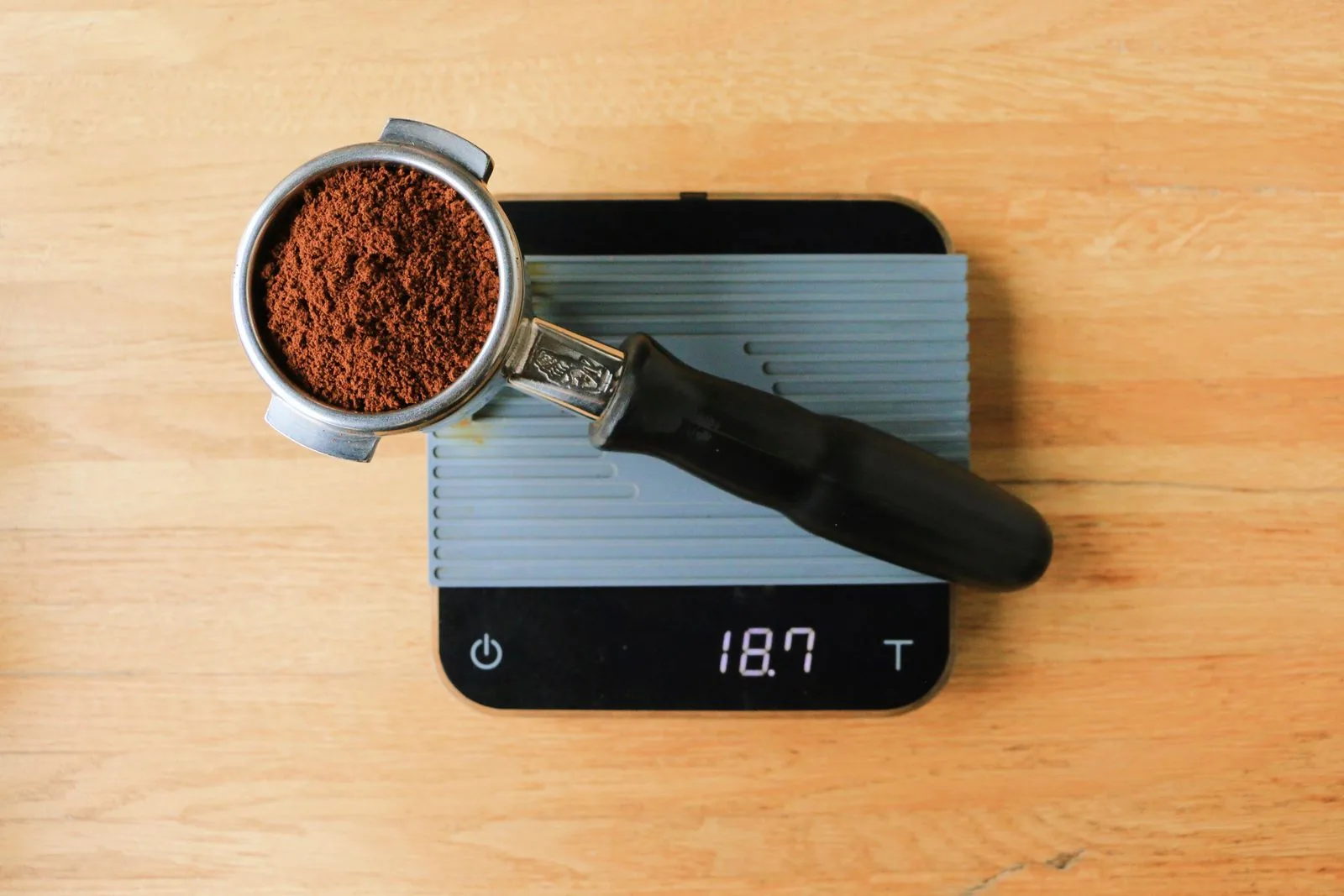
A brewing ratio is a comparison of two masses: the dry coffee you start with and the water you brew it in, written as coffee to water, smallest number first. A 1:16 ratio means 16 grams of water for every 1 gram of coffee, so 20 grams of coffee calls for 320 grams of water.
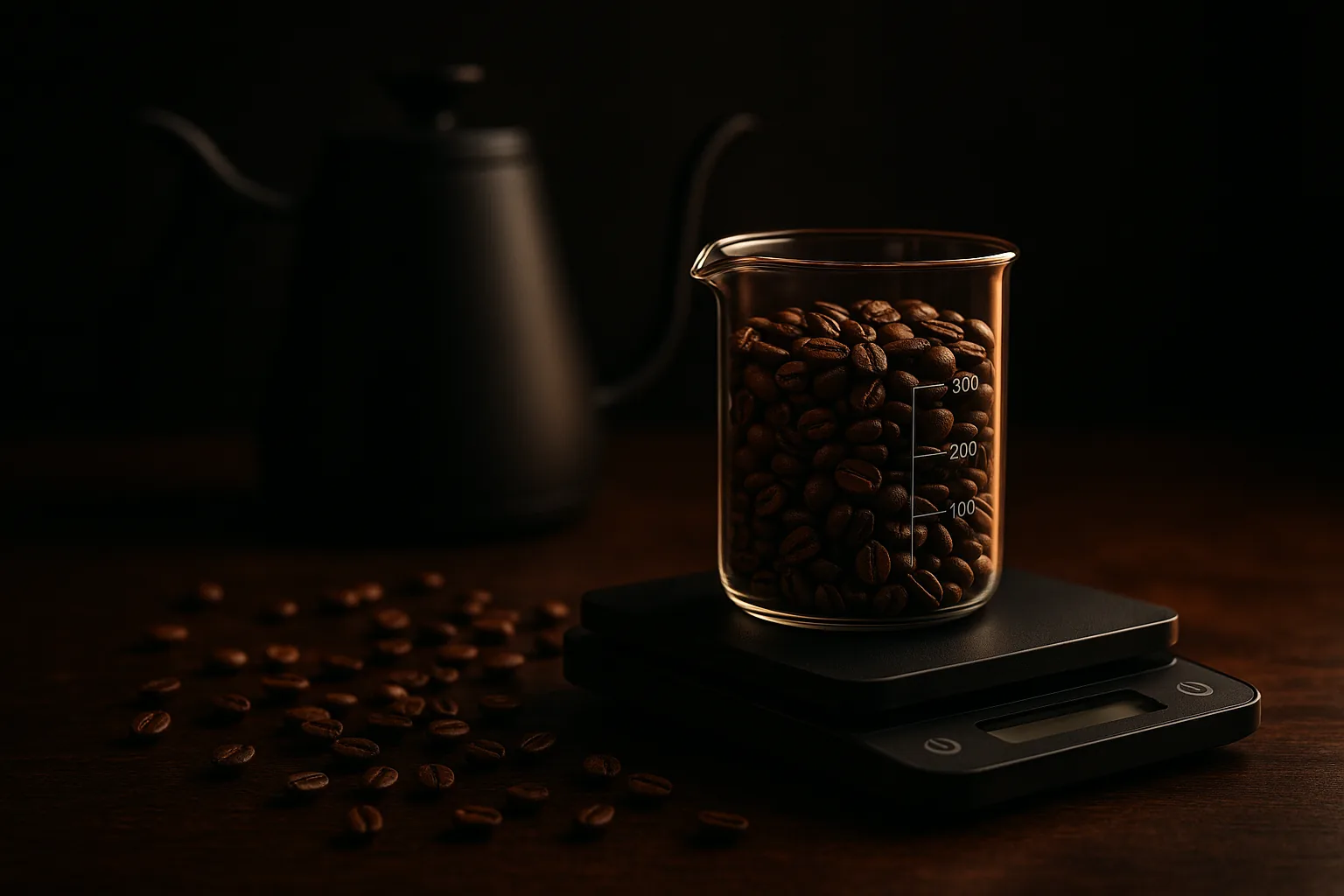
Notice the word grams, twice. Ratios are a weight relationship, not a volume one, and that distinction matters more than it looks. A “tablespoon of coffee” is not a fixed mass. Grind it fine and it packs tighter, so a level tablespoon holds more coffee by weight than the same tablespoon filled with a coarse grind. Roast it dark and the bean has physically expanded and lost density during roasting, so a tablespoon of dark roast weighs less than the same tablespoon of light roast. Water is more forgiving, roughly 1 gram per millilitre at brewing temperature, but coffee volume is not forgiving at all. That is why 1:15 notation has replaced “two tablespoons per cup” in every serious brewing guide: a gram of coffee is the same gram regardless of grind, roast, or how firmly you packed the scoop. A kitchen scale costing under twenty dollars removes an entire category of inconsistency that no amount of careful scooping ever will.
Where the golden ratio comes from
The standard usually shortened to “the golden ratio” is the Specialty Coffee Association’s Golden Cup Standard, and its lineage runs back further than most pages mention. In 1952 the Coffee Brewing Institute was formed by the Pan American Coffee Bureau and the National Coffee Association, with biochemist Ernest Earl Lockhart as director. Lockhart’s research culminated in a 1957 paper, “The Soluble Solids in Beverage Coffee as an Index to Cup Quality,” which introduced the Coffee Brewing Control Chart: a plot of brew strength against extraction yield, with a small rectangle in the middle marking the zone that trained tasting panels rated as balanced. The Institute dissolved in 1964, but the chart survived it. The Specialty Coffee Association of America, founded in 1982, adopted that rectangle as its own Golden Cup Zone, and it is still the basis for the standard cited today by the merged Specialty Coffee Association, formed in 2017 when the SCAA and the Specialty Coffee Association of Europe combined.
What the standard actually specifies, according to the SCA’s published coffee standards, is three linked numbers, not one. Brew strength, measured as Total Dissolved Solids, should fall between 1.15 and 1.35 percent. Extraction yield, the share of the dry coffee mass that ends up dissolved in the cup, should fall between 18 and 22 percent. And the ratio that reliably lands inside both ranges for drip brewing is 55 grams of coffee per litre of water, with an explicit variance of plus or minus 10 percent, giving a working range of 50 to 60 grams per litre. Converted to the notation most brewers actually use, 55 g/L is 1:18.2, and the full tolerance band runs from roughly 1:16.7 up to 1:20. The “golden ratio,” read correctly, was never 1:16 or 1:18. It is a corridor with 1:18 near its centre, built specifically around batch drip coffee brewed at 90 to 96 degrees Celsius (195 to 205 Fahrenheit), not a rule for every method in your cupboard.
It is also worth knowing the chart got a serious update. The UC Davis Coffee Center, working with the Coffee Science Foundation and the SCA, published a new Sensory and Consumer Brewing Control Chart in the Journal of Food Science, online in March 2023 and in print that May (Volume 88, Issue 5, pages 2168 to 2177), the product of seven years of research, 324 chemical measurements, over 32,000 sensory descriptive ratings, and more than 3,000 consumer liking scores, led by food scientist Jean-Xavier Guinard. Lockhart’s original insight, that dissolved solids predict cup quality, held up. What the research added is the finding that no single rectangle fits everyone: the update offers separate preference maps for different taster groups rather than one universal “ideal” zone, which is the more rigorous, modern version of the point this page is making about ranges.
The full ratio chart, by method
These figures track what specialty coffee sources and our own brew guides converge on for each method, expressed as grams of coffee to grams of water so you can scale to whatever pot you own.
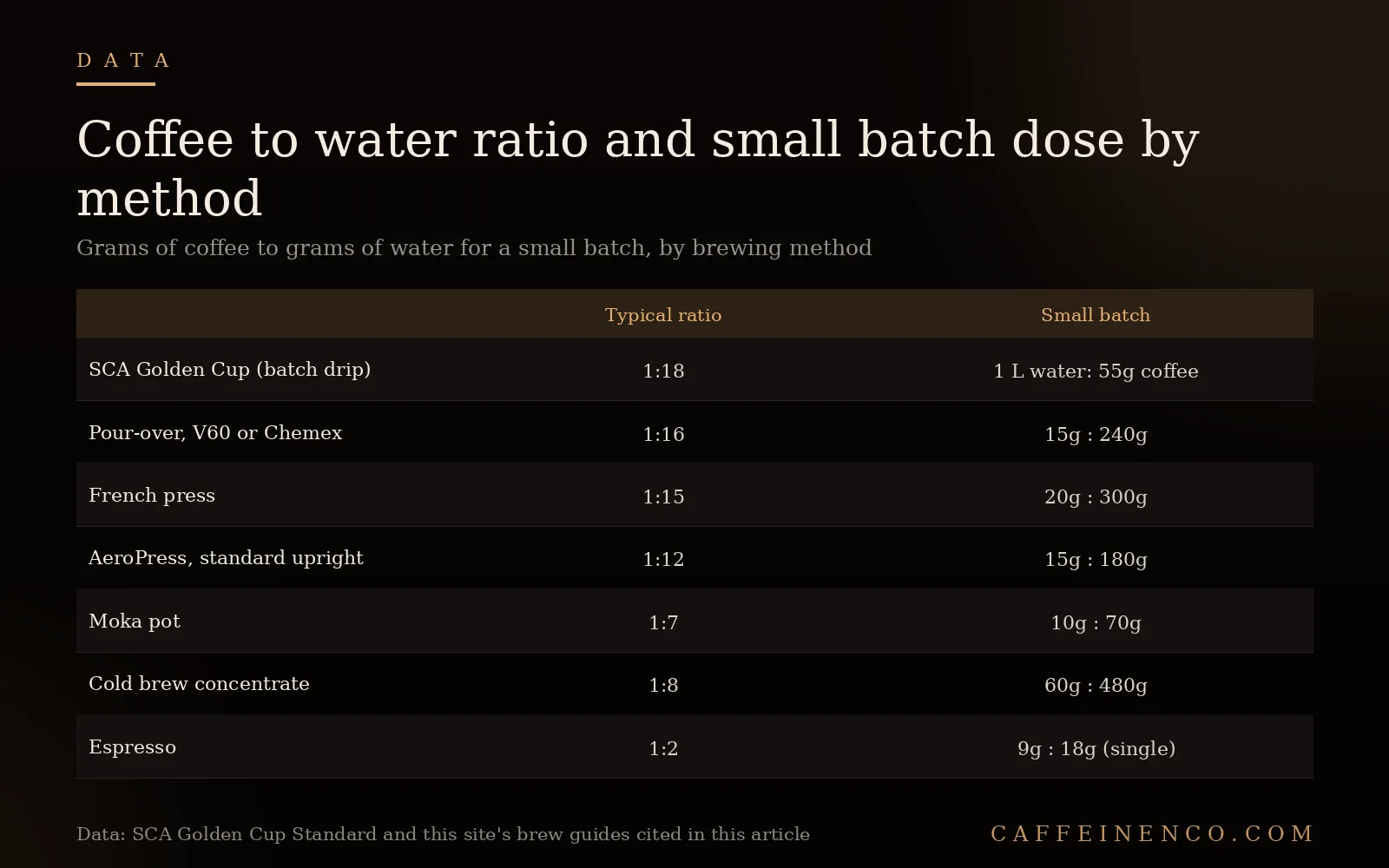
| Method | Typical ratio | Small batch | Medium batch | Large batch |
|---|---|---|---|---|
| SCA Golden Cup (batch drip) | 1:18 (55 g/L, 50 to 60 g/L range) | 1 L water: 55g coffee | 1.5 L water: 83g coffee | 2 L water: 110g coffee |
| Pour-over, V60 or Chemex | 1:16 | 15g : 240g | 22g : 350g | 30g : 480g |
| French press | 1:15 | 20g : 300g | 30g : 450g | 60g : 900g |
| AeroPress, standard upright | 1:12 | 15g : 180g | 18g : 216g | 20g : 240g |
| Moka pot | 1:7, basket fill | 10g : 70g | 15g : 105g | 20g : 140g |
| Cold brew concentrate | 1:8 | 60g : 480g | 100g : 800g | 150g : 1,200g |
| Espresso | 1:2 | 9g : 18g (single) | 18g : 36g (double) | 20g : 40g (large double) |
Two of these need a caveat rather than a single number. AeroPress genuinely runs anywhere from about 1:4 for Alan Adler’s original concentrate method up to 1:18 for full immersion, because the device is used three fundamentally different ways; our AeroPress ratio and grind size guide breaks out each mode. Moka pot dosing is basket fill rather than scale measured for most home brewers, so 1:7 is a rough guide, not a precise target, as covered in our moka pot brew guide. Cold brew concentrate at 1:8 is also meant to be diluted again, often close to 1:1, before it is actually drunk.
Ratio and extraction are different variables
This is the point most “just use 1:16” advice skips, and it is the reason the SCA standard bothers to specify two numbers instead of one. Strength and extraction are independent variables. Strength is how much dissolved coffee ends up in your cup relative to the water; it is set mostly by your ratio. Extraction is what percentage of the coffee’s soluble material that dissolved material represents; it is set mostly by grind size, water temperature, contact time, and agitation. As Barista Hustle’s coffee control chart work explains, a fixed ratio does not fix a point on that chart, it restricts you to one diagonal line running through it. You can brew a strong, under-extracted cup or a weak, well-extracted one at the very same ratio. Where you land on that line is a grind and time question, not a ratio question.
That is why changing ratio alone cannot fix a bitter or sour cup. A sour, thin, underdeveloped coffee is usually under-extracted: not enough of the coffee’s soluble compounds made it into the water, typically from too coarse a grind, water that was not hot enough, or too short a contact time. Adding more coffee to that cup makes it stronger, but it does not extract anything further; the coffee tastes like more of the same underdeveloped flavour, just at higher concentration. A bitter, harsh, or dry coffee is usually over-extracted: too much material dissolved, often the later-developing, harsher compounds that come out only once the easier, sweeter ones are already gone, typically from too fine a grind, water that was too hot, or a contact time that ran long. Adding water to that cup dilutes the bitterness you can taste, but the harsh compounds are still there in the same proportion; you have just made a weaker bitter coffee instead of a strong one. In both cases, the fix lives in grind size, temperature, or time, not in the ratio.
The American versus European Golden Cup
Even inside the SCA’s own numbers, taste preference splits along regional lines that predate the 2017 merger. The classic Brewing Control Chart tops out its “ideal” strength at 1.35 percent TDS, but as coffee writers who work across both markets have noted, European drinkers have historically leaned toward stronger coffee than that ceiling suggests, with surveyed preferences running closer to 1.45 to 1.50 percent TDS, according to the Coffee Chronicler’s review of the standard. Nothing in the merged SCA documentation splits the ratio itself by region today, but on both sides of the old SCAA and SCAE divide, the golden ratio was always closer to a starting point calibrated for a specific, largely American panel of tasters in the 1950s than a universal preference. That history is one reason competition baristas and home enthusiasts alike routinely brew tighter than 1:18, often in the 1:15 to 1:17 window, and call it correct.
The volume trap: a cup is not a cup
Even once you have a gram figure, the water side of the equation hides a second trap. A “cup” printed on the side of a drip coffee maker’s carafe is a manufacturer convention, not a standard unit, and it commonly means something closer to 5 or 6 fluid ounces (roughly 150 to 180ml) rather than the 8 fluid ounces (237ml) a cup means everywhere else in cooking. Two machines both marked “12 cup” can hold noticeably different actual volumes of water. If you calculate your dose from the markings on the machine rather than from a scale reading the actual water weight, you can be off by 20 percent or more before you have ground a single bean, which alone can push a correctly reasoned 1:16 recipe outside the SCA’s own 1:16.7 to 1:20 tolerance band. The fix is the same one that solves the tablespoon problem: weigh the water in the reservoir once, note what your machine’s markings actually correspond to in grams, and use that number going forward instead of the printed cup lines.
How to adjust to taste, systematically
Once ratio, grind, and temperature are separated in your head, adjusting a recipe stops being guesswork.
- Start inside the range, not at a single point. 1:15 for immersion methods like French press, 1:16 to 1:17 for pour-over, 1:18 near the SCA centre for batch drip, and the method-specific figures in the chart above for espresso, AeroPress, moka pot, and cold brew.
- Taste before changing anything. Decide whether the problem is intensity (the whole cup is too strong or too weak, but otherwise balanced) or extraction (the cup tastes sour and thin, or bitter and harsh, regardless of strength).
- If it is intensity, adjust ratio. Too strong: add water in small steps, 5 to 10 grams at a time, and retaste. Too weak: add coffee in similarly small steps rather than jumping methods.
- If it is extraction, leave the ratio alone and adjust grind, time, or temperature instead. Sour or thin: grind finer, raise the water temperature toward the top of the method’s range, or extend contact time. Bitter or harsh: grind coarser, drop the temperature slightly, or shorten contact time.
- Change one variable at a time and log what you changed. Moving grind and ratio together in the same brew makes it impossible to know which change caused which result, and it is the single most common reason home brewers report the “same” recipe tasting different every day.
Common questions
Is 1:16 or 1:17 the “correct” golden ratio? Neither is more correct than the other; both sit inside the SCA Golden Cup Standard’s own tolerance band of roughly 1:16.7 to 1:20, centred near 1:18 at the standard’s 55 g/L reference point. Method also matters: immersion brewing like French press typically runs tighter, near 1:15, while pour-over commonly sits at 1:16 to 1:17. Treat any single ratio you read as a starting point inside a known range, not a fixed target.
Does the Golden Cup Standard apply to espresso? No. The Golden Cup Standard as published describes batch drip and filter coffee specifically, targeting 1.15 to 1.35 percent TDS at 18 to 22 percent extraction yield. Espresso is a different brewing regime entirely, with its own strength range around 7 to 11 percent TDS at a roughly 1:2 ratio, reflecting how much less water passes through a much smaller, denser coffee bed under pressure.
Why does the same ratio taste different on two different grinders? Because ratio only fixes the mass relationship between coffee and water; it says nothing about particle size. Two grinders set to “medium” can produce meaningfully different actual particle distributions, which changes extraction speed even when the ratio, water temperature, and time are identical. If a trusted recipe tastes off on your setup, adjust grind before you touch the ratio.
Once your ratio and grind are dialled in, the two other numbers worth tracking are your water and your caffeine. If you want to see how a given dose and serving size stack up against your daily intake, our caffeine calculator is built for exactly that, strength and intake tracking, separate from the ratio work on this page. For method-specific troubleshooting once the fundamentals are right, see why a pour-over stalls, why French press turns muddy, and why moka pot coffee runs bitter. For more sourced brewing data like this, delivered weekly, subscribe to The Sunday Pour.
Sources & data
- Specialty Coffee Association: Coffee Standards
- Guinard et al., Journal of Food Science: A New Coffee Brewing Control Chart Relating Sensory Properties and Consumer Liking to Brew Strength, Extraction Yield, and Brew Ratio
- UC Davis Coffee Center: Contributes Research to New Brewing Control Chart
- Coffee Chronicler: It's Time to Retire the Golden Cup Standard
- Barista Hustle: Towards a Common Coffee Control Chart
- Complete Home Barista: SCA Golden Cup Ratio Guide
- Honest Coffee Guide: James Hoffmann's Ultimate V60 Recipe