Water is by far the largest ingredient in any cup of coffee, so it is odd how rarely it gets blamed when a brew tastes wrong. People change beans, grinders and ratios for months and never look at what comes out of the tap. This guide covers the three numbers that matter most, hardness, alkalinity and pH, explains what the Specialty Coffee Association (SCA) recommends, and shows how to find your own numbers without buying anything fancy.
It also flags something most water pages skip. The published SCA figures are not quoted the same way everywhere. Pages that all say they describe “the SCA standard” give different hardness and TDS ranges. We lay out the disagreement below rather than pick one flatly. This is a settings and testing guide only, with no product rankings.
The short version
- The SCA Water Quality Handbook (Wellinger, Smrke and Yeretzian, 2018) is the reference most pages cite. The targets Prima Coffee quotes from it are 150 mg/L total dissolved solids (TDS), about 4 grains of hardness (roughly 68 mg/L by our own conversion), about 40 mg/L alkalinity, pH 7 and about 10 mg/L sodium. We did not read the handbook itself.
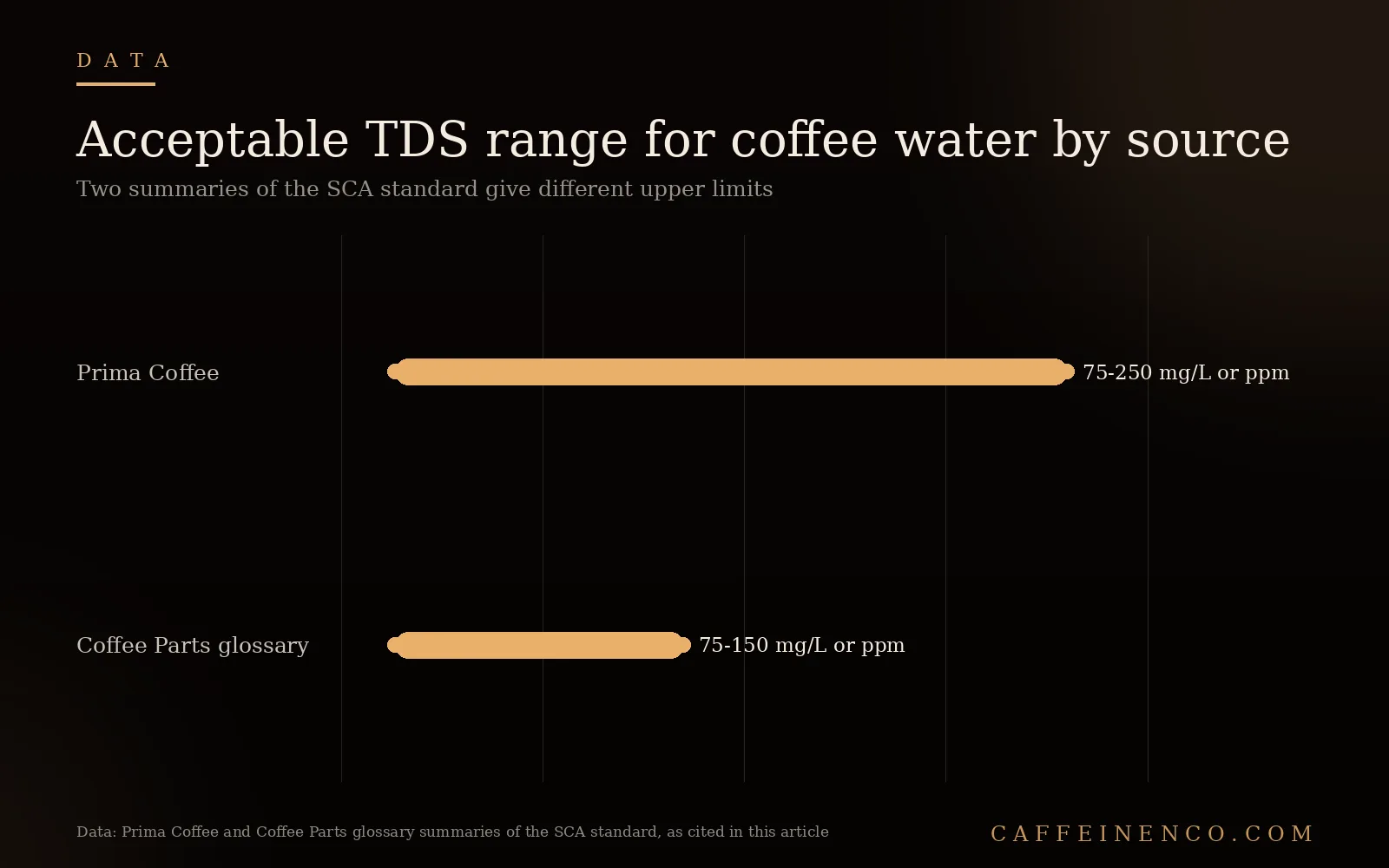
- The acceptable ranges differ by source. Prima Coffee lists TDS of 75 to 250 mg/L and hardness of 1 to 5 grains. The Coffee Parts glossary lists 75 to 150 ppm TDS and 50 to 80 mg/L of calcium carbonate hardness.
- A 2014 paper reported that the mix of sodium, magnesium and calcium in water changes how coffee extracts, so “total minerals” is not the whole story.
- A TDS meter tells you how many dissolved solids there are, not which ones. Your water utility’s report is usually the better first stop.
- If your water is far from the targets, the easy fixes are a filter jug, a blend of tap and softer water, or bottled water chosen by its label numbers.
Why water changes the cup
Brewing is extraction: hot water pulls dissolved compounds out of ground coffee. The water is not a neutral carrier. Its dissolved minerals take part in the process.
The best-known paper on this is Hendon, Colonna-Dashwood and Colonna-Dashwood, published in the Journal of Agricultural and Food Chemistry in 2014. The abstract states that different rates and compositions of coffee extraction are achieved through control of the water “impurities” sodium, magnesium and calcium. It reports binding-energy calculations showing that magnesium and calcium ions coordinate to nucleophilic motifs in coffee compounds. In plain terms, the specific ions in your water influence what gets pulled out of the grounds and how fast.
Two cautions. First, the paper is largely computational chemistry on selected flavor compounds. It supports the idea that mineral makeup matters, but it does not hand you a recipe for your kitchen. Second, the abstract says nothing about bicarbonate or buffering, so the alkalinity advice later in this guide rests on the SCA handbook and the retailer guides we cite, not on that paper.
The numbers, one at a time
Hardness
The USGS defines water hardness simply as the amount of dissolved calcium and magnesium in the water. It classifies hardness, in mg/L as calcium carbonate, like this:
| USGS class | Hardness (mg/L as CaCO3) |
|---|---|
| Soft | 0 to 60 |
| Moderately hard | 61 to 120 |
| Hard | 121 to 180 |
| Very hard | Over 180 |
Hardness is reported in different units depending on where you live: mg/L or ppm (these are treated as equivalent for water), and grains per gallon in the US. The sources we fetched do not give a conversion, so this guide uses the standard one: 1 grain per US gallon is about 17 mg/L. On that basis the 4 grain target is roughly 68 mg/L. That figure is our arithmetic, not a number quoted by Prima Coffee or the Coffee Parts glossary.
Alkalinity
Alkalinity, sometimes called buffer capacity or bicarbonate, is the water’s ability to neutralize acid. Coffee is acidic, so very high alkalinity can flatten the acidity you paid for, and very low alkalinity leaves the cup sharp. The SCA target quoted by Prima Coffee is at or near 40 mg/L. Hardness and alkalinity are related but not the same, and a water report may list them separately.
pH
pH measures how acidic or basic the water is. The SCA target is 7, with an acceptable range of 6.5 to 7.5. Prima Coffee’s guide says lower pH tends to produce bitter coffee and higher pH produces a flat cup lacking in distinct flavor notes. Treat that as a retailer’s rule of thumb, not a measured result from a controlled study.
TDS
TDS is the total of everything dissolved in the water. The SCA target is 150 mg/L. TDS meters are cheap and quick, but Prima Coffee makes the key caveat: a TDS reading does not specify what kind of solids are present. A water with 150 mg/L of mostly calcium and magnesium and one with 150 mg/L of mostly sodium would read the same on the meter and behave differently in the cup.
Sodium and chlorine
The SCA values quoted by Prima Coffee also list sodium at or near 10 mg/L and chlorine at 0 mg/L. Chlorine in tap water is easy to smell, and a basic carbon filter jug addresses it for most households.
Where the sources disagree
Here are the SCA numbers as reported by the two pages we fetched:
| Measure | Prima Coffee | Coffee Parts glossary |
|---|---|---|
| TDS | 150 mg/L target, 75 to 250 acceptable | 75 to 150 ppm |
| Hardness | 4 grains target, 1 to 5 grains acceptable | 50 to 80 mg/L calcium carbonate hardness |
| Alkalinity | At or near 40 mg/L | Not given |
| pH | 7 target, 6.5 to 7.5 acceptable | 6.5 to 7.5 |
On pH the two agree. On TDS they overlap but the upper limit differs by 100 mg/L. On hardness the ranges are written in different units and label slightly different things: one gives a target and an acceptable band in grains, the other gives a calcium carbonate hardness band in mg/L. Converting 1 to 5 grains at roughly 17 mg/L per grain gives about 17 to 85 mg/L, while the glossary gives 50 to 80.
We cannot tell you which summary is the more faithful copy of the handbook, because the full text is a paid publication and we did not read it. What we can say is that the target values (150 mg/L TDS, 4 grains hardness, pH 7) are consistent where both pages give them, and the ranges are where the summaries drift. Use the target as a goal and the ranges as a loose guide, not as a pass or fail line.
A worked example: reading a water report
Most municipal water utilities publish an annual report. Here is how to turn it into a verdict. The numbers in this example are invented for illustration.
Step 1: find hardness. Suppose the report says 140 mg/L as calcium carbonate. On the USGS scale that is “hard” (121 to 180).
Step 2: convert to grains. Divide by about 17: 140 / 17 is roughly 8.2 grains.
Step 3: compare with the target. The SCA target is 4 grains (roughly 68 mg/L by our conversion). This water is about double. Even the generous 1 to 5 grain range is exceeded.
Step 4: check the other lines. Say the report gives pH 7.8 and alkalinity of 110 mg/L. Both are above the SCA values (pH 7, alkalinity near 40 mg/L). Per the retailer rule of thumb above, high pH may read as flat, and high alkalinity buffers away acidity.
Step 5: decide what to do. Options are to dilute with a softer water, to use a filter that reduces hardness, or to use a bottled water whose label numbers are closer to the target. Our section on fixes explains each.
Reports also vary through the year and by supply zone. Treat a single annual figure as a ballpark, not a measurement of your tap this morning.
How to test your own water
You have three practical routes.
Route 1: your water utility’s report
Free, and it names the minerals rather than lumping them. Search for your utility’s annual water quality report. It will usually list hardness and pH, and sometimes alkalinity. It will not reflect what your pipes or home filters add or remove.
Route 2: a TDS meter
A handheld meter gives a number in seconds. Use it as a rough screen. If it reads near 150 mg/L you are in the right zone for total dissolved solids, but remember Prima Coffee’s caveat that it cannot say what the solids are. A reading of 30 and a reading of 400 tell you a lot. A reading of 140 versus 160 tells you almost nothing.
Route 3: test strips or a drop kit
Prima Coffee’s guide covers a hardness test strip that tests carbonate hardness only, a more comprehensive kit that tests hardness, pH, alkalinity, TDS and chlorine among other measures, and mail-in lab kits with results in one to two weeks. Which you choose depends on how many of the numbers you want. For a first check, the free utility report is usually enough to see whether you are close to the target or far off.
Fixing water that is off target
If the water is too hard
Hard water tends to leave scale in your kettle and machine. See our espresso machine descaling guide, which explains that descaling frequency depends on water hardness rather than a fixed calendar. Beyond scale, you can dilute with a softer water or use a filter that reduces hardness. A basic carbon filter does not necessarily reduce hardness, so check the filter’s own specification before assuming it does.
If the water is too soft or too pure
Distilled and heavily filtered water has almost no minerals. Given the 2014 paper’s point that calcium and magnesium influence extraction, water with none of them is unlikely to be ideal for brewing. Blending a little tap or mineral water into very soft water moves it toward the target.
If you are not sure
Change one thing at a time. Brew the same coffee, with the same ratio and grind, on your tap water and on a bottled water whose label hardness and TDS are closer to the target. If the cups taste different you have learned something real. Our brew ratio calculator will keep the ratio constant between the two.
Water versus the usual suspects
Before you blame water, rule out the common causes of a bad cup. Bitterness is usually over-extraction or a dark roast, and our why is my coffee bitter guide walks through it. A weak cup is more often ratio or grind, as in why does my coffee taste watery or weak. Temperature matters too: see our brewing water temperature guide.
Water becomes the prime suspect when:
- The same beans taste noticeably different at a friend’s house or when you travel.
- You have dialed in ratio, grind and temperature and the cup is still flat or harsh.
- Scale builds up quickly in your kettle, which is a strong sign of hard water.
Practical takeaways
- Know your three numbers. Hardness, alkalinity and pH, plus TDS as a rough screen.
- Aim for the targets, not the edges. 150 mg/L TDS, about 4 grains (roughly 68 mg/L) hardness, pH 7.
- Expect disagreement in ranges. Sources quoting the SCA standard differ on acceptable bands.
- Do not trust TDS alone. It cannot tell calcium from sodium.
- Change one variable at a time. Test water changes with everything else fixed.
- Start with the free report. Your utility has likely published the numbers already.
Common mistakes
Using distilled water. It has no minerals, and minerals take part in extraction.
Treating a TDS meter as a full water test. It measures the total, not the makeup.
Assuming a filter jug fixes hardness. Many remove chlorine and taste, not hardness. Check the specification.
Reading one report as gospel. Values change through the year and across supply zones.
Blaming water first. Ratio, grind and temperature are cheaper to fix.
Common questions
What is the ideal water hardness for coffee? The SCA target as Prima Coffee quotes it is about 4 grains, which is roughly 68 mg/L by the standard conversion. Sources give acceptable ranges of 1 to 5 grains (Prima Coffee) or 50 to 80 mg/L (Coffee Parts glossary).
What is the ideal pH for brewing coffee? The SCA target is 7, with an acceptable range of 6.5 to 7.5.
What TDS should coffee brewing water have? The SCA target is 150 mg/L. Prima Coffee gives 75 to 250 mg/L as acceptable, while the Coffee Parts glossary gives 75 to 150 ppm.
Is hard water bad for coffee? Water that is much harder than the target may change extraction and flavor, and it builds scale in kettles and machines. How much it affects taste depends on the beans and the brew method, and we did not find a controlled home-brewing study that quantifies it.
Can I use distilled water for coffee? We would not. A 2014 paper reports that sodium, magnesium and calcium influence what is extracted, and distilled water has none of them.
What is the difference between hardness and alkalinity? Hardness is mostly dissolved calcium and magnesium, per the USGS. Alkalinity is the water’s capacity to neutralize acid. They are related and often move together, but they are separate measurements.
Does a TDS meter tell me if my water is good for coffee? It gives a useful rough screen, but Prima Coffee notes it does not specify which solids are present, so two waters with the same reading can behave differently.
How often should I test my water? Once to learn your baseline is enough for most homes. Retest if your utility changes supply, you install a filter, or your taste results shift for no other reason.
Sources & data
- Wellinger M, Smrke S, Yeretzian C: The SCA Water Quality Handbook (Specialty Coffee Association, 2018; ZHAW record)
- Hendon CH, Colonna-Dashwood L, Colonna-Dashwood M: The Role of Dissolved Cations in Coffee Extraction (Journal of Agricultural and Food Chemistry, 2014; 62(21):4947-4950)
- USGS Water Science School: Hardness of water
- Prima Coffee: Testing your water (SCA target values and test methods)
- Coffee Parts: SCA water standards (glossary entry)