Bitter coffee almost always comes down to one mechanism: over extraction, pulling too many soluble compounds out of the grounds relative to how much water and time you gave them. Roast level plays a real secondary role, and water chemistry a smaller one still, but if your coffee tastes bitter, the fastest place to look is grind size, water temperature, and brew time, in that order. Fix those three and most bitterness problems disappear before you touch anything else.

There is a catch, though, and it trips up more people than any single brewing mistake. A lot of what gets reported as “bitter” coffee is actually sour, under extracted coffee that tastes sharp and unpleasant enough to read as bitterness to an untrained palate. Sorting out which one you actually have changes which fix you reach for, so that comes first.
Bitter or sour? The taste test that actually works
James Hoffmann, the 2007 World Barista Champion, has a name for this mix up: bitter sour confusion. As explained by Broadway Coffeehouse, it is “quite a common phenomenon in the general population,” and research from the Society of Sensory Professionals backs up why it happens: most people encounter pure sweetness and saltiness constantly in daily life, but rarely taste pure sourness or pure bitterness in isolation, so they lack the vocabulary to tell them apart. It is not that two people are tasting different things. It is that one of them has never learned the word for what they are tasting.
Here is the taste test, and you can run it on your next cup without any equipment. Take a sip and pay attention to two things: where in your mouth the sensation lands, and what your saliva does.
Sourness, real acidity, shows up along the sides of your tongue and toward the front, and it makes you salivate, the same reflex a lemon triggers. It is sharp, sometimes described as vinegary, green, or like unripe fruit, and it tends to hit fast and fade.
Bitterness lands at the back of the tongue and the back of the throat, and it does not make you salivate, if anything your mouth feels drier afterward. It lingers rather than fading, often described as ashy, burnt, medicinal, or like the pith of a grapefruit rather than the juice. Barista Hustle describes under extracted coffee as “sour, lacking sweetness, weirdly salty” with “a disappointingly quick finish,” while over extracted coffee is “dry and bitter,” with much of that dryness coming through as astringency alongside the bitterness itself.
If your coffee is thin, sharp, and makes your mouth water, you are almost certainly under extracting, and the fix is the opposite direction from everything below: grind finer, brew longer, or use hotter water, not less. If it is heavy, dry, and lingering at the back of your throat, you are over extracting, and the causes below are ranked by how often they turn out to be the culprit.
The real causes of bitter coffee, ranked
1. Your grind is too fine for the method
This is the dominant cause, and it is worth understanding why rather than just accepting it as a rule. Grinding finer increases the total surface area of coffee exposed to water, and more surface area means faster, more thorough extraction in the same amount of time. Push the grind fine enough for a given method and brew time, and the water simply pulls more out of the coffee than that method was designed to extract, running straight past the desirable compounds into the bitter, dry ones that come later in the extraction curve.
The fix is specific to your method, not a vague “grind coarser.” Drip and pour over want a texture like table salt, French press wants something closer to sea salt, and espresso wants a fine, almost powdery grind that still resists compacting into paste. If you switched grinders recently, or you are using a blade grinder that chops unevenly rather than crushing to a consistent size, that inconsistency alone can push a meaningful share of your grounds fine enough to over extract even when the average setting looks right. Our pour over, french press, and espresso guides each give the specific target texture for that method.
2. Your water is too hot
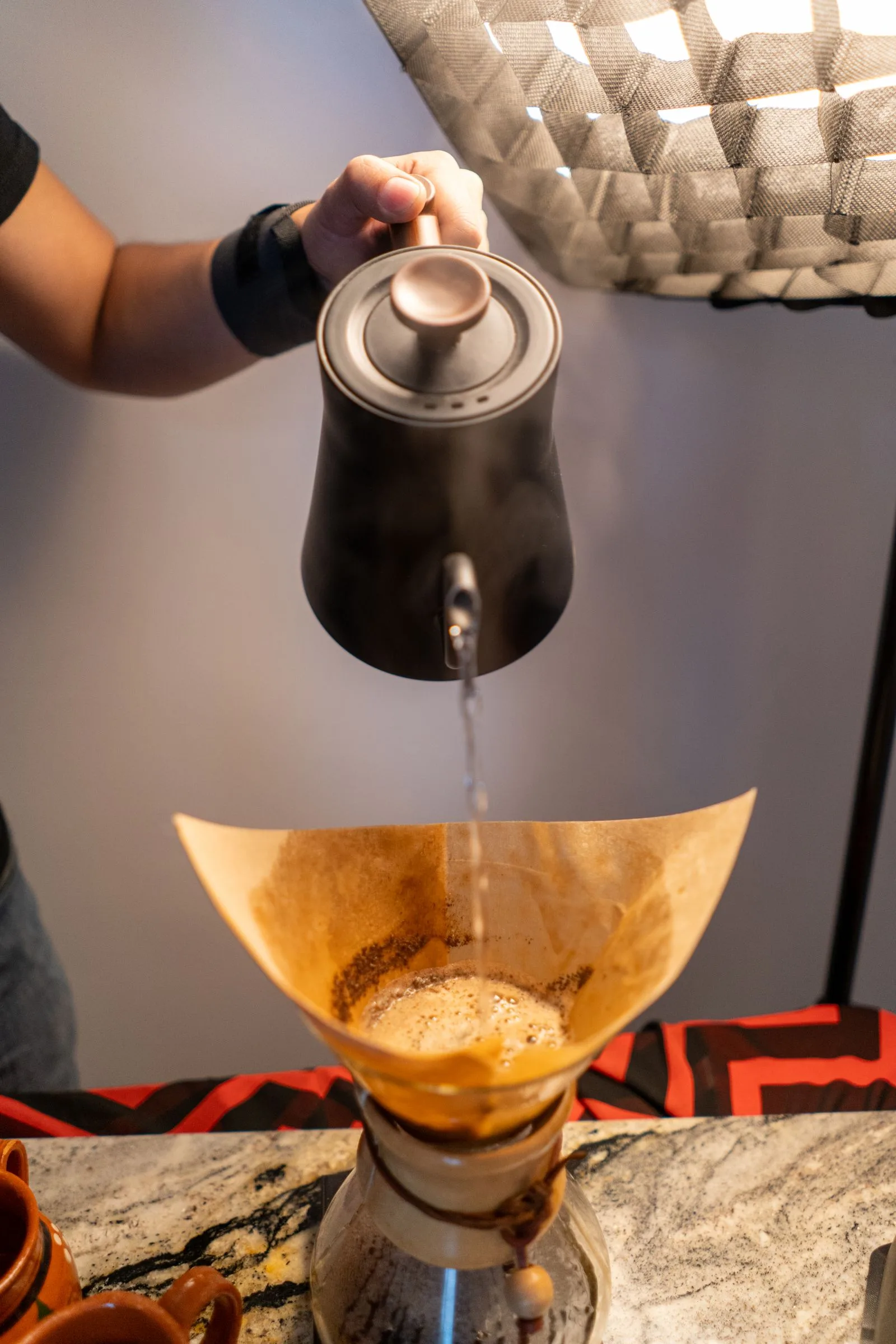
The Specialty Coffee Association’s Golden Cup Standard puts brewing water at 200°F, plus or minus 5°F, which works out to roughly 90 to 96°C. Go meaningfully hotter than that and you accelerate extraction the same way a finer grind does, pulling bitter compounds out faster than the desirable ones, and doing it early enough in the brew that there is no way to correct for it later in the same cup.
Boiling water straight off the kettle is the most common version of this mistake. Water at a full rolling boil sits around 100°C, well past the top of the SCA range, and it stays there for longer than most people expect if you pour immediately. Let boiled water rest off the heat for 30 to 60 seconds before pouring, or use a kettle with temperature control set to 92 to 96°C, and you remove this variable almost entirely without touching anything else about your brew.
3. Your brew time is too long
Time and grind size do the same job from different angles, both controlling how long water and coffee stay in contact, and both push you toward bitterness when they run too far. A stalled pour over that should take three minutes but takes six is extracting well past the point of diminishing returns, and immersion methods like French press or cold brew are especially vulnerable because there is no natural point where contact stops on its own the way it does when water drains through a filter.
If your brew is consistently running long, check the obvious culprit first: grind size, since too fine a grind slows flow and stretches brew time as a side effect rather than a separate problem. If the grind is right and time is still creeping, a stopwatch is a cheap fix. Four minutes for French press, two and a half to three for a standard V60 pour over, and cutting a cold brew steep back toward 12 to 16 hours rather than letting it run overnight out of habit, all keep contact time inside the range where extraction stays balanced rather than tipping into bitter territory.
4. Your dose and ratio are wrong
This one is more subtle than “too much coffee equals bitter,” because that is not quite how it works. Brewing convention lands most methods somewhere between 1:15 and 1:17, coffee to water by weight, which is roughly what our own pour over and french press guides recommend, and the SCA’s Golden Cup Standard sits close by at 55 grams per liter, near 1:18. Drift too far from that ratio in either direction and something breaks, but the two failure modes taste different.
Too little coffee for the water pushes you toward sour, under extracted coffee, the opposite problem to this article. Too much coffee for the water, on the other hand, produces a cup that is simply more concentrated, higher in total dissolved solids, and a very strong, over concentrated coffee can taste harsh and overwhelming in a way that reads as bitter even when the extraction percentage itself is technically normal. The fix in that case is not to change your extraction at all, it is to weigh your dose properly with a scale rather than trusting a scoop, since scoop volumes vary wildly between grind sizes and bean densities and are one of the easiest ways to end up brewing far stronger than you intended without realizing it.
5. Stale beans or a dirty brewer
Two separate problems that produce a similar result. Stale beans have lost much of their pleasant aromatic complexity to oxidation, so what is left is disproportionately the flatter, harsher compounds, making an otherwise correctly brewed cup taste duller and more bitter than the same beans would have a week or two earlier. Coffee is generally best somewhere between 4 and 21 days off roast, and it declines steadily after that window closes.
Dirty equipment is the one people skip over because the brewer looks clean. Ratio Coffee points out that oil residue builds up in spray heads, internal tubing, filter baskets, and carafes with every brew, and that old oils oxidize and “impart sharp, harsh notes” into whatever you brew next, on top of mineral scale that can lower brewing temperature and mute the cup further. None of this shows up as visible grime. Run a monthly descale and a full wash of every removable part, not just a rinse, and treat “it looks fine” as insufficient evidence that it is fine.
6. You are drinking a dark roast and expecting light roast flavor
Some bitterness is not a mistake at all, it is chemistry doing exactly what roasting does. Peer reviewed work led by food chemist Thomas Hofmann, covered by ScienceDaily, traced coffee’s bitterness to two compound families: chlorogenic acid lactones, the dominant bitter contributor in light and medium roasts, and phenylindanes, which those lactones break down into as roasting continues, and which build up at higher levels in dark roasted coffee. The phenylindanes carry a more lingering, harsher bitterness than the lactones they came from, which is a chemical explanation for something most coffee drinkers already sense intuitively: dark roast is simply built to taste more bitter than light roast, by design, not by accident.
If you are brewing a dark roast with correct grind, temperature, and time and it still tastes notably more bitter than a lighter roast brewed the same way, that is not a brewing fault to chase down. It is the roast profile working as intended, and the fix is a lighter roast, not a different brew ratio.
7. Your water chemistry is working against you
The smallest lever of the group, but a real one once everything else is dialed in. According to Scott Rao, “alkalinity is the single most important factor in how water will affect coffee flavor,” and it works independently of the water’s pH reading. Alkalinity, driven mainly by dissolved bicarbonate, acts as a buffer against acidity, so water with high alkalinity mutes the bright, acidic notes in coffee and can leave what remains tasting flatter and comparatively more bitter, even when nothing about your brewing technique has changed.
Rao’s own reference point, drawn from his book Everything But Espresso, lands around 50 milligrams per liter of alkalinity for balanced results, with a lower range of 30 to 40 ppm for lighter, well developed roasts specifically. Very hard tap water or water run through a softener that raises alkalinity can both push you toward this flatter, duller profile. If you have already fixed grind, temperature, time, and dose and something still tastes off in a way you cannot pin down, water chemistry is the remaining variable worth testing, and a basic lab water analysis is the only way to know where you actually stand rather than guessing.
Ranked causes at a glance
| Rank | Cause | What it does | Fastest fix |
|---|---|---|---|
| 1 | Grind too fine | Increases surface area, speeds extraction past balance | Match grind texture to method exactly |
| 2 | Water too hot | Pulls bitter compounds out faster and earlier | Keep water at 90 to 96°C, off the boil |
| 3 | Brew time too long | Extends contact time past the balanced window | Time your brew, fix grind if it is the cause |
| 4 | Dose and ratio wrong | Over concentrates the cup, not always true over extraction | Weigh dose on a scale, target 1:15 to 1:17 |
| 5 | Stale or dirty gear | Rancid oils and flat aromatics dull the cup | Buy closer to roast date, wash gear monthly |
| 6 | Dark roast expectations | Phenylindanes build up with continued roasting | Choose a lighter roast if this is the goal |
| 7 | Water chemistry | High alkalinity mutes acidity, flattens the cup | Test alkalinity, target roughly 30 to 50 ppm |
Common questions
Can bitter coffee ever be fixed after it is brewed? Only partially, and mostly through dilution rather than correction. Adding hot water Americano style reduces concentration and makes bitterness less overwhelming, and milk or a small amount of salt can mask it further on the palate. Neither removes the bitter compounds already dissolved in your cup, so both are damage control for today’s cup rather than a real fix, which has to happen on the next brew.
Is bitter coffee ever a sign of bad beans rather than bad brewing? Rarely, and it is worth ruling out brewing first since it is the more common cause by a wide margin. Beans that were roasted unevenly, roasted too dark for their origin, or have gone stale well past their best window can all contribute genuine bitterness independent of technique. But because grind, temperature, time, and dose account for most bitter cups, changing beans before checking those four is usually solving the wrong problem.
Does adding salt to coffee actually reduce bitterness? There is a real mechanism behind it, not just a kitchen myth. A very small pinch of salt can suppress the perception of bitterness on the tongue without adding noticeable saltiness itself, a genuine taste interaction rather than a masking trick. It is worth knowing as an emergency fix for a cup you have already brewed, but it treats the symptom, not the extraction problem that caused it.
Why does my coffee taste bitter even though I followed the ratio exactly? Ratio only controls one variable among several, so getting it right does not guarantee the others are. Grind size, water temperature, and brew time can each independently push a correctly dosed cup into bitter territory, and a correct ratio brewed with too fine a grind or overly hot water will still come out bitter. Check those three before assuming the ratio itself is the problem.
Is espresso naturally more bitter than other brewing methods? Yes, and there is a real reason beyond just “it’s strong.” Research on bitter compound formation found that pressure combined with high temperature, which is exactly what espresso brewing uses, tends to produce the highest levels of bitter compounds among common brewing methods. A well pulled shot balances that bitterness against sweetness and acidity rather than eliminating it, which is part of why espresso extraction is judged on such a narrow time and yield window compared with other methods.
Once grind, temperature, and time are dialed in, precise dosing is the next lever worth pulling. Our caffeine calculator is built for strength and intake tracking rather than brew ratios, but if you want the full step by step breakdown for getting grind, dose, and time right for your specific method, start with our espresso, pour over, or french press brew guides.
For more brewing fixes like this one, sourced and reasoned through rather than guessed at, delivered weekly, subscribe to The Sunday Pour.
Sources & data
- Barista Hustle: Coffee Extraction and How to Taste It
- Broadway Coffeehouse: How to Taste Coffee, Part 3, Bitter Sour Confusion
- Scott Rao: Demystifying Water for Coffee
- ScienceDaily: Battling Bitter Coffee, Chemists Identify Roasting As The Main Culprit
- Podium Coffee Club: The SCA Brewing Control Chart, Explained for Home Brewers
- Ratio Coffee: That Clean Looking Brewer Is Probably Not Clean Enough