Every other brewing method this site has walked through, AeroPress, Chemex, Kalita Wave, moka pot, siphon, Turkish, gets a dedicated ratio and grind size guide with gram amounts and a worked recipe. Cold brew has not, even though this site’s own coffee to water ratio chart already lists a 1:8 concentrate ratio for it, and the grind size chart already places its texture at 800 to 1,500 microns. Those two references are correct as far as they go, but cold brew has a wrinkle none of the pour-over or immersion methods above it share: most recipes are not meant to be drunk as brewed, they are a concentrate diluted after the fact, and that single fact changes what “ratio” even means for this method. Three independently published guides, from Counter Culture Coffee, Mystic Monk Coffee, and Coffee Project NY, give this site enough to build the same depth of guide for cold brew that the other methods already have, concentrate ratio, single-strength ratio, grind, and the steep-time question that trips up more home brewers than almost anything else about this method.
The ratio: concentrate versus single-strength, reconciled
Cold brew gets brewed strong and then cut down, and every sourced guide here agrees on that mechanic even though they disagree on how strong “strong” should be. Counter Culture Coffee states its concentrate method directly: a “1:8 ratio, 1 gram of coffee for every 8 grams of water and then diluting as your final step.” That 1:8 figure matches this site’s own ratio chart exactly. Critically, Counter Culture is explicit that the finished concentrate is not the drink: it recommends a “concentrate-to-water ratio between 2:1 and 1:1” once you actually pour a glass, meaning the true strength you taste is considerably more diluted than the 1:8 brewing ratio alone would suggest. Counter Culture also offers the reverse option for anyone who wants to skip that step: brew at a 1:11 ratio instead, and “you can also use a 1:11 ratio and not dilute at the end depending on your brewing device.”
Coffee Project NY’s number is not a lighter, drink-as-is alternative, it is one of the strongest concentrates among the sources here. A straight “1:5 ratio” (5 grams of water for every 1 gram of coffee) produces what the source itself calls an “unfiltered concentrate [that] is very dense and syrupy,” and the instruction is the same as Counter Culture’s: “dilute your cold brew concentrate and enjoy.” A 1:8 batch cut 1:1 lands close to a 1:16 final strength; Coffee Project NY’s 1:5 concentrate starts out considerably more potent than 1:8, so it needs a bigger dilution to land in a comparable range, not a smaller one.
Ratio by strength preference
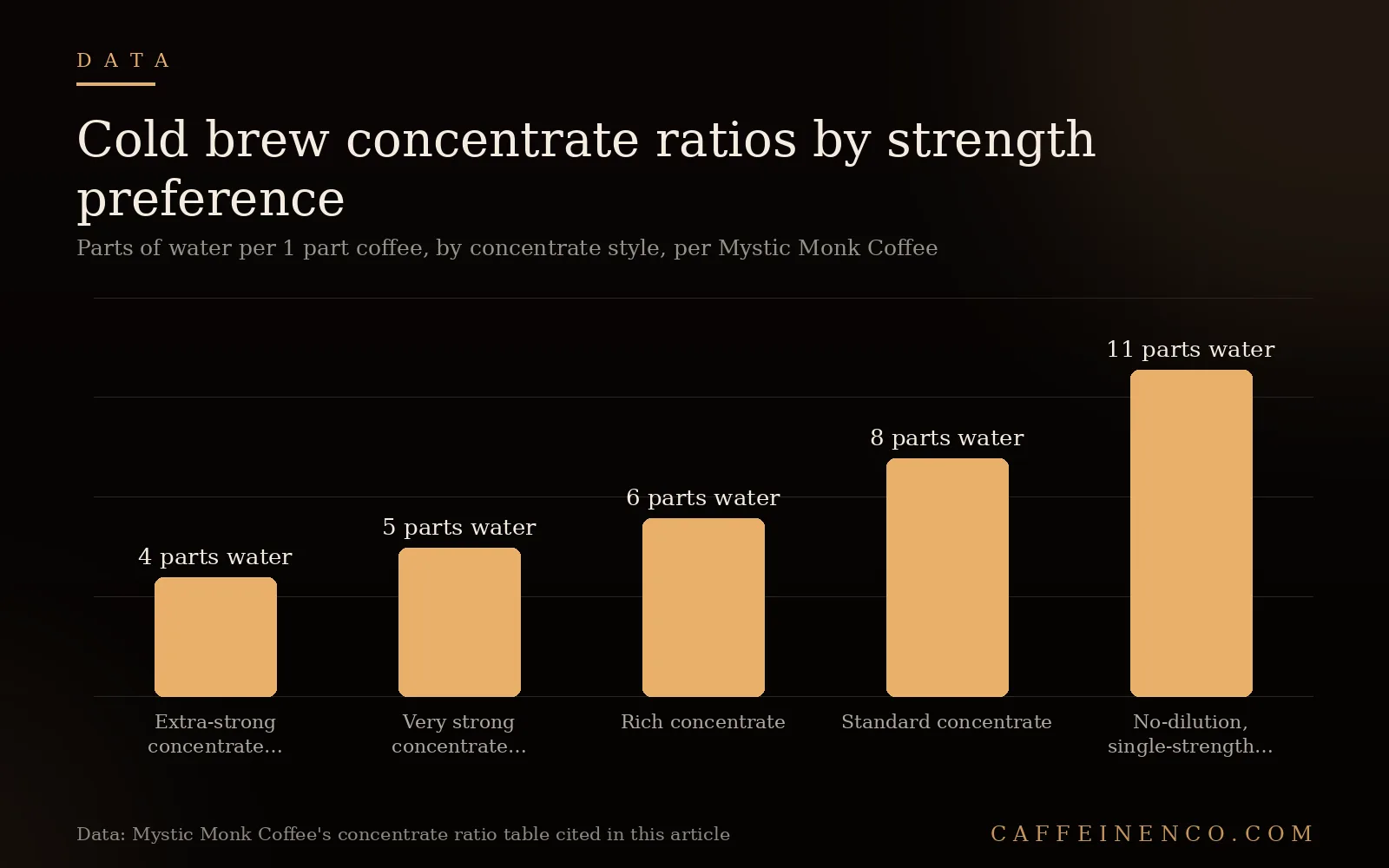
Mystic Monk Coffee breaks the concentrate range down further by strength, giving a genuinely useful spread rather than one flat number:
| Style | Ratio (coffee : water) | Result |
|---|---|---|
| Extra-strong concentrate | 1:4 | Espresso-like intensity, meant for heavy dilution |
| Very strong concentrate | 1:5 | Coffee Project NY’s method: “very dense and syrupy,” needs a bigger dilution than 1:8 |
| Rich concentrate | 1:6 | Full-bodied, still meant to be cut with water or milk |
| Standard concentrate | 1:8 | This site’s default, and the most commonly published figure |
| Light, easy-sipping | 1:9 to 1:10 | Gentler concentrate, still meant to be diluted, just less |
| No-dilution, single-strength | 1:11 | Counter Culture’s own alternative: brew at this ratio and skip the dilution step entirely |
If you only remember one number, make it 1:8: it is the figure this site’s own ratio chart already uses, it is Counter Culture’s stated default, and it sits near the middle of the concentrate range across all three sourced guides. Everything else in the table is a deliberate departure from that midpoint toward either more concentrated or more diluted, not a competing “correct” answer.
Not every published guide draws the concentrate versus ready-to-drink line in the same place, and it is worth being upfront about that rather than smoothing it over. Ratio Coffee, cited in this site’s own cold brew troubleshooting guide, states plainly that “cold brew concentrates are typically made with a 1:4 to 1:5 coffee-to-water ratio, later diluted before serving,” while “for ready-to-drink cold brew: aim for about 1:8 to 1:10 ratio,” placing 1:8 on the drink-it-straight side of the line. Counter Culture Coffee, Coffee Project NY, and Mystic Monk Coffee, the three guides sourced in this piece, disagree: all three treat 1:8 as a concentrate that still wants a dilution step, and only Counter Culture’s own 1:11 alternative is described as light enough to skip it. Both readings are accurate to their own source; there is no single industry-wide line between “concentrate” and “ready to drink.” This guide follows the dilution instructions Counter Culture, Coffee Project NY, and Mystic Monk each give directly for a 1:8 batch. If a 1:8 batch has already been tasting right to you served straight, per other guidance, there is no need to change that on this guide’s account.
The grind: coarse, the texture of raw sugar or breadcrumbs
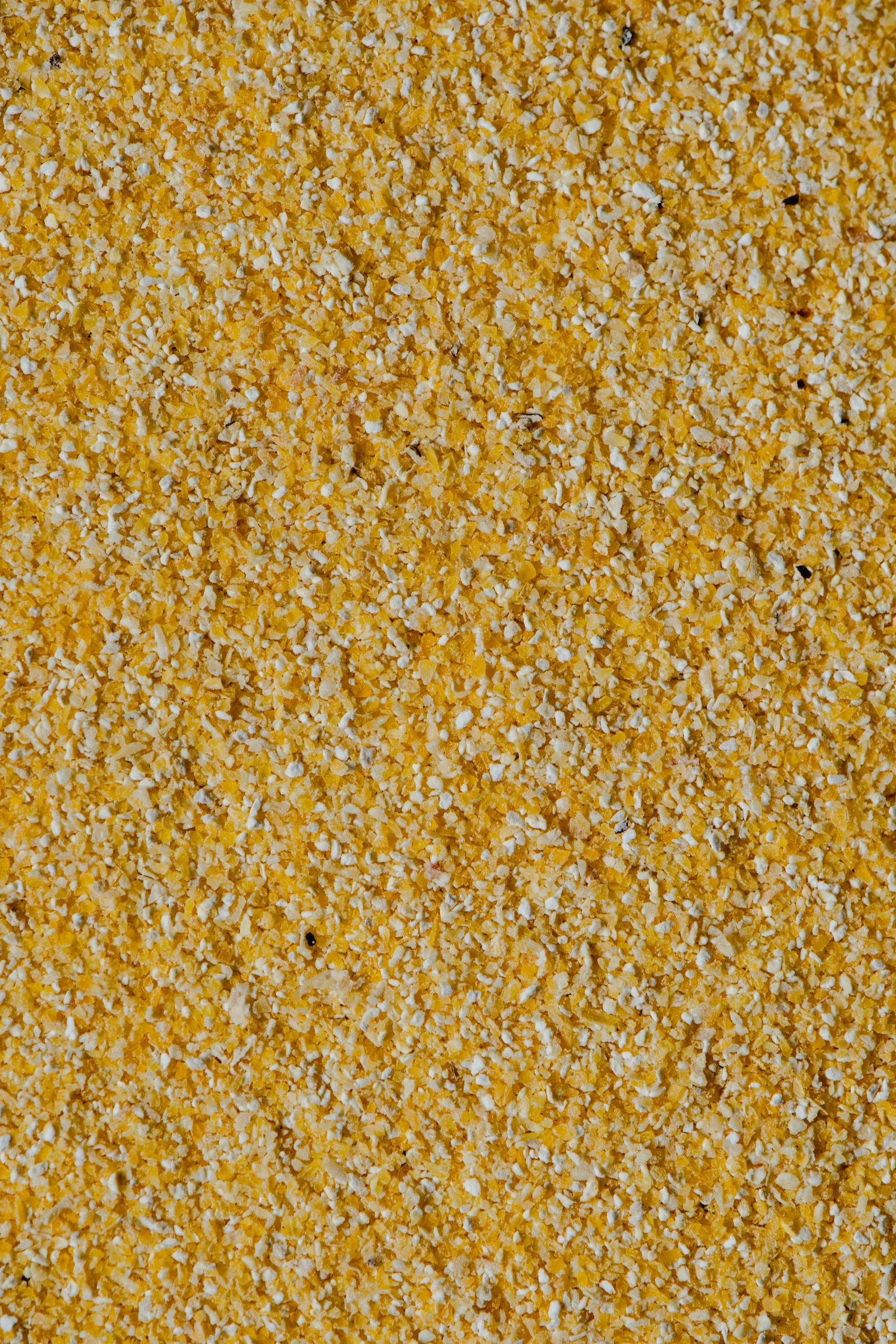
All three sourced guides describe the same grind in close to identical language, which is a stronger three-way agreement than most methods on this site get. Mystic Monk Coffee calls for a texture “similar to coarse sea salt or raw sugar (you should be able to see and feel each grain between your fingers),” and separately describes the result as looking like “tiny coffee ‘pebbles’ or dense breadcrumbs.” Coffee Project NY goes a step coarser still, calling for an “extra-coarse grind the size of breadcrumbs.” Counter Culture Coffee quantifies it differently, recommending “medium-coarse” ground at “a seven or so” on its own 1-to-10 coarseness scale, which lands in the same coarse-but-not-extreme territory as the other two guides’ texture comparisons.
That agreement matches what this site’s own grind size chart already documents for cold brew: 800 to 1,500 microns, described there as “raw sugar to peppercorn,” and flagged as one of only a few methods where published charts genuinely disagree on the exact range. The reason a coarse grind matters here specifically, more than for almost any faster brew method, is extraction time. Mystic Monk states the mechanism plainly: “the finer the grind, the quicker it extracts flavor,” and with cold brew’s extended steep, anywhere from 12 to 24 hours, a fine grind has enormously more contact time to pull out bitter, over-extracted compounds than the same grind would in a four-minute French press or a three-minute pour-over. The same source is direct about the symptom: “if your cold brew tastes bitter or gritty, the grind is likely too fine.”
A burr grinder with a coarse or cold-brew-specific setting gets you into this range consistently, or you can browse the same category on Amazon. A blade grinder can get close, and cold brew is one of the more forgiving methods for one, per this site’s own grind size chart, but a blade’s uneven particle spread still means more fines slipping into that 12-to-24-hour steep than a burr grinder set to a genuinely coarse gap would produce.
Steep time: why room temperature and refrigerated recipes disagree
Read enough cold brew recipes and the steep-time numbers scatter more than the ratio or grind figures do, and temperature explains part of that, but not all of it. Counter Culture is direct that its steep should always happen in the fridge, “no matter how long you brew,” recommending “14 hours is a good place to start.” Mystic Monk gives two separate windows depending on where you steep: “12-16 hours” at room temperature, or “18-24 hours” refrigerated. Coffee Project NY calls for a refrigerated steep of “20-24 hours” specifically “for better brewing consistency.”
Temperature accounts for some of that spread: within Mystic Monk’s own guidance, the room-temperature window (12-16 hours) runs shorter than its own refrigerated window (18-24 hours), because a colder steep extracts more slowly. But it does not account for all of it. Counter Culture’s fridge steep starts at 14 hours and Coffee Project NY’s fridge steep starts at 20, and both are refrigerated recommendations, so that eight-to-ten-hour gap is a genuine disagreement between sources, not a temperature effect. This site’s own grind size chart already gives a single rounded “12 to 24 hour steep” for cold brew, and that wide range covers both the temperature effect and the plain disagreement between published guides. The honest takeaway: refrigerated is the safer default, per Counter Culture and Coffee Project NY, and if you steep at room temperature instead, per Mystic Monk, expect a shorter window, roughly 12 to 16 hours, since extraction runs faster without the cold.
Worked example: brewing your first batch
- Pick your method. Concentrate (brew strong at a ratio like 1:5 to 1:8, dilute later) or single-strength (brew at roughly 1:11 and skip dilution, per Counter Culture’s own alternative). This guide uses the standard 1:8 concentrate, since it is what this site’s own ratio chart and Counter Culture’s default both use.
- Weigh your ratio. For a standard 1-liter batch at 1:8, that is 125 grams of coffee to 1,000 grams (1 liter) of water. Scale up or down from there; the ratio holds regardless of batch size.
- Grind coarse. Aim for the texture of coarse sea salt or raw sugar, per Mystic Monk and Coffee Project NY’s matching descriptions, distinctly coarser than a French press grind.
- Combine and stir. Add the grounds to a large jar or pitcher, pour the water over them, and stir once to make sure every ground is saturated. No bloom, no pour technique, unlike a hot brew method.
- Choose your temperature and set a timer. Refrigerated is the safer default: Counter Culture starts checking at 14 hours, and Coffee Project NY calls for 20 to 24. Room temperature moves faster, 12 to 16 hours per Mystic Monk. Pick one and stay consistent rather than mixing timings meant for a different steep environment.
- Filter thoroughly. A paper filter, a fine mesh strainer lined with cheesecloth, or a dedicated cold brew maker with a built-in filter all work; the goal is removing sediment that a quick pour through a regular strainer will not catch. A dedicated cold brew pitcher with a fine-mesh steeping filter makes this step a lot less messy than jar-and-cheesecloth if you make cold brew regularly.
- Dilute to taste. Start at Counter Culture’s suggested 1:1 concentrate-to-water ratio and adjust from there; some drinkers prefer closer to 2:1 concentrate for a stronger glass.
- Store the concentrate, not the diluted drink. Undiluted concentrate keeps in the refrigerator for roughly one to two weeks; dilute single servings as you go rather than diluting the whole batch at once, which keeps it fresher longer.
How cold brew’s ratio compares to other methods on this site
At a 1:8 concentrate ratio, cold brew sits close to moka pot’s 1:7 to 1:8 range, which looks like a coincidence until you remember both are meant to be strong by design, moka pot because it is drunk in small cups, cold brew because the concentrate gets diluted again before serving. Once you account for that dilution step, a 1:8 batch cut 1:1 lands closer to a 1:16 final strength, in the same neighborhood as this site’s French press ratio guide at 1:12 to 1:17, or drip coffee’s 1:15 to 1:18 range. Coffee Project NY’s stronger 1:5 concentrate, once diluted down to drinking strength, lands in a similar range to the other concentrate figures above; it is Counter Culture’s own undiluted 1:11 option, by contrast, that is close to Turkish coffee’s 1:8 to 1:12 concentration once you allow for Turkish being simmered rather than steeped cold. The grind tells a cleaner story: at 800 to 1,500 microns, cold brew is one of the coarsest methods this site covers, coarser even than French press, and edged out only by percolator’s 1,000 to 1,600 micron range, because the extended steep time can pull flavor from particles no fast hot-water method could ever extract evenly.
Common mistakes
Treating a concentrate recipe’s 1:8 ratio as the strength you are supposed to drink is the most common mistake, when Counter Culture and this site’s own ratio chart both treat that number as a brewing ratio meant for a second dilution step, not a serving ratio. Grinding too fine to “speed up” a batch is the second: cold brew’s 12-to-24-hour steep already gives fine particles far more contact time than any hot brew method, and per Mystic Monk’s own guidance, grit and bitterness are the direct result, not a faster or stronger cup. Comparing steep-time numbers across recipes without checking whether they were brewed at room temperature or refrigerated is the third, since a 12-hour room-temperature steep and a 20-hour refrigerated one can land at a similar extraction stage despite the numbers looking wildly different on the page.
Common questions

What is the best coffee to water ratio for cold brew? 1:8 for a standard concentrate, per Counter Culture Coffee and the midpoint of Mystic Monk’s full concentrate range, which also matches the figure this site’s own coffee to water ratio chart already uses. Dilute the finished concentrate with water at roughly 1:1 to 2:1 before drinking.
Do I need to dilute cold brew concentrate? Yes, if you brewed it at the standard 1:8 concentrate ratio. Counter Culture Coffee recommends a concentrate-to-water ratio “between 2:1 and 1:1” for a drinkable cup; skipping this step means drinking coffee brewed roughly twice as strong as intended.
What grind size is best for cold brew? Coarse, roughly the texture of coarse sea salt, raw sugar, or breadcrumbs, per matching descriptions from Mystic Monk Coffee and Coffee Project NY. This site’s own grind size chart places that at 800 to 1,500 microns, coarser than French press and every faster hot-brew method, and second only to percolator’s 1,000 to 1,600 microns.
How long should I steep cold brew? Refrigerated is the safer default across sources: Counter Culture starts at 14 hours, Mystic Monk’s fridge window is 18 to 24 hours, and Coffee Project NY calls for 20 to 24 hours refrigerated. Room temperature moves faster, 12 to 16 hours per Mystic Monk. Pick one temperature and stay consistent rather than mixing timings from different-temperature recipes.
Why does my cold brew taste bitter or gritty? Almost always a too-fine grind. Mystic Monk states the mechanism directly: finer grounds extract faster, and cold brew’s long steep gives them far more time to over-extract than a hot brew method would allow. This site’s cold brew troubleshooting guide covers the other common causes, including filtration and water quality.
Is cold brew concentrate the same as ready-to-drink cold brew? It depends which guide you’re reading; sources genuinely disagree on where the line falls. Counter Culture Coffee, Coffee Project NY, and Mystic Monk Coffee, the three guides sourced in this piece, all treat 1:8 as a concentrate still meant for dilution, with Counter Culture’s own 1:11 option the only exception, brewed deliberately light enough to skip that step. Ratio Coffee, cited in this site’s own cold brew troubleshooting guide, draws the line differently, placing 1:8 to 1:10 in the ready-to-drink category instead. Both are accurate to their own source. This guide follows the dilute-at-1:8 instructions Counter Culture, Coffee Project NY, and Mystic Monk each give directly; pre-bottled ready-to-drink cold brew from a store is a separate product brewed by the manufacturer to its own target ratio either way.
For the caffeine math behind a glass of cold brew rather than the brewing ratio, see this site’s cold brew caffeine content breakdown. For more sourced brewing breakdowns like this one, delivered weekly, subscribe to The Sunday Pour.