Every other brewing method on this site has drawn plenty of search traffic asking for its exact ratio, AeroPress, Kalita Wave, Turkish coffee, French press, but the method actually sitting on most kitchen counters every morning is the plain electric drip machine, and it has never gotten its own dedicated breakdown here. That is a real gap, because drip coffee has a specific, well-documented ratio range and a genuinely underexplained trap hiding inside nearly every machine’s own markings. Two independently written guides converge on the same 1:15 to 1:18 range, and both flag the same problem: the “cup” printed on your carafe almost certainly is not 8 fluid ounces.
The ratio: 1:15 to 1:18, reconciled
The Coffee Ratio states the SCA’s Golden Ratio for drip coffee lands at roughly 1:16 to 1:18, and separately notes the SCA recommends 55 grams of coffee per litre of water, which works out to about 1:18. For a full 12-cup machine holding 1.8 litres of water, it gives a working range of 100 to 112 grams of coffee for the whole pot, and for two cups, roughly 475 milliliters of water, it specifies about 30 grams at a 1:16 ratio or 26 grams at a lighter 1:18. Coffee Gear Hub independently arrives at a near-identical figure set: a 1:16 default, 19 grams of coffee for a single 300 gram mug, and 113 grams for a full 1,800 gram, 12-cup carafe, while also citing the same SCA Golden Cup standard of 1:18 (55 g/L), which it notes is calibrated for certified commercial machines running at 92 to 96 degrees Celsius. Coffee Gear Hub adds a detail The Coffee Ratio does not: most home drip machines run cooler than that certified benchmark, so it recommends compensating with a slightly stronger 1:16 default, and tightening further to roughly 1:15 for full 8 to 12 cup batches, where extraction efficiency drops slightly compared to a single mug.
Put together, the two guides describe the same corridor from two angles. 1:18 is the SCA’s calibrated standard for certified equipment; 1:16 is the practical default both sources actually recommend for a typical home machine; and 1:15 is where both push for full-batch brewing or a stronger cup. This site’s own coffee to water ratio chart covers the same SCA standard in more depth, converting it to a 50 to 60 gram per litre tolerance band, 1:16.7 to 1:20, and makes the same point these two sources do: 1:18 is a corridor’s center, not a single mandatory number.
Ratio by pot size, in grams
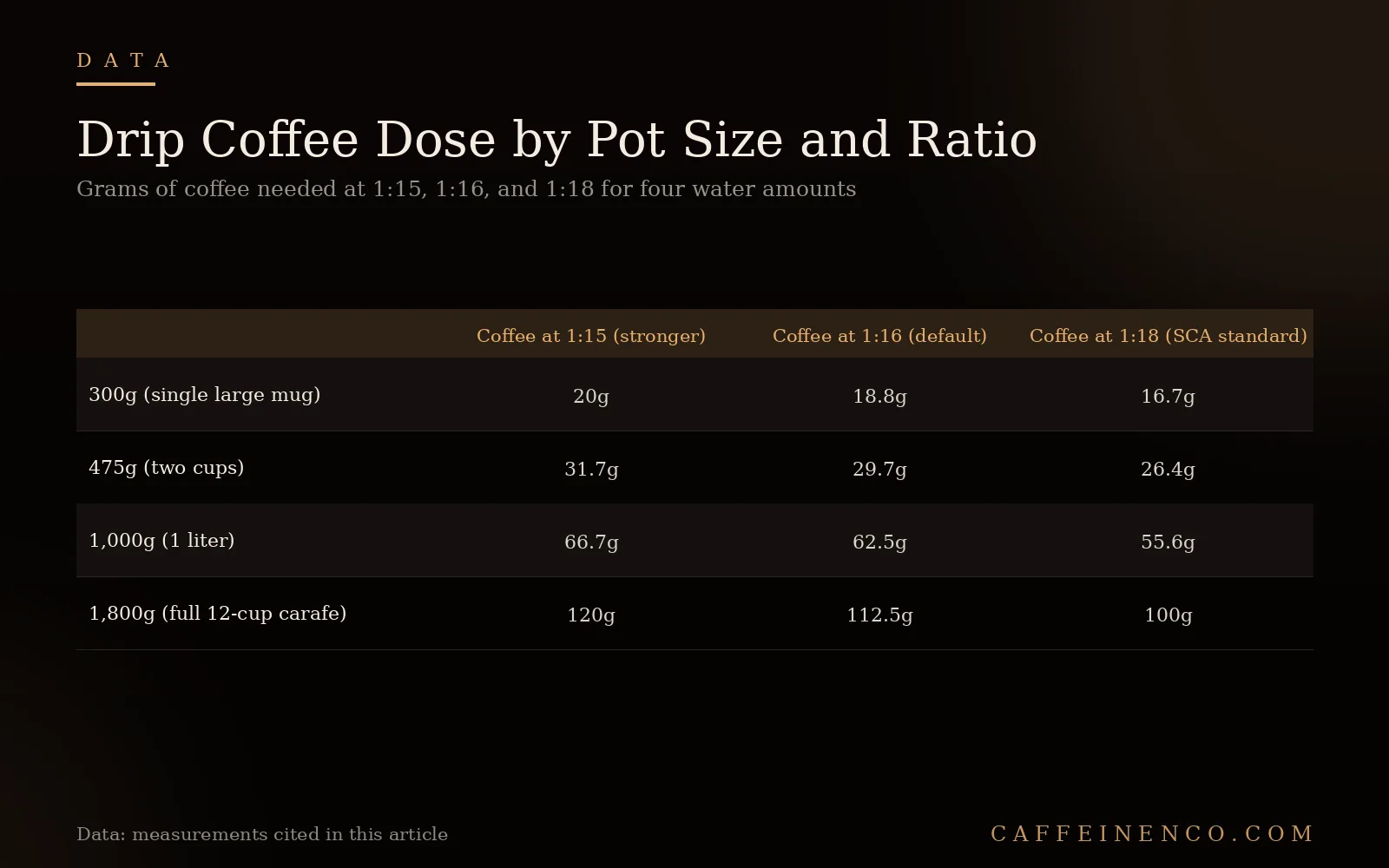
| Water | Coffee at 1:15 (stronger) | Coffee at 1:16 (default) | Coffee at 1:18 (SCA standard) |
|---|---|---|---|
| 300g (single large mug) | 20g | 18.75g | 16.7g |
| 475g (two cups) | 31.7g | 29.7g | 26.4g |
| 1,000g (1 liter) | 66.7g | 62.5g | 55.6g |
| 1,800g (full 12-cup carafe) | 120g | 112.5g | 100g |
Both sourced guides’ full-carafe figures, 100 to 112 grams from The Coffee Ratio and 113 grams from Coffee Gear Hub, land inside a few grams of the table above, confirming the same range from two independent sources.
The trap: a “cup” on your machine is not 8 ounces
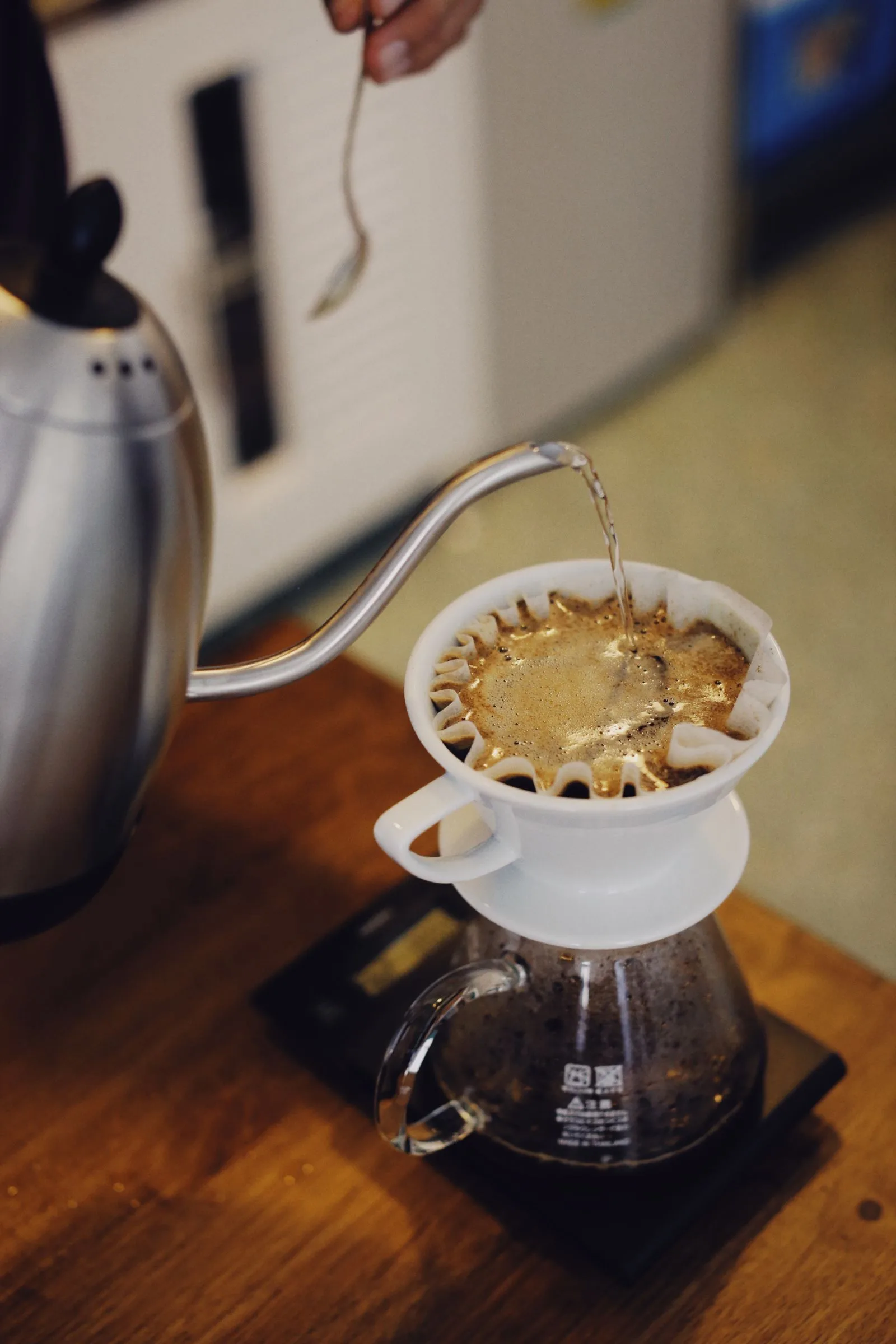
This is the part both sourced guides flag and most competing pages skip entirely. A drip machine marked “12 cup” is not promising 12 standard 8-fluid-ounce cups, 96 ounces total; it is using a manufacturer’s internal convention that commonly runs closer to 5 or 6 fluid ounces per marked cup. This site’s ratio chart covers the same trap in detail: two machines both labeled “12 cup” can hold meaningfully different actual water volumes, and calculating your coffee dose from the printed markings rather than an actual weighed amount can put you 20 percent or more off your target ratio before you have ground a single bean.
The fix is simple and only needs doing once per machine. Fill your carafe to a marked line, pour that water onto a kitchen scale, and note the actual gram weight next to that line. From then on, use the weighed number, not the printed one, to calculate your coffee dose from the table above. If your coffee has been coming out weaker than you expect despite what looks like a careful measurement, our guide to why coffee tastes watery or weak covers under-dosing as one of the most common, and most fixable, causes.
Grind size and brew time
Drip machines are built around a specific grind window, and this site’s own grind size chart puts standard auto-drip machines at 600 to 900 microns, described there as “medium sand,” with a typical 4 to 6 minute brew cycle per pot. That is coarser than a Kalita Wave or V60 pour-over grind and considerably coarser than espresso, because a drip machine’s flat, wide filter bed and gravity-only flow need a coarser grind to avoid over-extracting during the longer contact time. If your machine’s grounds compartment drains sluggishly and leaves standing water, coarsen slightly; if your coffee tastes thin despite hitting your gram target, a slightly finer grind within that band is usually the first thing to try before assuming the ratio itself is wrong.
How to dial in your own machine, step by step
- Weigh your machine’s actual water capacity. Fill the reservoir to your usual line, pour it onto a kitchen scale, and record the real gram weight rather than trusting the printed cup markings.
- Pick a starting ratio. Use 1:16 as your default for a single mug or a partial pot, and 1:15 if you are brewing a full 8 to 12 cup batch, matching both sourced guides’ recommendation to compensate for a home machine’s lower brew temperature and larger-batch extraction loss.
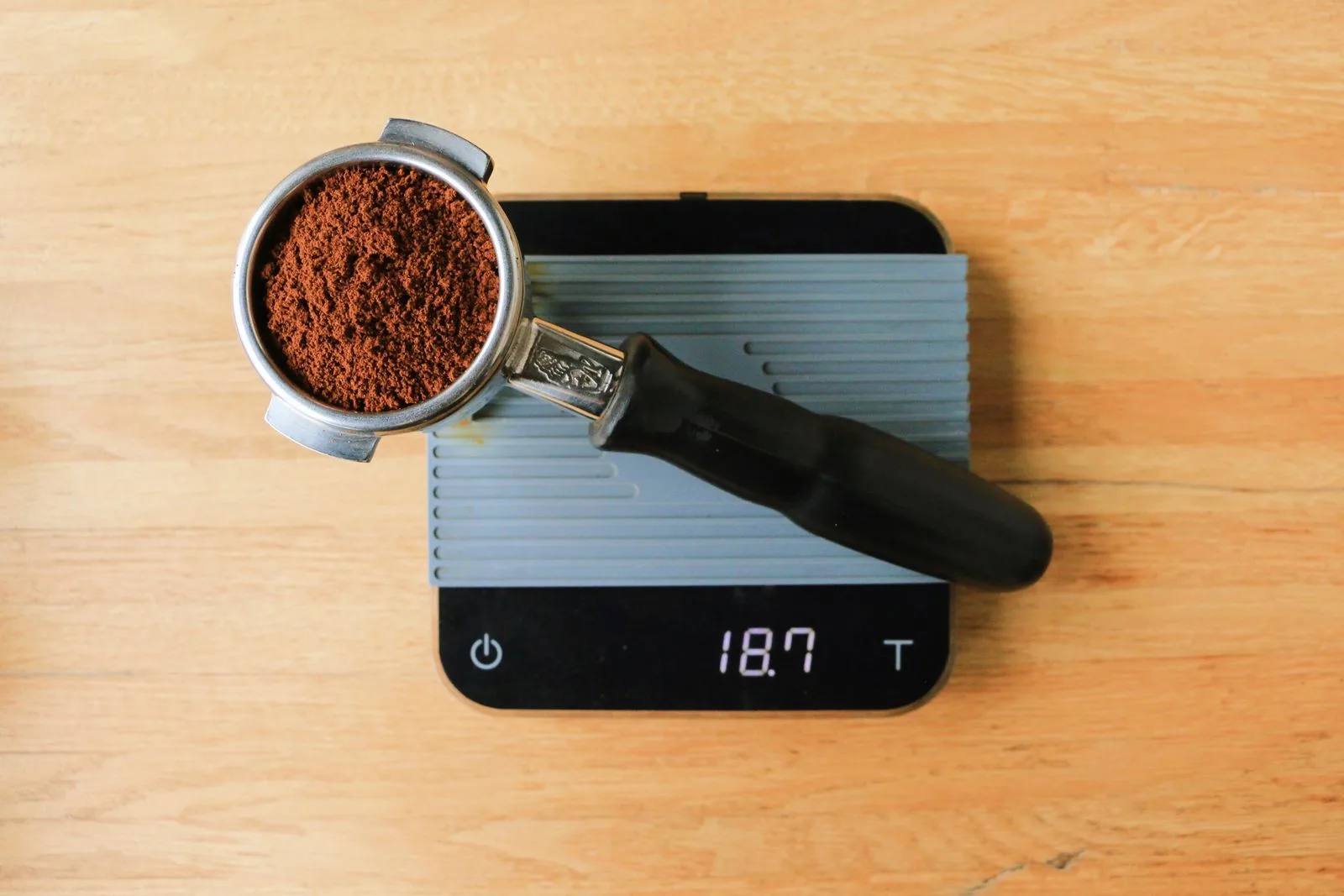
- Weigh the coffee, not the scoop. A standard coffee scoop varies enough between brands that it cannot reliably hit a specific gram target; use the table above and a kitchen scale instead.
- Grind to a medium, sand-like texture. Aim for the 600 to 900 micron band this site’s grind chart specifies for drip machines, and adjust the machine’s built-in grind setting if it has one, or your standalone grinder if it does not.
- Run one full brew and taste before adjusting further. If it tastes weak or sour, move toward 1:15 next time. If it tastes bitter or harsh, move toward 1:18 or coarsen the grind slightly.
- Lock in the number that works and stop guessing. Once you find your ratio, write down the gram figures for your specific machine’s actual capacity so every future pot starts from a known baseline instead of the printed cup lines.
Common mistakes
Trusting the printed cup lines is the single most common mistake, and it is the one both sourced guides go out of their way to correct: those markings are a manufacturer convention, not a real fluid measurement, and using them directly instead of a weighed baseline is the most common reason home drip coffee comes out inconsistent from one brew to the next. Using a scoop instead of a scale is the second most common shortcut, and it fails for the same underlying reason, an imprecise volume measurement standing in for what should be a weight measurement. The third is brewing a full 8 to 12 cup batch at the same 1:16 ratio that works well for a single mug, rather than tightening toward 1:15 the way both sourced guides recommend to offset the slight extraction efficiency loss that comes with larger batches.
How drip compares to other methods on this site
At 1:15 to 1:18, drip sits close to the lighter end of Kalita Wave’s reconciled 1:16 and noticeably more diluted than immersion methods like French press at 1:12 to 1:17. That similarity is not a coincidence: both drip and Kalita Wave are filtered pour-through methods the SCA’s Golden Cup standard was built around, while French press keeps grounds in direct contact with the full volume of water for the whole brew, which is why it can run stronger at a comparable ratio. If your machine has a built-in grind setting, our coffee to water ratio chart has the full method-by-method comparison for whichever brewer you switch to next.
Common questions
What is the correct drip coffee ratio? Between 1:15 and 1:18, coffee to water, depending on batch size and strength preference. 1:16 is a reasonable default for a single mug or partial pot; tighten to 1:15 for a full 8 to 12 cup batch, and use 1:18 if you want to match the SCA’s certified Golden Cup standard directly.
How much coffee do I need for a full 12-cup pot? Roughly 100 to 113 grams, based on two independently sourced guides that both converge on that range for a full 1.8 liter carafe. Weigh your specific machine’s actual capacity first, since “12 cup” does not reliably mean the same volume across brands.
Why does my coffee maker’s “cup” not match a real measuring cup? Because it is a manufacturer convention, not a standard unit. A marked “cup” on a drip machine commonly runs closer to 5 or 6 fluid ounces rather than the 8 fluid ounces a cup means everywhere else in cooking, so a “12 cup” machine rarely holds a true 96 ounces.
What grind size should I use for a drip machine? A medium grind with a texture like sand, in roughly the 600 to 900 micron range per this site’s own grind size chart. That is coarser than pour-over methods like Kalita Wave and considerably coarser than espresso.
Should I use a different ratio for a full pot versus a single cup? Yes, slightly. Both sourced guides recommend tightening from a 1:16 default toward 1:15 for full 8 to 12 cup batches, since larger batches lose a small amount of extraction efficiency compared to brewing a single mug.
For more sourced brewing breakdowns like this one, delivered weekly, subscribe to The Sunday Pour.