This site’s McDonald’s caffeine breakdown opens with a company that has never once published a caffeine number for its coffee. Dunkin’ is a genuinely different case. On its own news blog, Dunkin’ states directly that “the approximate amount of caffeine per cup of hot coffee at Dunkin’ ranges from 180mg for a small to 330mg for an extra-large,” and gives a matching range for iced coffee. That is a real, if approximate, first-party figure, not a customer-service reply relayed secondhand. Two independent trackers, Caffeine Informer and Barista Life, filled in the size-by-size and drink-by-drink detail Dunkin’s own blog post does not spell out, and their numbers line up with Dunkin’s own range at nearly every point, with one small named exception worth being honest about.
The numbers: hot brewed coffee by size
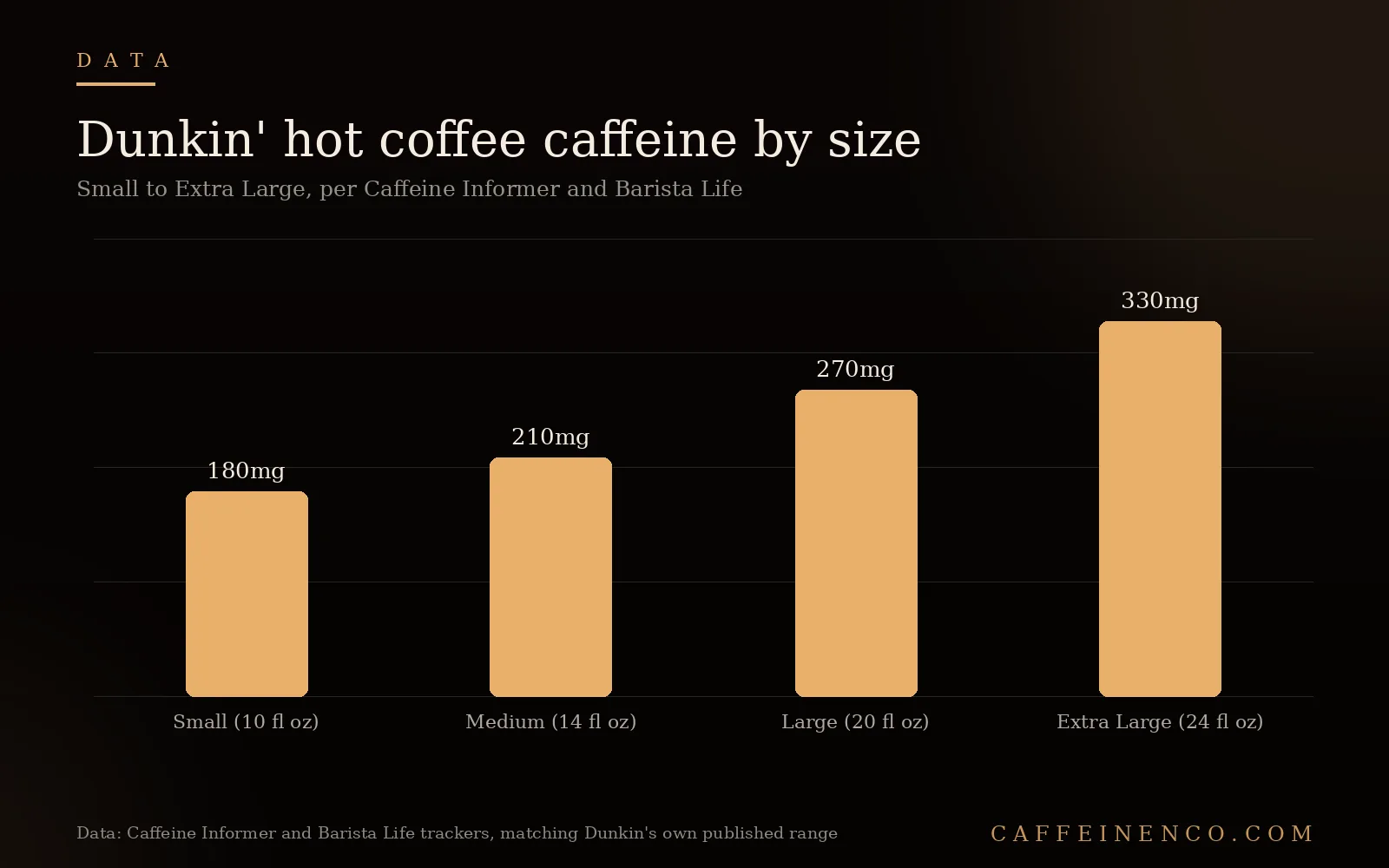
Caffeine Informer and Barista Life independently publish the identical figures across all four Dunkin’ hot coffee sizes:
| Size | Caffeine |
|---|---|
| Small (10 fl oz) | 180mg |
| Medium (14 fl oz) | 210mg |
| Large (20 fl oz) | 270mg |
| Extra Large (24 fl oz) | 330mg |
Caffeine Informer’s own per-item page for Dunkin’ brewed coffee expresses the Medium figure as a rate too: 210mg in a 14 fl oz cup “equates to 15.00 mg of caffeine for every fl oz.” That per-ounce number becomes useful later in this piece for comparing Dunkin’ against other chains that sell coffee in different-sized cups. Dunkin’s own blog range, 180mg small to 330mg extra-large, matches both trackers’ endpoints exactly, which is the strongest agreement on this entire page: a company statement and two independent trackers landing on the same numbers at both ends of the size range.
Why Dunkin’ actually tells you the range
Caffeine Informer’s per-item page states that its Dunkin’ brewed coffee figure traces back to “communications with Dunkin’ Donuts customer service and from dunkindonuts.com,” the same kind of secondhand-but-company-sourced origin this site found behind McDonald’s numbers. What is different here is that Dunkin’ has also put a version of the same range directly on its own public blog, unprompted by a tracker’s inquiry, rather than only handing it out when a customer-service line is asked. Barista Life makes the same point explicitly, stating that its “per-size numbers below come from Caffeine Informer’s Dunkin’ guide, which lines up with Dunkin’s published ranges,” and adding that “Dunkin’ calls these approximate values, since brew strength varies a little by batch and location.” That is an important caveat to sit next to the tidy tables above: even Dunkin’s own number is a range, not a lab-tested constant, because a cup brewed at one location on one day will not extract identically to a cup brewed somewhere else the next morning.
Worth being precise about here: Barista Life’s own figures are not a fully independent second measurement, since the guide itself names Caffeine Informer as its source. What makes the numbers on this page trustworthy anyway is that Dunkin’s own blog post gives the same 180mg to 330mg hot-coffee range independently of either tracker, which is the closest thing to a genuine second confirmation this page has.
Iced coffee and cold brew: where the two trackers actually diverge from Dunkin’ itself
Caffeine Informer and Barista Life again agree with each other exactly on iced coffee and cold brew:
| Size | Iced coffee | Cold brew |
|---|---|---|
| Small (16 fl oz) | 198mg | 174mg |
| Medium (24 fl oz) | 297mg | 260mg |
| Large (32 fl oz) | 396mg | 347mg |
This is the one spot on the page where Dunkin’s own blog does not match the trackers precisely. Dunkin’ states its iced coffee “ranges from 198mg for a small to 398mg for a large,” matching the trackers’ 198mg at the small end but landing 2mg above their 396mg at the large end. That is a trivial gap in absolute terms, well within the batch-to-batch variation Dunkin’ itself names, but it is worth naming rather than quietly rounding away, since it is the only figure on this page where the company’s own stated number and the two trackers do not land on the identical value. Cold brew runs meaningfully lower than iced coffee at every matching size, 174mg versus 198mg at Small and 347mg versus 396mg at Large, which tracks with how this site’s own cold brew caffeine reconciliation explains the method: cold brew’s long steep pulls caffeine differently than hot-brewed coffee poured over ice, and Dunkin’s iced coffee is the latter, not a cold-brewed product.
Espresso drinks: Americano and Macchiato outrank the Latte
Both trackers agree on Dunkin’s espresso-based menu too, and the pattern is worth explaining rather than just listing:
| Size | Americano / Macchiato (2 shots) | Latte / Cappuccino |
|---|---|---|
| Small | 237mg | 118mg |
| Medium | 284mg | 166mg |
| Large | 371mg | 252mg |
A single espresso shot carries 118mg by both trackers’ figures, which is exactly the Small Latte number, confirming a Small Latte is built on one shot. The Americano and Macchiato, despite being very different drinks in body and presentation, an Americano is espresso cut with hot water while a Macchiato is espresso “stained” with a splash of milk foam, share identical caffeine figures at every size because both use two shots regardless of size, the same shot-count logic this site’s Starbucks and McDonald’s caffeine pages already document for their own espresso menus. A Latte or Cappuccino instead scales shot count with size, one shot Small, presumably two at Medium and Large going by the near-doubling of the Small figure, which is why a Small Latte carries barely half the caffeine of a Small Americano even though both are espresso drinks ordered at the same size.
Decaf and Dunkaccino: one figure both trackers confirm, one only Caffeine Informer names
Caffeine Informer and Barista Life agree exactly on Dunkin’s decaf figures: 7mg Small, 10mg Medium, 15mg Large, and 18mg Extra Large. Caffeine Informer’s separate general decaf coffee page cites a 2006 University of Florida study finding 8.6mg to 13.9mg in a 16 fl oz decaf drip coffee from national chains generally. Dunkin’s own 7 to 18mg range does not sit inside that study’s range, it actually extends past it on both ends, running lower at the small end and higher at the extra-large end, rather than nesting inside it. That is not a contradiction so much as a reminder that a chain-specific figure and a multi-chain study average will not line up perfectly.
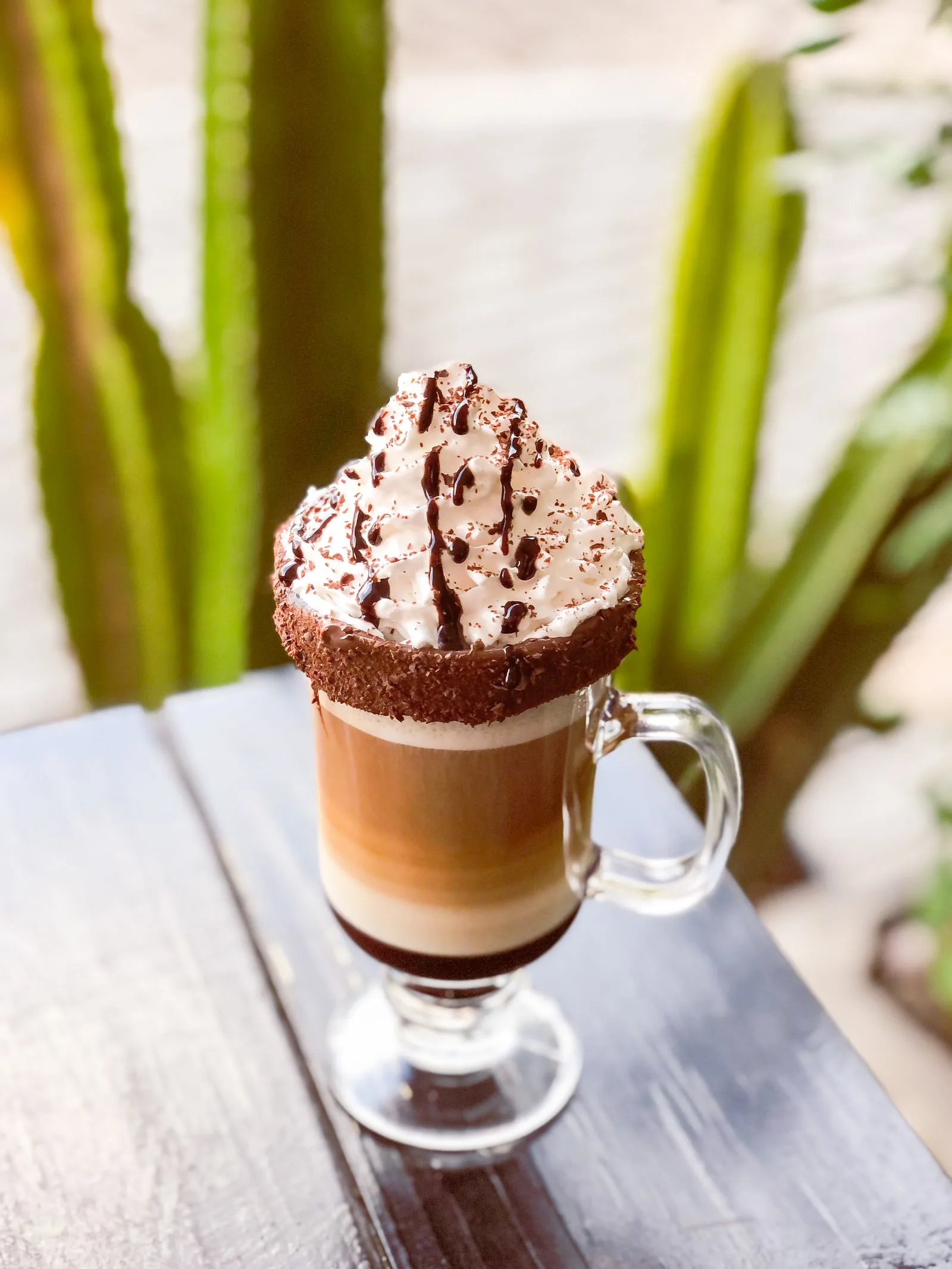
Dunkaccino, Dunkin’s chocolate-and-coffee drink, gets full size-by-size figures from Caffeine Informer’s Dunkin’ guide: 58mg Small, 85mg Medium, 119mg Large, and 129mg Extra Large. Barista Life’s own Dunkin’ guide does not include a Dunkaccino entry at all, so this is a one-tracker figure rather than a two-tracker agreement, worth flagging the same way this site’s McDonald’s page flags its own least-precisely-tracked menu item.
How Dunkin’ stacks up against McDonald’s and Starbucks
Comparing chains fairly means comparing rate, not just total milligrams, since Dunkin’, McDonald’s, and Starbucks all use different cup sizes for their named “Medium.” Caffeine Informer’s own per-ounce figure for Dunkin’, 15.00mg per fl oz, sits almost exactly between the other two chains this site has already covered:
| Chain | Medium size | Caffeine | Per fl oz |
|---|---|---|---|
| McDonald’s | 16 fl oz | 145mg | About 9.1mg |
| Dunkin’ | 14 fl oz | 210mg | 15.0mg |
| Starbucks (Grande Pike Place) | 16 fl oz | 310mg | About 19.4mg |
Dunkin’ brews noticeably stronger than McDonald’s, by more than half again as much caffeine per ounce, but still trails Starbucks’ Pike Place by a meaningful margin. That places Dunkin’ in the middle of the three biggest US coffee chains rather than at either extreme, which matters if you are switching chains expecting the same jolt from a similarly named cup size. Against the rest of this site’s brand coverage, a Dunkin’ Medium’s 210mg also comfortably outpaces a standard Nespresso OriginalLine pod at 55 to 65mg and sits well below Death Wish Coffee’s reconciled 59 to 61mg per fluid ounce, which would put a same-size 14oz serving of Death Wish north of 800mg.
Worked example: building a caffeine-aware Dunkin’ order
- Start from your daily target. MD Anderson Cancer Center reports the FDA’s general guidance that “most adults can consume about 400 milligrams of caffeine per day without negative effects.” Treat that as a working ceiling unless a doctor has told you otherwise.
- Pick drink type before size. A Medium hot coffee (210mg) and a Medium Latte (166mg) are not interchangeable the way they nearly are at McDonald’s; the Americano and Macchiato at 284mg Medium run well ahead of both.
- Remember iced coffee and cold brew are not the same drink. At matching sizes, iced coffee carries noticeably more caffeine than cold brew, 198mg versus 174mg at Small, the reverse of what the “cold brew is stronger” assumption usually predicts.
- Use the per-ounce rate to compare across chains. At roughly 15mg per fl oz, a Dunkin’ order lands between McDonald’s (about 9.1mg per fl oz) and Starbucks (about 19.4mg per fl oz), useful if you are deciding between chains rather than sizes.
- Reach for decaf or a Dunkaccino for a genuinely low-caffeine option. Decaf tops out at 18mg even at Extra Large, and a Medium Dunkaccino’s 85mg still sits well below a Medium hot coffee’s 210mg.
Common mistakes reading a Dunkin’ caffeine number
Assuming Dunkin’s “approximate” range on its own blog is a precise lab measurement is the first mistake, when Dunkin’ itself states the figures vary by batch and location and both trackers cited here echo the same caveat. Treating iced coffee and cold brew as interchangeable is the second, since the two drinks differ by 24 to 49mg at matching sizes depending on size, with iced coffee actually the stronger of the two, not cold brew as the name might suggest. Comparing a Dunkin’ Medium directly against a McDonald’s or Starbucks Medium without accounting for cup size is the third: Dunkin’s Medium is 14 fl oz, McDonald’s and Starbucks call a 16 fl oz cup Medium, so a raw milligram comparison overstates how much stronger Dunkin’ is than McDonald’s and understates how much weaker it is than Starbucks unless you convert to a per-ounce rate first.
Common questions
How much caffeine is in a medium Dunkin’ coffee? 210mg in the 14 fl oz Medium, a figure Caffeine Informer and Barista Life report identically and that falls inside the 180 to 330mg range Dunkin’s own blog publishes for its hot coffee sizes.
Does Dunkin’ officially publish its caffeine content? Yes, in approximate form. Dunkin’s own news blog states hot coffee “ranges from 180mg for a small to 330mg for an extra-large” and gives a matching range for iced coffee, a genuine company statement rather than only a customer-service reply, which sets it apart from chains like McDonald’s that do not publish a caffeine figure at all.
Is Dunkin’ iced coffee stronger than cold brew? Yes, at every matching size. Small iced coffee carries 198mg against cold brew’s 174mg, and Large iced coffee carries 396mg against cold brew’s 347mg, both per Caffeine Informer and Barista Life’s matching figures.
Is a Dunkin’ Americano stronger than a Latte? Yes, by roughly double at every size. Both use two espresso shots regardless of size, 237mg Small, 284mg Medium, 371mg Large, while a Latte’s shot count scales with size starting from a single shot, giving a Small Latte just 118mg.
How much caffeine is in Dunkin’s decaf coffee? Very little: 7mg Small up to 18mg Extra Large, per matching figures from both Caffeine Informer and Barista Life. That range actually falls outside the 8.6 to 13.9mg per 16oz cup a 2006 University of Florida study found for decaf drip coffee generally, running lower at the small end and higher at the extra-large end rather than nesting inside it.
Is Dunkin’ coffee stronger or weaker than Starbucks and McDonald’s? It sits in the middle. At roughly 15mg of caffeine per fluid ounce, Dunkin’ brews stronger than McDonald’s (about 9.1mg per fl oz) but weaker than Starbucks’ Pike Place (about 19.4mg per fl oz), based on each chain’s own published Medium-size figures.
For more sourced caffeine breakdowns like this one, delivered weekly, subscribe to The Sunday Pour.