Search “how much caffeine is in Death Wish Coffee” and the first two answers you land on will disagree by 256 milligrams. One page will tell you a cup has 472mg. Another will tell you it has 728mg. Neither number is made up, and neither site is copying the other’s homework wrong. They are two real, independently reported figures for the same product, and taken at face value they look like proof that nobody actually knows how strong this coffee is. Pull the two source reports directly, though, and the disagreement mostly disappears. This is what those numbers actually measure, where they came from, and what happens when you put them on the same footing.
Where the published numbers actually land
The 728mg figure traces back to a 2015 lab analysis Death Wish commissioned from EMSL Food Chemistry Lab. According to the results as reported by Caffeine Informer, the lab measured brewed Death Wish at 200 to 210 mg of caffeine per 100 millilitres across its samples, averaging 205 mg/100ml, a figure the company has cited in its own marketing since. Scaled up to a 12 fluid ounce cup, that averages out to 728mg. Death Wish’s own brewing instructions specify a notably concentrated dose to hit that number: 2 1/2 tablespoons of finely ground coffee per 6 fluid ounces of water, a heavier dose than typical brewing guidance, which commonly runs 1 to 2 tablespoons per 6 fluid ounces, meaning Death Wish’s ratio runs up to roughly double the low end of that range.
The 472mg figure comes from Consumer Reports, which bought Death Wish ground coffee directly from the company’s website and brewed it according to the manufacturer’s own instructions rather than relying on the company’s cited lab data. Consumer Reports reports the result as 472mg of caffeine in an 8 fluid ounce cup, a number the outlet uses to make a direct point: “The Food and Drug Administration says 600 milligrams a day is too much,” and a single cup of Death Wish, brewed as directed, already comes within range of that daily ceiling on its own.
For comparison, Consumer Reports puts typical brewed coffee at roughly 12 to 16 mg per fluid ounce. Both Death Wish figures land far above that range, which is the one point every source on this topic actually agrees on without qualification.
Per fluid ounce, the two headline numbers nearly agree
Here is the reconciliation almost nobody runs before repeating either number: normalize both to the same unit. The EMSL-derived 728mg is for a 12 fluid ounce cup, which works out to 60.67 mg per fluid ounce. Consumer Reports’ 472mg is for an 8 fluid ounce cup, which works out to 59.0 mg per fluid ounce. That is a gap of roughly 1.7 mg per fluid ounce, less than a 3 percent difference between a company-commissioned lab test from 2015 and an independent outlet brewing the same product years later.
Read as raw headline numbers, 472 and 728 look like two different coffees. Read per fluid ounce, they are the same coffee, tested twice, by two parties with no reason to agree with each other, landing within rounding distance of one another. The “wild disagreement” that shows up across blog roundups of this topic is a serving-size artifact, not a measurement conflict: one source is quoting an 8oz cup, the other a 12oz cup, and almost nothing that repeats either number bothers to say so.
That does not mean every number attached to Death Wish Coffee online is trustworthy. Plenty of aggregator pages round the figure up or down without citing either underlying test, and a few list serving sizes inconsistently in the same table. But the two headline figures that actually anchor most of that secondary coverage, EMSL’s and Consumer Reports’, corroborate each other once the units match, which is a meaningfully different finding than “these sources can’t agree.”
Why one was commissioned and one wasn’t, and why it barely mattered here
It is worth being clear about who ran which test, because the two are not equivalent in independence even though they ended up close. The EMSL figure came from a lab Death Wish itself paid to test its own product, the standard way a food company generates a number it can put in marketing copy. That does not make the result wrong, EMSL is a real accredited testing lab, but a company-commissioned test always deserves a mental asterisk, the same way a mattress company’s own “clinically proven” sleep study does.
There is a further wrinkle worth naming plainly rather than glossing over: Caffeine Informer’s own page, the same one this piece relies on for the EMSL figure, notes that a more recent test from SDS Agri Food Laboratory found Death Wish Coffee running significantly lower in caffeine than what EMSL’s 2015 test determined, without stating the actual number that newer test produced. An unnamed figure cannot be normalized to a per-ounce comparison, so it does not overturn the reconciliation below, but it is a real, cited signal that a 2015 company-commissioned lab report may not represent exactly what ships today. Treat 728mg, and everything built on it here, as anchored to that specific 2015 test rather than a permanently fixed constant.
The Consumer Reports figure is the more independent check: an outlet with no relationship to Death Wish bought the product retail and brewed it exactly as instructed. That two tests with different incentives, run years apart, land within 3 percent of each other per fluid ounce is a reasonable basis for trusting the ballpark, even if you’d still want a third, more recent independent test to fully close the loop. Neither figure should be read as more precise than it is; caffeine content in any brewed coffee varies with bean crop, grind, water, and how closely a home brewer actually follows the stated ratio, so treat 59 to 61 mg per fluid ounce as the honest range here rather than a single decimal-precise number.
Why it tests this high in the first place
Two separate factors stack on top of each other to produce a number this far above typical drip coffee, and it is worth separating them because only one is about the beans themselves.
The first is bean species. Death Wish’s blend combines robusta and arabica beans, and robusta genuinely carries more caffeine than arabica as a matter of plant chemistry, not marketing. Caffeine Informer cites figures from CoffeeChemistry.com putting robusta beans at 2.2 percent caffeine by dry weight against 1.2 percent for arabica, meaning robusta beans carry roughly 83 percent more caffeine gram for gram before a single drop of water touches them. That is a real, well documented difference, and it is the reason coffee marketed as extra strong so often leans on a robusta component rather than a rarer or darker roast of pure arabica. Roast level itself barely moves the needle on caffeine, a common point of confusion covered in our roast levels guide; bean species is the lever that actually matters here.
The second factor is dose, and it may matter more than the bean blend. Death Wish’s own brewing instructions of 2 1/2 tablespoons per 6 fluid ounces of water are a noticeably concentrated ratio next to typical drip coffee guidance of 1 to 2 tablespoons for the same water volume. Brew any coffee, arabica or robusta, at a meaningfully heavier dose for the same water volume, and the resulting cup will carry meaningfully more caffeine regardless of bean species. Death Wish’s number is almost certainly the product of both factors compounding rather than either one alone: a naturally higher-caffeine bean blend, brewed at an unusually strong ratio.
The 2017 recall, and why marketing claims deserve a second look
There is a separate, non-caffeine reason to read any “world’s strongest” style claim from this company with a bit of extra scrutiny. In September 2017, Death Wish recalled its Nitro Cold Brew cans after determining, in consultation with an outside food safety authority, that its canning process could allow the growth of Clostridium botulinum, the bacterium responsible for botulism, in a low-acid product packaged with reduced oxygen. Food Safety News reported that roughly 3,360 cans had gone out to retail stores, plus additional units sold online since February of that year, and that the company halted production to add a further safety step to its process. No illnesses were ultimately reported, and Death Wish refunded every buyer it could identify.
The recall has nothing to do with caffeine content specifically, and it should not be read as evidence the caffeine numbers themselves are unreliable, the two lab-derived figures above genuinely corroborate each other. But a company that has had to walk back a manufacturing process once is a company worth double-checking on every other claim it makes too, caffeine included, rather than taking marketing copy at face value. That instinct is exactly what produced the reconciliation in this piece: going to the two actual underlying reports instead of repeating whichever number came up first in search.
The reconciliation table
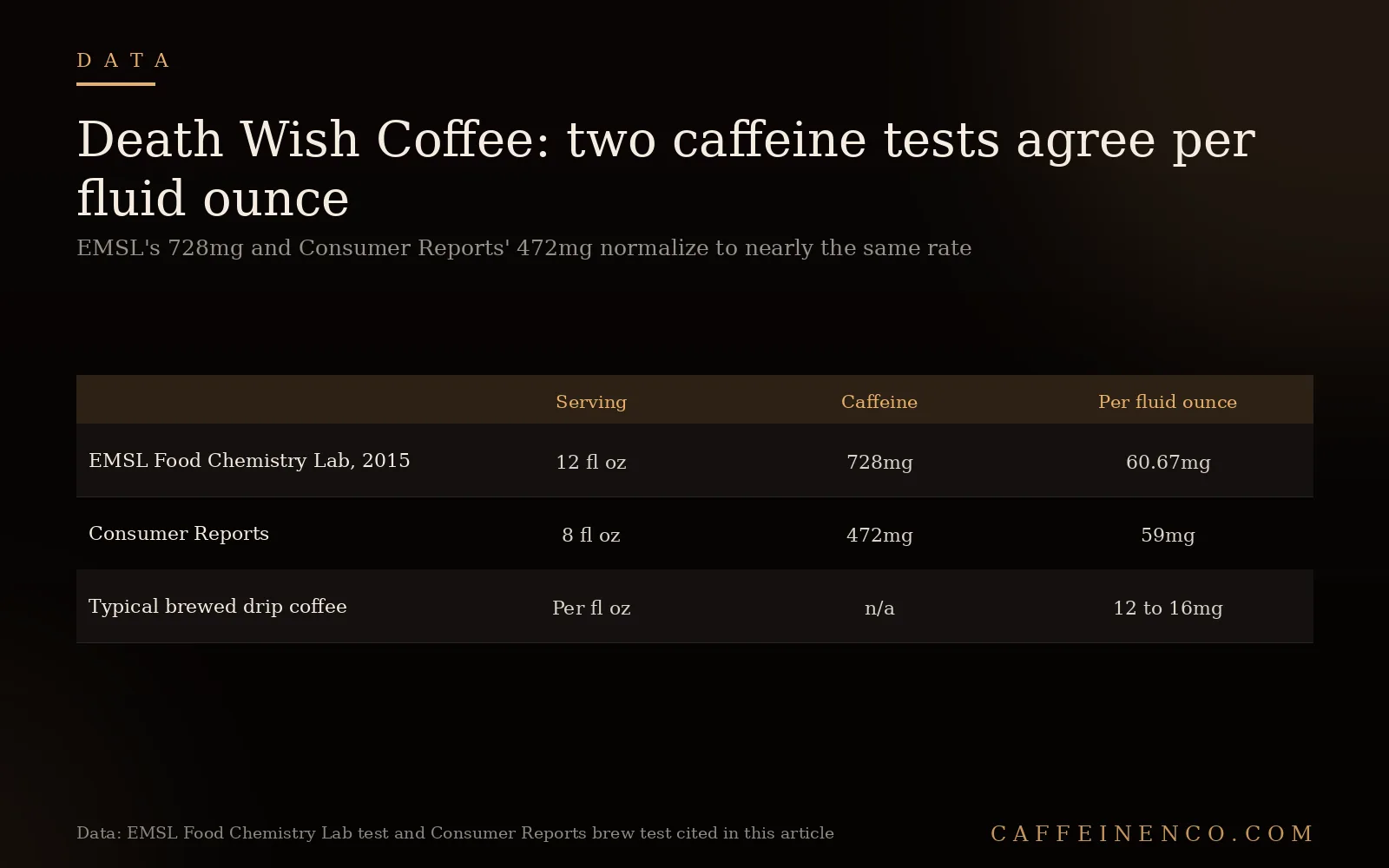
| Source | Type | Serving | Caffeine | Per fluid ounce |
|---|---|---|---|---|
| EMSL Food Chemistry Lab, 2015 (via Death Wish, cited by Caffeine Informer) | Manufacturer-commissioned lab test | 12 fl oz | 728mg | 60.67mg |
| Consumer Reports, brewed per instructions | Independent outlet, brewed and tested | 8 fl oz | 472mg | 59.0mg |
| Typical brewed drip coffee (Consumer Reports comparison figure) | Baseline for comparison | Per fl oz | n/a | 12 to 16mg |
How to check any “strongest coffee” claim yourself
Death Wish is far from the only brand marketed on caffeine bragging rights, and the same confusion between headline number and serving size shows up across that entire category. The fix is the same five-step check every time:
- Find the serving size the milligram figure is attached to. A number with no stated fluid ounce or gram weight cannot be compared to anything.
- Divide the milligram figure by the fluid ounce count to get mg per fluid ounce, the one unit that lets you compare across cup sizes.
- Check whether the number comes from the brand’s own testing or an independent outlet. Both can be accurate, but only one carries an obvious incentive to round up.
- Compare the per-ounce figure to typical drip coffee’s 12 to 16 mg per fluid ounce range to see the real multiplier, rather than reacting to the raw milligram number alone.
- If two sources still disagree meaningfully after normalizing for serving size, that is a real conflict worth digging into further. If they agree once normalized, as EMSL’s and Consumer Reports’ numbers do here, the “disagreement” was in the reporting, not the coffee.
Our reconciled read
Both widely cited Death Wish Coffee numbers hold up. Once put on the same per-fluid-ounce basis, EMSL’s manufacturer-commissioned 60.67 mg/fl oz and Consumer Reports’ independently brewed 59.0 mg/fl oz agree within about 3 percent, which is a tight enough margin that treating 472 and 728 as competing claims misreads what actually happened: two different serving sizes, not two different coffees. The honest number to carry away is roughly 59 to 61 mg of caffeine per fluid ounce, which lands at approximately 472mg in an 8oz cup and 728mg in a 12oz cup, both true statements about the same drink. That is a real 4x jump over typical drip coffee’s 12 to 16 mg per fluid ounce, driven by a robusta-heavy blend brewed at a meaningfully heavier dose than typical guidance, not by any single mysterious ingredient.
Common questions
Is Death Wish Coffee actually the strongest coffee in the world? “Strongest” isn’t a standardized or regulated claim, so there’s no official ranking to confirm or deny it against. What is verifiable is that Death Wish tests at roughly 59 to 61 mg of caffeine per fluid ounce across two independently sourced figures, which is genuinely about four times a typical drip coffee’s 12 to 16 mg per fluid ounce, a real and unusually high number even without the marketing framing.
Why do two sources report 472mg and another reports 728mg for the same coffee? Because they are describing different serving sizes rather than different coffees. 472mg is for an 8 fluid ounce cup and 728mg is for a 12 fluid ounce cup. Normalized to the same fluid ounce, both land within about 3 percent of each other, at roughly 59 to 61 mg per fluid ounce.
Is it dangerous to drink a full cup of Death Wish Coffee? A single 8 to 12oz cup, brewed as directed, delivers somewhere in the 472 to 728mg range, which Consumer Reports notes already approaches or exceeds the daily 600mg ceiling the article attributes to the FDA on its own. That does not make one cup an emergency for most healthy adults, but it leaves little to no room for additional caffeine that day from other coffee, tea, or energy drinks, and people with caffeine sensitivity, heart conditions, or who are pregnant should be more cautious with a coffee at this concentration than with a typical cup.
Does Death Wish use a special bean nobody else has access to? No. Its stated blend combines robusta and arabica beans, and robusta itself is a widely grown, ordinary commercial species that naturally carries more caffeine than arabica, roughly 2.2 percent versus 1.2 percent by dry weight. What sets Death Wish apart is closer to a strong dose and a caffeine-forward bean blend than a proprietary ingredient.
How does Death Wish compare to cold brew or a shot of espresso? Differently enough that a direct comparison needs its own reconciliation. Our breakdown of cold brew’s caffeine numbers and our piece on caffeine in a shot of espresso both work through the same kind of serving-size confusion covered here, applied to a different corner of the caffeine conversation.
Want to see how a given cup, brand, or serving size stacks up against your own daily intake? Our caffeine calculator is built for exactly that comparison. For more reconciled, sourced coffee data like this, delivered weekly, join The Sunday Pour.