McDonald’s publishes calorie counts, fat grams, and sodium for every item on its menu down to the ketchup packet, but it has never once put a caffeine number next to a cup of McCafe coffee. That is not an oversight. Caffeine Informer reports that McDonald’s does not publish caffeine amounts, quoting the company’s own stated reason: “The FDA does not require publishing caffeine levels.” Barista Life independently confirms the same gap, both noting that whatever figures exist online were compiled secondhand, not handed out by the company itself. Two trackers went looking anyway, one working from McDonald’s own customer service responses and a USDA reference database, the other compiling the same kind of indirect estimate, and their numbers land close enough together to trust for the sizes that matter most, while diverging in a couple of specific spots worth naming honestly.
The numbers: brewed coffee by size
Caffeine Informer and Barista Life were checked independently for this piece, and their Premium Roast brewed coffee figures line up closely at every size McDonald’s sells.
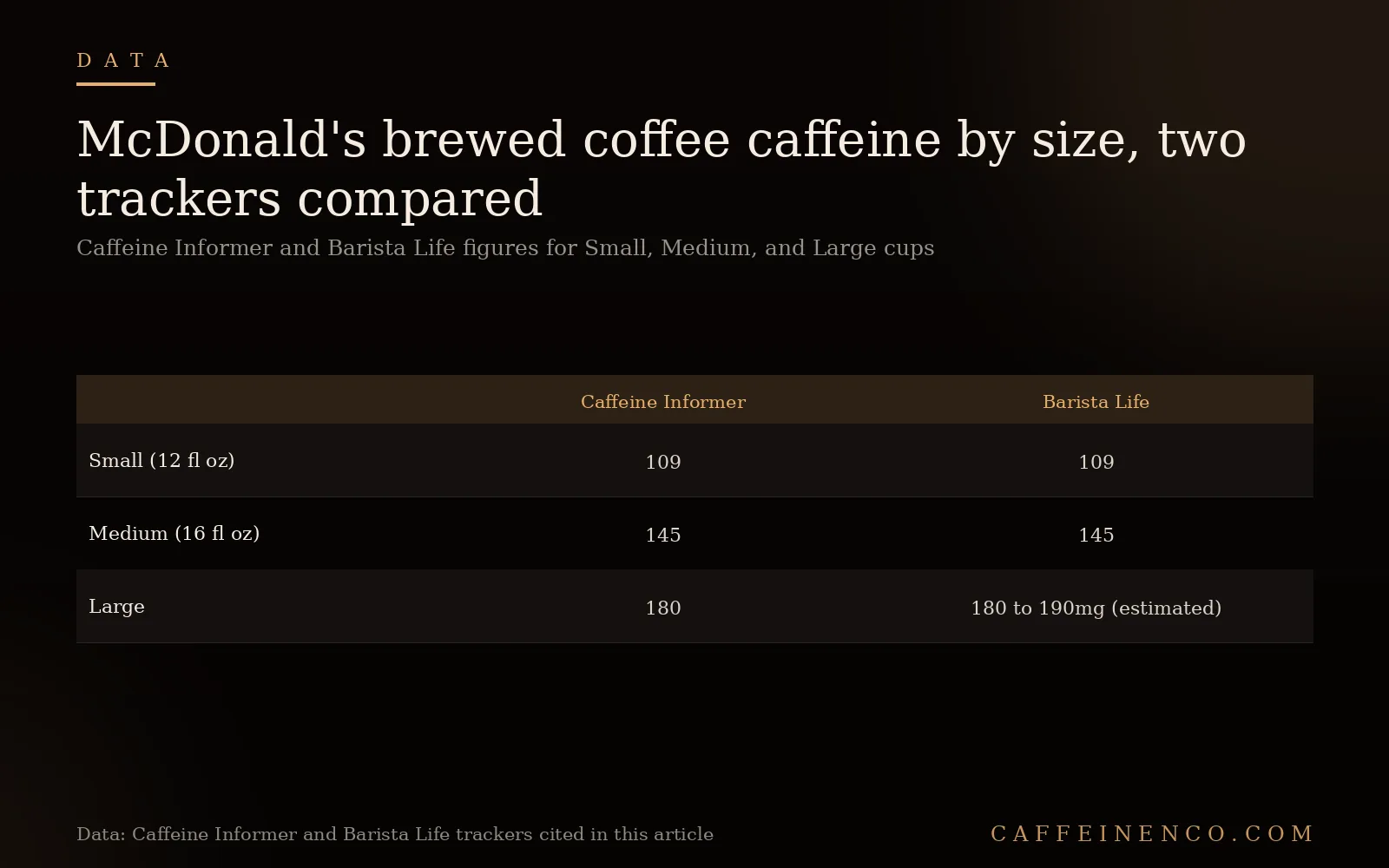
| Size | Caffeine Informer | Barista Life |
|---|---|---|
| Small (12 fl oz) | 109mg | 109mg |
| Medium (16 fl oz) | 145mg | 145mg |
| Large | 180mg | 180 to 190mg (estimated) |
Both trackers hit the exact same number at Small and Medium, and Large differs only by the width of Barista Life’s own stated estimate range. Note that the two sources don’t even agree on what “Large” means in ounces: Caffeine Informer lists a Large brewed coffee as 21 to 24 fl oz, while Barista Life’s own Large is a narrower 21 to 22 fl oz. For a product neither company can pull from an official spec sheet, the milligram convergence at Small and Medium is still a strong one, and it means those two figures in particular are about as solid as an unofficial number gets.
Why McDonald’s won’t just publish this
Caffeine Informer’s explanation is the more detailed of the two: McDonald’s told the tracker directly that it “uses the USDA National Nutrient Database for Standard Reference to estimate the amount of caffeine in its coffee products,” and separately acknowledged that “Not all of our McCafe products have been tested for caffeine content at this time.” In plain terms, the company is estimating its own coffee’s caffeine from a generic government reference table for brewed coffee rather than lab-testing what actually comes out of a McCafe brewer, and it has told at least one caffeine-tracking site that estimate directly rather than posting it anywhere a customer would find it. Barista Life’s reporting matches that account: the site states its own numbers come from Caffeine Informer, which in turn compiled them from McDonald’s customer service, since McDonald’s itself does not publish caffeine content. Every number on this page, then, traces back to the same origin point: a company estimate relayed through customer service, not a lab result and not a published spec.
Espresso-based McCafe drinks
McDonald’s espresso-based menu, Lattes, Cappuccinos, Caramel Macchiatos, and French Vanilla drinks, all draw caffeine from the same shot count regardless of the flavoring poured on top, which is why Caffeine Informer lists them all at identical figures.
| Size | Latte, Cappuccino, Macchiato, Flavored Latte | Espresso Shot |
|---|---|---|
| Small (12 fl oz, single shot) | 71mg | 71mg |
| Medium (16 fl oz, double shot) | 142mg | 142mg |
| Large (21 to 24 fl oz) | 178mg | n/a |
Barista Life’s figures agree at Small and Medium (71mg and 142mg) and simply does not report a Large size for the espresso drinks, rather than contradicting Caffeine Informer’s 178mg. The pattern worth noticing here is the same one this site’s Starbucks caffeine breakdown already covers for a different chain: an espresso-based drink’s caffeine comes from shot count, one shot small, two shots medium and up, not from how much milk or syrup gets added on top, so a large caramel latte and a large plain latte carry the same caffeine even though only one of them tastes like dessert.
Where the two trackers disagree: iced coffee and decaf
This is the part of the page worth reading carefully rather than skimming past, because the two sources genuinely do not agree here, and pretending they do would misrepresent both of them.
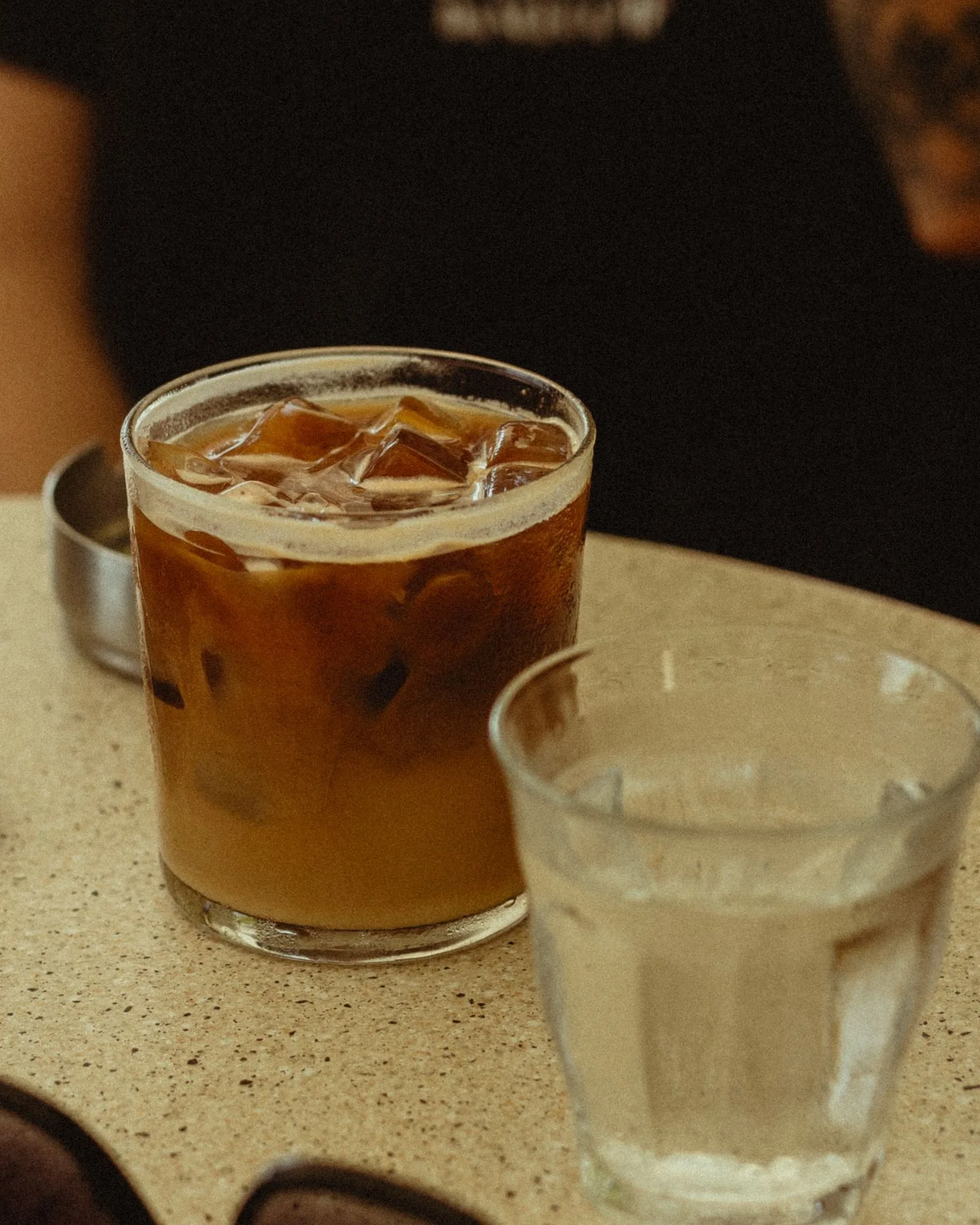
Iced coffee. Caffeine Informer’s table lists 133mg at Medium, 200mg at Large, and 320mg at an Extra-Large size, with no figure given for Small at all. Barista Life instead attaches that same 133mg figure to a Small cup and 200mg to a Medium, one size bracket lower across the board. Both trackers are working from the same underlying company estimate and neither cites a McDonald’s document that spells out iced coffee sizing the way it does for brewed coffee, so this reads like a labeling mismatch between the two write-ups rather than two genuinely different figures. The safest way to use this table: treat 133mg and 200mg as real numbers that apply to McDonald’s iced coffee at two of its three sizes, but confirm your own cup’s exact ounce count against the cup itself rather than assuming which named size you are holding.
Decaf coffee. Caffeine Informer gives specific per-size figures, 8mg Small, 11mg Medium, 14mg Large. Barista Life instead states decaf runs “under 5mg” at any size. Neither source explains the gap, and it may simply reflect the reality that decaf coffee is never fully caffeine-free and that trace amounts vary more from batch to batch than a regular brewed coffee’s caffeine does. What both sources agree on despite the gap matters more than the exact figure: McDonald’s decaf, whichever number is closer, carries a small enough amount that it is not a meaningful contributor to a daily caffeine count either way.
Coffee versus McCafe treats: mocha and frappe
Mocha, hot or iced, tracks close to the Latte line since it is also espresso-based: Caffeine Informer lists 86mg Small, 167mg Medium, and 200mg Large, all consistent with a coffee-forward drink that happens to have chocolate added rather than a fundamentally different caffeine source. Frappes are the outlier on the whole menu. Caffeine Informer’s figures for Mocha Frappe specifically, 100mg Small, 125mg Medium, and 180mg Large, do not scale the way brewed coffee or espresso drinks do, and other blended Frappe flavors run even lower, 75mg Small, 90mg Medium, 130mg Large, with a 32-ounce Extra-Large actually landing at 100mg rather than the highest number on the list. Barista Life’s own Frappe entry is vaguer, a flat “70 to 100mg estimated” regardless of size, which does not contradict Caffeine Informer’s more granular numbers so much as confirm that even the trackers themselves treat Frappe caffeine as the least precisely known figure on the whole menu. A Frappe is built more like a milkshake with coffee flavoring blended through ice than a coffee drink with milk added, and the caffeine content follows that recipe logic rather than the shot-count logic that governs Lattes and Cappuccinos.
How McDonald’s stacks up against Starbucks
The comparison most people actually want to make is chain against chain, and matching cup size against cup size makes it a clean one. A Medium McDonald’s brewed coffee is 16 fluid ounces, the exact same volume as a Starbucks Grande. This site’s Starbucks caffeine breakdown puts a Grande Pike Place at 310mg, more than double McDonald’s Medium at 145mg, and even a Grande Featured Dark Roast at 260mg still comes in well ahead of McDonald’s equivalent cup. The gap holds at the small end too: a McDonald’s Small at 12 ounces carries 109mg against a Starbucks Tall Pike Place, also 12 ounces, at 235mg. None of this means McDonald’s coffee is weak in absolute terms, 109 to 180mg across its size range is a normal amount of caffeine for a cup of drip coffee by most published benchmarks, it means Starbucks brews noticeably stronger than McDonald’s does at every matching size, which is worth knowing if you are switching between the two chains expecting a similar jolt from a similarly sized cup.
Against the rest of this site’s caffeine coverage, McDonald’s brewed coffee sits solidly in the middle of the pack: well above a standard Nespresso OriginalLine pod at 55 to 65mg, and nowhere close to Death Wish Coffee’s reconciled 59 to 61mg per fluid ounce, which works out to well over 900mg in a 16-ounce serving, more than six times a McDonald’s Medium.
Worked example: building a caffeine-aware McDonald’s order
- Start from your daily target. MD Anderson Cancer Center reports the FDA’s general guidance that “most adults can consume about 400 milligrams of caffeine per day without negative effects.” Treat that as your working ceiling unless a doctor has told you otherwise.
- Pick your drink type first, then size. A Medium brewed coffee (145mg) and a Medium Latte (142mg) land almost identically, so the meaningful choice is between brewed coffee or espresso-based versus a Frappe, which runs lower at 90 to 125mg for the same Medium size.
- Watch the iced coffee sizing gap. Since Caffeine Informer and Barista Life disagree on which named size carries 133mg, check your actual cup’s ounce marking rather than assuming a Small is automatically the lowest-caffeine iced option.
- Use decaf for a genuinely low add-on, whether the real figure is closer to Caffeine Informer’s 8 to 14mg range or Barista Life’s under-5mg estimate, both are low enough to round toward zero against a 400mg daily target.
- Compare against your usual order elsewhere. If you normally drink a Starbucks Grande and switch to a McDonald’s Medium for the same volume, expect roughly half the caffeine, not an equivalent swap.
Common mistakes reading a McDonald’s caffeine number
Assuming McDonald’s caffeine figures are as official as its calorie counts is the first one, when both trackers cited here state directly that the numbers are estimates relayed through customer service or drawn from a generic USDA reference table, not lab results specific to McDonald’s own coffee. Treating “Large” as a fixed ounce count is the second, since McDonald’s own Large brewed coffee spans 21 to 24 ounces depending on the source consulted, wide enough that the caffeine figure attached to it should be read as an estimate for a size range, not a single cup. Assuming iced coffee sizing matches brewed coffee sizing is the third, since the two trackers used here genuinely disagree on which named size carries which number, a gap this page addresses directly above rather than picking one source’s labeling as gospel.
Common questions
How much caffeine is in a medium McDonald’s coffee? 145mg, a figure both Caffeine Informer and Barista Life report identically for the 16-ounce Medium size, McDonald’s most reliably sourced caffeine number on this whole page.
Does McDonald’s list caffeine content on its app or website? No. Both trackers cited here state that McDonald’s does not officially publish caffeine data alongside its nutrition information, and that the figures in circulation online were compiled through customer service responses or a generic USDA reference database rather than a published McDonald’s document.
How much caffeine is in a McDonald’s latte? 71mg Small, 142mg Medium, and 178mg Large per Caffeine Informer, with Barista Life independently confirming the Small and Medium figures. The caffeine comes from shot count, one shot Small, two shots Medium and up, not from the milk or syrup added on top.
Is McDonald’s coffee stronger or weaker than Starbucks? Weaker, cup for cup. A 16-ounce McDonald’s Medium carries 145mg against a same-size Starbucks Grande Pike Place at 310mg, more than double, and the gap holds at the 12-ounce size too.
How much caffeine is in McDonald’s decaf coffee? Somewhere between 5mg and 14mg depending on the source: Caffeine Informer gives 8mg Small up to 14mg Large, while Barista Life estimates under 5mg at any size. Neither figure is large enough to meaningfully affect a daily caffeine total.
How much caffeine is in a McDonald’s Frappe? Less than the coffee and espresso lines, and less precisely tracked. Caffeine Informer lists Mocha Frappe at 100 to 180mg by size and other Frappe flavors at 75 to 130mg, while Barista Life gives a flatter 70 to 100mg estimate regardless of size, both agreeing that Frappe caffeine runs lower and less consistently than a straight coffee or espresso order.
For more sourced caffeine breakdowns like this one, delivered weekly, subscribe to The Sunday Pour.