“Drink coffee before you train” is common enough gym advice that it barely gets questioned anymore, but the actual research behind it is more specific, and more interesting, than a blanket yes. The International Society of Sports Nutrition has a formal position stand on exactly this question, built from decades of controlled trials, and it does not say “coffee helps.” It says caffeine helps, at a specific dose, on a specific timeline, more for some kinds of exercise than others, and more for some people than others because of a single gene. This site’s own caffeine in an espresso shot breakdown already covers how much caffeine actually ends up in a given cup; this page covers what that caffeine does once it is in your system before a workout, and why two people can drink the identical cup and get meaningfully different results.
What the sports science actually says
The ISSN’s position stand states that caffeine “has consistently been shown to improve exercise performance when consumed in doses of 3 to 6 mg/kg body mass.” That is not a vague performance claim; it is a dose-response relationship built from a large body of controlled trials, and the position stand is specific that a minimal effective dose can run as low as 2 mg/kg. It is equally specific about the ceiling: doses around 9 mg/kg are “associated with a high incidence of side effects” without producing a bigger performance benefit, meaning more caffeine past a certain point is not more ergogenic, it is just more side effects for no extra gain.
Timing matters almost as much as dose. The position stand states that “the most commonly used timing of caffeine supplementation is 60 min pre-exercise,” giving the compound time to absorb and reach peak blood concentration before the first rep or the first mile. That single number, 60 minutes, is the difference between a coffee that is still doing very little for you at the start of a workout and one that has actually kicked in.
Which kind of exercise actually benefits
Not every type of training gets the same boost, and the position stand ranks them with real specificity rather than treating “exercise performance” as one undifferentiated category.
Endurance work shows the strongest and most consistent effect. The position stand describes aerobic endurance as “the form of exercise with the most consistent moderate-to-large benefits from caffeine use,” which is also the category with the largest and longest research base behind it, going back to distance-running and cycling trials from decades earlier.
Strength and power training benefit too, just by a smaller margin. The position stand reports effect sizes in the 0.16 to 0.20 range for these categories, translating to roughly 2 to 7% improvements, real but modest, and most meaningful for competitive strength athletes chasing a specific number rather than a recreational lifter who will not notice a 3% difference in a working set.
Sprint and repeated-sprint work is the least settled category. The position stand notes that “caffeine ingestion may be beneficial to enhance single and intermittent-sprint performance,” but that the effects on repeated-sprint efforts specifically are inconsistent across studies, meaning a single 40-yard dash is a better bet for a caffeine boost than a full session of repeated sprint intervals.
Cognitive performance, attention and vigilance specifically, gets its own separate mention in the position stand as reliably ergogenic “in most individuals,” which matters for any sport where reaction time or focus is part of the performance, not just raw output.
Why some people respond more than others: the CYP1A2 gene
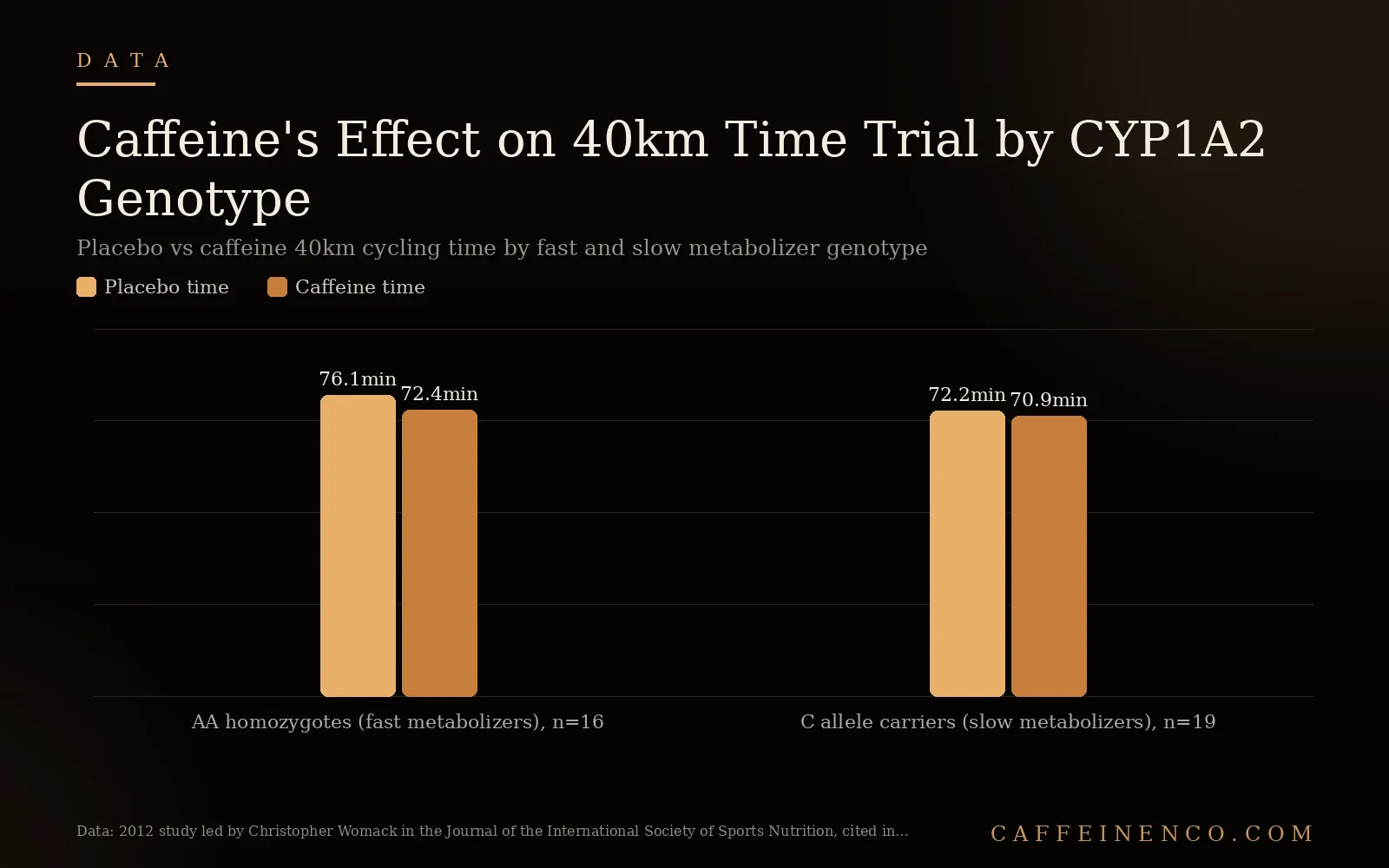
The clearest demonstration that “does caffeine help” has an individual answer, not a universal one, comes from a 2012 study published in the Journal of the International Society of Sports Nutrition. Researchers led by Christopher Womack recruited 35 trained male cyclists and had each one complete a computer-simulated 40-kilometer time trial one hour after ingesting 6 mg/kg of caffeine, and again after a placebo, in randomized order.
The riders were split by a variation in the CYP1A2 gene, which controls how quickly the liver metabolizes caffeine. Sixteen riders were AA homozygotes, so-called “fast metabolizers.” Nineteen were C allele carriers, who clear caffeine more slowly. Both groups got faster with caffeine, but by very different margins. The AA group’s average time trial dropped from 76.1 minutes on placebo to 72.4 minutes on caffeine, a 4.9% improvement. The C allele group dropped from 72.2 minutes to 70.9 minutes, a 1.8% improvement, on the exact same dose.
| Genotype | Placebo time | Caffeine time | Improvement |
|---|---|---|---|
| AA homozygotes (“fast metabolizers”), n=16 | 76.1 min | 72.4 min | 4.9% |
| C allele carriers (“slow metabolizers”), n=19 | 72.2 min | 70.9 min | 1.8% |
The study reported a significant treatment-by-genotype interaction (p = 0.005), meaning the genotype difference was not noise; it was a real, measurable split in how much the identical dose actually helped. Both groups still improved, which is the detail worth holding onto if you are the kind of person who has never noticed a dramatic pre-workout jolt from coffee: caffeine was still doing something for the slower metabolizers in this study, just less of it.
There is no consumer test built into a normal gym routine to check your own CYP1A2 status, so the practical takeaway is not “get genotyped before your next leg day.” It is that a friend swearing by a double espresso before every session and another friend saying coffee “does nothing” for them can both be reporting an honest, physiologically real difference rather than one of them imagining the effect.
Translating the dose into an actual cup
The 3 to 6 mg/kg range means nothing on its own until it is converted into an actual cup, and the conversion depends entirely on body weight. Using the roughly 63mg-per-shot espresso figure this site’s own caffeine in an espresso shot breakdown already documents, and the roughly 96mg-per-8oz-cup filter coffee figure this site’s own Americano vs Long Black vs filter coffee comparison already documents, the position stand’s dose range works out very differently depending on who is drinking it.
| Body weight | Minimal effective dose (2 mg/kg) | Standard effective range (3 to 6 mg/kg) | Side-effect threshold (9 mg/kg) |
|---|---|---|---|
| 60kg (132 lb) | 120mg, about 1.25 cups brewed or 2 shots | 180 to 360mg, about 1.9 to 3.75 cups or 3 to 5.7 shots | 540mg, about 5.6 cups or 8.6 shots |
| 70kg (154 lb) | 140mg, about 1.5 cups brewed or 2.2 shots | 210 to 420mg, about 2.2 to 4.4 cups or 3.3 to 6.7 shots | 630mg, about 6.6 cups or 10 shots |
| 80kg (176 lb) | 160mg, about 1.7 cups brewed or 2.5 shots | 240 to 480mg, about 2.5 to 5 cups or 3.8 to 7.6 shots | 720mg, about 7.5 cups or 11.4 shots |
Two things stand out from that table. First, the minimal effective dose is genuinely modest, well under a single large mug for most adults. Second, the top of the standard range and the side-effect threshold both climb past the 400mg-per-day ceiling Mayo Clinic cites as the FDA’s general guidance for healthy adults, which is a reminder that “effective for a workout” and “fine for the rest of your day’s intake” are two different budgets, not the same number counted twice. Mayo Clinic’s own guidance on that 400mg figure adds the same genetic caveat the CYP1A2 research above demonstrates directly: “genes determine how your body breaks down caffeine, so some people can drink more than 400 mg a day and some can drink less before they get side effects.”
The dehydration myth, and the side effects that are real

“Coffee will dehydrate you during your workout” is the single most repeated caution about pre-training caffeine, and it does not hold up well. Cleveland Clinic registered dietitian Beth Czerwony is direct about the mechanism: “coffee itself is not what’s going to dehydrate you, it’s about having a caffeine overload.” The Cleveland Clinic article adds that regular coffee drinkers experience even less of that diuretic effect, since the body builds up a tolerance to caffeine over time. For someone who already drinks coffee daily and is having a normal pre-workout cup rather than a caffeine overdose, the dehydration warning is mostly inherited folklore rather than a training-day risk.
The side effects that are real are more specific than “dehydration,” and the position stand names them directly. Caffeine “prolongs time to fall asleep, decreases the deep stages of non-rapid-eye movement sleep, and reduces sleep efficiency,” which matters most for anyone training in the evening rather than the morning, since a late pre-workout dose can cost more sleep quality than the workout gained in performance. The position stand also flags a genetic anxiety link separate from CYP1A2: carriers of a specific variant in the ADORA2A gene are “more sensitive to the stimulating effects of caffeine and experience greater increases in feelings of anxiety” after taking it, and the position stand specifically advises that “athletes with higher risks and prevalence for anxiety may want to limit or avoid caffeine consumption… during times where they are feeling anxious or stressed.” Anyone who has felt a workout-day coffee tip over from focused into jittery has likely felt exactly this variant’s effect, whether or not they know their own genotype.
This site’s own is coffee a laxative breakdown covers a third, more practical timing risk worth factoring in before a workout specifically: a 1990 study cited there found that only 29 percent of coffee drinkers felt a bathroom urge from a cup at all, and that post’s own self-tracking method checks for the urge within 30 minutes of the first cup. Pairing that 30-minute window with the ISSN’s 60-minute pre-exercise window is worth doing deliberately, since the gap between “drank coffee” and “started training” is also the window where that urge, if you are one of the people who gets it, is most likely to show up.
Worked example: building a pre-workout coffee routine
- Estimate your dose using your body weight, not a flat number. A 70kg (154 lb) lifter aiming for the standard effective range needs roughly 210 to 420mg, about 2.2 to 4.4 cups of brewed coffee or 3.3 to 6.7 espresso shots, using the USDA-derived and Mayo Clinic-derived figures in the table above. A 200mg pre-workout supplement or two strong cups of drip coffee both land comfortably inside that range for most adult body weights.
- Drink it 60 minutes before you start, not 10. The position stand’s own most common protocol is a 60-minute pre-exercise window; caffeine taken right before a warm-up has not had time to reach peak blood concentration by the time the working sets start.
- Start at the low end of the range if this is new to you. The minimal effective dose, 2 mg/kg, is real and produces a genuine benefit per the position stand, so there is no need to jump straight to 6 mg/kg on a first attempt, especially given how unpredictable the ADORA2A-linked anxiety response can be until you know how you personally react.
- If your workout starts before your own schedule does, remove the guesswork rather than eyeballing it. A single-serve machine with a built-in timer from 1st in Coffee’s single-serve range can have a consistent, pre-measured cup ready at the same time every training day, or you can browse the same category on Amazon.
- Save your highest dose for endurance work, not a light strength session. The position stand’s own data shows aerobic endurance gets the most consistent moderate-to-large benefit, while strength and power gains from the same dose run closer to 2 to 7%, useful, but not the category where caffeine does its heaviest lifting.
- If it is an evening session, weigh the sleep cost against the performance gain. The position stand’s own findings on reduced sleep efficiency and deep sleep apply regardless of how good the workout felt in the moment, and this site’s own decaf coffee caffeine content breakdown covers a genuinely lower-dose option, 2 to 15mg per cup rather than a full 200mg-plus dose, for anyone who wants the ritual without the late-night tradeoff.
Common mistakes
Assuming caffeine works identically for everyone is the most common mistake, and the CYP1A2 research above is the direct rebuttal: the same 6 mg/kg dose produced a 4.9% time trial improvement in fast metabolizers and a 1.8% improvement in slow metabolizers in a controlled trial, a genotype-driven gap, not an imagined one. Drinking coffee immediately before training is the second mistake; the position stand’s own protocol is a 60-minute window, and caffeine taken at the warm-up has not reached peak blood concentration by the time it matters. Fearing dehydration from a normal pre-workout cup is the third mistake, per Cleveland Clinic’s own dietitian, tolerance in regular drinkers makes coffee’s mild diuretic effect a non-issue at ordinary intakes, and the real risks worth tracking are sleep disruption and anxiety, not fluid loss. Treating a bigger dose as automatically a bigger benefit is the fourth mistake; the position stand is specific that doses around 9 mg/kg raise side effects without adding extra performance benefit over the 3 to 6 mg/kg range.
Common questions
How much coffee should I drink before a workout? The ISSN position stand’s effective range is 3 to 6 mg/kg body mass, which works out to roughly 210 to 420mg for a 70kg (154 lb) adult, about 2.2 to 4.4 cups of brewed coffee or 3.3 to 6.7 espresso shots using the USDA and Mayo Clinic figures cited on this site. A minimal effective dose can run as low as 2 mg/kg.
How long before exercise should I drink coffee for it to work? About 60 minutes, per the position stand’s most commonly used protocol, giving caffeine time to reach peak blood concentration before the workout starts. Drinking it right at the warm-up misses most of that window.
Does caffeine help with all types of exercise equally? No. The position stand describes aerobic endurance as having the most consistent moderate-to-large benefit, strength and power gains as smaller (roughly 2 to 7%), and repeated-sprint performance specifically as inconsistent across studies, even though single-sprint efforts can benefit.
Why does coffee seem to help some people more than others before a workout? A gene called CYP1A2 controls how fast the body metabolizes caffeine. A 2012 study found the same 6 mg/kg dose improved a 40km cycling time trial by 4.9% in fast metabolizers versus 1.8% in slower metabolizers, a statistically significant genotype interaction, not a placebo effect or personal bias.
Will coffee dehydrate me during my workout? Unlikely at normal intakes. Cleveland Clinic states that coffee itself is not the dehydration risk, caffeine overload is, and that regular coffee drinkers build tolerance to its mild diuretic effect over time. The more relevant real risks from the sports nutrition research are sleep disruption from late doses and anxiety in people with a specific genetic sensitivity, not fluid loss.
Is it bad to drink coffee before an evening workout? It depends on how close to bedtime the session falls. The position stand documents that caffeine can reduce sleep efficiency and deep sleep even hours after intake, so a strong pre-workout dose before a late session carries a real sleep-quality tradeoff worth weighing against the performance benefit, independent of how the workout itself felt.
For more sourced breakdowns like this one, delivered weekly, subscribe to The Sunday Pour.
Sources & data
- Journal of the International Society of Sports Nutrition: Position Stand, Caffeine and Exercise Performance
- Journal of the International Society of Sports Nutrition: Womack et al., The Influence of a CYP1A2 Polymorphism on the Ergogenic Effects of Caffeine
- Cleveland Clinic: Does Coffee Really Dehydrate You?
- Mayo Clinic: Caffeine, How Much Is Too Much?