
“Coffee makes me go” is one of the most repeated pieces of coffee folklore there is, and like a lot of repeated folklore, the actual evidence behind it is messier and more interesting than the one-line version. A 1990 study of 99 volunteers found that coffee triggered the urge to defecate in only 29 percent of them, a minority, not the universal reflex the folklore implies. Meanwhile, a 2023 systematic review pooling eight studies and 432,022 participants found that coffee drinkers overall had lower odds of developing irritable bowel syndrome than non-drinkers, the opposite direction of harm the “coffee wrecks your gut” version of the folklore implies. Both of those findings are real, both come from published research, and reconciling them tells you more about how coffee actually interacts with digestion than either number does alone. This site’s own caffeine in an espresso shot breakdown covers what a shot delivers in milligrams; this page covers what that caffeine, and the rest of the cup, actually does once it is in your system.
The gastrocolic reflex: why coffee moves your bowels at all

Coffee’s laxative effect starts with something your body does after any food or drink, not something unique to coffee: the gastrocolic reflex, a response where the stomach stretching triggers increased motility further down in the colon, the body clearing space for what just arrived. McGill University’s Office for Science and Society describes this as the core mechanism, centered on gastrin, which “prompts the stomach to release more hydrochloric acid and digestive enzymes” and increases stomach contractions. Cleveland Clinic’s Health Essentials describes the same gastrin-driven mechanism and adds a second hormone to the picture: coffee also increases the release of cholecystokinin (CCK), “another hormone that plays a key role in the digestive process.” Cleveland Clinic also notes a detail that matters for timing: “your intestinal tract is more sensitive and prone to movement early in the day,” which is part of why a first cup of the day is more likely to send you to the bathroom than the same cup at 3pm.
Critically, both sources are explicit that this is not a caffeine-only story. McGill states plainly that both regular and decaf coffee stimulate gastrin, meaning the reflex fires even without caffeine in the cup at all. That single fact undercuts the simplest version of the “coffee is a laxative” claim, since if it were purely about caffeine, decaf would not move the needle at all. It does, just less.
Caffeine sharpens the effect, but is not the whole story
Where caffeine does matter is degree, not mechanism. Cleveland Clinic cites research showing caffeinated coffee increases colon activity 60 percent more than water and 23 percent more than decaf coffee, a clear, measurable gradient: water triggers some baseline reflex from stomach stretching alone, decaf adds more on top of that through gastrin and the coffee’s acids, and caffeine adds a further boost on top of decaf. McGill’s account matches that shape, citing a study where coffee stimulated colon activity comparably to a 1,000-calorie meal, with decaf producing a reduced but still measurable version of the same effect.
That gradient is also why the folklore oversells the reliability of the effect for any one person. The 1990 study’s 29 percent figure, the same figure both Cleveland Clinic and McGill cite independently, means that more than two out of three coffee drinkers in that study did not report a defecation urge from drinking coffee. If your own experience is “coffee does nothing to my gut,” you are not an anomaly; you are most of the sampled population. If your experience is “coffee sends me running for the bathroom within minutes,” you are in the smaller, but very real, minority the reflex hits hardest, and morning timing likely makes it worse for you specifically, since the gastrocolic reflex Cleveland Clinic describes is naturally more active early in the day, on top of whatever coffee adds to it.
Is coffee a diuretic too? A related but separate question

The laxative question and the diuretic question get conflated constantly, but they describe different organs and different mechanisms, and the evidence on each is different too. Mayo Clinic states directly that caffeine does increase urine production, technically qualifying it as a diuretic, but adds the critical caveat that “most research suggests that the fluid in caffeinated drinks balances the diuretic effect of typical caffeine levels,” meaning a normal cup of coffee does not leave you net dehydrated the way the “caffeine dehydrates you” version of the folklore claims. Mayo Clinic also notes the diuretic effect is strongest in people not used to caffeine, since regular coffee drinkers build a tolerance to caffeine’s diuretic action that occasional drinkers have not developed.
The practical distinction: coffee’s laxative effect runs through the gastrocolic reflex and gut hormones, hits within minutes for the people it affects, and happens regardless of whether the coffee is caffeinated. Coffee’s diuretic effect runs through the kidneys, requires caffeine specifically, and is largely offset by the fluid volume of the cup itself at normal drinking levels. They are not the same mechanism wearing two names, and a cup of coffee is not quietly dehydrating you every time it sends you to the bathroom for the other reason.
Does coffee help or hurt IBS? The real disagreement
This is the part of the research that genuinely splits, and it is worth walking through both sides rather than picking whichever number sounds better. A 2023 systematic review and meta-analysis pooling eight studies and 432,022 participants found that coffee drinkers, at any intake level, had a pooled odds ratio of 0.84 for developing IBS compared to non-drinkers, meaning coffee drinkers in the pooled data had lower odds of an IBS diagnosis, not higher. That is a genuinely protective-looking number, and it is the headline result of a meta-analysis, generally a stronger form of evidence than any single study underneath it.
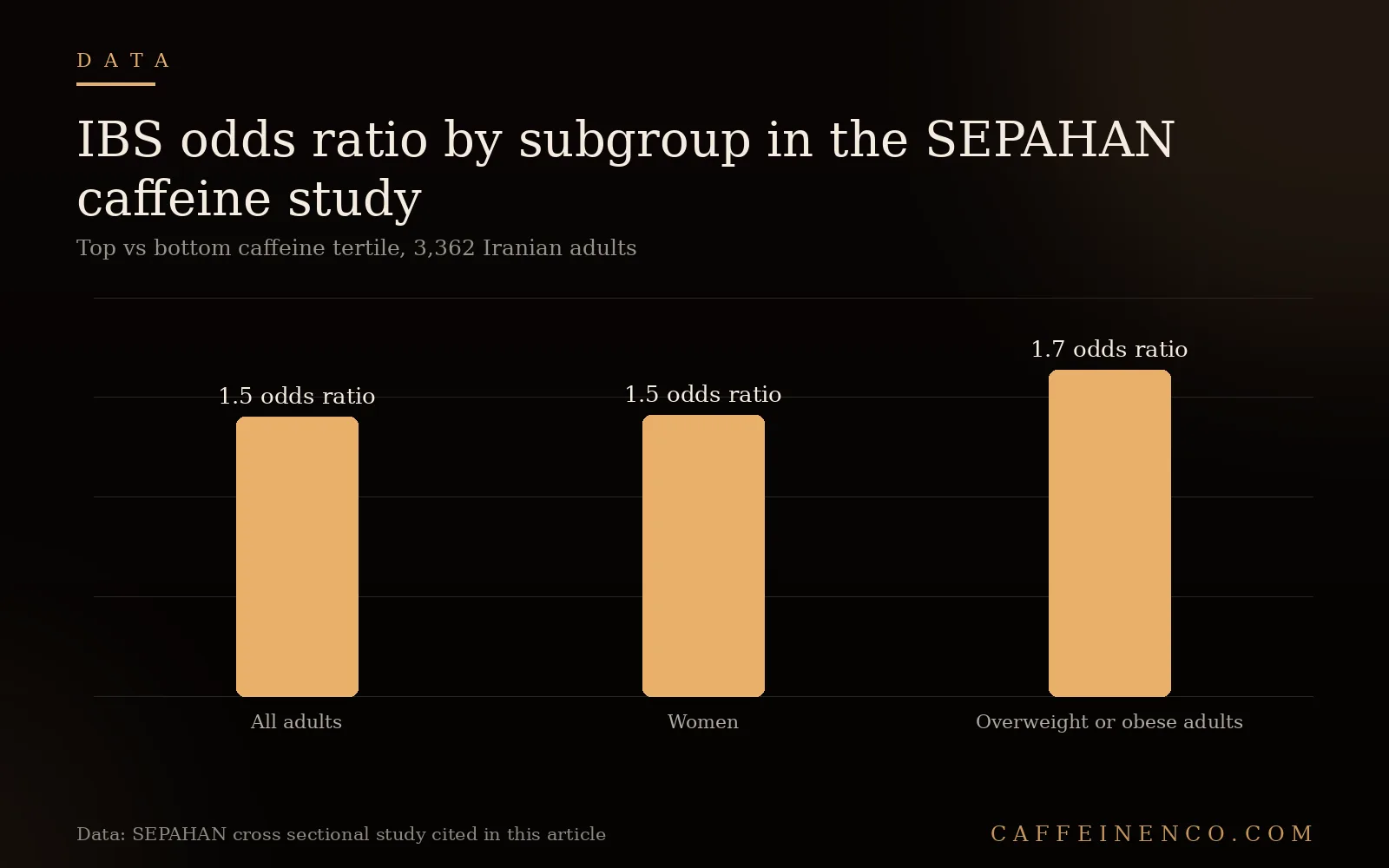
But a separate, independently published cross-sectional study of 3,362 Iranian adults (the SEPAHAN project) found the opposite direction for heavy caffeine intake specifically: participants in the top tertile of caffeine consumption, at least 106.5mg a day, had 47 percent greater odds of an IBS diagnosis than participants in the bottom tertile, under 69.4mg a day, a statistically significant result (OR 1.47, 95% CI 1.14 to 1.87). That same study found the association held for women specifically (OR 1.48) but not for men, and was strongest in participants who were overweight or obese (OR 1.72).
| Study | Design | Population | Finding |
|---|---|---|---|
| Meta-analysis (PMC10674416) | Pooled 8 studies | 432,022 people | Any coffee intake: 16% lower odds of IBS (OR 0.84) vs non-drinkers |
| SEPAHAN cross-sectional (PMC8241212) | Single cross-sectional survey | 3,362 Iranian adults | Top caffeine tertile: 47% greater odds of IBS (OR 1.47) vs bottom tertile |
Why the numbers disagree
The meta-analysis itself explains most of the gap, rather than leaving it a mystery. Its authors note that the protective 0.84 result is driven largely by one very large cohort study; when that single study is removed from the pooled analysis, the effect disappears almost entirely, landing at a pooled odds ratio of 1.00 (95% CI 0.74 to 1.36), statistically indistinguishable from no effect in either direction. The same review also acknowledges the studies pointing the other way, like the SEPAHAN cross-sectional data above, but notes that cross-sectional designs “may contain several biases, and cannot establish causal links,” since they cannot tell you whether high coffee intake caused IBS symptoms or whether people already managing digestive symptoms happened to also drink more coffee for unrelated reasons.
Read together rather than cherry-picked, the honest summary is this: at a population level, across the best pooled evidence available, coffee is not shown to meaningfully raise IBS risk, and the apparent protective effect from the meta-analysis is fragile, resting heavily on one large study rather than a broad, consistent signal. At an individual level, one well-designed study found a real, dose-dependent association between heavy caffeine intake and IBS, concentrated specifically in women and in people who were overweight or obese. Neither result cancels the other out; they are answering slightly different questions, population-wide causation versus a specific demographic association, and the honest answer to “does coffee cause IBS” is that the current evidence does not support a confident yes or no at the population level, while individual sensitivity clearly varies enough that a heavy daily habit is worth paying attention to if you already have digestive symptoms.
Worked example: reading your own coffee-gut pattern
- Track one variable at a time. Note whether you feel a bowel urge within 30 minutes of your first cup on five separate mornings, same size cup, same roughly consistent time. You are checking whether you are in the roughly 29 percent the 1990 study found respond reliably, or the majority who do not.
- Swap in decaf for a few days if you get a strong response. Since McGill and Cleveland Clinic both confirm decaf still triggers gastrin and a real, if reduced, gastrocolic effect, decaf tells you whether caffeine specifically is driving your response or whether the coffee itself, independent of caffeine, is the trigger.
- Note the temperature. This site’s own water temperature guide covers how brewing temperature changes extraction, but temperature also plays a role here: Cleveland Clinic notes warm coffee “facilitates transit time,” so an iced version of the same coffee may produce a milder response purely from being cold.
- Watch for milk-driven effects separately. Cleveland Clinic flags that cream or milk can intensify the effect for people with any degree of lactose sensitivity, which is a dairy reaction layered on top of, not the same as, coffee’s own gastrocolic effect. Try a black cup on a day you normally add milk to isolate which one is actually responsible.
- If you already manage IBS symptoms, watch total daily intake, not just your first cup. The SEPAHAN data above found the elevated IBS association specifically at higher total daily caffeine intake, not at any single cup, so the relevant number is your running daily total rather than any one serving.
If step 2 shows your gut responds mainly to caffeine rather than to coffee itself, a dedicated decaf coffee selection from 1st in Coffee keeps the ritual and the flavor while dropping the caffeine-driven portion of the gradient described above, or you can browse the same category on Amazon.
Common mistakes
Treating “coffee makes you poop” as something that happens to everyone is the most common mistake; the actual 1990 figure both sourced guides above cite is 29 percent, a real minority effect, not a universal one. Conflating the laxative and diuretic questions is the second: they run through different organs and different mechanisms, and Mayo Clinic is explicit that normal coffee drinking does not leave you net dehydrated even though caffeine does technically increase urine output. Assuming decaf is gut-neutral is the third mistake; both McGill and Cleveland Clinic confirm decaf still triggers gastrin and a measurable, if smaller, gastrocolic response, so switching to decaf reduces but does not eliminate the effect for people whose response is caffeine-sensitive. Treating either the meta-analysis’s 0.84 protective figure or the SEPAHAN study’s 1.47 risk figure as the final word on IBS is the fourth mistake; the honest reading, as the meta-analysis’s own authors note, is that the pooled protective effect is fragile and driven by one large study, while the risk finding comes from a single cross-sectional design that cannot establish causation on its own.
Common questions
Does coffee actually make you poop, or is that a myth? It is real but far from universal. A 1990 study of 99 volunteers, cited independently by both Cleveland Clinic and McGill’s Office for Science and Society, found coffee triggered a defecation urge in only 29 percent of participants.
Is it the caffeine, or something else in coffee, that causes the effect? Mostly something else, with caffeine adding a boost on top. Both regular and decaf coffee stimulate the hormone gastrin, per McGill, which is why decaf still has a real, measurable laxative effect. Cleveland Clinic cites caffeinated coffee as producing 60 percent more colon activity than water and 23 percent more than decaf specifically, meaning caffeine sharpens an effect that coffee’s other compounds already trigger.
Is coffee a diuretic? Technically yes, per Mayo Clinic, caffeine does increase urine production. But Mayo Clinic is clear that normal coffee consumption does not cause net dehydration, since the fluid volume in the cup itself offsets caffeine’s diuretic action at typical drinking levels. The effect is strongest in people not regularly exposed to caffeine, since habitual coffee drinkers build tolerance to it.
Does coffee cause or worsen IBS? The evidence genuinely disagrees. A 2023 meta-analysis of 432,022 people found coffee drinkers overall had lower odds of IBS (OR 0.84), but that result is driven mostly by one large cohort study and disappears (OR 1.00) when that study is excluded. A separate cross-sectional study of 3,362 adults found heavy caffeine intake specifically associated with 47 percent greater IBS odds, strongest in women and in people who were overweight or obese. Neither study definitively settles the question at a population level.
Why does coffee seem to affect me more in the morning than later in the day? The gastrocolic reflex itself, the mechanism behind coffee’s effect, is naturally more active in the morning regardless of what you eat or drink, per Cleveland Clinic. A first cup of the day is working with a more responsive system than the same cup at 3pm, on top of whatever coffee itself adds to it.
Should I switch to decaf if coffee upsets my stomach? It is a reasonable first experiment, but expect a smaller effect, not zero. Since both regular and decaf coffee stimulate gastrin, decaf coffee still produces a real gastrocolic response, just a reduced one, so decaf is worth trying specifically if your own tracking shows caffeine is sharpening a response you would rather not have, not as a guaranteed fix for coffee-related stomach upset in general.
For more sourced breakdowns like this one, delivered weekly, subscribe to The Sunday Pour.
Sources & data
- Cleveland Clinic Health Essentials: The Daily Grind: Why Coffee Makes You Poop
- McGill Office for Science and Society: Why does coffee make you poop?
- PMC: Association of Coffee and Caffeine Intake With Irritable Bowel Syndrome in Adults
- PMC: Examining the Association between Coffee Intake and the Risk of Developing Irritable Bowel Syndrome: A Systematic Review and Meta-Analysis
- Mayo Clinic: Caffeine: Is it dehydrating or not?