This site’s Dunkin’ and McDonald’s caffeine breakdowns cover two of the biggest coffee chains in North America, but Tim Hortons, the chain that arguably out-sells both of them across Canada and is expanding fast in the northern US, has been missing from that lineup. Tim Hortons also happens to be the rare chain that did the opposite of McDonald’s here: Caffeine Informer’s large-coffee page reports that “from 2008 Tim Hortons published detailed caffeine information of their entire line of beverages,” compiled by “Tim Hortons Research and Development department in Ontario, Canada.” That is a genuine company-sourced figure, not a customer-service reply relayed secondhand, though it is worth being upfront that it is now nearly two decades old. A second independent source, The Tart Tart, converges closely with those numbers, and Caffeine Informer’s own broader drink-by-drink page reveals something neither of this site’s other chain breakdowns has needed to explain: Tim Hortons’ US and Canadian menus carry meaningfully different caffeine figures for the same drink names.
The numbers: brewed coffee by size
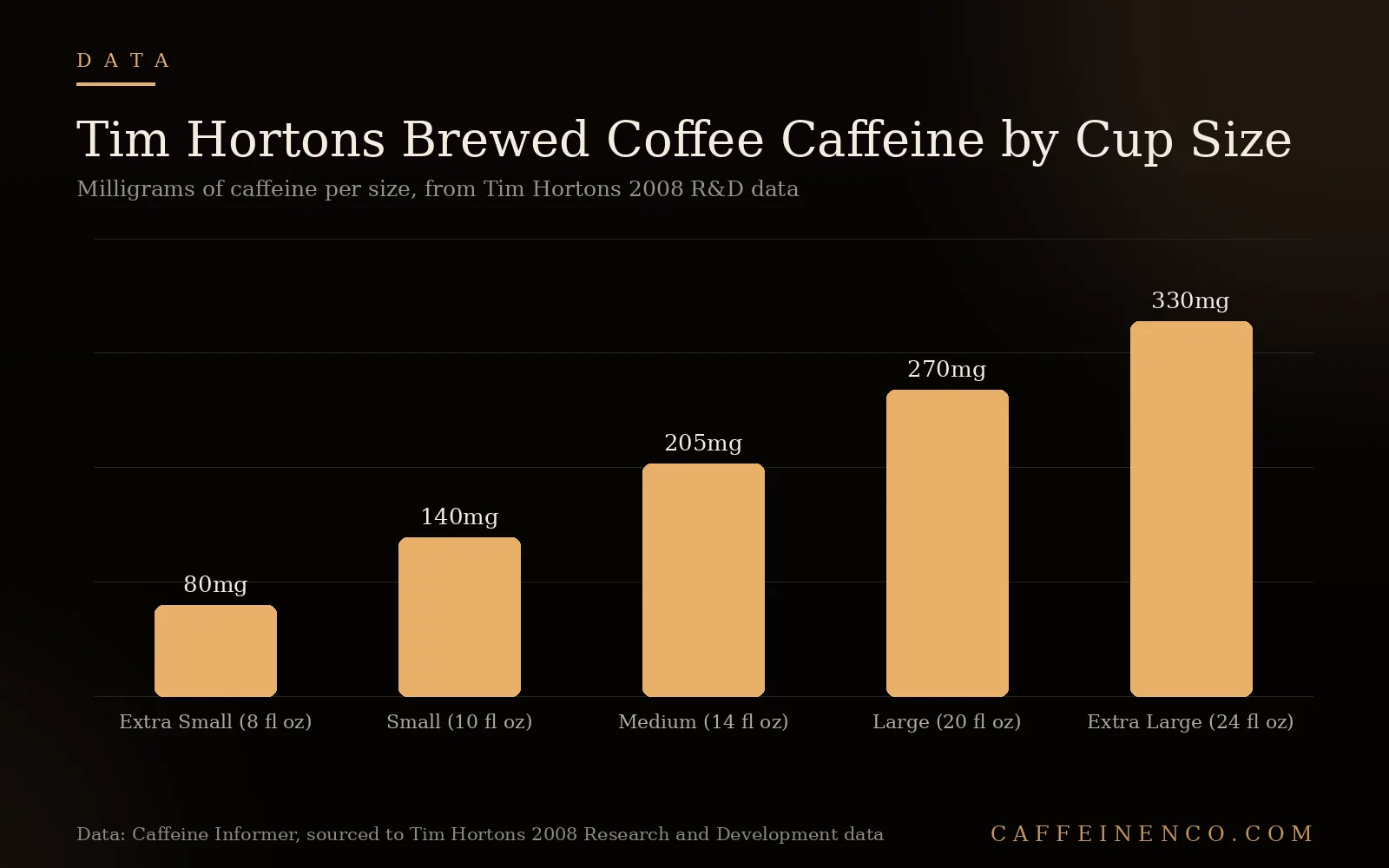
Caffeine Informer’s per-item page states the brewed coffee figures directly, sourced to that 2008 Tim Hortons Research and Development report:
| Size | Caffeine |
|---|---|
| Extra Small (8 fl oz, Canada only) | 80mg |
| Small (10 fl oz) | 140mg |
| Medium (14 fl oz) | 205mg |
| Large (20 fl oz) | 270mg |
| Extra Large (24 fl oz) | 330mg |
The Tart Tart independently gives closely matching figures: “approximately 140 mg” at Small, “roughly 205 to 210 mg” at Medium, and “between 270 and 290 mg” at Large. That guide adds an important caveat worth carrying forward: “caffeine varies by roast and preparation,” since “factors like water temperature and roast profile influence the final cup.” The two sources do not disagree at Small, and only diverge by a handful of milligrams at Medium and Large, well within the batch-to-batch variation any brewed coffee produces.
What is genuinely notable here is that Caffeine Informer’s separate drink-by-drink page lists the identical 140mg to 330mg range for both the US and Canadian menus. Brewed coffee is the one part of this page where the two countries’ numbers match exactly. That is not true everywhere else on the menu.
Where the US and Canada menus actually diverge
This is the part of Tim Hortons’ caffeine data that neither this site’s Dunkin’ nor McDonald’s page needed to untangle, because both of those chains are US-only. Tim Hortons operates a large, established Canadian menu alongside a smaller US footprint, and Caffeine Informer’s own breakdown lists genuinely different figures for the same drink names depending on which country’s menu is being described:
| Drink | Canada | USA |
|---|---|---|
| Espresso | 125mg (30ml shot) | 45mg (Small only) |
| Latte | Up to 205mg (Medium only) | 35 to 75mg (Small to Large) |
| Cappuccino | Up to 205mg (Medium only) | 75 to 140mg (Small to Large) |
| Dark Roast brewed coffee | 130 to 315mg (Small to Extra Large) | 135 to 320mg (Small to Extra Large) |
Dark roast brewed coffee is close between the two markets, within 5mg at every matching size. Espresso, lattes, and cappuccinos are not. A Canadian espresso shot at 125mg runs nearly three times a US espresso shot at 45mg, and Canada’s espresso-based drinks are listed as a single Medium figure rather than scaling by size the way the US menu does. Caffeine Informer does not spell out the mechanical reason for the gap, and this site could not independently verify one; take the following as a guess rather than a sourced explanation: a plausible driver is that Canada’s espresso-based drinks are built around a single shot size and menu format that predates the US market’s smaller, size-scaled lineup. The practical takeaway matters more than the mechanism: if you are ordering a Tim Hortons latte or cappuccino while traveling between the two countries, do not assume the same drink name delivers the same jolt.
Decaf: consistently low in both markets
Decaf is the one category where the US and Canadian figures line up again. Caffeine Informer lists decaf brewed coffee at 6 to 15mg across the full Small-to-Extra-Large range in both countries, low enough that it barely registers against a daily caffeine total either way.
Dark roast barely moves the number either way
Dark roast brewed coffee at Tim Hortons, 135 to 320mg across the US size range, runs about 5mg below the standard brewed coffee’s 140 to 330mg range at every matching size, a difference small enough to round away. That lines up with what this site’s own roast levels guide already explains: roasting drives off moisture and mass rather than caffeine itself, so the popular assumption that a darker roast means a bigger caffeine hit, or the opposite assumption that dark roast is somehow “decaffeinated by the roasting,” both miss what is actually a fairly small, bean-and-brew-ratio-driven difference. Tim Hortons’ own dark roast and regular figures sitting within 5mg of each other at every size is a clean, chain-specific confirmation of that same principle.
Worked example: building a caffeine-aware Tim Hortons order
- Start from your daily target. MD Anderson Cancer Center reports the FDA’s general guidance that “most adults can consume about 400 milligrams of caffeine per day without negative effects.” Treat that as a working ceiling unless a doctor has told you otherwise.
- Know which country’s menu you are reading. A Medium latte or cappuccino tops out at 205mg in Canada but runs only 35 to 140mg across the US size range for the same drink names, a bigger gap than exists anywhere on this site’s Dunkin’ or McDonald’s pages.
- Do not assume dark roast is dramatically weaker. At 135 to 320mg across the US sizes, Tim Hortons’ dark roast runs only about 5mg below its regular brewed coffee at each size, not the steep drop many people expect.
- Reach for decaf for a genuinely low-caffeine option. Decaf tops out at 15mg even at Extra Large in both markets, low enough to round toward zero against a 400mg daily target.
- Compare by size, not by drink name alone, when switching chains. A Tim Hortons Medium is 14 fl oz, the same pour size Dunkin’ uses for its own Medium, which makes the two chains unusually easy to compare directly against each other.
How Tim Hortons stacks up against Dunkin’, McDonald’s, and Starbucks
Comparing chains fairly means comparing caffeine per fluid ounce, since a “Medium” means a different cup size at every chain. Tim Hortons’ 205mg in a 14 fl oz Medium works out to about 14.6mg per fl oz:
| Chain | Medium size | Caffeine | Per fl oz |
|---|---|---|---|
| McDonald’s | 16 fl oz | 145mg | About 9.1mg |
| Tim Hortons | 14 fl oz | 205mg | About 14.6mg |
| Dunkin’ | 14 fl oz | 210mg | 15.0mg |
| Starbucks (Grande Pike Place) | 16 fl oz | 310mg | About 19.4mg |
Tim Hortons and Dunkin’ use the identical 14 fl oz Medium pour size and land within half a milligram per ounce of each other, the closest match between any two chains this site has compared. Both brew noticeably stronger than McDonald’s per ounce but trail Starbucks’ Pike Place by a real margin. Against the rest of this site’s brand coverage, a Tim Hortons Medium’s 205mg also comfortably outpaces a standard Nespresso OriginalLine pod at 55 to 65mg, and sits nowhere near Death Wish Coffee’s reconciled 59 to 61mg per fluid ounce, which would put a same-size 14oz serving of Death Wish north of 800mg.
Common mistakes reading a Tim Hortons caffeine number
Assuming the same drink name delivers the same caffeine in Canada and the US is the biggest one on this page: a Canadian espresso shot at 125mg is nearly three times a US espresso shot at 45mg, and Canadian lattes and cappuccinos are listed as a single Medium figure rather than scaling by size at all. Treating the 2008 Tim Hortons Research and Development figures as a fresh lab measurement is the second mistake; Caffeine Informer’s own sourcing note states the company’s data “is accurate to the best of our knowledge, no warranty is expressed or implied regarding its accuracy,” which is an honest disclaimer about an estimate, not a guarantee. Assuming dark roast carries meaningfully less caffeine than regular brewed coffee is the third; Tim Hortons’ own figures put dark roast only about 5mg below its standard brewed coffee at matching sizes, essentially the same cup rather than a real reduction.
Common questions
How much caffeine is in a medium Tim Hortons coffee? 205mg in the 14 fl oz Medium, per Caffeine Informer’s figures sourced to Tim Hortons’ own 2008 Research and Development data, with The Tart Tart independently converging on a close “roughly 205 to 210mg” range.
Does Tim Hortons publish its own caffeine content? Yes, and it has for longer than most competitors: Caffeine Informer traces the figures to a 2008 Tim Hortons Research and Development report covering the chain’s full beverage line, a genuine company-sourced dataset rather than a customer-service estimate.
Is Tim Hortons coffee stronger than Dunkin’ or McDonald’s? It is nearly identical to Dunkin’ and stronger than McDonald’s per ounce. At about 14.6mg of caffeine per fl oz, Tim Hortons sits within half a milligram of Dunkin’s 15.0mg per fl oz, both using the same 14 fl oz Medium size, and comfortably ahead of McDonald’s roughly 9.1mg per fl oz.
Does a Tim Hortons latte have the same caffeine in Canada and the US? No. Canada’s latte and cappuccino figures top out at a single Medium-only 205mg, while the US menu scales by size from 35mg Small to 75mg Latte or 140mg Cappuccino at Large, a real gap rather than a rounding difference between sources.
Does Tim Hortons dark roast have more caffeine than regular coffee? No, and it is not meaningfully less either: 135 to 320mg for dark roast versus 140 to 330mg for regular brewed coffee across matching sizes, a roughly 5mg gap at each size, confirming that roast level is not a reliable predictor of caffeine content.
How much caffeine is in Tim Hortons decaf coffee? Very little: 6 to 15mg across the full size range in both Canada and the US, low enough that it is not a meaningful contributor to a daily caffeine total.
For more sourced caffeine breakdowns like this one, delivered weekly, subscribe to The Sunday Pour.