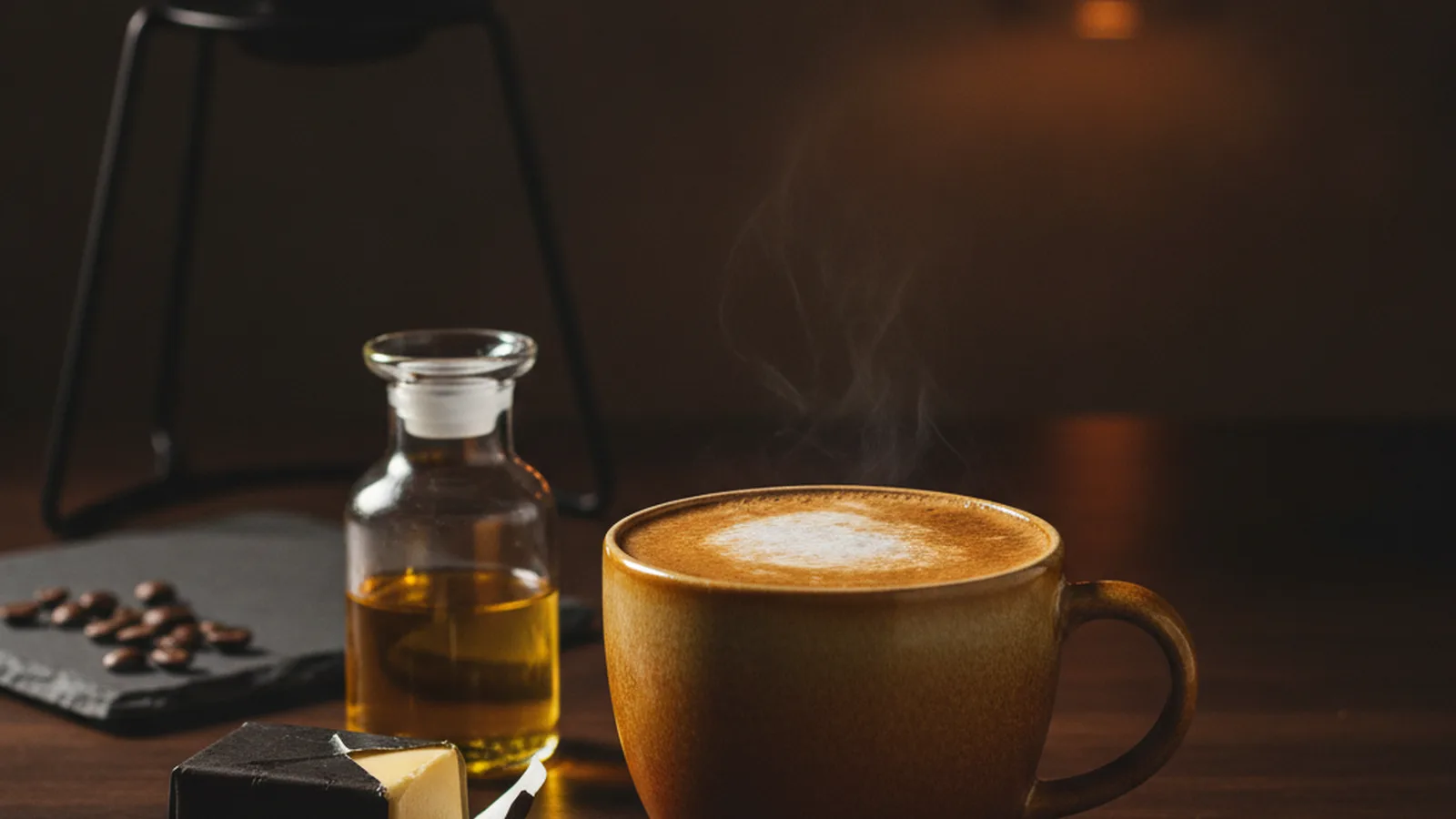
“Does Bulletproof Coffee actually do anything” sounds like one question and is really three. Does blending butter and MCT oil into your coffee sharpen your focus. Does it keep you full and burning fat until lunch the way a true ketogenic breakfast replacement should. And is drinking the saturated fat equivalent of a steak in liquid form every single morning something your cardiologist would sign off on. The brand itself answers all three with a confident yes. The actual research, once you separate it from the marketing, answers each question differently, and the most surprising finding of the three is not the one most articles lead with.
Bulletproof Coffee is a trademarked recipe created by entrepreneur Dave Asprey around 2009, built from a cup of coffee blended with one to two tablespoons of unsalted grass-fed butter and one to two tablespoons of MCT oil, a concentrated, manufactured source of medium-chain triglycerides typically derived from coconut or palm kernel oil. Asprey has said the idea traces back to a cup of yak-butter tea he drank while trekking in Tibet. The pitch is that the combination of fat and caffeine, with no carbohydrates, keeps you in a fat-adapted or ketogenic state while still giving you sustained energy and mental clarity, which is why it is marketed specifically as a breakfast replacement rather than a coffee add-in. This site’s own coffee and intermittent fasting breakdown covers a closely related question, whether black coffee alone breaks a fast. Bulletproof Coffee is a different case entirely, because unlike black coffee’s roughly 2 calories a cup, it is designed to add hundreds of calories back in.
What is actually in a cup, calorie by calorie

A tablespoon of unsalted butter contains about 100 calories and roughly 7 grams of saturated fat. A tablespoon of MCT oil runs about 130 calories, all of it fat. At the standard one-to-two-tablespoon range for each ingredient, a cup of Bulletproof Coffee lands somewhere between about 230 and 500 calories, depending on how heavy a hand the person blending it uses, before anything else, like a scoop of protein powder or a sweetener, gets added.
The 2024 clinical trial covered in detail below used a specific, representative dose: 2 tablespoons of MCT oil (230 calories, 28 grams of fat) plus 2 tablespoons of butter (200 calories, 22 grams of fat), for a total of 430 added calories a day on top of the coffee itself. That dose alone pushes past the American Heart Association’s own saturated fat guidance. The AHA recommends keeping saturated fat under 6% of total calories, which works out to roughly 13 grams a day on a 2,000-calorie diet. Two tablespoons of butter alone, at about 14 grams of saturated fat, already exceeds that daily ceiling in a single drink, before counting breakfast, lunch, or dinner.
Does it sharpen focus or give sustained energy
The clearest, most citable summary of Bulletproof Coffee’s cognitive claims comes from a 2023 systematic review published in the journal Beverages, which pulled together the small existing body of research testing the drink directly. One of the studies it reviewed, a single-blind, randomized crossover trial by Crampton and colleagues, gave six healthy coffee drinkers either 10 ounces of Bulletproof Coffee or 10 ounces of regular black coffee and found no significant difference in cognitive performance between the two. Across the broader review, the same conclusion held: no significant improvements in cognition, alertness, or energy levels from Bulletproof Coffee compared with regular coffee. The review’s own summary of the overall evidence base, not just the cognition studies specifically, is blunt about why: the current evidence is small, and overall there is weak or insufficient evidence to support the claimed benefits.
Does it keep you full until lunch
The same 2023 review found the picture on hunger, satiety, resting energy expenditure, and fat oxidation equivocal, with any benefit offset by the extra 230 to 500 calories the drink itself adds. One notable exception inside that otherwise weak evidence base: a separate double-blind, randomized crossover trial found a statistically significant elevation in resting energy expenditure specifically in the Bulletproof Coffee condition, a real, narrow positive finding rather than nothing at all. It is worth being precise about what that one finding does and does not mean. A higher resting energy expenditure is not the same thing as a net calorie deficit once a 400-plus-calorie drink is factored back in, and it is a single trial rather than a replicated pattern.
Separately from Bulletproof Coffee itself, MCT oil in general, outside the branded coffee recipe, does have a more established research base on weight and satiety. A meta-analysis of randomized controlled trials found that compared with long-chain triglycerides, the kind found in most dietary fats, MCT consumption was associated with an additional 0.51 kilogram of weight loss, 1.46 centimeters off waist circumference, and 0.79 centimeters off hip circumference, along with reduced total body fat. Separate controlled trials found that 35 grams of MCT oil at lunch reduced food intake at dinner in healthy men, and that 20 grams at breakfast plus 10 grams before lunch reduced next-meal intake in overweight men. Those are genuinely useful data points about MCT oil as an ingredient. They are not evidence about Bulletproof Coffee as a drink, because none of those trials added 230 to 500 calories of butter and oil to a beverage the way the branded recipe does, and higher MCT doses are also linked to gastric distress, cramping and diarrhea in particular, an effect that remained small at 30 grams but has not been well characterized at higher, blended-into-coffee amounts.
Will it raise your cholesterol: two studies that disagree
This is the question most worth getting right, and the honest answer is that two real pieces of evidence point in different directions, for a reason worth understanding rather than just picking a side.
The more rigorous evidence comes from a randomized controlled trial sponsored by Walter Reed National Military Medical Center and published in 2024. Sixty healthy adults aged 18 to 45, all regular coffee drinkers without hyperlipidemia, diabetes, or prediabetes, were randomized to drink either coffee alone or coffee with the 430-calorie butter-and-MCT-oil combination described above, every day for 12 weeks. Forty-one participants completed the trial, 19 in the control group and 22 in the experimental group.
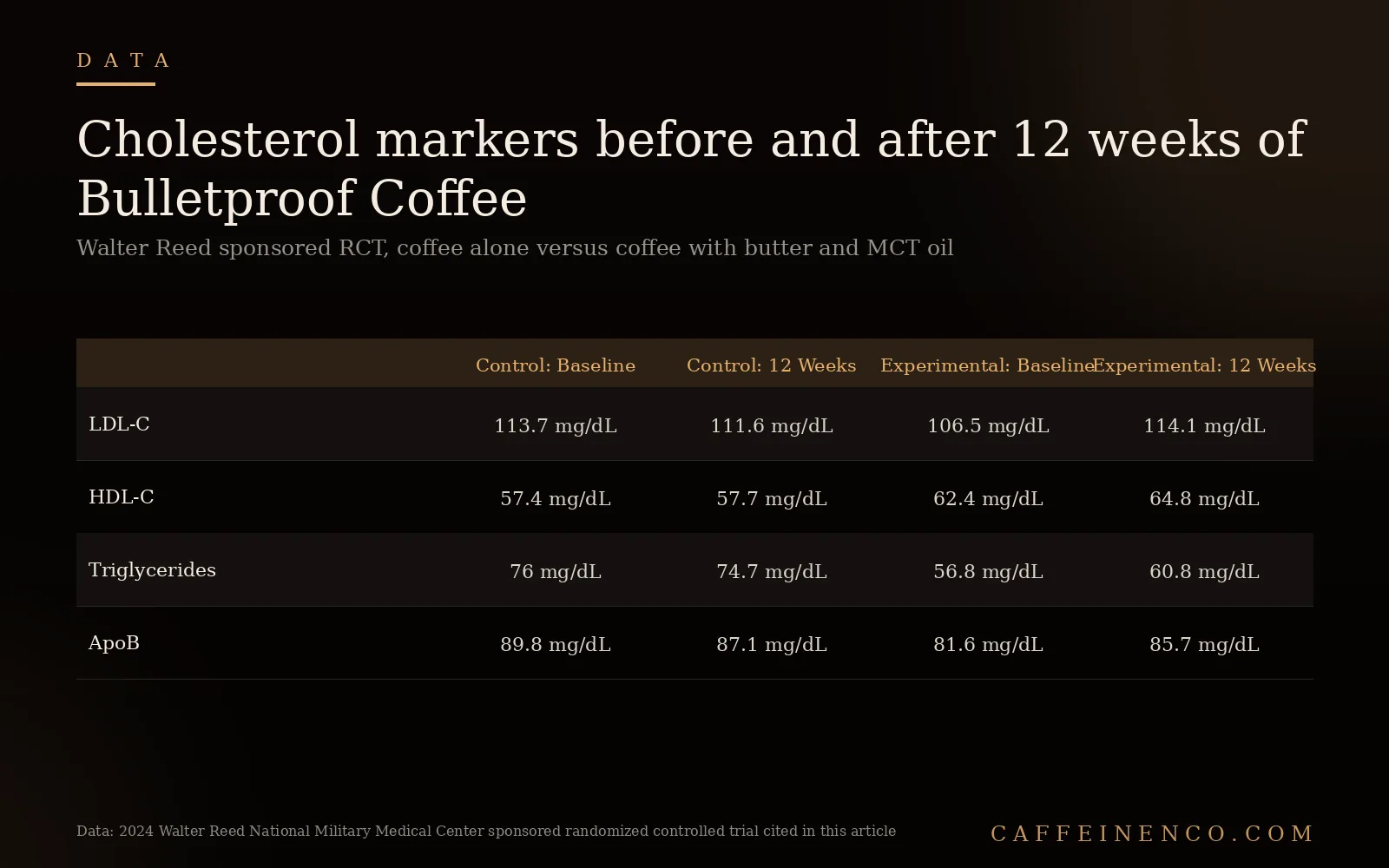
| Marker | Control: baseline to 12 weeks | Experimental (Bulletproof): baseline to 12 weeks |
|---|---|---|
| LDL-C (mg/dL) | 113.65 to 111.59 | 106.50 to 114.10 |
| HDL-C (mg/dL) | 57.35 to 57.71 | 62.41 to 64.85 |
| Triglycerides (mg/dL) | 76.00 to 74.71 | 56.77 to 60.80 |
| ApoB (mg/dL) | 89.85 to 87.1 | 81.60 to 85.7 |
At a significance level of 5%, the researchers found no statistically significant difference between the two groups, either at baseline or after 12 weeks, on any of these markers. The LDL number in the experimental group did tick up numerically, from 106.50 to 114.10, but that shift did not clear statistical significance given the sample size and the spread of individual results. The trial’s own conclusion is correspondingly modest: based on these findings, adding MCT oil and butter to coffee may be safe, over this dose and this 12-week window, in healthy adults who did not already have high cholesterol.
The competing data point is a single case report, published in the Journal of Clinical Lipidology in 2015, describing a 59-year-old man with pre-existing dyslipidemia who was referred to a lipid clinic after his cholesterol spiked following months of daily Bulletproof Coffee. His total cholesterol rose 33%, to 285 mg/dL, and his LDL rose 49%, to 232 mg/dL. On its own, that sounds like a direct contradiction of the 12-week trial above. It is a real, documented case, but it is also a confounded one: the same patient had self-discontinued his rosuvastatin, a cholesterol-lowering statin, around the same time he started the coffee habit. A single person stopping a statin and starting a 400-plus-calorie daily butter habit at once makes it impossible to say how much of his lipid spike came from which change.
There is a third, underappreciated factor worth raising here, one that most Bulletproof Coffee coverage skips entirely: the brewing method. Bulletproof Coffee is conventionally brewed unfiltered, often in a French press, which is also the vessel most associated with the recipe’s own branding and community recipes. Unfiltered coffee contains meaningfully more cafestol, a diterpene compound identified in a 1994 study as directly raising LDL cholesterol, at roughly 0.0104 mmol/L, about 0.187 mg/dL, of LDL increase per milligram of daily cafestol intake. Cafestol concentrations vary enormously by brewing method: boiled, unfiltered coffee can run as high as 939.2 mg/L, workplace brewing machines around 175.7 mg/L, and French press or percolator coffee in the 86.8 to 91.2 mg/L range, compared with near-zero for paper-filtered drip coffee. That means a French-press Bulletproof Coffee habit is adding a second, entirely separate LDL-raising mechanism, from the coffee itself, on top of whatever the butter and MCT oil are or are not doing, and a case report that does not record the brewing method cannot rule that mechanism out.
Worked example: deciding whether to try it
- If you are generally healthy, without diagnosed high cholesterol, and you are curious, the 12-week trial is reassuring on cholesterol specifically. The Walter Reed-sponsored RCT found no statistically significant LDL, HDL, or triglyceride change from a full daily dose over 12 weeks in healthy adults.
- Do not expect a focus or energy edge over regular coffee. The 2023 review’s own cognition studies found no significant difference between Bulletproof Coffee and plain black coffee on cognitive performance.
- Count the calories as a real breakfast, not a free add-on. At 230 to 500 added calories, a cup is calorically closer to a fast-food breakfast sandwich than to a splash of cream, which matters if the goal is weight management rather than a treat.
- If you already have high cholesterol or are on a statin, treat the case report as a reason to ask your doctor first, not as settled proof of harm. The 2015 case was confounded by a simultaneous statin discontinuation, but the same scenario, an existing lipid condition plus a 430-calorie daily saturated-fat habit, is exactly the population the 12-week RCT did not include.
- Switch to a paper filter if cafestol is a separate concern. This site’s own brewing guides for pour-over and AeroPress both use paper filters that strip out nearly all of a coffee’s cafestol, regardless of whether you add butter afterward. A paper-filter-friendly brewer like a coffee maker from 1st in Coffee’s grind-and-brew range or the same category on Amazon is a straightforward swap if a French press is your current method.
- If you want to test MCT oil’s satiety research without committing to the full branded recipe, start small and separately from coffee. A bottle of plain MCT oil on Amazon lets you test a smaller, single-ingredient dose, since the gastric-distress threshold in the research sits around 30 grams, well above a single tablespoon.
Common mistakes
Assuming the brand’s ketosis and fat-burning claims are backed by direct research on the drink itself is the most common mistake; the actual Bulletproof-Coffee-specific research is small, and the 2023 systematic review covering it found weak or insufficient evidence for most of the claimed benefits. Treating the single 2015 case report as proof that butter and MCT oil in coffee raise cholesterol is the second mistake; the patient in that report also stopped taking a statin at the same time, and a 12-week randomized trial with 41 completers found no significant lipid change under the same daily dose. Citing general MCT oil research, the weight-loss meta-analysis or the satiety trials, as if it were research on Bulletproof Coffee specifically is the third mistake; those trials tested MCT oil alone, not a 230-to-500-calorie butter-and-oil coffee drink. Ignoring the brewing method is the fourth mistake; French press and other unfiltered coffee carries meaningfully more cafestol than paper-filtered coffee, a documented, separate LDL-raising mechanism that has nothing to do with the butter. Treating the drink as calorie-free because it replaces a meal is the fifth mistake; at up to 500 calories, it is closer to a full breakfast than to a condiment.
Common questions
What is Bulletproof Coffee exactly? A trademarked recipe, coffee blended with one to two tablespoons each of unsalted grass-fed butter and MCT oil, created by Dave Asprey and marketed as a ketogenic breakfast replacement rather than a coffee add-in.
Does Bulletproof Coffee raise cholesterol? The best controlled evidence, a 2024 randomized trial sponsored by Walter Reed National Military Medical Center, found no statistically significant change in LDL, HDL, or triglycerides after 12 weeks of daily use in healthy adults. A separate 2015 case report described a cholesterol spike in one patient, but that patient had also stopped taking a statin at the same time.
Does it actually improve focus or energy compared to regular coffee? No significant difference was found in the controlled studies reviewed in a 2023 systematic review, including a crossover trial that compared Bulletproof Coffee directly against regular black coffee on cognitive performance.
How many calories are in a cup? Roughly 230 to 500 calories, depending on how much butter and MCT oil are used, built from about 100 calories per tablespoon of butter and about 130 calories per tablespoon of MCT oil.
Does the brewing method matter for cholesterol? Yes, separately from the butter and MCT oil. Unfiltered coffee, including the French press method commonly used for Bulletproof Coffee, contains meaningfully more cafestol, a compound with its own documented LDL-raising effect, than paper-filtered coffee does.
Is it safe to drink every day? The 12-week RCT found no significant lipid change in healthy adults without existing high cholesterol at a standard daily dose. People with diagnosed high cholesterol, those on cholesterol medication, or anyone managing diabetes should treat it as a conversation for their doctor rather than an assumed-safe daily habit, since none of those groups were included in the trial.
For more sourced breakdowns like this one, delivered weekly, subscribe to The Sunday Pour.
Sources & data
- Beverages, via MDPI: Assessing the Validity of Bulletproof Coffee's Claims
- Cureus, via PubMed: The Effects of Medium-Chain Triglyceride Oil and Butter on Lipid Profiles
- ClinicalTrials.gov: Effect of Butter and MCT Oil on Lipoproteins, A RCT (NCT02611102)
- Journal of Clinical Lipidology: Rise in Serum Lipids After Dietary Incorporation of Bulletproof Coffee
- Healio Cardiology: Use of Coffee Filters in Brewing May Lower LDL and Risk for Heart Disease
- American Heart Association: Saturated Fats
- PubMed: Effects of Medium-Chain Triglycerides on Weight Loss and Body Composition, A Meta-Analysis of Randomized Controlled Trials