Blue Bottle is the specialty roaster most people picture when they think of a careful, small-batch cup, and that image makes it easy to assume the caffeine is a mild, artisan-sized number. The company’s own published figures say otherwise for at least one product: a single 8 ounce can of its Bold cold brew carries 234mg of caffeine, more than half of the FDA’s daily reference amount in a can you can finish in a few minutes.
The more interesting finding is how little Blue Bottle actually measures. Its support site publishes caffeine for exactly four ready-to-drink products and states plainly that it does not test its whole bean coffee, its instant coffee, or the espresso and brewed coffee served in its cafes. So almost any other “Blue Bottle caffeine” number you find, for a NOLA shakerato, an in-cafe cold brew or a Nespresso pod, is somebody’s estimate. This guide separates what is published from what is guessed, does the per-ounce math so you can compare against other chains, and builds a few worked days against the 400mg line. It follows the same format as this site’s breakdowns of La Colombe, Dutch Bros and 7-Eleven.
What Blue Bottle actually publishes
Blue Bottle’s support article titled “Caffeine” lists tested figures for its ready-to-drink line only. As I read it, the page gives these four numbers:
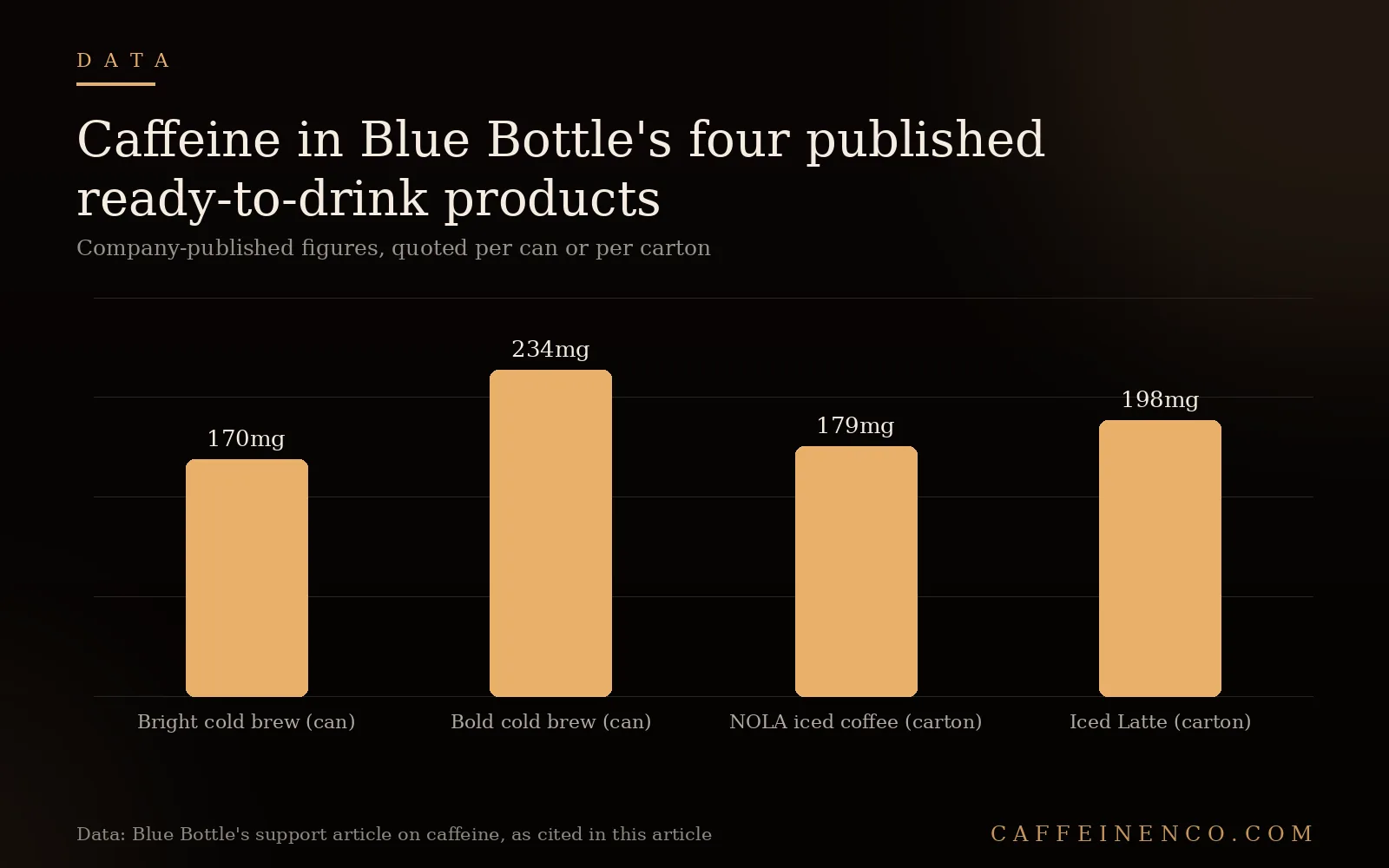
| Product | Caffeine (Blue Bottle’s figure) | Unit it is quoted per |
|---|---|---|
| Bright cold brew | 170mg | can |
| Bold cold brew | 234mg | can |
| New Orleans style iced coffee (NOLA) | 179mg | carton |
| Iced Latte | 198mg | carton |
The same article says the company does not currently test its whole bean or instant coffees for caffeine, and that it does not test the espresso shots, brewed coffee or tea served in its cafes either. The only cafe detail it offers is a recipe fact, not a caffeine one: espresso drinks use 18g of coffee in what it calls the “double ristretto” shot. The page I read carries no date, so I cannot say when the four figures were last measured.
That is a refreshingly honest page, and also a narrow one. It means the canned and boxed drinks have real, company-sourced numbers, and everything else has to be reasoned about.
The sizes behind the numbers
A caffeine figure per can is only useful if you know how big the can is. Blue Bottle’s own support page quotes per can and per carton without stating volumes, so I checked retailer listings:
- Bright cold brew: Costco Business Delivery lists it as an 8 fl oz (237 mL) can, sold in 6-packs. Retail listings for the Bold cold brew also show 8 fl oz cans.
- NOLA iced coffee: Bristol Farms lists the carton at 10.66 fl oz.
- Iced Latte: Good Eggs lists the carton at 10.6 fl oz.
These are retailer listings, not Blue Bottle’s own spec sheet, and I could not open the company’s main site to confirm them directly (it returned an access error to my fetch). Treat the sizes as reliable but secondhand. If your can or carton says something different, redo the math below with the printed volume.
Per-ounce math: how strong is it really?
Dividing each published figure by its volume gives the number that lets you compare across brands, since a small can and a big cup are not directly comparable.
| Product | Caffeine | Volume | Per fl oz |
|---|---|---|---|
| Blue Bottle Bold cold brew | 234mg | 8 fl oz | About 29.3mg |
| Blue Bottle Bright cold brew | 170mg | 8 fl oz | About 21.3mg |
| Blue Bottle Iced Latte | 198mg | 10.6 fl oz | About 18.7mg |
| Blue Bottle NOLA iced coffee | 179mg | 10.66 fl oz | About 16.8mg |
Two things stand out. First, the two straight cold brews are far more concentrated than the two milk drinks. That is what you would expect, since milk takes up volume that coffee otherwise would. The NOLA carton is built with milk, chicory and a little cane sugar, and the Iced Latte lists organic whole milk and coffee concentrate as its ingredients, so a good part of each carton is not coffee at all.
Second, the Bold can is the strongest drink in the table by a wide margin. At roughly 29mg per ounce it is more concentrated than most of what this site has measured elsewhere, which brings us to the comparisons.
How Blue Bottle compares with other chains
The rows below combine the Blue Bottle figures above with per-ounce numbers from this site’s other posts. Those other numbers come from different sources, such as company nutrition pages and caffeine trackers, so this is a comparison across published figures rather than one controlled test.
| Drink | Size | Caffeine | Per fl oz |
|---|---|---|---|
| Blue Bottle Bold cold brew | 8 oz | 234mg | About 29.3mg |
| Dutch Bros cold brew can | 11.5 oz | 293mg | About 25.5mg |
| Blue Bottle Bright cold brew | 8 oz | 170mg | About 21.3mg |
| La Colombe cold brew can | 9 oz | 180mg | 20.0mg |
| Starbucks Grande Pike Place | 16 oz | 310mg | About 19.4mg |
| Blue Bottle Iced Latte | 10.6 oz | 198mg | About 18.7mg |
| Starbucks Nitro Cold Brew, Black, Grande | 16 oz | 280mg | 17.5mg |
| Blue Bottle NOLA iced coffee | 10.66 oz | 179mg | About 16.8mg |
The pattern is that Blue Bottle’s Bold sits above even the Dutch Bros can, which this site’s Dutch Bros breakdown already flagged as a very concentrated drink. Bright lands right next to the La Colombe cold brew can. The two milk-based cartons sit in the same band as a Starbucks Nitro Cold Brew, whose numbers are in the Nitro guide.
The per-ounce view also explains why a small can can still be a big dose. Bold has the smallest volume in the table and the highest total of the cans, so it is easy to drink fast and easy to underestimate. For the wider question of why cold brew numbers vary so much from brand to brand, see this site’s cold brew caffeine reconciliation.
Worked example: a Blue Bottle day against 400mg
The FDA says 400mg a day is an amount not generally associated with negative effects for most healthy adults, and that sensitivity varies by person. Here is how the published Blue Bottle figures stack up against that line.
- One Bold can. 234mg. That leaves 166mg of room.
- One Bright can and one NOLA carton. 170 + 179 = 349mg. Under the line, with 51mg to spare.
- One Bold can and one Bright can. 234 + 170 = 404mg. Over the line by 4mg, from two small cans.
- One Bold can and one Iced Latte. 234 + 198 = 432mg. Over by 32mg.
- Two Bold cans. 468mg. Over by 68mg.
- Three NOLA cartons. 3 x 179 = 537mg. Each carton feels like a sweet, milky treat, which is exactly why this one is easy to overshoot.
Notice that example 3 comes out just over the line even though neither can looks large. That is the main practical lesson of the data: the cans are small, so the habit of finishing one in ten minutes and opening a second is the thing that crosses 400mg.
The cafe menu: what is not published
If you order at a Blue Bottle cafe, you are in the part of the menu the company says it does not test. That covers espresso, drip coffee, cold brew on tap, and the iced and milk drinks built from them. I found no published caffeine number for any cafe drink, so any table claiming one is an estimate. The best you can do is reason from what is known.
What we know about the espresso
Blue Bottle says its espresso drinks use 18g of coffee in a double ristretto shot. This site’s espresso shot guide explains why per-shot caffeine numbers spread so widely: the commonly quoted 63mg figure comes from a USDA entry for a roughly 1 ounce shot, while a University of Glasgow survey of 20 cafe shots found a range from 51mg to 322mg with a median of 140mg.
Using those two sources as brackets, and assuming a Blue Bottle double behaves like two typical shots, a double could plausibly land anywhere from roughly 125mg (two shots at the USDA figure) to about 280mg (two shots at the Glasgow median). That is a wide bracket on purpose. It is arithmetic on other people’s measurements, not a Blue Bottle number, and a ristretto pull, which uses less water, may extract differently from a normal shot. Use it as a planning range, not a fact.
Milk drinks and cold brew on tap
Milk drinks built on that espresso will carry the espresso’s caffeine regardless of how much milk is in the cup, since milk adds volume, not caffeine. A larger latte therefore does not mean more caffeine unless it also has more shots. For cold brew poured from a cafe tap, the canned Bright and Bold figures hint at the range, but cafe concentrate, dilution and cup size can all differ, so I would not apply a can figure to a cup.
The NOLA shakerato
A shakerato is an espresso-based drink shaken with ice. I searched for a caffeine figure for Blue Bottle’s NOLA shakerato and found only nutrition-database entries covering calories and macros, none listing caffeine. Because the company says it does not test cafe espresso, I would treat any shakerato caffeine number you see online as unverified. If you want a rough sense, the espresso bracket above applies to the shots, and it is the shots, not the milk or sweetener, that carry the caffeine.
Instant, whole bean and pods
Blue Bottle’s NOLA Craft Instant Coffee launched in July 2024 as single-serve sachets, according to Tea & Coffee Trade Journal, which gives no caffeine figure. Blue Bottle’s support page says it does not test its instant coffee. This site’s instant coffee guide shows instant coffee generally running well below brewed coffee per cup, from about 30 to 100mg for standard packets, but that is a category figure and not a Blue Bottle one.
For whole bean, the company does not publish a number either. The caffeine you get from beans depends mostly on how much you use, not on the roaster: a dose of 18g of coffee in a double ristretto and a 20g dose in a pour-over simply contain different amounts of the same stuff. The ratio guides on this site, such as the coffee to water ratio chart, are a better route for planning a home cup than any per-brand figure.
I also found no company-published figure for Blue Bottle’s Nespresso-compatible pods. For pods in general, the Nespresso guide lays out what is known for that system.
Decaf
I found no sourced caffeine number for decaf at Blue Bottle, and the support page does not address it. Decaf is low in caffeine but not zero, as the decaf guide explains, and the amount varies with the process and the bean. If you rely on decaf for medical or sleep reasons, ask the cafe or check the packaging.
Who should be careful
Anyone sensitive to caffeine, pregnant or breastfeeding, or taking medication that interacts with it should plan from the high end of any range and speak to a health care provider about a personal limit, as the FDA also advises. The cans are the place where the numbers get ahead of people, because a drink that looks small and tastes smooth can carry a real dose. If you notice jitters or a racing feeling after a Bold can, this site’s coffee and anxiety guide covers how dose and speed of intake interact. If you decide to cut back after a heavy canned-coffee habit, the caffeine withdrawal timeline describes what to expect.
Common mistakes when reading a Blue Bottle number
- Assuming one number covers the whole brand. The company publishes four figures, for cans and cartons. Nothing else is tested.
- Comparing per can instead of per ounce. An 8 ounce Bold can and a 16 ounce latte are different sizes. Divide first.
- Applying a can figure to a cafe cup. Cafe cold brew and espresso drinks are a different supply chain from the canned line.
- Treating the milk cartons as light. The NOLA carton at 179mg and the Iced Latte at 198mg both carry more than a typical home cup of drip.
- Believing unsourced shakerato or pod numbers. If a page gives a precise figure and no source, it is probably a guess.
- Drinking two small cans. Bold plus Bright is 404mg, over the 400mg reference.
Common questions
How much caffeine is in Blue Bottle cold brew? Blue Bottle’s support site lists 170mg for a can of Bright and 234mg for a can of Bold. Retail listings show 8 fl oz cans, which works out to about 21mg and 29mg per ounce.
How much caffeine is in a Blue Bottle NOLA iced coffee? Blue Bottle lists 179mg per carton. Retailers list the carton at 10.66 fl oz, so about 16.8mg per ounce.
How much caffeine is in a Blue Bottle Iced Latte? Blue Bottle lists 198mg per carton, which retailers list at about 10.6 fl oz.
How much caffeine is in a Blue Bottle NOLA shakerato? There is no published figure. Blue Bottle says it does not test cafe espresso. The caffeine comes from the espresso shots, so the shot bracket in this guide is the nearest reasoning available, and it is an estimate.
Does Blue Bottle publish caffeine for its espresso or brewed coffee? No. Its support page says it does not test cafe espresso shots, brewed coffee or tea. It states only that espresso drinks use 18g of coffee in a double ristretto.
How much caffeine is in Blue Bottle instant coffee? Not published. The support page says instant coffee is not tested for caffeine, and a launch report on the NOLA Craft Instant Coffee gave no figure.
Is Blue Bottle stronger than Starbucks? For the canned cold brews, Bold at about 29mg per ounce is above the 17 to 19mg per ounce of Starbucks Pike Place and Nitro Cold Brew in this site’s guides. These come from different sources, so it is a comparison of published numbers, not a lab test.
Can I have two Blue Bottle cans in a day? Bright plus Bold totals 404mg and two Bold cans total 468mg, both above the FDA’s 400mg reference for most healthy adults. Two Bright cans total 340mg. Individual tolerance varies.
For more sourced caffeine breakdowns like this one, delivered weekly, subscribe to The Sunday Pour.
Sources & data
- Blue Bottle Coffee Support: Caffeine
- Costco Business Delivery: Blue Bottle Coffee Bright Cold Brew Coffee, 8 fl oz, 6 ct
- Bristol Farms: Blue Bottle Coffee Organic New Orleans Style Iced Coffee, 10.66 oz
- Good Eggs: Blue Bottle Coffee Organic Iced Latte
- Tea & Coffee Trade Journal: Blue Bottle Debuts NOLA Craft Instant Coffee
- FDA: Spilling the Beans: How Much Caffeine Is Too Much?