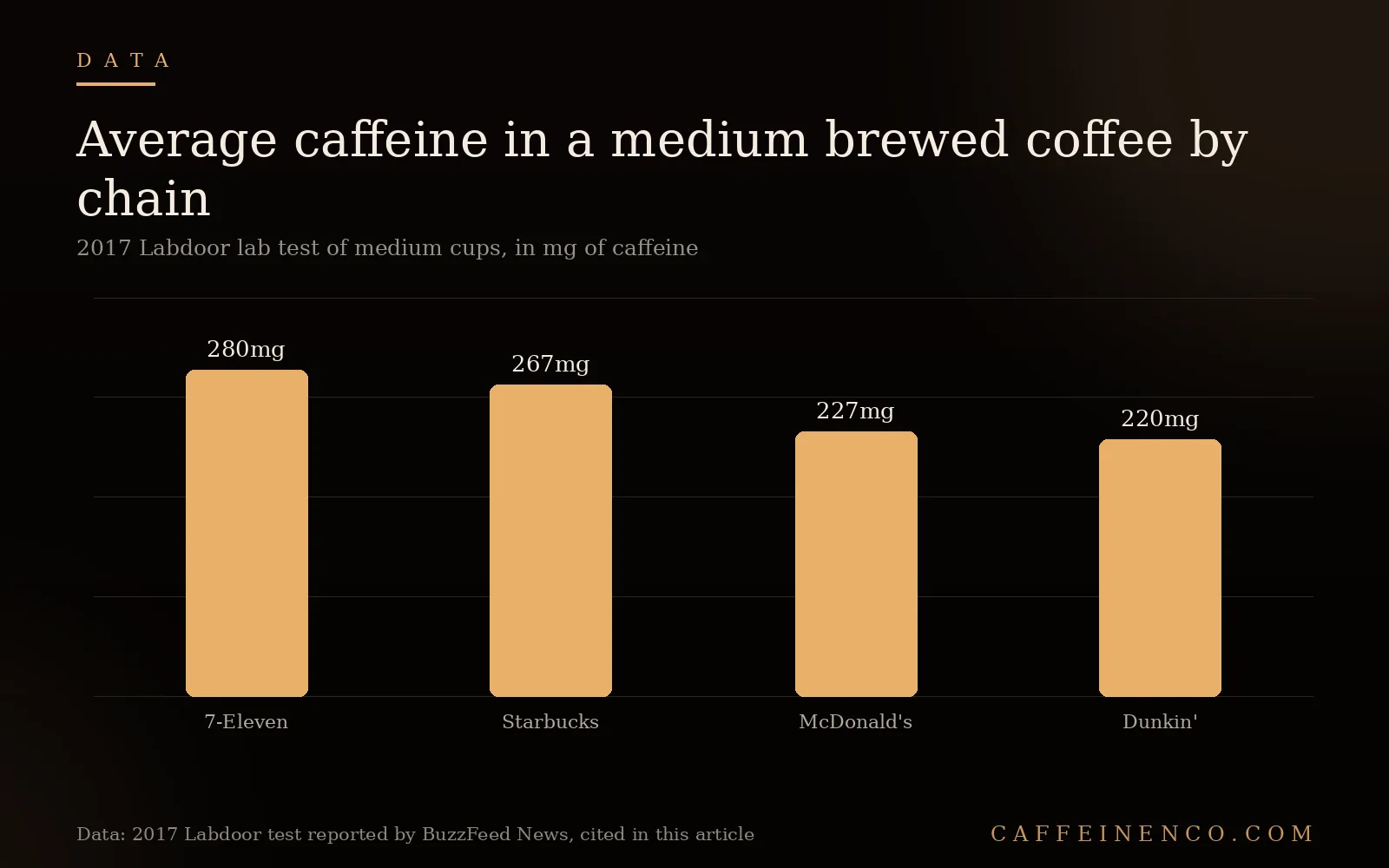
7-Eleven is the cheapest, most available cup of coffee in most American towns, and it has a quiet reputation for being strong. The best hard evidence for that reputation is a 2017 lab test of medium brewed coffees from four national chains, which put 7-Eleven first, at an average of 280mg of caffeine per cup. That is more than the Starbucks, McDonald’s and Dunkin’ cups tested alongside it.
The catch is that the evidence is thin and old. There is one lab test, run in two cities, with an unspecified cup size, and almost every other 7-Eleven caffeine number on the internet traces back to it. This guide lays out what the test actually found, how the numbers get stretched into the size tables you see elsewhere, where they conflict with 7-Eleven’s own marketing, and how to plan a day around them. It follows the same format as this site’s breakdowns of Starbucks brewed coffee, Dunkin’ and McDonald’s, so you can compare chains directly.
Where the 7-Eleven numbers come from
Everything solid starts with one article. BuzzFeed News published “We Tested Coffee Chains To See Who Has The Most Caffeine” on May 22, 2017. The testing was done by Labdoor on medium cups of brewed coffee bought from four chains: Starbucks, McDonald’s, 7-Eleven and Dunkin’. Samples came from outlets in New York and San Francisco. The article refers to roughly two dozen medium cups, but does not give a clean sample count for each chain, and it does not describe the lab method in detail.
Here is what it reports, as I read it:
| Chain (medium brewed) | Average caffeine | Caffeine per ounce |
|---|---|---|
| 7-Eleven | 280mg | 19 to 22mg (New York stores) |
| Starbucks | 267mg | 16 to 17mg |
| Dunkin’ | 220mg | 16 to 20mg (New York stores) |
| McDonald’s | 227mg | 10 to 17mg |
Labdoor’s research director is quoted as saying that, statistically, the chains “are all kind of overlapping,” and that consumers can expect around 250mg of caffeine. That is an important correction to the “7-Eleven wins” headline. The 7-Eleven average is the highest of the four, but with this few samples and this much cup-to-cup spread, the honest summary is “at or near the top of the pack,” not “proven strongest.”
How the 280mg figure became a size table
Caffeine Informer lists 7-Eleven brewed coffee at 280mg per 16 fl oz, which is 17.5mg per fluid ounce, and names the 2017 BuzzFeed lab test as its source. Its page lists no other sizes. It also notes that during that test, samples ranged from 224mg to 357mg, and that 7-Eleven’s other blends and roasts could vary from what is listed. I could see that range on Caffeine Informer’s page but not on the BuzzFeed page I read, so I am attributing it to Caffeine Informer’s summary.
Notice what happened there. BuzzFeed said “medium” without giving ounces. Caffeine Informer assigned it 16 fl oz. That is a reasonable guess, and 16 ounces is a common medium, but it is an assumption layered on a test, not a measurement. The same 17.5mg per ounce figure also appears in a January 2019 Foodbeast article, which credits the sleep-education site Sleepopolis for the underlying ranking and does not give cup sizes. So the “multiple sources agree” look is partly an echo of one data point.
What each cup size probably contains
7-Eleven sells coffee in several cup sizes, and I could not find an official caffeine table for any of them. What you can do is scale the lab’s per-ounce figure, which is arithmetic, not a published measurement. The assumption is that caffeine concentration stays the same as the cup gets bigger, which is how brewed drip coffee generally behaves, since each pot is the same brew poured into different cups.
| Cup size | Estimate at 17.5mg per oz (average) | Estimate at 19mg per oz | Estimate at 22mg per oz |
|---|---|---|---|
| 12 fl oz | 210mg | 228mg | 264mg |
| 16 fl oz | 280mg | 304mg | 352mg |
| 20 fl oz | 350mg | 380mg | 440mg |
| 24 fl oz | 420mg | 456mg | 528mg |
Treat the middle column as the central estimate, and the other two as the spread you might see from one store or one pot to the next. The 19 to 22mg range comes from the New York samples, so it is a fair picture of how much concentration varied in that test.
Two things follow. First, a 20 ounce cup is already around 350mg on the average figure, and a 24 ounce cup lands above the 400mg daily reference from the FDA before you add anything else. Second, the spread matters about as much as the size. A 16 ounce cup from a strong pot can hold more caffeine than a 20 ounce cup from a weak one.
Worked example: how far apart two “medium” cups can be
Suppose you buy a 16 ounce coffee on Monday and Thursday, from two different stores.
- Monday’s pot tests at the low end of the New York range, 19mg per ounce: 16 x 19 = 304mg.
- Thursday’s pot tests at the high end, 22mg per ounce: 16 x 22 = 352mg.
- The difference is 48mg, about three-quarters of the 63mg in a typical espresso shot.
That is a 16 percent swing between two cups with the same name, same size and same price. It is why a precise-looking number like “280mg” should be read as a center of a range, not a promise. Over a week of five cups, the two extremes would differ by about 240mg in total, nearly an extra cup of coffee.
7-Eleven’s own number disagrees
7-Eleven’s blog post “Coffee vs Energy Drinks: What’s Better For You?” states that 7-Eleven coffee “boasts a caffeine punch ranging from 80 to 200 mg per cup.” The post does not give cup sizes or a breakdown by size, and I did not find a date or testing method for the range.
That range is much lower than the lab result. Even the lowest per-ounce figure from the 2017 test, 19mg, would put a 12 ounce cup at 228mg, above the top of the blog’s range. There are a few possible explanations, and none can be confirmed from public material:
- The blog may be describing a small cup, or an 8 ounce serving, since it names no sizes.
- The blog may be a general-purpose marketing range written without reference to lab data.
- Recipes or coffee blends may have changed in the years since 2017, in either direction.
Without more information, the sensible approach is to plan from the higher figure. If the real number is lower, you lose nothing. If you plan from the low end and the lab figure is closer to the truth, you could exceed your intended limit without noticing.
7 Select Coffee Energy Shot: a different animal
7-Eleven’s house brand has also sold a concentrated coffee energy shot. Caffeine Informer lists the 7 Select Coffee Energy Shot at 150mg per 2 fl oz, which is 75mg per fluid ounce, in French Vanilla, Toasted Coconut and Mocha flavors, citing product samples from the company. The page flags that the item may be discontinued, so check the shelf before assuming it exists in your store.
The per-ounce number is the point. A 2 ounce shot carrying 150mg is concentrated about four times as strongly as the drip coffee, so it is easy to drink in two swallows what would take twenty minutes with a cup. Pair that with a large coffee and you are near 500mg before lunch. The speed of intake matters for how it feels as well as the total, which this site’s coffee and anxiety guide covers.
How 7-Eleven compares per ounce
Here are the averages from the 2017 test next to this site’s own size-based figures for the same chains, where those exist.
| Chain and drink | Size | Caffeine | Per fl oz |
|---|---|---|---|
| 7-Eleven brewed (2017 lab average, assuming 16 oz) | 16 oz | 280mg | 17.5mg |
| Starbucks Grande Pike Place | 16 oz | 310mg | About 19.4mg |
| Dunkin’ medium hot | 14 oz | 210mg | 15.0mg |
| McDonald’s medium | 16 oz | 145mg | About 9.1mg |
The Starbucks, Dunkin’ and McDonald’s rows come from published size tables summarized in the linked posts, not from the 2017 lab test, so this comparison mixes two kinds of evidence. The lab found Starbucks at 16 to 17mg per ounce, a little below the 19.4mg published for a Grande Pike Place, which shows that lab tests and company or tracker figures do not line up exactly even for one chain.
The overall picture holds up under either set of numbers. 7-Eleven sits in the strong group with Starbucks, clearly above Dunkin’ and well above McDonald’s. If you want to see what a chain at the other end of the spectrum looks like, the Dutch Bros breakdown shows a large brewed coffee at under 10mg per ounce.
What about decaf, flavored and other blends?
Caffeine Informer’s page says only that other blends and roasts could vary, and gives no figure for decaf, flavored coffee or specialty blends. I found no published, sourced caffeine number for 7-Eleven’s decaf. As a general reference, this site’s decaf caffeine guide explains that decaf is low but not zero. If you rely on a specific decaf, ask the store or check the label on packaged products.
The same goes for iced coffee, cold brew and the frozen coffee drinks. I did not find a size-by-size, sourced caffeine table for any of them, so I am not going to guess.
Worked example: a 7-Eleven day against 400mg
The FDA cites 400mg a day as an amount not generally associated with negative effects for most healthy adults, and stresses that sensitivity varies from person to person. These sums use the average of 17.5mg per ounce, and then show what happens at 22mg.
- One 16 oz coffee. 280mg on average, 352mg at the high end. Fine on either number, leaving between 48mg and 120mg of room.
- One 24 oz coffee. 420mg on average, 528mg at the high end. Over the line from a single cup.
- 16 oz coffee plus an energy shot. 280mg + 150mg = 430mg on average. Over the line, and the shot arrives fast.
- Two 12 oz coffees, morning and early afternoon. 210mg x 2 = 420mg on average, or 528mg at 22mg per ounce.
- One 12 oz coffee and a second half-cup top-up (6 oz). 210mg + 105mg = 315mg on average. Comfortable.
The pattern is that the bigger cups are where the line gets crossed. If you want the habit without the overshoot, the simplest fix is to pick a size down. Because brewed coffee scales with volume, stepping from 24 ounces to 16 cuts about 140mg on the average figure.
Who should be careful
People who are sensitive to caffeine, pregnant, breastfeeding, or taking certain medications should treat the high end of the range as the working number and speak to a health care provider about their own limit, as the FDA also advises. If you drink a large gas-station coffee every morning and decide to cut back, expect some rebound effects, and see the caffeine withdrawal timeline for what to expect and how long it lasts.
Common mistakes when reading a 7-Eleven number
- Treating 280mg as a guarantee. It is an average from a small sample in two cities in 2017. The reported spread was wide.
- Assuming “medium” is 16 ounces everywhere. The lab article did not say. The 16 ounce label was added later by a data site.
- Believing the size tables. Any table with a number for every size was probably produced by multiplying one figure, as the one above is.
- Trusting the 80 to 200mg marketing range. It contradicts the lab data and gives no sizes.
- Forgetting the pot. Freshly brewed coffee at a convenience store varies from pot to pot and hour to hour.
- Ignoring the shot. A 2 ounce coffee energy shot at 150mg is the most concentrated item in this guide.
Common questions
How much caffeine is in a 7-Eleven coffee? A 2017 Labdoor test reported by BuzzFeed News found an average of 280mg in a medium brewed cup. Caffeine Informer treats that as 280mg per 16 fl oz, or 17.5mg per ounce.
Is 7-Eleven coffee stronger than Starbucks? In that test, yes on average: 280mg versus 267mg for a medium. But the lab’s own research director described the chains’ results as statistically overlapping, so the honest answer is “about the same, possibly a little stronger.”
How much caffeine is in a large 7-Eleven coffee? There is no official published figure. At the lab’s average of 17.5mg per ounce, a 20 ounce cup would hold about 350mg and a 24 ounce cup about 420mg. These are calculated estimates.
Why does 7-Eleven say 80 to 200mg per cup? That is the range given in 7-Eleven’s own blog post, with no sizes or method stated. It does not match the lab results, and I could not find the reason for the difference.
How much caffeine is in a 7 Select coffee energy shot? Caffeine Informer lists 150mg per 2 fl oz, in French Vanilla, Toasted Coconut and Mocha, and notes the item may be discontinued.
Does 7-Eleven decaf have caffeine? I found no sourced figure for 7-Eleven’s decaf. Decaf generally contains a small amount, covered in this site’s decaf guide.
Is the 7-Eleven test still accurate? It is nearly a decade old and covered two cities. Recipes, beans and brewing equipment may have changed, so use it as a rough guide.
Can I drink a 7-Eleven coffee every day? A single 16 ounce cup falls under the FDA’s 400mg reference for most healthy adults on either the average or the high-end estimate. Bigger cups, or adding a shot, can push past it. Individual tolerance varies.
For more sourced caffeine breakdowns like this one, delivered weekly, subscribe to The Sunday Pour.
Sources & data
- BuzzFeed News: We Tested Coffee Chains To See Who Has The Most Caffeine
- Caffeine Informer: 7 Eleven Brewed Coffee Caffeine Content
- Caffeine Informer: 7 Select Coffee Energy Shot
- Foodbeast: 7-11 Coffee Is Surprisingly One Of The Strongest In Fast Food
- 7-Eleven: Coffee vs Energy Drinks, What's Better For You?
- FDA: Spilling the Beans: How Much Caffeine Is Too Much?