La Colombe is the canned-coffee brand that turned up in most supermarket coolers before most cafes had heard of nitro. Its draft lattes, with a frothy head from infused nitrous oxide, and its plain cold brew cans are a common mid-afternoon grab, and they raise a question the can itself rarely answers loudly: how much caffeine is actually in there? The honest answer is that the number depends on which can you are holding. The figures in circulation do not agree, and the reason is not carelessness. La Colombe relaunched its draft lattes in 2024 with new packaging, and the older and newer numbers have been sitting side by side on the internet ever since. This guide lays out both sets, shows where they come from, and works out what they mean per ounce and per day, in the same format as this site’s Dutch Bros and Starbucks Nitro Cold Brew breakdowns.
Why La Colombe numbers disagree
Two things are going on at once, and they are easy to confuse.
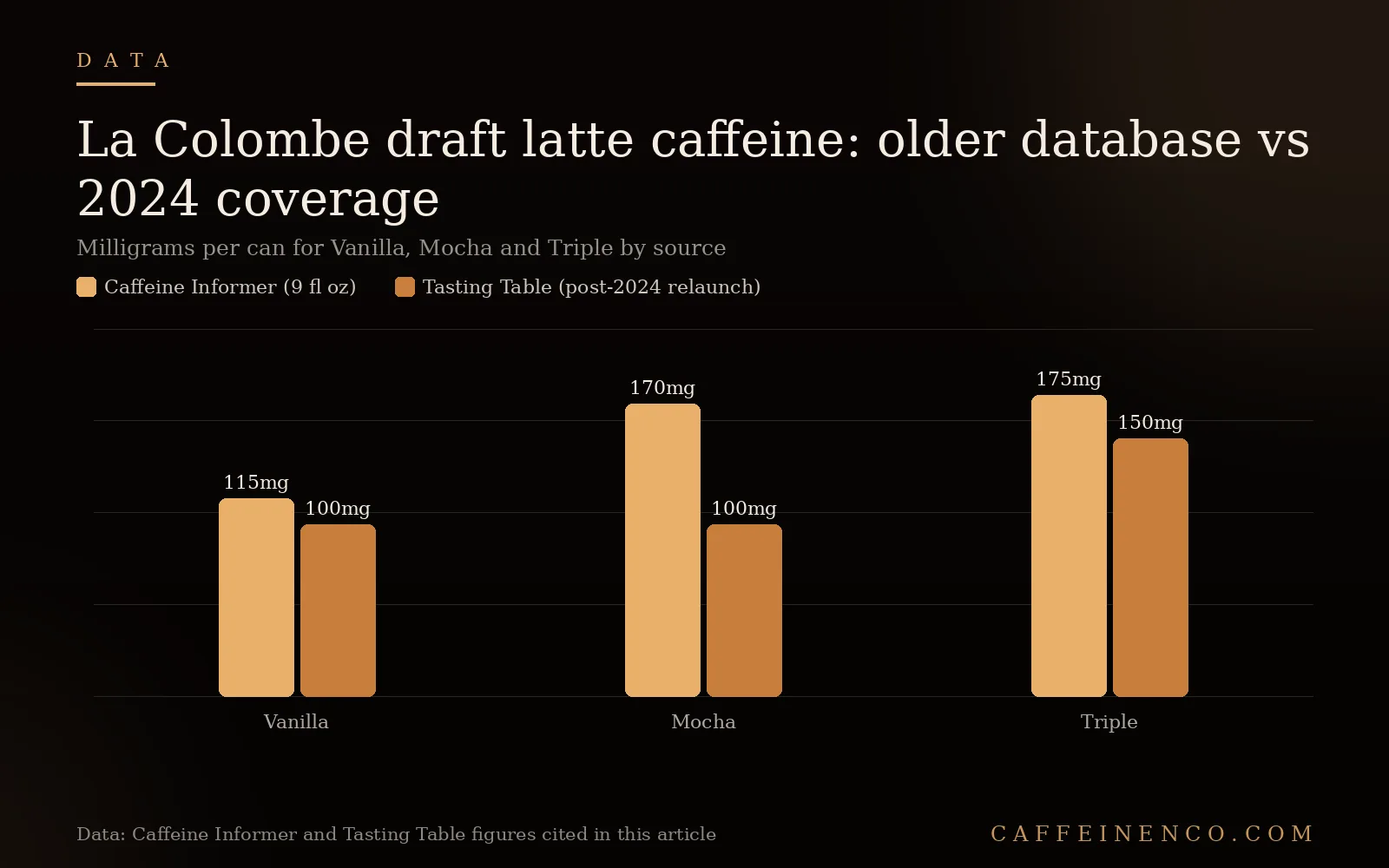
The first is a compiled database. Caffeine Informer lists La Colombe’s draft lattes at 9 fl oz per can: Original 120mg, Triple 175mg, Vanilla 115mg, Mocha 170mg, Oatmilk 120mg and Oatmilk Vanilla 120mg. The page cites La Colombe’s own product page as its source, and it carries no date or note about a recipe change.
The second is press coverage of the product as it exists after the 2024 relaunch. Tasting Table reports that La Colombe launched its collection of ready-to-drink draft lattes in April 2024 and lists the flavors it sampled at 100mg of caffeine each (Vanilla, Double, Mocha, Pumpkin Spice and Caramel) with the Triple Draft at 150mg. In a second article, it says the Triple contains 150mg “compared to the others’ 100 milligrams,” and describes the relaunch as including a package redesign and larger cans, 11 ounces instead of 9. The same article quotes customer reviews on La Colombe’s own site complaining of a drop from 180mg to 150mg, and notes that some Redditors theorized the brand changed the latte formula itself.
I could not open La Colombe’s own product page during research (the request was rate-limited), so I cannot tell you which of these numbers is printed on a can today. What can be said with confidence is the pattern: the older database lists higher numbers for the lattes, the 2024-era coverage lists lower ones, and the gap is roughly 15 to 20 percent across the lineup.
| Flavor | Caffeine Informer (9 fl oz) | Tasting Table (post-2024 relaunch) | Change |
|---|---|---|---|
| Original or Vanilla | 120mg or 115mg | 100mg (Vanilla) | About 13 to 17 percent lower |
| Mocha | 170mg | 100mg | About 41 percent lower |
| Triple | 175mg | 150mg | About 14 percent lower |
The mocha row is the odd one. A drop from 170mg to 100mg is far larger than the others, and the two sources may simply be describing different products, so treat that gap as unresolved, not as evidence that the recipe was cut by 41 percent.
The draft latte lineup, in plain numbers
Reading both sets together gives a workable range for the milk-based draft lattes.
Standard flavors (vanilla, caramel, pumpkin spice, double): roughly 100mg on the post-relaunch figures and 115mg to 120mg on the older database. Either way this is about one strong cup of drip coffee or a little over one espresso shot at the roughly 63mg baseline discussed in this site’s espresso shot breakdown.
Triple: 150mg after the relaunch and 175mg on the older figures. This is the strongest of the lattes, and Tasting Table’s headline for it calls it the strongest and, in the writer’s view, the worst. Taste is subjective, the milligrams are not.
Oat milk versions: the Caffeine Informer figure is the same as the dairy standard flavors, 120mg for both Oatmilk and Oatmilk Vanilla. Tasting Table excluded the oat options from its ranking, so there is no post-relaunch figure for them in the sources I could open.
One more detail from the older database: it describes the lattes as a cold brew coffee and milk drink made frothy with infused nitrous oxide. That matters because the base is cold brew coffee, which is why the lattes carry real caffeine even though they taste like a milky dessert.
The plain cold brew can: 180mg per 9 oz
La Colombe’s non-milk cold brew is documented more simply. Caffeine Informer lists it at 180mg per 9 fl oz can, citing La Colombe’s website, and gives the same 180mg for the milk-and-sugar version. It also notes the cans use single-origin arabica beans with chicory root extract added. The page does not say whether the figure has changed with the 2024 relaunch, which only covers the draft latte line in the sources I found.
That works out to 20mg per fluid ounce, which is high for a ready-to-drink coffee. For context on why cold brew can run strong or weak depending on how it is made, see this site’s cold brew caffeine analysis.
Per ounce: where La Colombe sits
Raw milligrams hide the can size, so here is the same data per fluid ounce, next to numbers already published on this site. The Starbucks and Dutch Bros figures come from the table in the Dutch Bros guide.
| Drink | Size | Caffeine | Per fl oz |
|---|---|---|---|
| La Colombe draft latte, standard (older figure) | 9 oz | 120mg | About 13.3mg |
| La Colombe Triple (older figure) | 9 oz | 175mg | About 19.4mg |
| La Colombe cold brew can | 9 oz | 180mg | 20.0mg |
| La Colombe Triple (post-relaunch figure, 11 oz can) | 11 oz | 150mg | About 13.6mg |
| La Colombe standard latte (post-relaunch figure, 11 oz can) | 11 oz | 100mg | About 9.1mg |
| Starbucks Grande Pike Place | 16 oz | 310mg | About 19.4mg |
| Dutch Bros cold brew can | 11.5 oz | 293mg | About 25.5mg |
The 11-oz rows rest on one assumption: that the newer cans really are 11 ounces, which is Tasting Table’s description of the relaunch. If your can says 9 oz, divide the milligrams by 9 instead.
The takeaway is that the plain La Colombe cold brew can is as concentrated as a Starbucks Grande Pike Place, ounce for ounce, while the relaunched lattes sit well below that. It is the cold brew can, not the latte, that behaves like a serious coffee.
Worked example: how many cans fit in a day
The FDA cites 400mg a day as an amount not generally associated with negative effects for most healthy adults, and it adds that the right amount varies with body weight, medications, conditions and individual sensitivity. Treat 400mg as a general ceiling, not a personal target. Here is how La Colombe cans stack up, using the numbers above.
- Two cold brew cans (180mg each). That is 360mg, which is 90 percent of the ceiling from two small cans.
- A Triple plus a cold brew can. On the post-relaunch figure that is 150mg + 180mg = 330mg. On the older figure it is 175mg + 180mg = 355mg. Either way, there is almost nothing left for a coffee at breakfast.
- Three standard lattes. At 100mg each that is 300mg, and at the older 120mg figure it is 360mg. The two sources differ by 60mg here, which is the practical cost of the number confusion.
- One standard latte on its own. At 100mg to 120mg it uses a quarter to a third of the 400mg ceiling, leaving room for a morning cup and more.
The pattern to take from this is that the older database figures and the newer figures disagree most when you stack several cans. If you drink one a day, the difference is academic. If you drink three, it is the difference between 300mg and 360mg.
If you drink them often, the can-by-can cost and the uncertainty about the number are both reasons to consider brewing your own concentrate, where you set the strength. A cold brew coffee maker on Amazon makes a batch you can measure, and this site’s cold brew ratio and grind guide explains how to dial the dose.
What to do if the number matters to you
Because the sources disagree, a few practical habits beat trusting any single figure.
Read the can first. A can you are holding is more reliable than a database entry that may predate a recipe change, and a can that shows the caffeine amount settles the question for that product.
Check the size. A can that is 11 oz and a can that is 9 oz are not interchangeable, and a figure quoted for one will overstate or understate the other.
Plan with the high number. If you are sensitive to caffeine, working from the older, higher figures gives you a margin of safety. This site’s coffee and anxiety guide explains why a single large dose can feel worse than the same total spread out, and the caffeine withdrawal timeline is worth reading if you are thinking of stepping down from several cans a day.
Common mistakes reading a La Colombe number
Assuming all draft lattes carry the same caffeine is the most common, since the Triple is 50mg higher than the others on the post-relaunch figures. Mixing 9 oz and 11 oz numbers is the second. Treating a database entry as a lab result is the third: Caffeine Informer’s figures trace back to La Colombe’s website, not an independent assay. Assuming the plain cold brew changed along with the lattes is the fourth, because nothing I found says it did. Treating the Tasting Table figures as an official company statement is the fifth: they are journalist-reported, and I could not confirm them against La Colombe’s own page.
Common questions
How much caffeine is in a La Colombe draft latte? Between roughly 100mg and 120mg for most flavors, depending on the source. Caffeine Informer lists Original at 120mg and Vanilla at 115mg per 9 oz, while Tasting Table reports 100mg for the standard flavors after the 2024 relaunch.
How much caffeine is in a La Colombe Triple Draft Latte? 175mg per 9 oz on the older Caffeine Informer figure and 150mg on the Tasting Table figure for the relaunched product.
How much caffeine is in La Colombe cold brew? 180mg per 9 fl oz can, per Caffeine Informer, for both the plain version and the milk-and-sugar version.
Did La Colombe reduce the caffeine in its lattes? The evidence points that way but is not conclusive. Customer reviews quoted by Tasting Table complain of a drop from 180mg to 150mg on the Triple, and the database and press figures differ by roughly 15 to 20 percent, but I could not confirm a statement from the company.
Is La Colombe stronger than Starbucks? The plain cold brew can is about equal per ounce to a Grande Pike Place, at 20mg per ounce against about 19.4mg. The relaunched draft lattes are much lower per ounce.
How many La Colombe cans can I drink a day? Against the FDA’s 400mg figure for most healthy adults, two cold brew cans already reach 360mg. Individual sensitivity varies, so this is a general reference only.
For more sourced caffeine breakdowns like this one, delivered weekly, subscribe to The Sunday Pour.