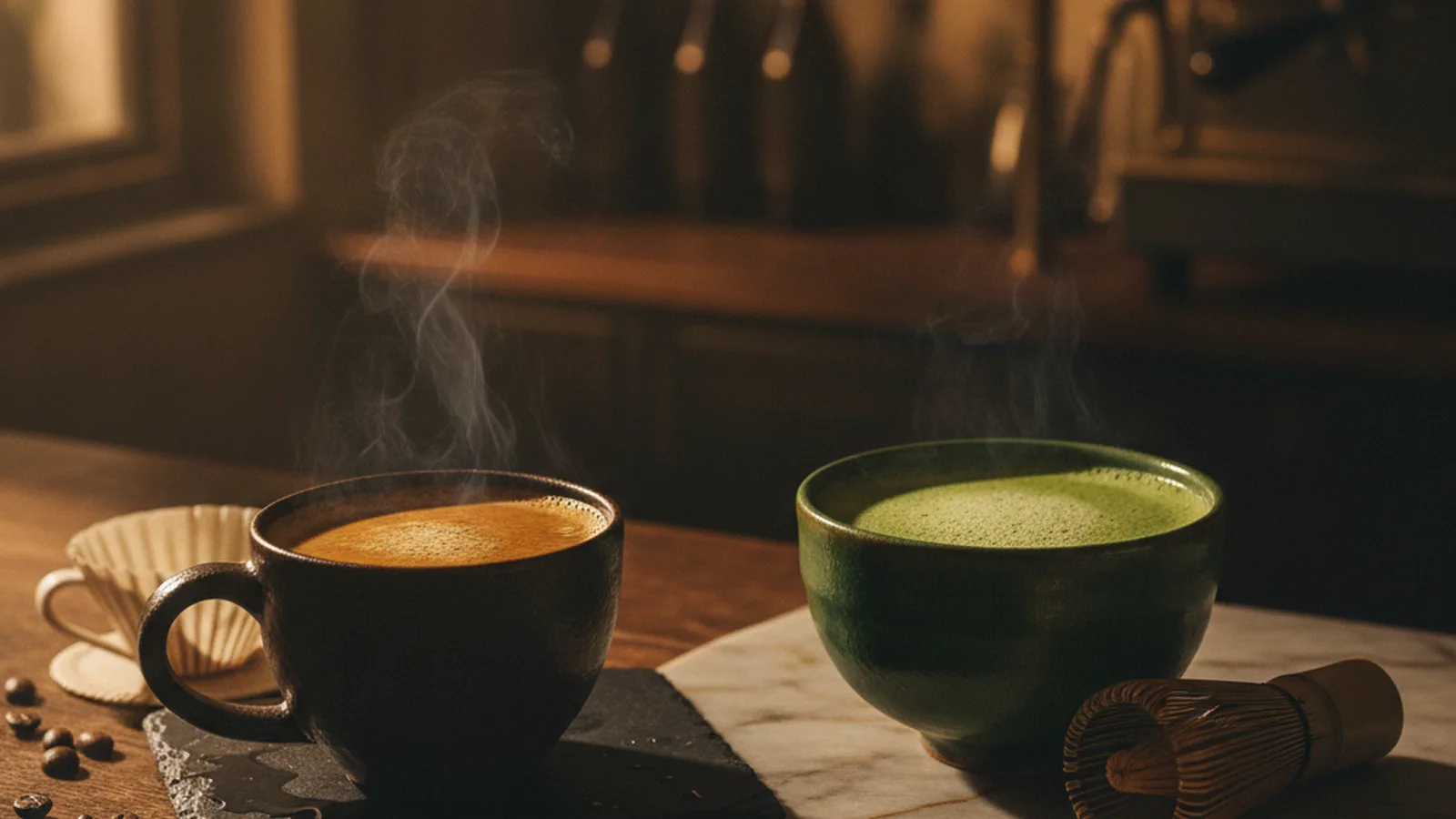
Ask whether matcha has more caffeine than coffee and you will get two confident, opposite answers. One says matcha is far stronger, because gram for gram it carries several times the caffeine of coffee beans. The other says matcha is the gentler choice, because a cup of it has less caffeine than a cup of coffee. Both are quoting real numbers. They are simply measuring different things: one divides by the gram of dry ingredient, the other by the drink in your hand.
This guide reconciles the two. It takes the published per-gram figures, shows how the amount of powder you whisk into a bowl swings the cup total, and puts matcha and coffee side by side at realistic serving sizes. It is a caffeine-data explainer, not a product review: no brands, no taste verdicts, just the arithmetic. If you want the coffee side in more depth, this site’s espresso shot breakdown and Starbucks brewed coffee guide cover how shaky a single “caffeine per cup” number can be.
The two numbers that seem to disagree
Here is what two health publishers report, as I read them:
| Claim | Healthline | Medical News Today |
|---|---|---|
| Matcha, per gram of powder | 19 to 44mg | 18.9 to 44.4mg |
| Coffee, per gram | 10 to 12mg | 10 to 12mg |
| Matcha, per serving | 38 to 176mg (2 to 4g of powder) | About 75.6 to 177.6mg (4g of powder) |
| Coffee, per 8 oz cup | Roughly 100mg | Not given |
The two sources agree closely on the per-gram range. They differ on the per-serving range only because they picked different serving sizes: Healthline spans 2 to 4 grams, while Medical News Today prices a strong 4 gram serving. Neither is wrong. The spread inside each range is the real story, and it comes from a handful of variables that are worth understanding.
Why per gram favors matcha
Matcha is a powder made from the whole tea leaf, and you drink the leaf itself rather than an infusion of it. Nothing is left behind in a filter. Coffee works the other way: you extract only part of what is in the grounds into water and throw the rest away. That whole-leaf difference is one plausible reason the per-gram numbers favor matcha, though the sources I read do not spell out the cause. Using the published ranges, matcha comes out at roughly 1.6 to 4.4 times coffee per gram (19 divided by 12 at the low end, 44 divided by 10 at the high end).
That ratio is a comparison of dry ingredients, which is not how anyone drinks either one.
Why per cup favors coffee, usually
A typical coffee uses many grams of beans for a single cup, while a typical matcha uses two to four grams of powder. So the multiplier that makes matcha look strong per gram is cancelled by the much smaller amount you actually use. Healthline puts a standard cup of coffee at roughly 100mg, and its matcha serving range of 38 to 176mg straddles that figure. In other words, depending on how you make it, a matcha can come in under a coffee or over it.
What moves the matcha number
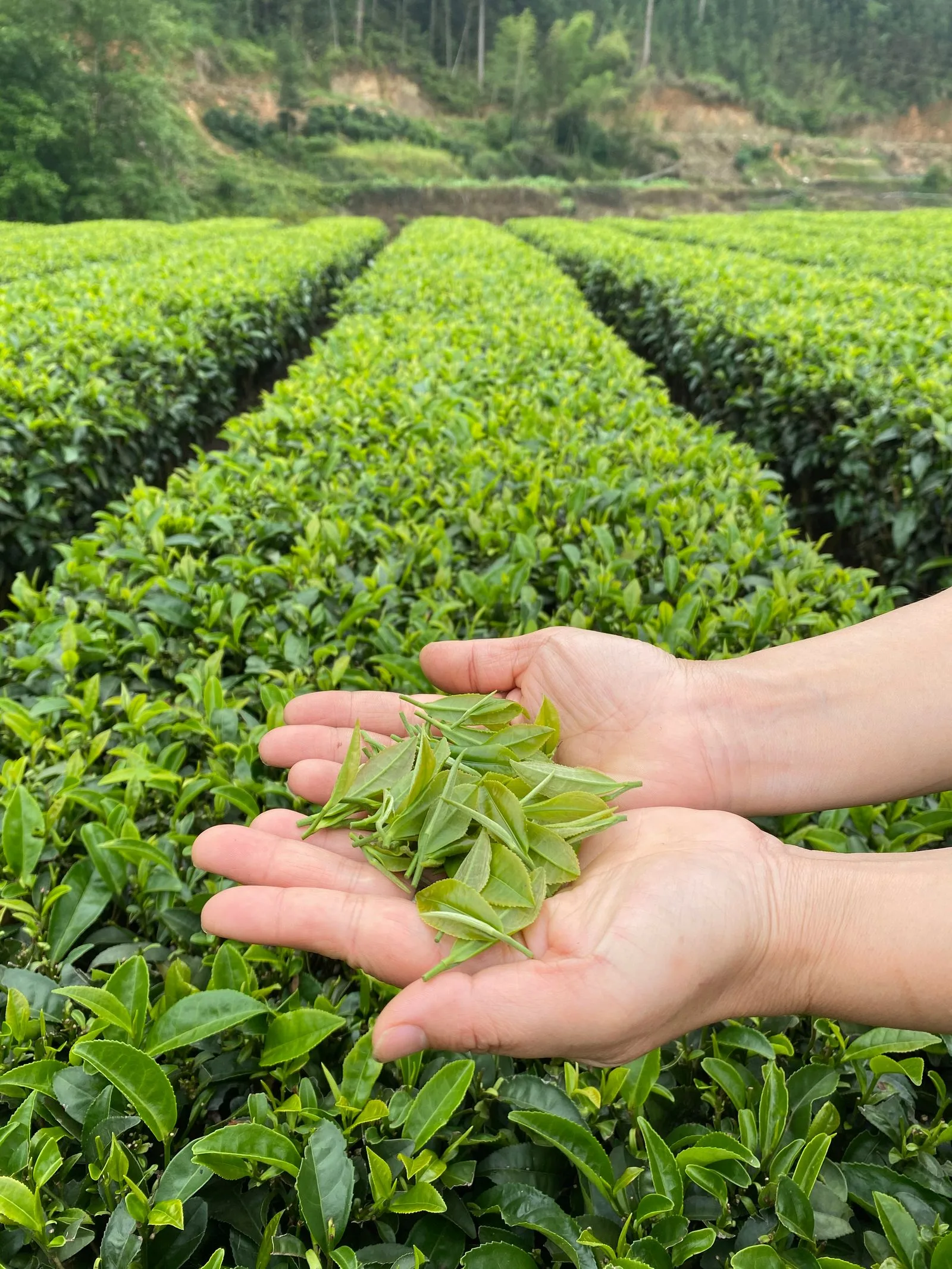
Medical News Today lists four factors that change how much caffeine ends up in your cup, and Healthline names three that overlap with them:
- How much powder you use. This is the largest lever by far. Doubling the scoop doubles the caffeine.
- Water temperature. MNT says warmer water increases caffeine content and cooler water reduces it. The same physics runs through coffee; our water temperature guide covers the coffee side.
- Age of the leaves. Younger and older leaves carry different amounts, which is part of why the per-gram range is so wide.
- Time of harvest. The timing of the harvest moves the number too.
Healthline adds the type of leaves and the brewing time to its list, which fits the same picture: the ingredient and the preparation both matter, and the label on a tin will rarely tell you either with any precision.
The practical consequence is that “how much caffeine is in matcha” does not have a single answer. It has a range of more than two-fold per gram before you even choose a scoop size, and the scoop adds a second layer of variation on top.
Do the math: grams of powder to milligrams
The cleanest way to compare is to multiply the published per-gram range by the grams you use. This is arithmetic on the sources’ ranges, not a new measurement.
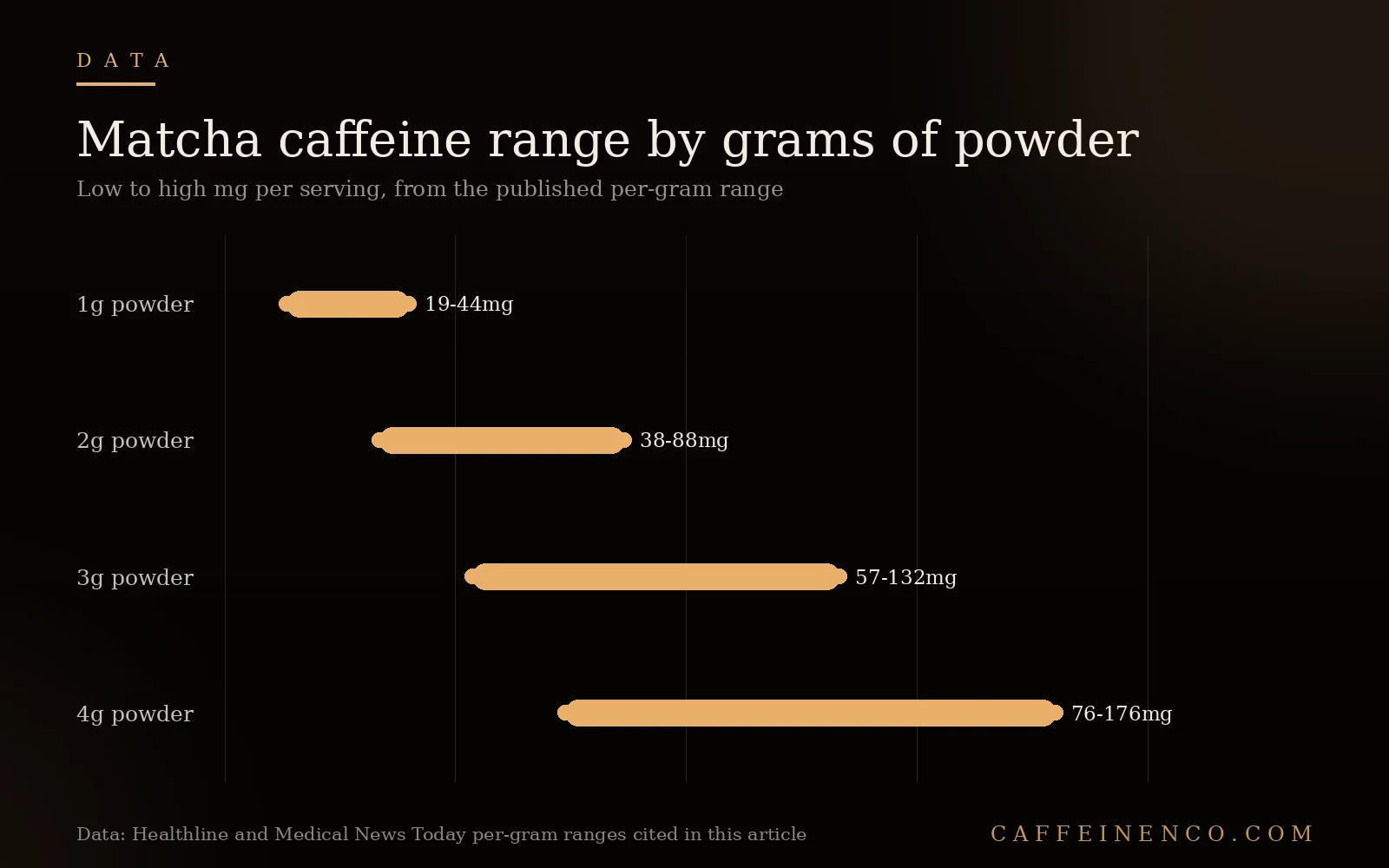
| Powder per serving | Low (19mg/g) | High (44mg/g) | Typical use |
|---|---|---|---|
| 1g | 19mg | 44mg | A very light bowl |
| 2g | 38mg | 88mg | A traditional-style serving |
| 3g | 57mg | 132mg | A generous cup |
| 4g | 76mg | 176mg | A strong cup or a latte |
Notice that the 2g and 4g rows line up with the published per-serving ranges: 38mg is the low end of Healthline’s range and 176mg is its high end, and 4g at 18.9 to 44.4mg per gram matches Medical News Today’s roughly 75.6 to 177.6mg.
How much powder equals one cup of coffee?
Take Healthline’s figure of roughly 100mg for an 8 oz cup of coffee and ask how many grams of matcha it takes to match it:
- At the high end of the range (44mg per gram): 100 divided by 44 is about 2.3 grams.
- At the low end (19mg per gram): 100 divided by 19 is about 5.3 grams.
So the break-even sits somewhere between roughly 2 and 5 grams of powder, depending on how potent your particular matcha is. A level 2 gram serving of strong powder is close to a cup of coffee, while a 2 gram serving of weak powder is well under half of one. This is the single most useful number in this post, because it shows why both camps are right.
Side by side: a realistic drink table
Putting the pieces together, here is how common drink shapes compare. The matcha rows are derived from the published per-gram range; the coffee rows use the figures quoted by Healthline and this site’s espresso guide. Treat them as planning ranges.
| Drink | Caffeine, planning range | Where it comes from |
|---|---|---|
| Matcha, 2g in water | 38 to 88mg | Per-gram range times 2g |
| Matcha, 4g in water | 76 to 176mg | Per-gram range times 4g |
| Matcha latte, 4g powder in milk | 76 to 176mg | Same as above, because milk does not reduce caffeine |
| Brewed coffee, 8 oz | Roughly 100mg | Healthline |
| Espresso, one shot | About 63mg or more | USDA entry; cafe-measured shots run higher, see the espresso guide |
| Espresso, double | About 126mg or more | Two shots, same caveat |
A few observations. A matcha latte made with a heaped 4 gram scoop can out-caffeinate a standard 8 oz coffee, which surprises people who assume the milk and the green color signal “light.” And a 2 gram bowl of matcha usually lands under a single cup of coffee, which is where the “matcha is gentler” reputation comes from.
Matcha latte vs coffee latte
This is where the confusion is greatest, because the cup size and the milk hide the underlying dose.
The matcha latte. Medical News Today states that using milk to brew the tea will not reduce the caffeine content any more than water does. The caffeine in a matcha latte is therefore set by the powder, not the milk. A cafe that uses 4 grams of powder is serving 76 to 176mg whether the drink is 8 or 16 ounces. A bigger cup with more milk is more dilute, but the dose does not change.
The coffee latte. A latte’s caffeine comes entirely from its espresso. One shot is about 63mg by the commonly quoted USDA figure, and a double is about 126mg, though cafes often pour more than that, as the espresso shot breakdown explains with a survey that found a median of 140mg per shot. As with matcha, the milk is a bystander. A small and a large latte built on the same number of shots carry the same caffeine.
So the honest comparison is shots against scoops. One shot of espresso and a 2 gram scoop of matcha sit in overlapping territory (about 63mg against 38 to 88mg), while a double shot and a 4 gram scoop also overlap (about 126mg against 76 to 176mg). If a cafe will not tell you how much powder or how many shots a size uses, you cannot know which drink has more caffeine. The size of the cup is not the answer.
Worked example: building a day against the 400mg line
The FDA says that 400mg a day is an amount not generally associated with negative effects for most healthy adults, and that people differ in how sensitive they are. It equates that amount to roughly four or five cups of brewed coffee. Here is how a few matcha-heavy days stack up, using the high end of each range to stay on the cautious side.
- Two bowls of 2g matcha. Up to 2 x 88 = 176mg. Well under the line.
- One 4g matcha latte and one coffee. Up to 176 + 100 = 276mg. Fine, with 124mg to spare.
- Two 4g matcha lattes. Up to 2 x 176 = 352mg. Still under 400mg, but close, and that is before any coffee.
- Two 4g matcha lattes and a cup of coffee. Up to 352 + 100 = 452mg. Over the line by 52mg at the top of the range.
- The same day at the low end. 2 x 76 + 100 = 252mg. Same drinks, almost 200mg lower.
The gap between examples 4 and 5 is the whole lesson. The same menu order can sit comfortably inside the limit or past it, depending on the leaf and the scoop. If you are sensitive to caffeine, plan from the high end.
A simple routine to know your own matcha dose
You can remove most of the uncertainty at home with a few steps:
- Weigh the powder. Use a small scale and write down the grams you use. A heaped scoop can easily be double a level one.
- Check the tin for any caffeine statement. Few brands publish one. If yours does not, use the range in this post rather than assuming the low end.
- Calculate both ends. Multiply grams by 19 and by 44, as in the table above.
- Keep a consistent serving. Once you settle on a serving you like, your dose is a known range instead of a guess.
- Track how you feel. If a 3 gram serving makes you jittery, the high end is likely closer to your tin’s reality.
What this analysis does not tell you
Be careful with the limits. The per-gram ranges are published by two health sites rather than a lab report you can inspect, and they are wide. The coffee cup figure of roughly 100mg is also an average: real brewed coffee varies a lot by method, dose and bean, and our coffee to water ratio chart shows how much a single recipe change moves the strength. Nothing here covers how caffeine feels in the body. Some people report that matcha feels smoother than coffee, but I have not found a source that settles the question with data, so I will not claim it. The comparison above is milligrams only.
For the health side of high intake, this site’s coffee and anxiety guide covers how dose and speed interact, and the caffeine withdrawal timeline describes what to expect if you cut back.
Common mistakes when comparing matcha and coffee
- Comparing per gram instead of per serving. Matcha wins per gram and often loses per cup. Decide which one matters to you before you pick a number.
- Assuming milk lowers a matcha latte’s caffeine. Medical News Today says milk does not reduce it any more than water does.
- Ignoring the scoop. A 4 gram serving can carry about double the caffeine of a 2 gram one.
- Trusting a single number. Anything that states “matcha has exactly X mg” is hiding a range of more than two-fold per gram.
- Judging a drink by its size. Caffeine follows the powder and the shots, not the ounces in the cup.
- Forgetting that decaf exists on the coffee side. If you are choosing a low-caffeine option, see our decaf coffee caffeine guide for real figures rather than the myth of zero.
Common questions
Does matcha have more caffeine than coffee? Per gram, yes: roughly 19 to 44mg against 10 to 12mg. Per cup, it depends on how much powder you use. A 4 gram serving can reach 176mg, above a typical 100mg cup of coffee, while a 2 gram serving tops out around 88mg.
How much caffeine is in matcha per gram? Healthline reports 19 to 44mg per gram, and Medical News Today reports 18.9 to 44.4mg per gram. The width of that range reflects differences in leaf type, leaf age and harvest timing.
How much caffeine is in a cup of matcha? Healthline gives 38 to 176mg for a 2 to 4 gram serving. Medical News Today gives about 75.6 to 177.6mg for a 4 gram serving.
How much caffeine is in a matcha latte? It depends on the grams of powder, not the milk. A 4 gram latte is roughly 76 to 176mg. Medical News Today says milk does not reduce caffeine compared with water.
How many grams of matcha equal a cup of coffee? Using roughly 100mg for a cup of coffee, the break-even is about 2.3 grams at the strongest published matcha and about 5.3 grams at the weakest. That is arithmetic on the published ranges, not a lab result.
Is matcha or coffee better for sensitive people? Neither is automatically gentler. A small, measured serving of matcha has less caffeine than a cup of coffee, but a heaped latte scoop can exceed it. Measure the powder and plan from the high end of the range.
Does water temperature change matcha caffeine? Medical News Today says warmer water increases caffeine content and cooler water reduces it, along with powder quantity, leaf age and harvest time.
Is 400mg a day a safe limit? The FDA says 400mg is an amount not generally associated with negative effects for most healthy adults, but individual sensitivity varies, and pregnancy or certain conditions change the advice. Talk to a health care provider about a personal limit.
For more sourced caffeine breakdowns like this one, delivered weekly, subscribe to The Sunday Pour.