Ask how much caffeine is in a latte and the usual answer is a single number, often “about 150 mg.” That figure is real, but it belongs to one specific drink: a two-shot, 16 ounce latte at one chain. Change the shot count and the number changes with it. Change the cup size and, in most cases, it does not.
Chai lattes are a different puzzle. Some contain no caffeine at all, others carry roughly as much as a strong cup of tea, and the menu rarely tells you which you have. This page works through both drinks with the published numbers, shows the arithmetic so you can price any cup yourself, and then adds a shot of espresso to a chai to see what a “dirty chai” really adds up to. It is a sourced explainer, not medical advice.
The short version
- Latte caffeine comes almost entirely from the espresso. Milk adds volume and texture, not caffeine.
- Caffeine Informer lists a Starbucks Grande Caffe Latte (16 fl oz, two shots) at 150 mg, and notes that other analyses have found only 58 mg per espresso shot, which would put the same drink near 116 mg.
- A peer-reviewed survey of 20 high-street espressos found a six-fold spread in caffeine from shot to shot, so any single latte number is an estimate.
- A chai latte made from flavored syrup and steamed milk is not caffeinated. One made from a brewed-tea concentrate, the way Starbucks makes it according to Caffeine Informer, is in the range of 25 to 60 mg.
- A “dirty chai” is simply chai plus espresso, so you add the two.
- The reference most adults are given is about 400 mg a day. One latte or chai uses only a part of that.
Why a latte’s caffeine tracks shots, not size
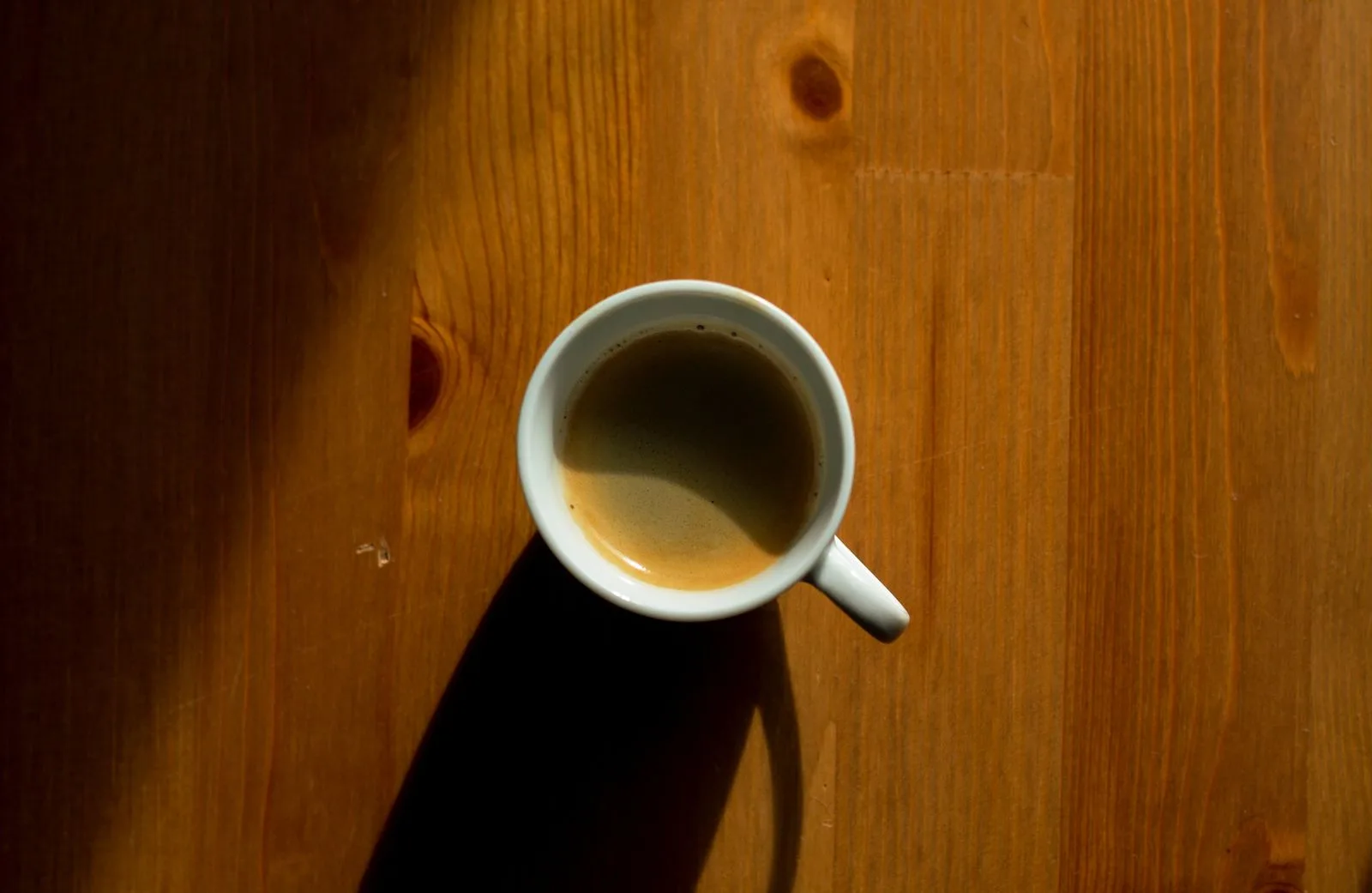
A latte is espresso with a lot of steamed milk on top. Our guide to cortado, flat white, cappuccino, latte and macchiato shows the usual build: a roughly 40 gram double shot and a large amount of milk. Milk contains no meaningful caffeine, so the caffeine in the cup is whatever the espresso carried in.
The Glasgow espresso survey makes the same point in its own abstract. The authors note that coffee houses prepare larger drinks, “such as Latte and Cappuccino, by dilution of a single or double shot of expresso.” Dilution lowers how strong each sip tastes. It does not lower how much caffeine you swallow by the time the cup is empty.
That has a practical consequence. Two lattes can be the same size and carry very different amounts of caffeine, because one has one shot and the other has three. And two lattes of different sizes can carry the same, because both are built on two shots.
What Starbucks-style sizing does to the count
Caffeine Informer’s latte page describes the usual US rule at Starbucks: one shot in a Tall and two shots in a Grande. A Grande is 16 fl oz. Other chains set their own rules, and many independent cafes pour a double by default regardless of size, so “small” tells you little. This is the same issue covered in our breakdown of caffeine in an espresso shot, where most cafes turned out to pour doubles.
The only reliable move is to ask how many shots are in the size you are ordering.
Where the 150 mg latte number comes from, and where it breaks
Caffeine Informer lists the Grande Caffe Latte at 150 mg for 16 fl oz. Divide by the two shots and each shot is assumed to carry 75 mg.
The same page then adds a caveat that most quoted versions of the number leave out: other analyses have come up with a value of only 58 mg of caffeine per espresso shot. Two shots at 58 mg is 116 mg, about 23 percent lower than 150 mg.
Neither figure is a mistake. They come from different measurements of different shots. The Glasgow study shows why this happens. Its authors used HPLC, a laboratory analysis method, on 20 commercial single espressos and found a six-fold difference in caffeine between them. The most in a single espresso was 322 mg, and three more contained over 200 mg. They concluded that the amount of beans used in the barista process is likely the predominant factor. A shot is not a fixed unit. It is whatever a given machine, grinder and person produced that minute.
So treat 116 to 150 mg as a reasonable planning range for a two-shot latte, and know that an individual cup could land outside it.
A shot-by-shot table you can reuse
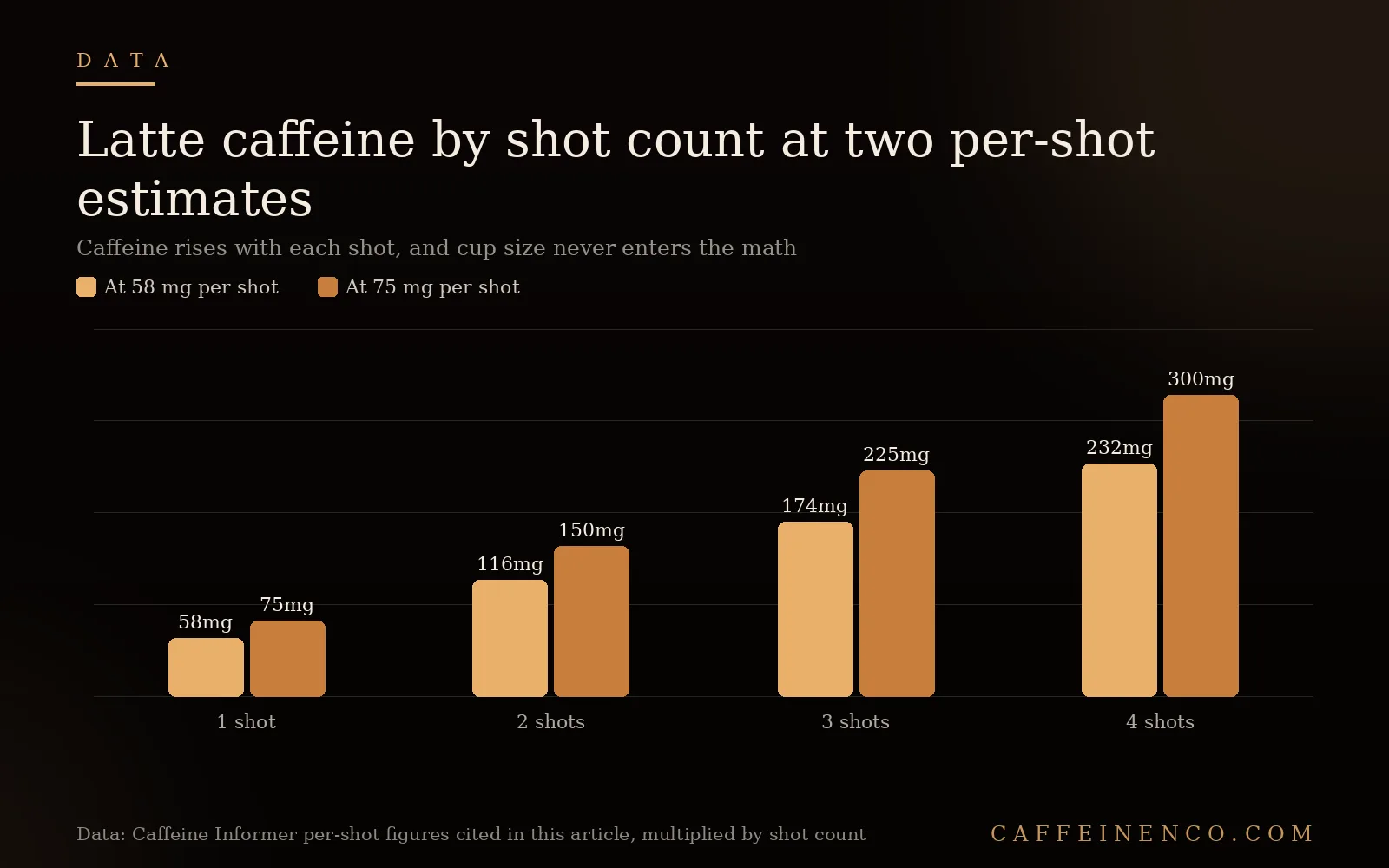
Because the caffeine tracks shots, you can build your own estimate. Here are three common per-shot assumptions: 58 mg (the lower analysis Caffeine Informer mentions), 63 mg (the commonly quoted figure explained in our espresso shot post) and 75 mg (the figure implied by 150 mg for two shots).
| Shots in the latte | At 58 mg per shot | At 63 mg per shot | At 75 mg per shot |
|---|---|---|---|
| 1 | 58 mg | 63 mg | 75 mg |
| 2 | 116 mg | 126 mg | 150 mg |
| 3 | 174 mg | 189 mg | 225 mg |
| 4 | 232 mg | 252 mg | 300 mg |
These are straight multiplication, not measured results for any drink. The table is useful mostly for the shape: each extra shot adds roughly 60 to 75 mg, and cup size never appears in it.
Iced lattes and flavored lattes
Ice takes up room in the cup, so an iced latte of a given size usually holds less milk, but the shot count is what matters for caffeine and it is set by the size rules, not the ice. Flavor syrups such as vanilla or caramel add sugar, not caffeine. The one flavor to check is anything made with tea, chocolate or a coffee-flavored base, which can carry its own small amount.
What the Glasgow survey adds for latte drinkers
The 2012 paper in Food and Function was about plain espresso, not lattes. The authors flagged that milk drinks are made by diluting a shot or two and said further study on them is warranted. So there is, as far as the sources used for this page go, no lab-measured survey of lattes from many cafes here. What we have is espresso measurements plus the dilution logic.
What the survey does tell you is that the starting point is unstable. The abstract also notes that three espressos in the sample exceeded 200 mg, over the 200 mg daily limit recommended in pregnancy by the UK Food Standards Agency. A latte built on two of those shots would carry far more than the 150 mg most tables show. That is not a typical cup, but it is a reminder that the printed number is an average of unknown quality. Anyone who has been told to limit caffeine for a medical reason should treat chain figures as a floor to check with a clinician, not a guarantee.
Chai lattes: why the number swings from zero to about 60 mg
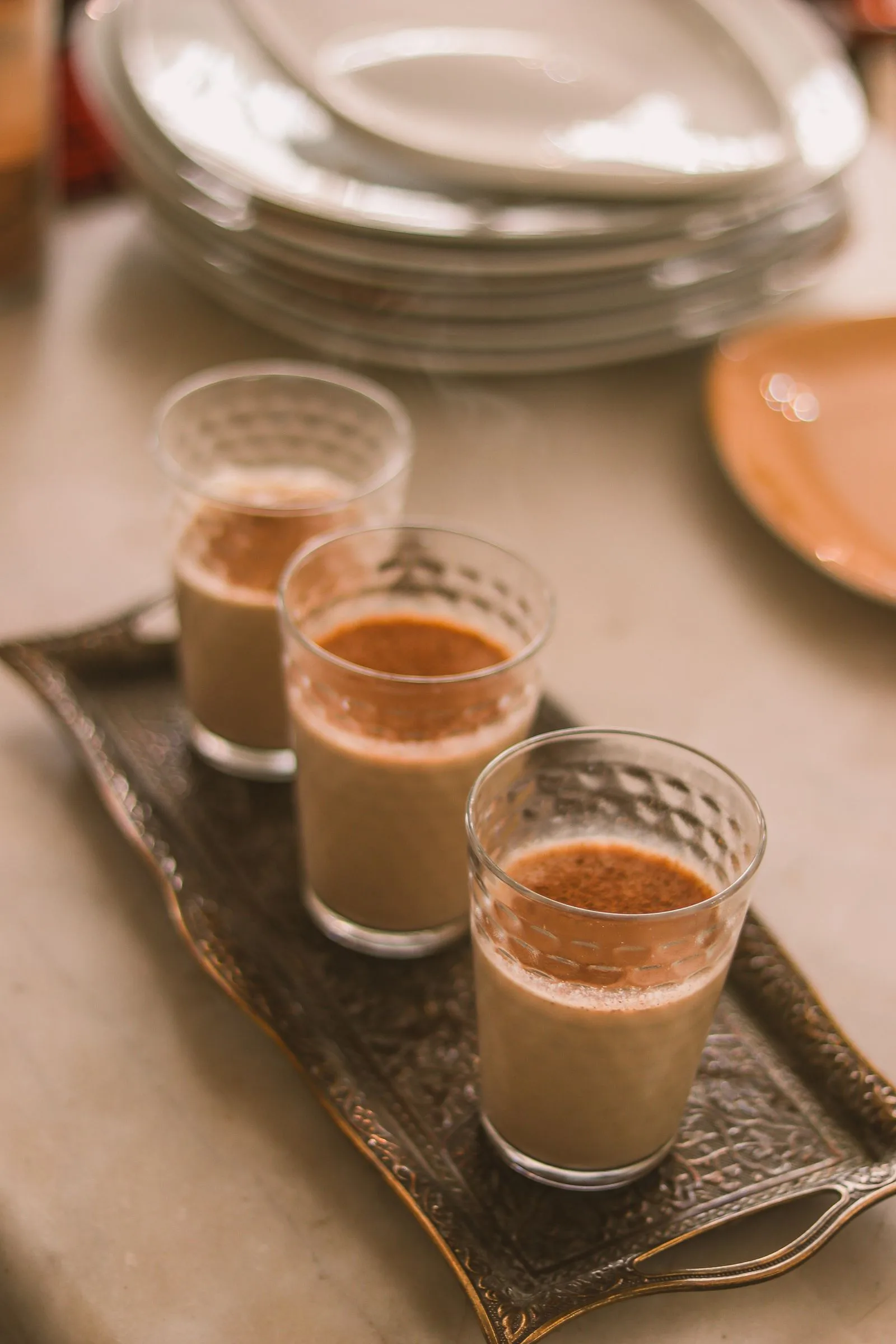
A chai latte is spiced tea with milk. Whether it has caffeine depends on how the spiced tea part is made, and Caffeine Informer draws a sharp line between two methods.
- Syrup-based. Some outlets sell a chai latte that is simply a chai-flavored syrup mixed with steamed milk. According to Caffeine Informer, these syrups are not caffeinated.
- Concentrate-based. Most other outlets, Caffeine Informer says, make their chai lattes from a chai concentrate that contains brewed tea and is therefore caffeinated. It places those drinks in the range of 25 to 60 mg of caffeine. It names Starbucks as an example of this approach.
The page’s own advice is to assume your chai does contain caffeine unless you are told otherwise. That is a sensible default, since the default error is the harmful one if you are avoiding caffeine.
How chai compares with brewed tea
Caffeine Informer lists chai tea at 50 mg per 8 fl oz, with brands ranging from 25 mg to 67 mg per 8 fl oz serving. MD Anderson gives tea in general as roughly 14 to 60 mg per 8 oz, so chai sits in the upper half of that. A chai latte is mostly milk, though, so the concentrate part is only a portion of the cup. That is consistent with the lower 25 to 60 mg range for lattes rather than a 16 ounce tea figure.
A number we deliberately left out
You may see a precise milligram figure for a Starbucks grande chai tea latte on aggregator sites, and a different one in other regions. We could not load Starbucks’ own nutrition page when preparing this article, and the aggregators do not agree or cite a primary document, so we have not printed a specific figure. If the exact number matters to you, check the nutrition panel in the Starbucks app or the cafe’s own published data for your country, since recipes and concentrate vary by market.
Dirty chai: just add the shot
A dirty chai is a chai latte with espresso added. The arithmetic is the whole answer: caffeine from the chai base plus caffeine from the shots.
Using the 25 to 60 mg range for a concentrate-based chai latte, and the 58 to 75 mg per shot range from the latte discussion:
| Drink | Low estimate | High estimate |
|---|---|---|
| Concentrate chai latte, no shot | 25 mg | 60 mg |
| Dirty chai, 1 shot | 83 mg | 135 mg |
| Dirty chai, 2 shots | 141 mg | 210 mg |
The low column pairs the smallest chai figure with the smallest shot figure, and the high column pairs the largest with the largest. Real drinks will land somewhere between. A syrup-based chai with a shot would sit at only the shot figure, 58 to 150 mg depending on shots, because the base adds nothing.
So a dirty chai is no longer a “light” caffeine drink. With two shots it can overlap with a full strong coffee.
Worked example: a day built from lattes
Here is how to use all of this for one hypothetical day, measured against the roughly 400 mg a day MD Anderson cites from the FDA as an amount most adults can consume without negative effects. This is a reference for healthy adults, not a target, and sensitivity varies.
Morning: a two-shot latte. Using 116 to 150 mg. Afternoon: a concentrate-based chai latte, 25 to 60 mg. Evening: a one-shot decaf latte. Decaf is not zero, and our decaf caffeine guide explains the small residue, so allow a few milligrams.
Daily total: roughly 141 to 210 mg plus a few for the decaf, which is about 35 to 53 percent of the 400 mg reference. Now swap the morning latte for a three-shot version and the afternoon chai for a two-shot dirty chai. The total becomes roughly 174 to 225 mg for the morning plus 141 to 210 mg for the afternoon, or about 315 to 435 mg. That is the point where the upper end crosses the 400 mg reference with just two drinks.
The lesson: the drink names did not change much between the two days. The shot count did.
A simple routine for knowing your own cup
- Ask the shot count for your size. One question, and it removes most of the uncertainty.
- Use 60 to 75 mg per shot as a planning number, and 58 mg if you want the lower published estimate.
- For chai, ask whether it is made from a tea concentrate or a syrup. If nobody can tell you, assume it has caffeine.
- Add them up across the day, including any brewed coffee. Our Starbucks brewed coffee caffeine data shows how much larger a single brewed cup can be than a latte.
- Move the last caffeinated drink earlier if sleep is the problem. Evening lattes carry the same caffeine as morning ones.
If you also drink matcha or other tea-based lattes, see how they compare in our matcha versus coffee caffeine analysis, and for a drink that stacks espresso with alcohol, our espresso martini caffeine guide works through a similar shot-based count.
What this evidence does not tell you
Three limits are worth stating plainly.
First, the latte number is tied to one chain’s shot count and one site’s estimate. It is not a lab measurement of a large sample of lattes.
Second, the Glasgow study measured espresso in one part of one city in 2012. It demonstrates variation, and it does not give a current average for any cafe near you.
Third, the chai range is a general range for concentrate-based lattes from a caffeine database. It is not a measurement of any specific menu item, and recipes change.
Common mistakes when counting
- Scaling caffeine with cup size. A larger latte usually has more milk, not more caffeine, unless the size comes with an extra shot.
- Treating one number as the number. 150 mg and 116 mg are both defensible for the same drink.
- Assuming all chai has caffeine, or none. It depends on syrup versus concentrate.
- Forgetting the shot in a dirty chai. The two sources add.
- Treating decaf as zero. It is low, not nothing.
- Ignoring the rest of the day. The reference amount is a daily total.
Common questions
How much caffeine is in a latte? It depends on the espresso shots. A two-shot, 16 oz latte is listed at 150 mg by Caffeine Informer, while another analysis of about 58 mg per shot would put it near 116 mg.
Does a bigger latte have more caffeine? Only if the bigger size comes with more shots. At Starbucks the usual rule is one shot in a Tall and two in a Grande, so moving between those sizes adds a shot, but a 16 oz and a 20 oz drink with the same two shots carry about the same.
How much caffeine is in a latte with 2 shots? Roughly 116 to 150 mg using the published per-shot figures on this page, with real cafe shots varying more widely than that.
Is there caffeine in a chai latte? It depends. Syrup-based chai lattes are not caffeinated, according to Caffeine Informer, while concentrate-based ones that contain brewed tea are in the range of 25 to 60 mg.
Which has more caffeine, a chai latte or a coffee? A concentrate-based chai latte at 25 to 60 mg is lower than a typical coffee, which MD Anderson puts at 95 to 200 mg per 8 oz. A dirty chai with shots can match or exceed a weak cup of coffee.
How much caffeine is in a dirty chai? By this page’s arithmetic, about 83 to 135 mg with one shot and about 141 to 210 mg with two, assuming a concentrate-based chai.
Is a latte or a cappuccino higher in caffeine? Both are built from the same kind of shot, so the shot count decides it, not the milk. See our espresso drink comparison for how the milk differs.
Is a latte safe to drink every day? For most healthy adults, one or two lattes fit within the roughly 400 mg reference. If you are pregnant, sensitive to caffeine, anxious or on medication, ask your clinician, and see our guide to coffee and anxiety for what high totals can feel like.
Sources & data
- Caffeine Informer: Starbucks Grande Caffe Latte (150 mg, 16 fl oz, two shots, note on 58 mg per shot)
- Caffeine Informer: Chai Tea (50 mg per 8 fl oz, brand range, syrup versus concentrate chai lattes)
- Crozier, Stalmach and Lean, Food and Function (2012): Espresso coffees, caffeine and chlorogenic acid intake (PubMed 22130653)
- MD Anderson Cancer Center: How Much Caffeine Is Too Much? (400 mg reference, citing the FDA)