Cortado, flat white, cappuccino, latte, macchiato: five menu names that all start from the same double shot of espresso, and most people ordering one could not tell you what actually separates it from the other four beyond “more milk” or “less milk.” This site’s own espresso dose ratio guide already covers the 18g to 36g espresso shot these drinks are built on, and the caffeine in an espresso shot breakdown covers what that shot actually delivers, but neither walks through what happens once milk gets added and a barista has to decide which of five names to call the result. Three independently published guides, from Coffee Bros, Majesty Coffee, and La Marzocco Home, give specific gram amounts, ratios, and cup sizes for all five drinks, and they mostly agree with each other, except on one drink where two of the three converge and the third is a genuine outlier worth flagging rather than smoothing over.
The five drinks, side by side

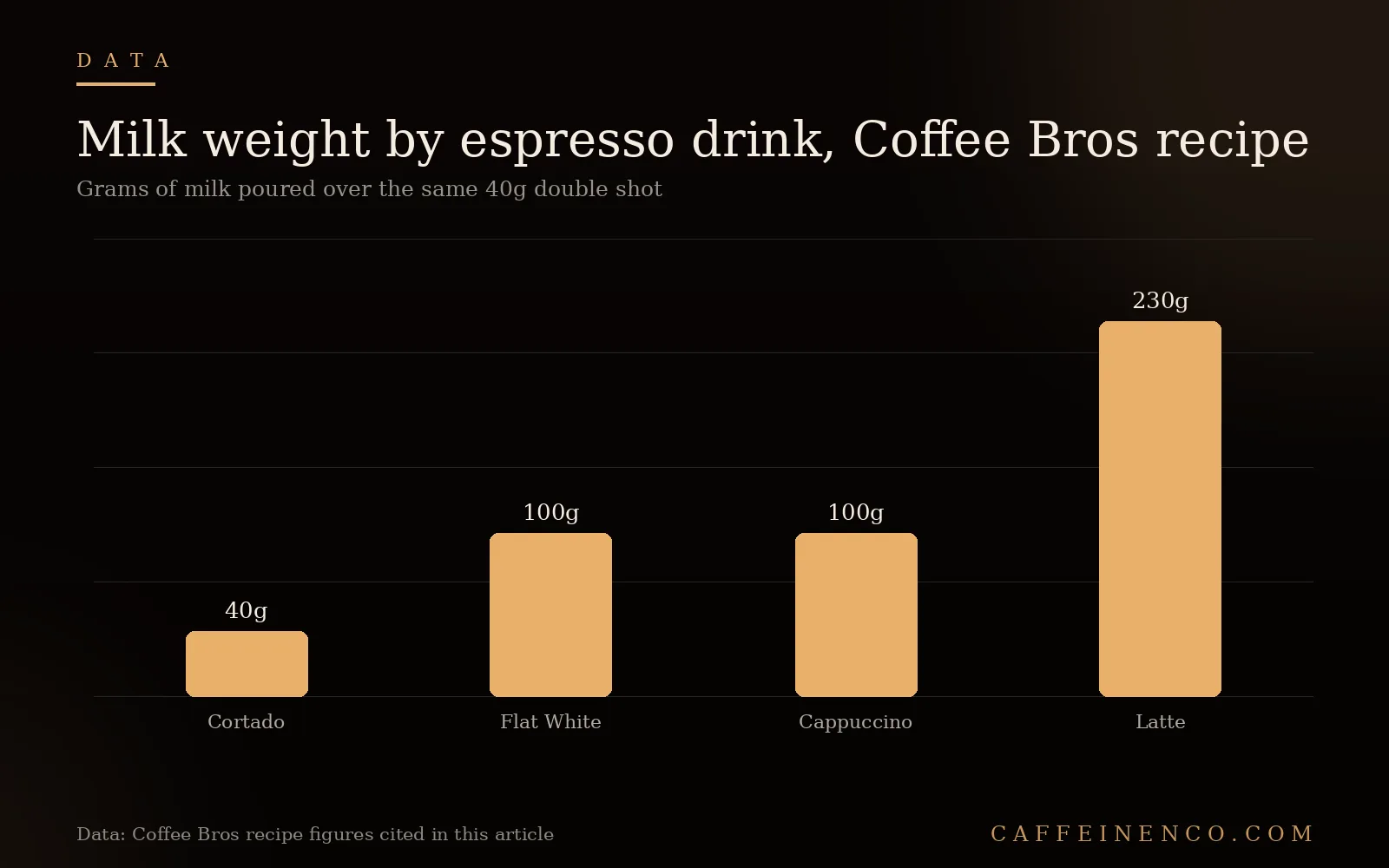
Coffee Bros publishes the most granular figures, a single reference dose of 40 grams of espresso (roughly a double shot) run against a specific milk and foam weight for each drink:
| Drink | Espresso | Milk | Foam | Approx. ratio | Typical size |
|---|---|---|---|---|---|
| Macchiato | 40g | none | About 5g | Roughly 8:1 | Demitasse, 2 to 3 oz |
| Cortado | 40g | 40g | Little to none | 1:1 | 4.5 oz |
| Flat White | 40g | 100g | Thin, under 0.5cm | About 1:2.5 | 5 to 6 oz |
| Cappuccino | 40g | 100g | Thick, about 1.5cm | About 1:2.5 liquid, classic 1:1:1 | 6 oz |
| Latte | 40g | 230g | Thin, about 1cm | About 1:5.75 | 8 to 12 oz |
Read top to bottom, that table is a spectrum, not five unrelated drinks: macchiato is nearly straight espresso, cortado is the exact midpoint at equal parts, flat white and cappuccino sit at the same milk weight as each other, and latte is by far the most diluted. La Marzocco Home’s own guide independently confirms the shape of that spectrum, giving cortado a straight 1:1 ratio at 4.5 ounces, flat white and modern cappuccino both “approximately 1:4,” and latte at “approximately 1:5+” in an 8 to 12 ounce cup. The two sources do not use identical numbers, Coffee Bros’ 40g to 100g works out to 1:2.5 rather than La Marzocco’s rounder 1:4, but both land in the same relative category for every drink: cortado is dead center at equal parts, latte is the most milk-heavy by a wide margin, and flat white and cappuccino cluster together in the middle rather than sitting at opposite ends.
Cortado: the one nobody disagrees about
All three sourced guides describe the cortado identically. Coffee Bros gives it as “40g Espresso / 40g of Milk,” a flat 1:1. Majesty Coffee independently defines it as “equal parts espresso and steamed milk,” with “smooth steamed milk without intricate foam.” La Marzocco Home matches both, stating the cortado ratio as 1:1 in a 4.5 ounce serving, with milk steamed to “the consistency of wet paint” at 130 to 140 degrees Fahrenheit, distinctly cooler than the other milk drinks on this page. The name itself supports the ratio: cortado comes from the Spanish cortar, to cut, describing espresso “cut” with an equal amount of milk to soften its intensity without masking it. If you want a drink where the coffee flavor is not competing with milk volume, and none of the sourced guides here disagree, the cortado is the one to order.
Flat white: milk-forward or espresso-forward? The real disagreement

This is the one place the three sourced guides genuinely split, and it is worth walking through both sides rather than picking a winner and moving on. Coffee Bros states the flat white as “40g Espresso / 100g of Milk,” describing the result as “strong coffee flavor with a velvety finish” despite the milk outweighing the espresso two and a half to one. La Marzocco Home independently puts the flat white’s ratio at “approximately 1:4,” similar to what it calls the modern cappuccino, with milk steamed “as thin as possible, no more than 1/2 centimeter thick.” Both of those guides agree on the basic shape: milk runs roughly two and a half to four times the weight of the espresso, meaning a flat white is, by liquid weight, mostly milk.
Majesty Coffee describes it the opposite way, as “2/3 espresso with 1/3 micro-foam milk,” a ratio that would make espresso the majority ingredient rather than the minority. That figure does not match either of the other two sourced guides, and it does not match what a flat white actually looks like in a cup at any specialty cafe that serves one: a 5 to 6 ounce drink built on a single double shot could not be two-thirds espresso by volume unless the cup itself were closer to 3 ounces. Treat Majesty Coffee’s “2/3 espresso” line as the outlier here, likely describing something closer to a straight ristretto or a very short cortado rather than a standard flat white, and lean on the two-source agreement instead: flat white milk runs somewhere around two and a half to four times the espresso weight, poured as thin, tightly integrated microfoam rather than a separate foam cap.
Cappuccino: same milk as a flat white, different foam
The single most useful, least obvious fact in this comparison is that Coffee Bros lists identical milk weight, 100 grams, for both the flat white and the cappuccino. What separates them on Coffee Bros’ own chart is foam alone: “around 1.5cm of foam” for the cappuccino against a flat white’s thin, sub-half-centimeter layer. La Marzocco Home’s classic definition backs up why that foam matters so much: a traditional cappuccino is “1/3 espresso, 1/3 milk, and 1/3 foam” by volume, with milk “doubled” in volume during steaming specifically to build that foam layer, while the modern espresso-bar version has drifted toward the same roughly 1:4 ratio as the flat white. In practice, that means the two drinks can start from nearly the same shot and the same amount of steamed milk and still taste and look completely different, because a cappuccino’s foam takes up cup space a flat white’s thinner microfoam does not, concentrating the liquid coffee and milk into a smaller visible portion of the same cup.
Latte: the most diluted, and the most familiar
Every source agrees the latte is the outlier on volume, not ratio disagreement. Coffee Bros gives “40g Espresso / 230g of Milk,” a 1:5.75 ratio nearly six times the espresso’s weight. Majesty Coffee’s figure lands close, describing the latte as “1/6 espresso, 4/6 steamed milk, and 1/6 foamed milk” in “a 10 oz glass,” which works out to roughly 1:4 espresso to milk plus a separate foam component, in the same neighborhood as Coffee Bros once foam is set aside. La Marzocco Home rounds it to “approximately 1:5+” in an 8 to 12 ounce cup with a thin, “about 1 centimeter thick” microfoam cap. The texture distinction matters as much as the ratio: Majesty Coffee notes that a latte’s foam sits “topped” on the drink as a separate final layer, while a flat white’s foam is “incorporated throughout the drink” rather than added on top, the same steamed milk poured all the way through rather than a foam cap poured last.
Macchiato: barely any milk at all
At the opposite end from the latte, the macchiato is closest to a plain espresso shot of anything on this list. Coffee Bros lists it as “40g Espresso / 5g of Foam,” no steamed milk body at all, just a small amount of foam. La Marzocco Home’s definition matches: “espresso that’s been dolloped with frothed milk,” traditionally “a small dollop of microfoam” in a demitasse-sized cup, with a ratio “generally equal to espresso or slightly less milk.” The name itself explains the drink: macchiato is Italian for “marked” or “spotted,” describing a shot of espresso simply marked with a small amount of milk foam rather than built around any real volume of it. If cortado is espresso cut in half by milk and latte is espresso diluted by milk, macchiato is espresso essentially unchanged, just softened at the edges.
Worked example: picking the right drink for your taste

- Want the strongest, least diluted coffee flavor with some milk softening the edge? Order a macchiato. At 40g espresso to about 5g of foam, it is closest to a straight shot of anything here.
- Want milk and espresso in genuinely equal measure? Order a cortado. All three sourced guides agree on a flat 1:1 ratio, served small at around 4.5 ounces.
- Want a smaller, milk-majority drink with a velvety, fully integrated texture rather than a foam cap? Order a flat white. Two of three sourced guides put the ratio around 1:2.5 to 1:4, poured as thin microfoam mixed through the drink rather than layered on top.
- Want that same roughly 1:2.5 to 1:4 milk ratio but with a distinct foam layer to spoon or sip through? Order a cappuccino. It shares Coffee Bros’ 100g milk figure with the flat white; the 1.5cm foam cap is what actually separates the two.
- Want the most milk, the biggest cup, and the mildest coffee flavor? Order a latte. At roughly 1:5 to 1:6 espresso to milk in an 8 to 12 ounce cup, it is the most diluted drink on this list by a wide margin.
If you are building any of these at home rather than ordering one, a milk frother built to steam and texture milk to a specific thickness, whether that is a flat white’s sub-half-centimeter microfoam or a cappuccino’s 1.5cm cap, makes the foam differences in the table above far easier to actually hit than a manual whisk or shake, or you can browse the same category on Amazon.
Does the caffeine change between these drinks?
Not meaningfully, and this is worth stating plainly since the milk differences above can make it look like a latte is a weaker drink than a macchiato. Every recipe in the table above starts from the same 40 gram double shot of espresso; milk changes volume, texture, and how diluted the coffee tastes, not how much caffeine is in the cup. This site’s own caffeine in an espresso shot breakdown covers why cafe-measured espresso shots vary so widely in caffeine even before any milk is added, largely driven by whether a cafe pours a single or double shot as its default. A latte and a macchiato built from the same size shot carry essentially the same caffeine; the latte just tastes far less intense because that same caffeine is spread through roughly six times the liquid.
Common mistakes
Assuming more milk means less caffeine is the most common mistake on this list; caffeine comes from the espresso shot, and every drink above uses the same size shot regardless of how much milk gets poured over it. Confusing a flat white and a cappuccino by milk quantity alone is the second: Coffee Bros’ own figures put both drinks at the identical 100 grams of milk, and the real difference is foam thickness, about 1.5cm for a cappuccino against a flat white’s thin, sub-half-centimeter layer. Treating Majesty Coffee’s “2/3 espresso” flat white figure as accurate is the third; it contradicts both Coffee Bros and La Marzocco Home, which independently agree the flat white runs roughly 1:2.5 to 1:4 in favor of milk, not espresso.
Common questions
What is the actual difference between a flat white and a cappuccino? Not the amount of milk. Coffee Bros lists identical 100 gram milk pours for both. The real difference is foam: a cappuccino carries a thick, roughly 1.5cm foam cap, while a flat white’s milk is steamed thin, under half a centimeter, and incorporated throughout the drink rather than layered on top.
What is a cortado, and how is it different from a flat white? A cortado is a flat 1:1 ratio of espresso to milk, per all three sourced guides here, served small at around 4.5 ounces. A flat white uses the same espresso shot but roughly two and a half to four times as much milk, in a slightly larger 5 to 6 ounce cup.
Which espresso drink has the most milk? The least? Latte has the most, at roughly 230 grams of milk against a 40 gram shot per Coffee Bros, close to a 1:5.75 ratio. Macchiato has the least, just a small dollop of foam and no steamed milk body at all.
Does a latte have less caffeine than a macchiato? No. Both are built from the same size espresso shot in the sourced recipes here; only the amount of milk changes. A latte tastes far milder because that same caffeine is diluted through roughly six times more liquid, not because it contains less of it.
What does “macchiato” actually mean? Marked or spotted, in Italian. La Marzocco Home describes the traditional drink as “espresso that’s been dolloped with frothed milk,” a small amount of foam marking an otherwise plain shot rather than any real volume of steamed milk.
Which drink should I order for the strongest coffee flavor with just a little milk? A macchiato first, since it is closest to a plain shot, or a cortado if you want that intensity cut by an equal amount of milk. Both sit at the concentrated end of the spectrum in the table above, well ahead of a flat white, cappuccino, or latte.
For more sourced brewing breakdowns like this one, delivered weekly, subscribe to The Sunday Pour.