If you live with irritable bowel syndrome, the coffee question is not abstract. A morning cup can feel like the thing that gets your gut moving, or the thing that ruins the next three hours, and sometimes both on different days. Search for advice and you will find confident claims in both directions: coffee is “a top IBS trigger” on one page and “protective against IBS” on the next.
Both claims can be traced to real studies, which is exactly why they are misleading on their own. This page sorts out which studies measured what. It looks at the 2021 study that found a higher IBS association with heavy caffeine intake and the subtype detail inside it that most summaries skip, the older work on which foods people with IBS blame, and the practical advice from the British Dietetic Association. Then it gives you a structured way to find out what coffee does to your gut, because that is the answer that actually matters. It is an explainer, not medical advice, and it cannot diagnose anything.
Two related pages cover neighbouring ground. Our is coffee a laxative guide explains the gastrocolic reflex and why coffee moves some people’s bowels, and our coffee and gut health guide covers the microbiome research. This one is narrower: it is about living with a diagnosed or suspected IBS and deciding what to do with your cup.
The short version
- In a cross-sectional study of 3,362 Iranian adults, people in the top third of caffeine intake (106.5 mg a day or more) had 47 percent higher odds of IBS than those in the bottom third (under 69.4 mg a day). Odds ratio 1.47, 95 percent confidence interval 1.14 to 1.87.
- Drinking coffee weekly or more, compared with none, was associated with 44 percent higher odds (odds ratio 1.44, interval 1.02 to 2.04).
- Inside that study, the association with IBS subtypes showed up for constipation-predominant IBS (IBS-C), not for diarrhoea-predominant IBS (IBS-D). That is the opposite of what most people assume.
- A 2023 meta-analysis of eight studies and more than 432,000 people found a pooled odds ratio of 0.84 for coffee drinkers versus non-drinkers, pointing the other way. The authors called for prospective studies.
- A 2001 questionnaire study of 330 people with IBS found that coffee was among the foods most frequently reported to cause symptoms.
- The British Dietetic Association’s advice is to limit caffeine from tea, coffee and soft drinks to three drinks a day, and to keep a food and symptom diary while you make changes.
- None of this proves coffee causes or cures IBS. The studies are observational or based on self-report, which is why a personal test beats any headline.
Why the studies disagree
The evidence looks contradictory until you notice that the studies are asking different questions.
Does coffee change your chance of developing IBS? That is a risk question about large groups. It is what the 2023 meta-analysis addressed, and what the Iranian cross-sectional study tried to approximate.
Does coffee make your symptoms worse once you have IBS? That is a trigger question about an individual. The 2001 and 2013 questionnaire studies speak to this, as does the dietetic advice.
These two questions can have different answers. A drink could be neutral for the average person’s chance of developing a condition yet still be a reliable trigger for someone who already has it. A great many people who find that coffee sets off their symptoms were never going to show up as a risk factor in a population study, because population studies average everyone together. Keep that distinction in mind as we go through each paper.
The 2021 SEPAHAN study: what it measured
The study is “Association of Coffee and Caffeine Intake With Irritable Bowel Syndrome in Adults” by Koochakpoor and colleagues, published in Frontiers in Nutrition in 2021. It used data from the SEPAHAN project, a large survey of Iranian adults, and analysed 3,362 of them.
IBS was assessed with a modified Persian version of the Rome III questionnaire. Coffee and caffeine intake came from a 106-item food frequency questionnaire. Coffee was grouped as none, monthly, or weekly or more. Caffeine was split into thirds: under 69.4 mg a day, 69.4 to 106.4 mg, and 106.5 mg or more.
| Comparison | Odds ratio | 95 percent interval |
|---|---|---|
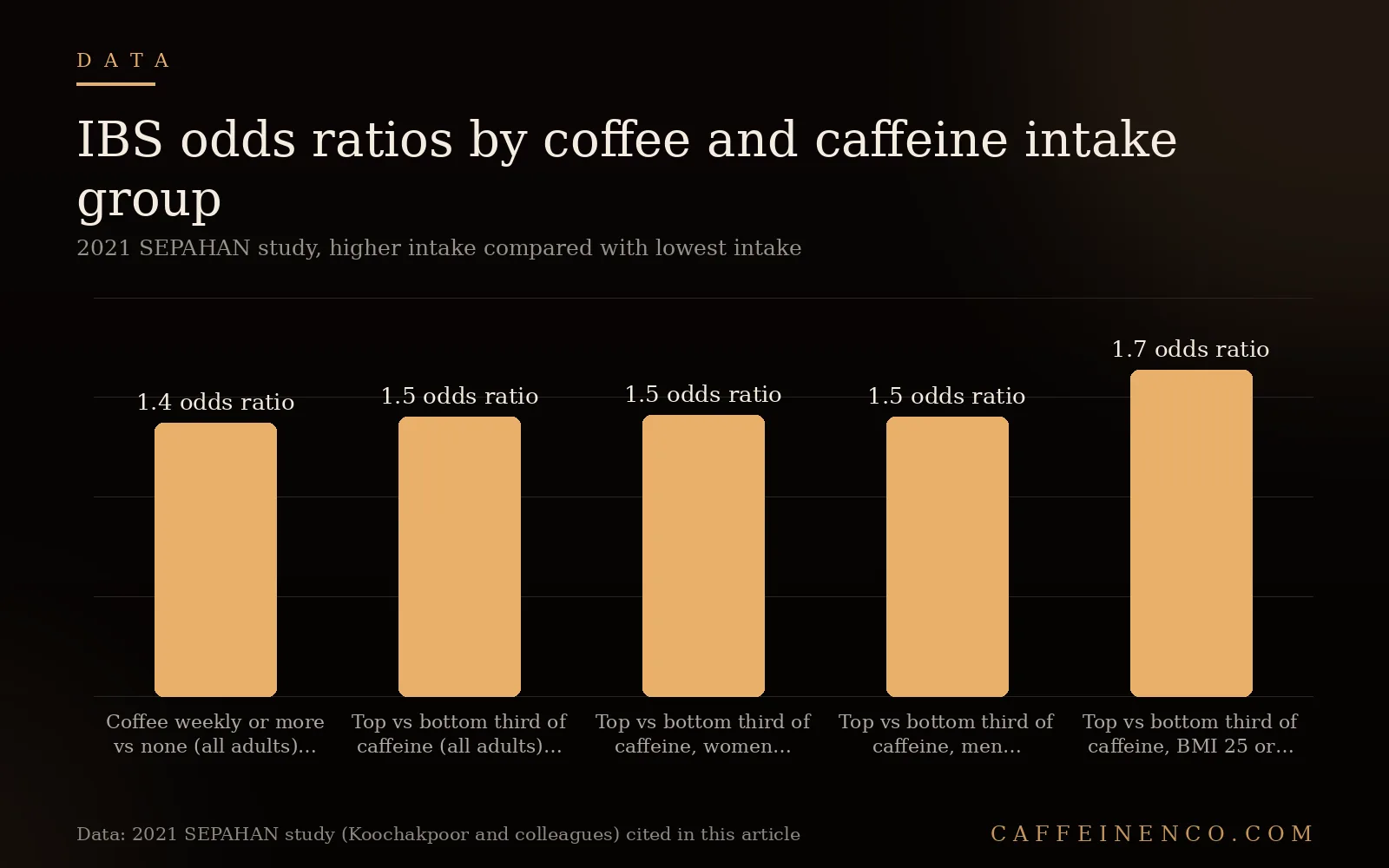
| Coffee weekly or more vs none (all adults) | 1.44 | 1.02 to 2.04 |
| Top vs bottom third of caffeine (all adults) | 1.47 | 1.14 to 1.87 |
| Top vs bottom third of caffeine, women | 1.48 | 1.10 to 2.00 |
| Top vs bottom third of caffeine, men | 1.47 | 0.94 to 2.30 (not significant) |
| Top vs bottom third of caffeine, BMI 25 or higher | 1.72 | 1.20 to 2.48 |
How to read those numbers
An odds ratio of 1.47 means the odds of having IBS were about 47 percent higher in the top caffeine group than the bottom group. It does not mean that 47 percent of heavy caffeine users have IBS, and it does not mean caffeine caused it.
Notice what happened with men. The point estimate for men (1.47) is almost identical to the one for women (1.48), but the interval for men crosses 1.0 so it is not statistically significant. That probably reflects fewer men in the sample rather than a real difference between the sexes, and the authors did not claim one. It is a good reminder that “significant in one group, not in another” often means “bigger sample in one group.”
The severity results were weaker. There was no significant link between coffee drinking and how severe IBS was in the overall group. A caffeine-severity association appeared only in people with a BMI of 25 or higher, with an interval (1.01 to 2.62) that barely clears 1.0.
The subtype detail most summaries skip
When the authors split IBS by subtype, the results were not what you would guess. Coffee was linked to IBS-C (odds ratio 1.66, interval 1.00 to 2.75) and caffeine was linked to IBS-C (odds ratio 1.49, interval 1.02 to 2.16). The study found no association for IBS-D, mixed IBS or unsubtyped IBS.
That runs against the common assumption that coffee is mainly a problem for people with diarrhoea, since coffee stimulates the bowel. We would be cautious about reading too much into it. The IBS-C interval for coffee starts at exactly 1.00, the subgroup is small, and one cross-sectional study cannot establish a mechanism. What it does show is that “coffee is bad for IBS-D” is not a finding of this study, and that you should not assume your subtype settles the question for you.
What the authors say about the limits
The paper lists its own caveats, and they matter:
- The cross-sectional design cannot show cause and effect. People may drink more or less coffee because of their symptoms, which would scramble the direction of the association.
- Both IBS and intake were self-reported on questionnaires, which risks misclassification.
- Few participants had severe IBS; most had mild to moderate symptoms.
- Chlorogenic acid content in the coffee was not measured, so the study cannot say whether something other than caffeine matters.
The caffeine figures come from a food frequency questionnaire, so they are estimates built from reported eating habits, and coffee is only one possible source of them.
The other side: the 2023 meta-analysis
A 2023 systematic review and meta-analysis in Nutrients, by Lee and colleagues, searched three databases through March 2023 and pooled eight studies covering more than 432,000 people. Coffee drinkers had a pooled odds ratio of 0.84 for IBS compared with non-drinkers, a lower risk. The authors recommended future prospective studies that follow disease-free people over time.
We cover how fragile that pooled number is in our is coffee a laxative guide, including what happens when the largest study is removed. For this page, the point is simpler. Even a favourable pooled result describes populations. It cannot tell you that coffee is safe for your particular gut on a bad day.
What people with IBS report in practice
The risk studies do not capture what living with IBS is like, and the questionnaire studies come closer.
A 2001 study in Digestion by Simren and colleagues gave 330 people with IBS and 80 healthy controls a questionnaire asking about symptoms after 35 different foods. About 63 percent of the patients linked their symptoms to meals, with gas and abdominal pain the most common complaints. Foods rich in carbohydrates, fatty food, coffee, alcohol and hot spices were most frequently reported to cause symptoms. The food sensitivity scores were higher in anxious patients and in women, and were not different between IBS subtypes or body weights.
A 2013 study in the American Journal of Gastroenterology by Bohn and colleagues, run in Sweden, found that 84 percent of IBS patients reported food-related symptoms, especially after foods rich in incompletely absorbed carbohydrates and fat, and that self-reported food intolerance went along with more severe symptoms and lower quality of life. We read this one through its published summary rather than the full paper, so we use it only for that headline finding.
Two caveats apply to both. First, these are self-reports, and people are not always right about what set off a flare, especially when a meal contains several suspects. Second, coffee is rarely consumed alone. If you drink a latte with breakfast, the milk, the sugar, the pastry, the speed you drank it and the stress of your morning commute all arrive at the same time as the caffeine.
The Simren finding about anxiety is worth pausing on. Caffeine and anxiety interact on their own, which our coffee and anxiety and coffee and cortisol guides cover. If your gut reacts to stress, a cup that makes you jittery may reach your gut by way of your nerves rather than your colon directly. We cannot tell from these studies how much each route contributes, and neither can anyone reading a headline.
What dietitians actually recommend
The British Dietetic Association publishes a patient page, “Irritable bowel syndrome (IBS) and diet” (dated January 2022 with a review date of January 2025, so check for a newer version). It is practical and notably modest in its coffee advice. It does not tell you to quit.
The relevant points are:
- General advice: reduce intake of caffeine-containing drinks, for example no more than two mugs (three cups) a day.
- If you have diarrhoea: limit caffeine from tea, coffee and soft drinks to three drinks a day, and replace lost fluids with plenty of uncaffeinated fluid.
- If you have constipation: make sure you drink six to eight glasses of uncaffeinated fluid a day.
- Drink at least eight cups of fluid a day, especially water or other non-caffeinated drinks.
- Eat regular meals and try not to skip meals or eat late at night.
- Keep a food and symptom diary while you make changes, so you can see what has helped.
- If simple changes are not enough, ask your doctor to refer you to a healthcare professional about a diet restricted in fermentable carbohydrates, known as a low FODMAP diet.
Two things stand out. The caffeine limit is a cap, not a ban, and it counts everything: tea, soft drinks and coffee together. And the advice around coffee is mostly about the other things in your day, such as fluids and meal regularity. Nothing on the page singles out coffee as the cause of IBS.
A worked example: a four-week coffee test

The common mistake with food triggers is changing five things at once, so that you never learn which one mattered. Here is a structure that follows the BDA’s food and symptom diary suggestion. It is our suggestion for organising a personal experiment, not a protocol from a trial.
Week 1: baseline. Change nothing. Each day, write down every caffeinated drink with its time, size and what you added (milk, sugar, syrup). Also record what you ate, your stool pattern, pain, bloating and stress on a 0 to 3 scale. To estimate your caffeine, use the figures in our caffeine in an espresso shot guide, which shows that individual cafe shots vary enormously, so treat any total as approximate.
Week 2: change the amount only. Keep the same drink, but cap yourself at the BDA’s three caffeinated drinks a day, or fewer if you were already below it. Do not change anything else. If you were at five cups, this is a meaningful cut, and our caffeine withdrawal timeline explains why headaches in the first days might be withdrawal, not your gut.
Week 3: change the timing. Go back to your week 1 amount, but drink it with food rather than on an empty stomach, or the other way round if you normally eat first. Our coffee on an empty stomach guide covers what the evidence says about that variable.
Week 4: change the caffeine. Swap one or two of your cups for decaf, keeping everything else the same. Our decaf coffee caffeine content guide explains how much caffeine decaf still contains. We did not find a study in the sources used for this page that tested decaf specifically in IBS, so this step is about your own response, not about a proven benefit.
At the end, compare the four weeks. You are looking for a pattern, such as “my worst days are the ones with more than three cups” or “symptoms track my stress, not my cup.” If one week is clearly better, that is a useful finding. If nothing differs, coffee may not be your trigger, and you can look at the other items on your diary.
If the milk is the problem
A latte is milk with coffee in it. A lactose problem or a reaction to the milk would show up as “coffee makes me ill” in a diary where you only log the drink. If you suspect this, run one extra week with black coffee. Whether milk matters for you is a matter for your doctor or dietitian, and we are not claiming a link from the studies cited here.
Practical takeaways
- Treat the three-drink cap as a sensible starting point. It comes from dietetic advice, not from a trial showing three is the safe line.
- Count all caffeine. The BDA cap covers tea, coffee and soft drinks together, so count them all in your total.
- Do not assume your IBS subtype tells you coffee is fine or not. The one large study that split by subtype found its association in IBS-C, not IBS-D.
- Test one variable at a time. Amount, timing, milk and decaf are separate experiments.
- Remember that stress and sleep travel with caffeine. If coffee seems to trigger symptoms mainly on bad days, the stress may be doing some of the work.
- See a doctor for anything new or worrying. Changes in your usual pattern are not a job for a coffee diary, and this page is not diagnostic.
Common mistakes
Blaming coffee after one bad morning. IBS symptoms fluctuate on their own. A single event proves very little, which is why a multi-week diary beats a hunch.
Quitting everything at once. Cutting coffee, dairy, gluten and alcohol in the same week leaves you unable to say what helped. The BDA’s own advice is to make changes while keeping a diary.
Switching to energy drinks or cola to avoid coffee. The BDA’s cap covers tea, coffee and soft drinks together, so a swap between them does not lower your total caffeine.
Reading an odds ratio as a probability. An odds ratio of 1.47 is not “47 percent of drinkers get IBS.” It is a relative measure from a single survey.
Assuming the meta-analysis proves coffee protects you. Its pooled estimate describes group risk, and its authors asked for better prospective studies.
Common questions
Does coffee cause IBS? No study cited here shows that it does. The 2021 SEPAHAN study found higher odds of IBS with higher caffeine intake, but it was cross-sectional, so it cannot show cause. A 2023 meta-analysis pooled eight studies and found lower odds for coffee drinkers. The honest summary is that the evidence on risk is mixed.
Can coffee trigger an IBS flare? Many people with IBS say so. In a 2001 survey of 330 patients, coffee was among the foods most often reported to cause symptoms. Self-reports are imperfect, though, so a diary is the way to check your own case.
How much coffee is okay with IBS? The British Dietetic Association suggests no more than two mugs (three cups) of caffeinated drinks a day, counting tea and soft drinks. That is a cap from dietetic advice, not a threshold proven by a trial.
Is coffee worse for IBS-D or IBS-C? In the SEPAHAN study, the subtype associations were found for IBS-C, not IBS-D. That is one cross-sectional survey with borderline intervals, so do not treat it as a rule. Our is coffee a laxative guide explains the bowel-stimulating effect that makes many people assume the reverse.
Is decaf safer for IBS? We found no study in our sources that tested decaf in people with IBS. Decaf still contains some caffeine, and the other compounds in coffee are still there. The week 4 swap in the test above is a way to find out for yourself.
Should I drink coffee on an empty stomach if I have IBS? The studies here did not test that. The BDA recommends regular meals and not skipping them. Our coffee on an empty stomach guide covers the broader evidence, and our does coffee cause acid reflux guide is relevant if reflux travels with your IBS.
Why do I get symptoms from coffee but not tea? These sources do not answer that. Differences in caffeine dose, other compounds, serving size, milk and how fast you drink each one are all possible, and a diary can help separate them.
Should I see a dietitian? The BDA says that if simple changes are not enough, you can ask your doctor to refer you to a healthcare professional about a low FODMAP diet. A dietitian can run that process safely, which is better than cutting foods at random.
Sources & data
- Koochakpoor G et al.: Association of Coffee and Caffeine Intake With Irritable Bowel Syndrome in Adults (Frontiers in Nutrition, 2021; SEPAHAN project, 3,362 Iranian adults)
- Simren M et al.: Food-related gastrointestinal symptoms in the irritable bowel syndrome (Digestion, 2001; PubMed 11244249)
- British Dietetic Association: Irritable bowel syndrome (IBS) and diet (January 2022)
- Lee JY et al.: Examining the Association between Coffee Intake and the Risk of Developing Irritable Bowel Syndrome: A Systematic Review and Meta-Analysis (Nutrients, 2023; PMC10674416)
- Bohn L et al.: Self-Reported Food-Related Gastrointestinal Symptoms in IBS Are Common and Associated With More Severe Symptoms and Reduced Quality of Life (American Journal of Gastroenterology, 2013)