
“Does coffee help or hurt your gut” sounds like one question and is actually three, stacked together without anyone separating them. There is the motility question: does coffee speed up how fast things move through you. There is the bacteria question: does coffee change which microbes actually live in your intestines. And there is the disease question: does any of this matter differently if you already have a diagnosed gut condition. This site’s own is coffee a laxative breakdown already covers the first question in depth, the gastrocolic reflex, the 29 percent figure, and the genuinely split evidence on coffee and IBS risk. This page covers the other two, starting with the newest and most specific finding in gut-microbiome research: a 2024 study of nearly 23,000 people that found coffee drinkers carry dramatically more of one particular species of gut bacterium than non-drinkers do, and that caffeine is not the main reason why.
One bacterium, 22,867 people, and a fold difference too large to ignore
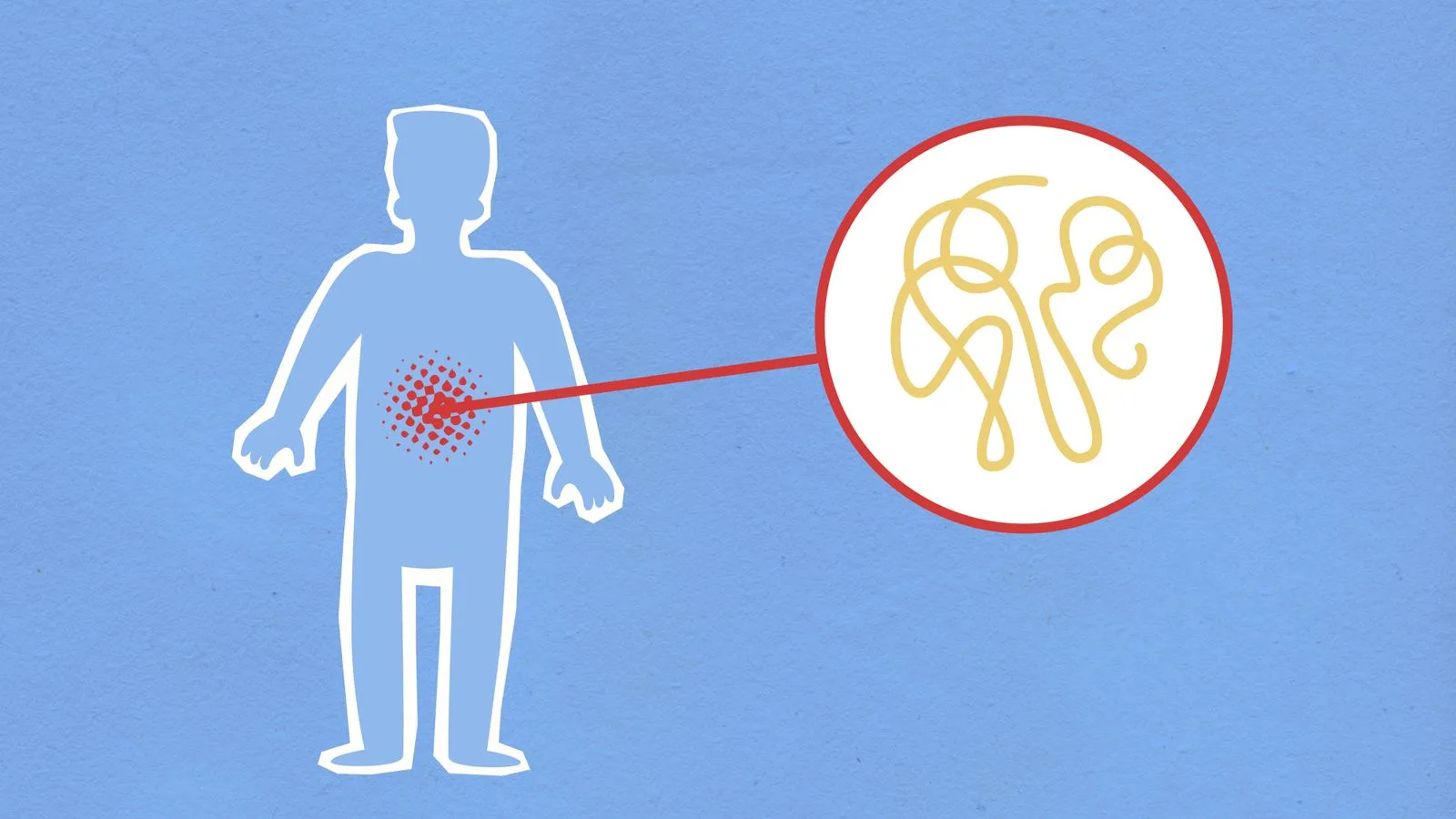
Published in Nature Microbiology in November 2024, the study pooled data from five ZOE PREDICT cohorts in the US and UK, plus the Mind-Body Study and the Men’s Lifestyle Validation Study, for a combined 22,867 participants and 35,214 stool metagenomes paired with detailed dietary records. The headline finding centers on a single species, Lawsonibacter asaccharolyticus, a bacterium that lives in the gut and was already known to produce butyrate, a short-chain fatty acid the colon’s own lining cells use as their primary fuel source.
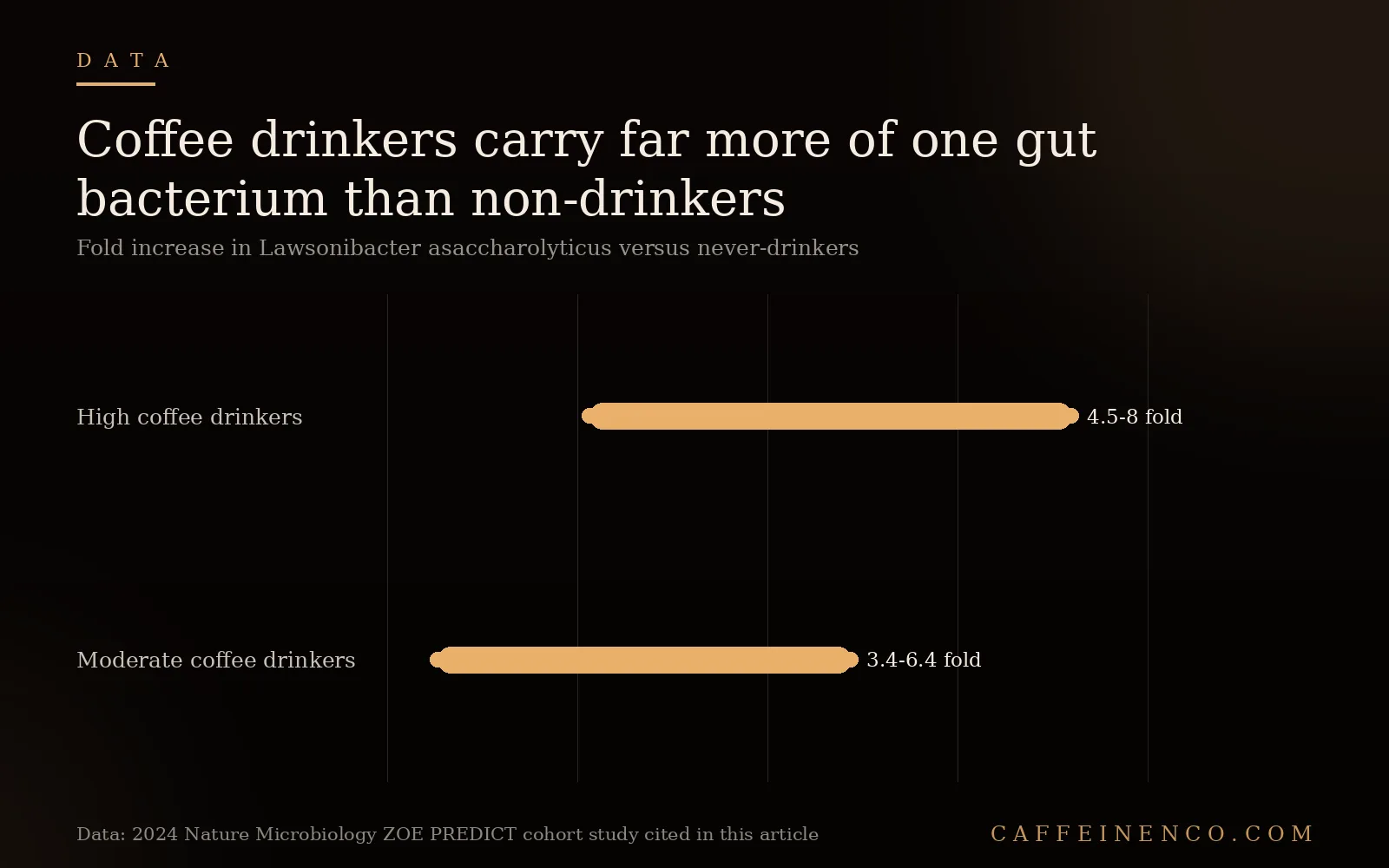
High coffee drinkers in the dataset carried a median of 4.5 to 8 times more L. asaccharolyticus than people who never drink coffee at all, and moderate drinkers showed a 3.4 to 6.4-fold increase over never-drinkers, a clear dose relationship rather than a single on-off switch. The researchers also looked well beyond this one species: 115 separate gut microbial species showed a statistically significant positive association with coffee intake (q < 0.001), meaning this bacterium is the sharpest single signal in a much broader pattern, not an isolated curiosity.
Caffeine is not the active ingredient here
The detail that makes this finding genuinely interesting, rather than just another “coffee is good for you” headline, is what happened when the researchers checked decaffeinated coffee specifically. The association with L. asaccharolyticus held for decaf drinkers too, though at reduced strength: a correlation of 0.27 for decaf-only drinkers versus 0.43 for coffee overall, a real drop but still highly significant. The study’s authors describe this as a “substantial independence on caffeine” of the microbiome effect, not an equal-magnitude one. They followed that observational finding with a direct lab test: supplementing growth media with coffee, at concentrations of 5 and 10 grams per liter, stimulated L. asaccharolyticus growth in two separate experiments. In liquid culture, coffee produced an average increase of 350 percent (a 3.5-fold median change) in growth. In a separate agar-plate version of the same test, run with both caffeinated and decaffeinated preparations, the stimulatory effect held regardless of coffee preparation or caffeine presence, though the paper does not report a percentage figure for that version of the experiment. That mirrors a mechanism this site’s own coffee and diabetes breakdown already documents for a different outcome: chlorogenic acid and other coffee polyphenols, not caffeine, driving coffee’s long-term protective association with type 2 diabetes risk, with decaf carrying nearly as much of the benefit as regular coffee in that dataset too. The same shape shows up again here, even if the decaf effect on L. asaccharolyticus is weaker rather than identical: whatever is feeding this bacterium survives decaffeination, just not at full strength.
One more piece of the same study is worth knowing: people who carried higher levels of L. asaccharolyticus also showed higher levels of hippurate, a metabolite the gut’s bacteria produce by breaking down dietary polyphenols. The study itself describes hippurate as a biomarker of metabolic and gut health; it is also used more broadly elsewhere in the microbiome literature as a general marker of diversity, though that specific use is not what this particular paper measured. That is consistent with, though not final proof of, this specific bacterium playing an active role in how coffee’s polyphenols get metabolized once they reach the colon.
It is not just one bacterium: the broader community shift
A separate literature review pulling together multiple studies on coffee and gut microbiota found the Lawsonibacter finding sits inside a wider pattern. Across studies of moderate coffee intake, generally defined as under 4 cups a day, researchers have consistently found increases in the phyla Firmicutes and Actinobacteria alongside decreases in Bacteroidetes, along with higher counts of Bifidobacterium, a genus commonly associated with gut health, and lower counts of Enterobacteria, a family that includes several opportunistic pathogens. The same review found higher coffee intake associated with higher alpha diversity, a standard measure of how many different microbial species are present and how evenly balanced they are, in colonic mucosa-associated bacteria specifically, along with a higher relative abundance of Faecalibacterium and Alistipes there. Faecalibacterium is one of the genera the review separately ties to short-chain fatty acid production, alongside Bifidobacterium longum; the Alistipes finding is about its abundance and diversity, not an SCFA role.
Read together, that is a coffee-associated microbiome that looks, by the field’s usual composition-based markers, more diverse and skewed toward bacteria known for producing compounds that feed the gut lining rather than bacteria associated with opportunistic infection. It is worth being precise about what that does and does not prove: a shift in bacterial composition is not the same thing as a measured improvement in digestion, symptoms, or disease outcome in the people who show it. Diversity and SCFA-producing genera are markers researchers generally treat as favorable, not symptoms a person would notice or a diagnosis a doctor would make from them alone.
What this means if you already have inflammatory bowel disease

Here the evidence gets genuinely more cautious, and it is worth not overstating it in either direction. Population-level research on coffee and the risk of developing Crohn’s disease or ulcerative colitis in the first place is mixed: some studies have found a lower risk of Crohn’s disease specifically among people who drink drip-filtered coffee daily, while other analyses, including Mendelian randomization studies that try to isolate genetic evidence of a causal effect, have found no consistent association with either condition. That is not a resolved question, and this page is not going to pretend it is.
The more useful evidence comes from people who already have an IBD diagnosis. A 2024 observational study followed 135 IBD patients, 57 with Crohn’s disease and 78 with ulcerative colitis, over six years, tracking their coffee habits against fecal calprotectin, a protein measured in stool that doctors use as a direct marker of active intestinal inflammation. Across the full group, calprotectin values were significantly lower in coffee consumers overall than in non-consumers (p = 0.04), but the study’s authors note that broken out by disease, that overall-group significance was not maintained in either UC or Crohn’s alone. The disease-specific split that does hold up shows up only in the narrower natural-coffee subgroup: among patients who drank natural coffee specifically, calprotectin was significantly lower than in non-consumers in ulcerative colitis patients (p = 0.03) but not in Crohn’s disease patients (p = 0.15). Systemic inflammatory markers, white blood cell count, C-reactive protein, and erythrocyte sedimentation rate, showed no significant difference by coffee consumption in either group.
That is a specific, narrow finding, not a green light to self-treat. A 135-person observational study cannot establish that natural coffee reduces inflammation in ulcerative colitis, only that the two were associated in this sample, and the same effect did not reach significance in Crohn’s patients in the same study. Anyone managing an actual IBD diagnosis should treat this as a data point worth discussing with a gastroenterologist, not as a reason to change medication or add coffee as a treatment.
Reading the three questions together
Separating the sub-questions this page opened with makes the overall picture easier to hold onto. The bacteria-composition question has the strongest single piece of new evidence behind it: a large, multi-cohort study with a lab-confirmed growth mechanism showing coffee, caffeinated or not, measurably increases one specific gut bacterium and shifts the broader community toward higher diversity. The motility question, covered in full on this site’s laxative breakdown, has a well-established mechanism, the gastrocolic reflex, but a genuinely split answer on whether that translates into higher or lower IBS risk at a population level. The disease-specific question is the most tentative of the three: a real but narrow signal in ulcerative colitis, no comparable signal yet in Crohn’s disease, and no study claiming coffee treats either condition.
Worked example: applying this to your own situation
- If you are generally healthy and just curious about gut health, the microbiome evidence favors keeping your habit, caffeinated or not. The Lawsonibacter finding held for decaf drinkers too, just at a weaker magnitude than for regular coffee drinkers, so caffeine sensitivity is not a reason to skip the bacterial benefit described above.
- If digestive symptoms, not microbiome composition, are your actual concern, start with the motility question instead. This site’s laxative breakdown has the full worked example for tracking whether your own gut responds to caffeine, coffee itself, or neither.
- If you have ulcerative colitis, the calprotectin finding is worth raising with your gastroenterologist, not acting on alone. A 6-year observational study of 78 UC patients found lower inflammation markers specifically among natural coffee drinkers, but 135 total patients is too small a sample to change a treatment plan on its own.
- If you have Crohn’s disease specifically, do not assume the same calprotectin benefit applies to you. The same study found no significant reduction in Crohn’s patients among natural coffee drinkers, a meaningfully different result from the UC finding in the same dataset.
- If you want to test whether caffeine itself, separate from coffee’s other compounds, is driving any symptom you notice, decaf is the cleanest comparison. A decaf coffee selection from 1st in Coffee or the same category on Amazon keeps the Lawsonibacter-associated polyphenols in your cup while removing caffeine as a variable; this site’s own decaf coffee caffeine content breakdown has the real per-cup range, 2 to 15mg, for planning around it.
- Do not read a diverse microbiome as proof of fewer symptoms. Alpha diversity and SCFA-producing genera are composition markers researchers treat as generally favorable, not a measured reduction in bloating, pain, or irregularity on their own.
Common mistakes
Treating the Lawsonibacter finding as proof that coffee fixes digestion is the most common mistake; it is a real, large, lab-confirmed shift in bacterial abundance, not a measured change in symptoms, and the study itself never claims the second thing. Assuming caffeine is responsible for the microbiome effect is the second mistake; the association held for decaf too, albeit at a weaker magnitude, and the lab growth experiments confirmed coffee’s stimulatory effect two ways, a 350 percent average increase in liquid culture and a separate agar-plate test showing the same effect regardless of caffeine presence. Conflating this page’s bacteria-composition findings with the separate motility question is the third mistake; coffee’s effect on how fast things move through your gut runs through a completely different mechanism, the gastrocolic reflex, covered in full on this site’s laxative breakdown. Assuming the IBD finding applies equally to Crohn’s disease and ulcerative colitis is the fourth mistake; the same 2024 study found a significant calprotectin reduction in UC patients and no significant reduction in Crohn’s patients, among those who drank natural coffee specifically. Treating a 135-patient observational study as proof that coffee treats IBD is the fifth mistake; it is an association in a small sample, not a clinical trial, and nobody managing an IBD diagnosis should change treatment based on it alone.
Common questions
Does coffee actually change your gut bacteria? Yes, according to the largest study on the subject. A 2024 analysis of 22,867 people across multiple cohorts found high coffee drinkers carried 4.5 to 8 times more of a specific bacterium, Lawsonibacter asaccharolyticus, than non-drinkers, alongside 115 other gut species showing a significant positive association with coffee intake overall.
Is it the caffeine causing the effect, or something else in coffee? Mostly something else. The bacterial association held for decaffeinated coffee too, though at a reduced magnitude compared with regular coffee. In the lab, coffee boosted the bacterium’s growth by an average of 350 percent in liquid culture, and a separate agar-plate version of the same test found that stimulatory effect held regardless of whether caffeine was present, pointing to coffee’s polyphenols rather than caffeine as the active driver.
Does coffee help or hurt inflammatory bowel disease? The evidence is mixed and narrow rather than a clear yes or no. Population studies on coffee and the risk of developing Crohn’s disease or ulcerative colitis disagree with each other. Among people who already have IBD, a 2024 study of 135 patients found coffee drinkers overall had modestly lower intestinal inflammation markers, with a stronger effect among those who drank natural coffee specifically; that natural-coffee effect was statistically significant in ulcerative colitis but not Crohn’s disease.
Does a more diverse gut microbiome mean better digestion? Not necessarily, at least not proven directly. Higher microbial diversity and more short-chain-fatty-acid-producing bacteria are markers researchers generally consider favorable, but the coffee studies covered here measured bacterial composition, not a change in symptoms like bloating, pain, or bowel regularity.
Should I switch to decaf for gut health? If the goal is specifically the bacterial and polyphenol-linked effects described above, decaf is a reasonable choice, since the Lawsonibacter association remains significant and the lab growth experiment’s agar-plate version held regardless of caffeine, though the observational decaf effect is weaker than regular coffee’s. If the goal is instead reducing a motility-driven symptom like urgency, this site’s laxative breakdown covers that separate, caffeine-sensitive mechanism in more depth.
Is this the same as the “coffee makes you poop” effect? No, they are different mechanisms entirely. The findings on this page concern which bacteria live in your gut over time. The laxative effect runs through the gastrocolic reflex and gut hormones like gastrin, hits within minutes, and is covered separately in this site’s is coffee a laxative breakdown.
For more sourced breakdowns like this one, delivered weekly, subscribe to The Sunday Pour.
Sources & data
- Nature Microbiology, via PMC: Coffee Consumption Is Associated With Intestinal Lawsonibacter asaccharolyticus Abundance and Prevalence Across Multiple Cohorts
- PMC: Effects of Coffee on Gut Microbiota and Bowel Functions in Health and Diseases, A Literature Review
- PMC: Impact of Coffee Consumption on Subjective Perception and Inflammatory Markers in Patients With Inflammatory Bowel Diseases