
Coffee has a reputation as a weight-loss aid, and the reputation is half earned. There is genuine research behind it: a 24-week randomized trial found a modest loss of fat mass in people drinking four cups a day, and large pooled analyses find coffee drinkers a hair leaner on average. But the same body of research includes a 2024 network meta-analysis of randomized trials that found no significant weight loss from coffee at all. The honest answer sits between “coffee melts fat” and “coffee does nothing”, and it depends a great deal on what is in the cup.

This page goes through the best evidence one study at a time, with the actual effect sizes, then does the calorie arithmetic that usually matters more than any of it. It is an explainer, not medical or dietary advice. If you are managing your weight for a health reason, or you take medication, your doctor or dietitian is the right person to tailor it.
The short version
- A 24-week placebo-controlled trial of 126 overweight adults found that 4 cups a day of instant coffee was associated with a 3.7 percent loss of fat mass compared with placebo. Weight loss was not its main aim.
- A 2019 meta-analysis of 12 epidemiologic studies found higher coffee intake linked to a very small difference in BMI (-0.08) and slightly larger for waist circumference (-0.27), more evident in men.
- A 2024 network meta-analysis of 22 randomized trials found no significant weight loss effect for coffee, decaf coffee or green coffee, though green tea showed a small effect on very low to low certainty evidence.
- Plain black coffee is about 2 calories per 8 ounces. A tablespoon of sugar adds 48 and a tablespoon of cream adds 52, so the cup’s additions usually outweigh any metabolic effect.
The best trial: 4 cups a day for 24 weeks
The most useful single study is a randomized placebo-controlled trial led by Derrick Alperet and published in the American Journal of Clinical Nutrition in 2020. It ran for 24 weeks in 126 overweight adults aged 35 to 69 who were not insulin sensitive. Participants drank either 4 cups of instant regular coffee (62 people) or 4 cups of a coffee-like placebo drink (64 people) every day.
The trial was designed to test insulin sensitivity, not weight. On that primary question it found nothing: no significant change compared with placebo. But the coffee group lost fat mass, by 3.7 percent relative to placebo (95 percent confidence interval -6.3 to -1.1 percent). The authors summarized this as “a modest loss of FM”. Harvard’s write-up of the work quotes the lead researcher suggesting the fat loss may come from caffeine nudging metabolism upward, which is a hypothesis, not something the trial itself proved.
How to read that 3.7 percent
Three things keep this result in proportion:
- It is a relative change in fat mass, not a body weight figure. The abstract does not claim a particular number of kilograms, and neither should anyone quoting it.
- It was a secondary outcome. Findings that were not the trial’s main question are better treated as leads than conclusions.
- The dose was large and the population specific. Four cups a day, in overweight adults of Chinese, Malay and Asian-Indian background who had reduced insulin sensitivity. The result may not transfer to a person drinking one cup, or to someone at a healthy weight.
If you are curious what four cups means for your caffeine total, the caffeine in espresso and Starbucks brewed coffee guides put real numbers on it. The Harvard Nutrition Source notes that a moderate amount of coffee is generally defined as 3 to 5 cups a day, or about 400 mg of caffeine, per the Dietary Guidelines for Americans.
The big picture from observational data
Observational studies follow what people already do and compare outcomes. They are good at spotting patterns and poor at proving cause.
A 2019 meta-analysis in Nutrients by Lee and colleagues pooled 12 epidemiologic studies found through February 2019. They looked at obesity measured by body mass index (BMI) or waist circumference (WC). The results:
| Measure | Result | 95% CI |
|---|---|---|
| BMI, weighted mean difference | -0.08 | -0.14 to -0.02 |
| BMI, risk of obesity (highest vs lowest coffee intake) | RR 1.49 | 0.97 to 2.29 |
| Waist circumference, weighted mean difference | -0.27 | -0.51 to -0.02 |
| Waist circumference, risk of obesity | RR 1.07 | 0.84 to 1.36 |
The pattern is worth reading slowly. The continuous measures lean slightly in coffee’s favor: higher coffee intake went with a marginally lower BMI and waist. But the BMI difference of -0.08 is tiny, and the two risk ratios for being classed as obese have confidence intervals that include 1.0, meaning those comparisons were not statistically significant. The authors’ own conclusion was cautious: higher coffee intake “might be modestly associated with reduced adiposity, particularly in men”. In men the weighted mean differences were -0.05 for BMI and -0.21 for waist circumference.
That is not a headline you could build a diet on. It is a faint signal, found in a field the authors themselves described as having inconsistent results.
The randomized evidence: where it gets less encouraging
Randomized trials are the better test of cause, and here the 2024 British Journal of Nutrition paper by Jayedi and colleagues is the key reference. It was a systematic review and network meta-analysis of 22 randomized controlled trials with 1,710 participants, with an average intervention length of 10 weeks.
Its findings, in short:
- Green tea showed a small weight reduction: -1.23 kg compared with placebo (low certainty) and -1.61 kg compared with water (very low certainty).
- Coffee, decaffeinated coffee, green coffee, black tea and sour tea showed no significant weight loss effects.
The authors concluded that green tea drinking may result in a small reduction in body weight on very low to low certainty evidence from short-term trials. For coffee, the message is flat: across the trials they could pool, no significant effect.
Why the studies seem to disagree
They are asking different questions. Alperet’s trial measured fat mass in a specific group over 24 weeks. Jayedi’s analysis pooled mostly short trials (averaging 10 weeks) and looked at body weight. Lee’s meta-analysis compared groups of people who already drink different amounts of coffee. A person can lose a little fat without losing meaningful scale weight, and a habit that tracks with leanness across a population may be a marker of other habits rather than a cause.
What about green coffee extract?
Green coffee supplements are sold as weight-loss products, so it helps to know what the research on them looks like. One small randomized, double-blind study of a green coffee bean extract (500 mg a day for 12 weeks in 71 overweight adults, published in SAGE Open Medicine in 2021) reported reductions in weight and BMI compared with placebo. That is a single small trial of a capsule, and it is a different thing from drinking coffee. The 2024 network meta-analysis above listed green coffee among the beverages it compared and reported no significant weight loss effect for it. If you are considering a supplement, ask your doctor first.
The calorie math that matters more
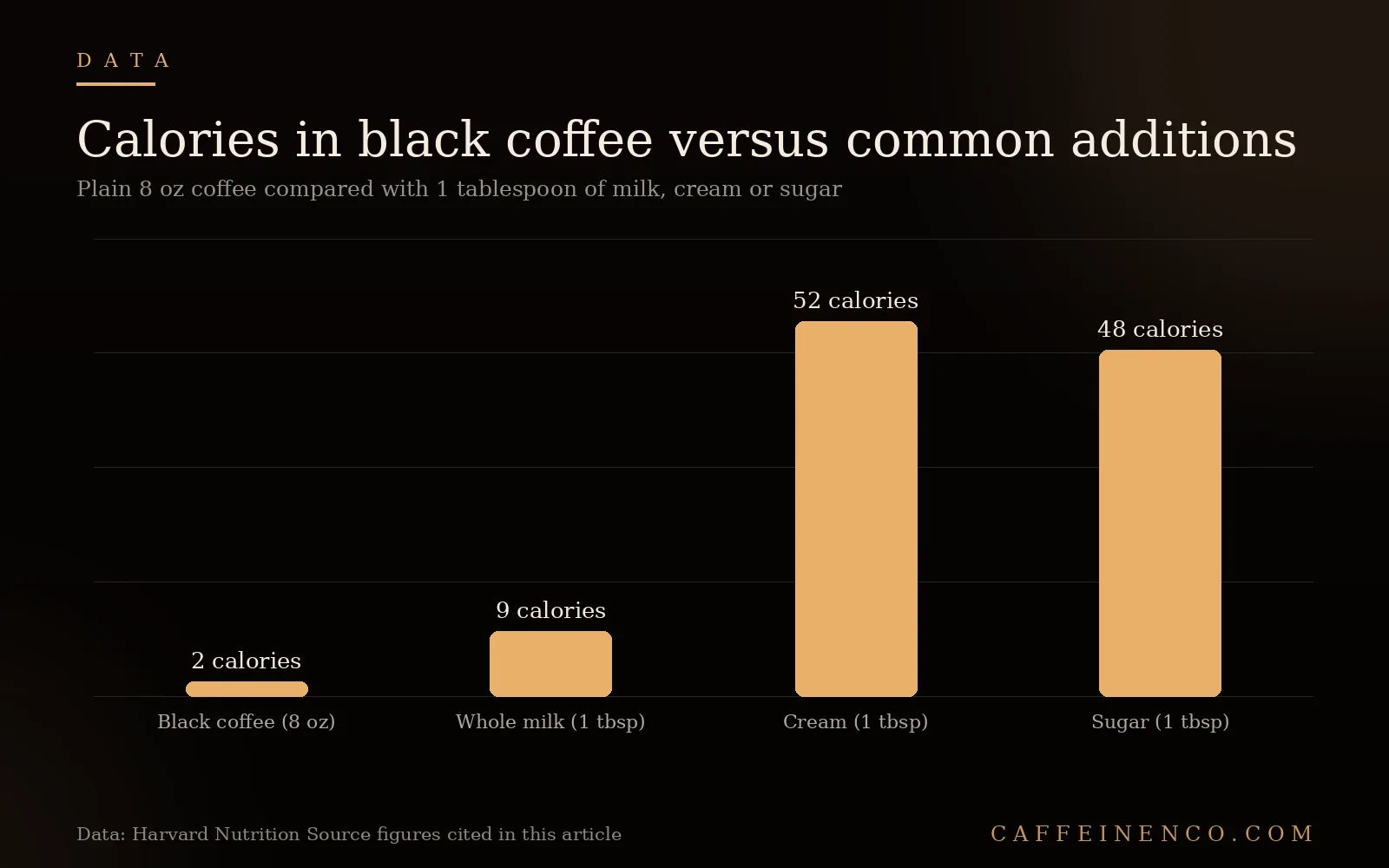
All of the studies above deal with effects of a few percent. The calories in the cup can swamp them. The Harvard Nutrition Source gives these figures:
- 8 ounces of plain black coffee: about 2 calories.
- 1 tablespoon of whole milk: 9 calories.
- 1 tablespoon of cream: 52 calories.
- 1 tablespoon of sugar: 48 calories.
- Specialty drinks, often super-sized: anywhere from 200 to 500 calories, with an extremely large amount of sugar.
Worked example: three cups a day
Take someone who drinks three 8-ounce cups of coffee a day.
- Black: 3 cups x 2 calories = about 6 calories a day.
- With 1 tablespoon of cream and 1 tablespoon of sugar in each cup: 3 x (2 + 52 + 48) = about 306 calories a day. Over seven days, that is roughly 2,142 calories.
- Switching to 1 tablespoon of whole milk and no sugar: 3 x (2 + 9) = about 33 calories a day.
The gap between step 2 and step 1 is about 300 calories a day, all of it from the additions. No trial in the literature above found a metabolic benefit of coffee that large, and several found no benefit at all. This arithmetic simply applies the Harvard figures; your own cup will differ with the real size of your spoonfuls.
If you want to change the cup without giving up the taste, the useful move is gradual: cut the sugar first, then the cream. Our guide to the coffee-to-water ratio can also help, because a properly extracted cup tastes better black than a weak, over-extracted one, which makes cutting additions easier. If your coffee tastes harsh, why is my coffee bitter walks through the fixes.
Practical takeaways
- Treat coffee as a neutral drink, not a fat burner. The randomized evidence does not support leaning on it for weight loss.
- Count what goes in it. The additions are where the calories are.
- Do not chase the studies’ dose. Four cups a day sits inside the 3 to 5 cup range Harvard calls moderate, but it is more than many people tolerate comfortably. If you are sensitive to caffeine, see our notes on coffee and anxiety.
- Watch the timing. If you drink coffee while fasting, the coffee and intermittent fasting guide covers what breaks a fast and what does not.
- Mind the blood sugar link. If you have diabetes or take glucose-lowering medication, read coffee and diabetes and talk to your clinician. Notably, the Alperet trial’s main finding on insulin sensitivity was null.
What this evidence does not tell you
- It does not show that coffee causes lasting weight loss. The best trial was 24 weeks long and measured fat mass as a secondary outcome.
- It does not apply equally to everyone. The trial population was overweight adults with reduced insulin sensitivity; the meta-analysis found associations stronger in men.
- It does not cover sweetened drinks. The research compares coffee with placebo or non-drinkers, not a 400-calorie blended drink.
- It does not replace medical advice. Caffeine interacts with sleep, blood pressure and some medicines, none of which a weight-loss study accounts for.
Common mistakes
The first mistake is quoting the 3.7 percent figure as if it were pounds lost. The second is ignoring what goes into the cup, which is where most of the calories are. The third is assuming that because observational studies find coffee drinkers slightly leaner, coffee is the reason. The fourth is jumping from drinking coffee to buying a green coffee extract, since the evidence is not the same. The fifth is increasing caffeine to hit a trial dose and then paying for it in poor sleep, which tends to work against any weight goal. And the last is skipping a conversation with a clinician when weight is a medical concern.
Common questions
Does coffee help you lose weight? Slightly, at best. A 24-week trial found a 3.7 percent loss of fat mass with 4 cups a day compared with placebo, but a 2024 meta-analysis of 22 randomized trials found no significant weight loss effect for coffee.
Does black coffee burn fat? There is no strong evidence that it burns fat on its own. Black coffee has about 2 calories per 8 ounces, which is its main advantage: it adds almost nothing to your day.
Is decaf coffee any different for weight? The 2024 network meta-analysis found no significant weight loss effect for decaffeinated coffee either, so there is no sign in those trials that decaf does better or worse.
How much coffee is linked to weight loss in studies? The notable randomized trial used 4 cups a day of instant coffee. That is not a recommendation. Harvard’s Nutrition Source defines moderate intake as 3 to 5 cups a day, or about 400 mg of caffeine.
What about adding cream or sugar? It matters more than the coffee itself. A tablespoon of cream adds about 52 calories and a tablespoon of sugar about 48, compared with 2 calories for the plain 8-ounce cup.
Is green coffee extract worth taking? A small 12-week trial reported benefits, but it is one study of a supplement, and the larger 2024 analysis found no significant effect for green coffee. Talk to your doctor before taking any supplement.
Does coffee help men and women equally? The 2019 meta-analysis found the inverse association with BMI and waist circumference was more evident in men. That is an association across studies, not a prediction for any individual.
Sources & data
- Alperet et al., The effect of coffee consumption on insulin sensitivity and other biological risk factors for type 2 diabetes: a randomized placebo-controlled trial (American Journal of Clinical Nutrition, 2020)
- Lee et al., Coffee Intake and Obesity: A Meta-Analysis (Nutrients, 2019)
- Jayedi et al., Comparative effects of tea and coffee drinking on body weight in adults: a systematic review and network meta-analysis of randomised trials (British Journal of Nutrition, 2024)
- Harvard T.H. Chan School of Public Health, The Nutrition Source: Coffee
- Harvard T.H. Chan School of Public Health news: coffee trial and body fat