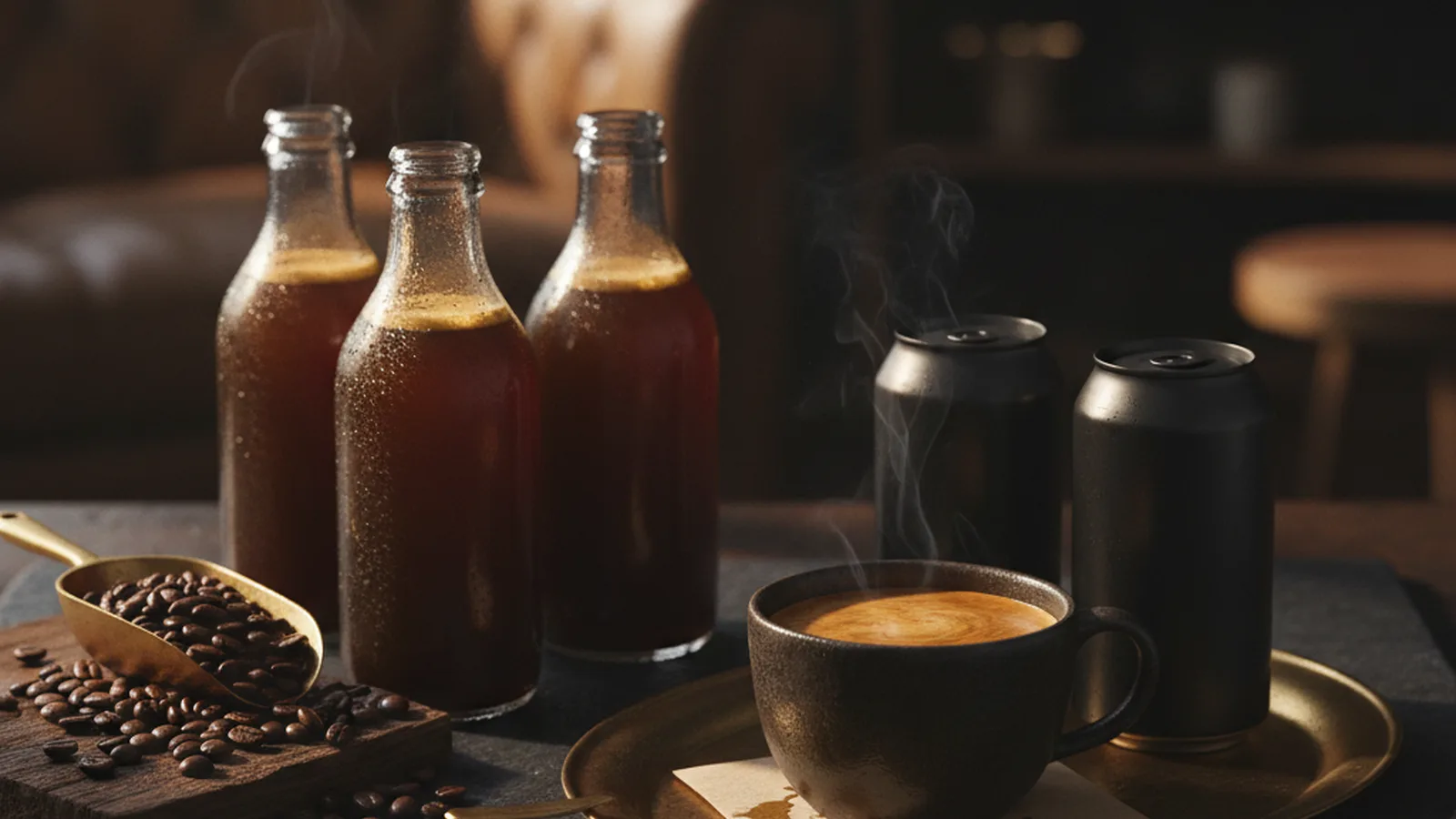
The Starbucks drinks you grab from a grocery cooler are a different product from the ones a barista makes, and the caffeine does not follow the same rules. A cafe latte is capped by its espresso shots. A bottle is capped by whatever the manufacturer put in the bottle, and the bottles come in sizes from 6.5 ounces to 40 ounces. That spread is the whole story: across the lines covered here, a single container can hold anywhere from about 45mg to 375mg of caffeine, and the label you glance at in the cooler rarely tells you which end you are holding.
This guide collects the published figures for the main bottled and canned lines (Doubleshot Energy, bottled Frappuccino, Iced Espresso Classics and canned Refreshers), converts them to milligrams per fluid ounce so you can compare them with each other and with cafe drinks, and flags the places where sources disagree. It sits alongside this site’s breakdowns of Starbucks brewed coffee and Starbucks Nitro Cold Brew, which cover the cafe side of the menu.
One note on sourcing before the numbers. Most of the figures below come from Caffeine Informer, which in turn credits PepsiCo’s published product data for these bottled lines. Tasting Table assembled a separate ranking, but it says it calculated “the caffeine amount adjusted for 12 ounces of each drink”, so its figures are per 12 ounces rather than per container and cannot be compared directly with Caffeine Informer’s per-container numbers. This guide notes where the two are consistent and where they cannot be compared.
The short answer
| Product | Container | Caffeine | Per fluid ounce |
|---|---|---|---|
| Doubleshot Energy (all flavors) | 15 fl oz can | 135mg | 9.0mg |
| Bottled Frappuccino, Coffee | 13.7 fl oz | 130mg | 9.5mg |
| Bottled Frappuccino, Mocha | 13.7 fl oz | 110mg | 8.0mg |
| Bottled Frappuccino, Vanilla | 13.7 fl oz | 75mg | 5.5mg |
| Iced Espresso Classics | 14 fl oz (older stock) | about 145mg | about 10.4mg |
| Iced Espresso Classics | 40 fl oz bottle | 375mg | about 9.4mg |
| Canned Refreshers | 12 fl oz can | 50mg | about 4.2mg |
Per-ounce figures are this site’s own division of the published milligrams by the published volume. They are for comparison, not a new measurement.
The practical headline: a Doubleshot Energy can or a coffee Frappuccino lands near 130 to 135mg, roughly a strong 8-ounce home-brewed cup. A canned Refresher is closer to a cup of weak tea. And the 40-ounce Iced Espresso bottle holds almost a full day’s reference amount in one container.
Doubleshot Energy
Caffeine Informer lists a single figure for the line: 135mg in a 15 fl oz can, with the note that every flavor (Coffee, Vanilla, Mocha, Hazelnut and White Chocolate) lists the same caffeine content. Tasting Table lists the Mocha can at 108mg per 12 ounces; scaled to the 15-ounce can, that works out to 135mg, which is consistent with Caffeine Informer (the scaling is this site’s arithmetic, not a figure Tasting Table prints for the can).
This is also the product where you will find the loosest numbers elsewhere. Unsourced pages quoting 175, 185 or 225mg for particular flavors circulate online. They do not cite a label, we could not confirm any of them against a primary source, and they conflict with the sourced figure. Treat a flavor-specific number above 135mg as unverified unless it comes with a photo of the can.
At 9.0mg per ounce, Doubleshot Energy is not unusually concentrated. It is a mid-strength drink in a large can. The caution is volume: people drink a 15-ounce can in one sitting the way they would a bottle of juice, and a 15-ounce serving of anything at 9mg per ounce is a real dose. For the caffeine behind the espresso itself, see this site’s guide to caffeine in a shot of espresso.
Bottled Frappuccino
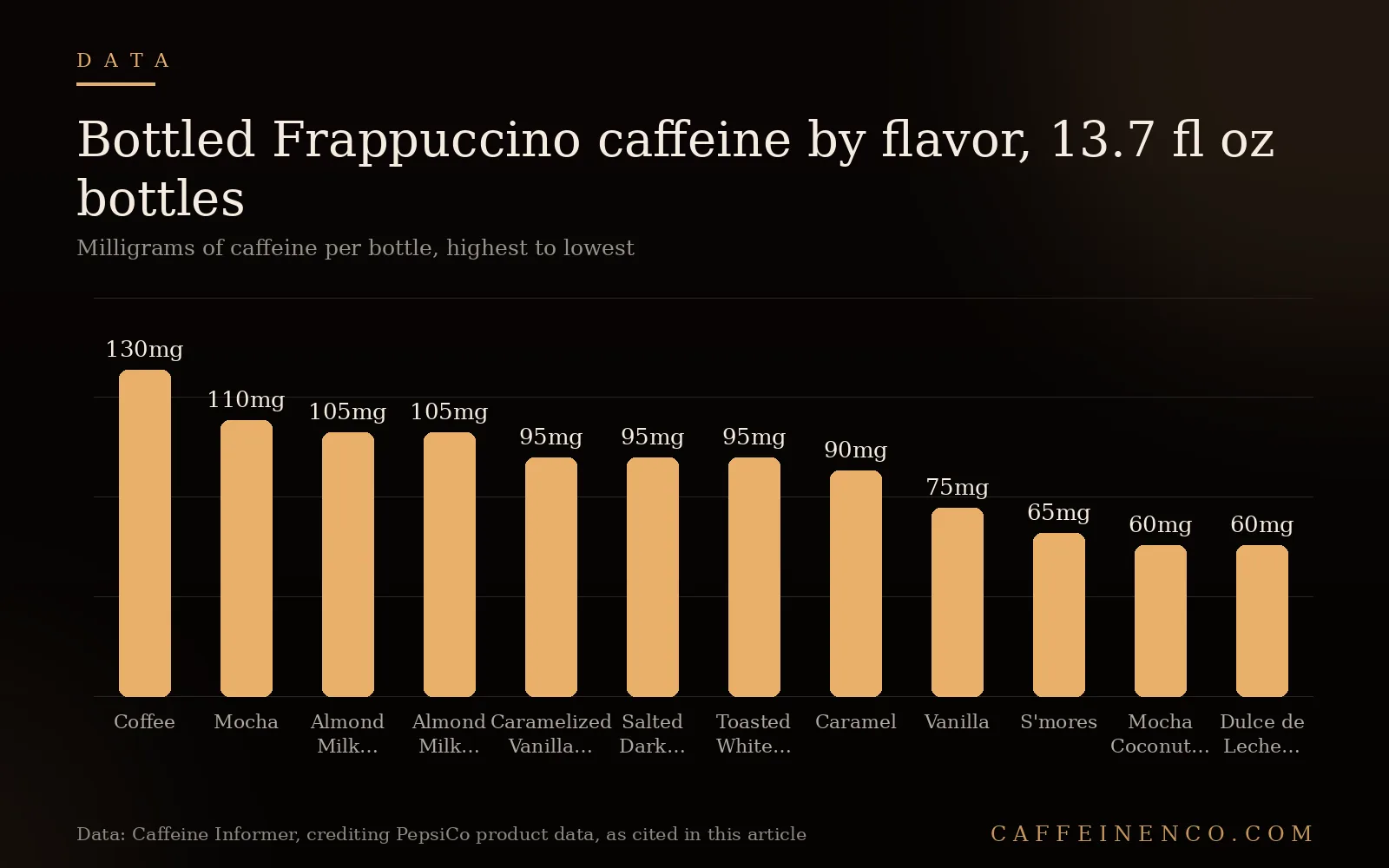
The bottled Frappuccino line has the widest spread of any Starbucks container, because flavor and size both change the number. Caffeine Informer’s table, which credits PepsiCo, lists:
| Flavor | Size | Caffeine |
|---|---|---|
| Coffee | 13.7 fl oz | 130mg |
| Mocha | 13.7 fl oz | 110mg |
| Almond Milk Mocha | 13.7 fl oz | 105mg |
| Almond Milk Vanilla | 13.7 fl oz | 105mg |
| Caramelized Vanilla Honey | 13.7 fl oz | 95mg |
| Salted Dark Chocolate | 13.7 fl oz | 95mg |
| Toasted White Chocolate | 13.7 fl oz | 95mg |
| Caramel | 13.7 fl oz | 90mg |
| Vanilla | 13.7 fl oz | 75mg |
| S’mores | 13.7 fl oz | 65mg |
| Mocha Coconut | 13.7 fl oz | 60mg |
| Dulce de Leche | 13.7 fl oz | 60mg |
| Mocha Lite | 9.5 fl oz | 75mg |
| Vanilla Lite | 9.5 fl oz | 50mg |
| Pumpkin Spice | 9.5 fl oz | 45mg |
The page adds that not every flavor is sold in every market, so the shelf in front of you may carry only a handful of these.
Why two Frappuccinos can differ by a factor of two
Coffee at 130mg and Dulce de Leche at 60mg sit in the same case at the same 13.7 ounces. The numbers say the drinks differ in how much coffee base they contain relative to the milk, sugar and flavoring, though the sources do not publish the recipe, so the reason is an inference from the pattern rather than a stated fact. The reliable rule from the table is simple: plain Coffee is the highest, chocolate-forward flavors sit in the middle at 95 to 110mg, and the dessert flavors (Vanilla, Caramel, S’mores, Dulce de Leche) are lower.
The 9.5 ounce confusion
Both a 9.5-ounce and a 13.7-ounce bottle appear in the published tables, so both sizes can turn up on shelves. Tasting Table lists a 9.5-ounce Mocha Frappuccino bottle at 88mg, but that is its figure adjusted to 12 ounces, which works out to about 7.3mg per ounce and roughly 70mg in the 9.5-ounce bottle (this site’s arithmetic). Caffeine Informer’s 9.5-ounce entries are Lite and seasonal flavors at 45 to 75mg, and its regular Mocha is the 13.7-ounce bottle at 110mg, or 8.0mg per ounce. The sources describe different containers and use different units, so they are not directly comparable. Check the volume printed on the bottle before comparing any two numbers.
Iced Espresso Classics
This is the line where the container size matters most. Caffeine Informer lists the 40 fl oz bottles (Caffe Mocha, Caramel Macchiato, Vanilla Latte, the two Skinny lattes and the seasonal Peppermint Mocha and Pumpkin Spice Latte) at 375mg each, and the older 14 fl oz bottles at roughly 145mg. The same page states that the figures for a 12 fl oz serving are 125mg. Tasting Table, which normalizes every drink to 12 ounces, also lists the 40-ounce Caramel Macchiato and Vanilla Latte bottles at 125mg.
The arithmetic is worth doing, because the three numbers do not line up perfectly:
- 125mg per 12 ounces is 10.4mg per ounce.
- 145mg in 14 ounces is 10.4mg per ounce, consistent with the serving figure.
- 375mg in 40 ounces is 9.4mg per ounce, a little lower than the other two.
If the bottle held exactly 40 ounces at the serving-size concentration, it would carry about 417mg. The listed 375mg is what you get from three 12-ounce servings. I cannot tell from the sources whether that reflects a differently labeled serving count or a slightly different recipe, so I would plan around the 375mg figure Caffeine Informer prints for the whole bottle, and treat anything near 417mg as a possible upper bound if you finish it in one day.
How to read a 40-ounce bottle
It is a multi-serving container. If you pour 12 ounces over ice, you are drinking about 125mg. The risk comes from treating it as a single drink: 375mg is 94 percent of the 400mg daily amount that MD Anderson, citing the FDA, gives for most healthy adults. The cooler format hides this because a bottle that size looks like a family-sized carton, not a stimulant.
Canned Refreshers
Caffeine Informer lists three canned Refreshers (Black Cherry Limeade, Peach Passionfruit and Strawberry Lemonade) at 50mg per 12 fl oz can, and says PepsiCo lists the caffeine as 50mg. Tasting Table lists the Black Cherry Limeade can at 50mg per 12 ounces, which for a 12-ounce can is the same figure. That is the lowest-caffeine container with any real caffeine in this guide, about 4.2mg per ounce.
Two cautions. First, the canned Refresher is not the same drink as the cafe Refresher. Caffeine Informer gives the in-store Refresher as 45mg per 12 fl oz and notes that, because the in-store drink is diluted by ice, it would expect the canned variety to have slightly more, which fits the 50mg listed for the can. Second, some of the Tasting Table list shows drinks that are barely caffeinated at all: it lists its 14-ounce Pink Drink bottle at 5mg per 12 ounces, which is only a few milligrams in the bottle. Do not assume every fruity Starbucks container has the same number.
The energy lines and the Tasting Table figures
Tasting Table also lists several can formats that I could not cross-check against a second source, so treat these as that outlet’s numbers only. Its figures are normalized to 12 ounces; the per-ounce column is this site’s division of those figures by 12.
| Product (per Tasting Table) | Can size | Caffeine per 12 fl oz | Per fluid ounce |
|---|---|---|---|
| Tripleshot Energy, Bold Mocha | 11 fl oz | 180mg | 15.0mg |
| Cold Brew Chocolate Cream | 11 fl oz | 180mg | 15.0mg |
| Doubleshot Espresso, Salted Caramel Cream | 6.5 fl oz | 221mg | about 18.4mg |
If these are right, the small cans are the most concentrated containers Starbucks sells in a cooler. At about 18.4mg per ounce, the 6.5-ounce can is close to a grande Pike Place at 310mg in 16 ounces (19.4mg per ounce), but in a can small enough to finish in three minutes. Scaled back to the actual cans, that would be roughly 165mg for each 11-ounce can and 120mg for the 6.5-ounce can (again, our arithmetic). The article gives no source for these, so the honest summary is that they are plausible, uncorroborated figures. For the cafe equivalents, the Nitro Cold Brew guide and the cold brew reconciliation piece explain why cold brew figures disagree so often.
Bottled versus cafe: a per-ounce comparison
Per-ounce concentration is the fairest way to compare a 40-ounce bottle with a 12-ounce can.
| Drink | Per fluid ounce |
|---|---|
| Canned Refresher | about 4.2mg |
| Bottled Frappuccino, Vanilla | 5.5mg |
| Bottled Frappuccino, Mocha | 8.0mg |
| Doubleshot Energy | 9.0mg |
| Iced Espresso Classics (40 oz) | about 9.4mg |
| Bottled Frappuccino, Coffee | 9.5mg |
| Iced Espresso Classics (12 oz serving) | about 10.4mg |
| Cafe Pike Place, Grande (this site’s guide) | about 19.4mg |
Brewed coffee at the cafe is roughly twice as concentrated as most bottled drinks. That surprises people who assume the bottle is the “strong” version. What makes a bottle strong is size: you are given 13.7, 15 or 40 ounces of something at 8 to 10mg per ounce, so the total climbs even though the concentration is modest. A grande Pike Place has 310mg in 16 ounces. A coffee Frappuccino has 130mg in 13.7 ounces. The Frappuccino has a little under half the caffeine, though it also has far more sugar and milk, which is a different conversation.
Worked example: three days against 400mg
The 400mg figure is a reference for most healthy adults, not a target. Here is how a few ordinary days stack up using the numbers above.
Day A: the commuter. A Doubleshot Energy can (135mg) on the way in, a coffee Frappuccino (130mg) at lunch. Total: 265mg. That leaves 135mg, about one more can.
Day B: the road trip. The family bottle of Iced Espresso Classics (375mg) is the only caffeine you plan to drink, shared over the day. If you drink 12 ounces at a time, you are done at three pours. Add a Doubleshot Energy can at the gas station and you reach 510mg, well past the line.
Day C: the low-caffeine afternoon. A canned Refresher (50mg) and a Vanilla Frappuccino (75mg). Total: 125mg. Even with a grande Pike Place (310mg) added, the day totals 435mg, over 400.
The pattern: bottles stack quickly because they feel like a snack rather than a coffee. Count the number printed or published for the container, not the number of “drinks”.
Who should be careful
The 400mg reference is for healthy adults. It does not apply to anyone who has been told by a clinician to limit caffeine, and it is not a guideline for children. If you are sensitive to caffeine, the larger formats here (the 40-ounce bottle and the 15-ounce energy can) deliver a dose that can cause jitters or poor sleep on its own. This site’s pieces on coffee and anxiety and caffeine withdrawal cover what to expect at both ends.
If you want the Starbucks taste with almost no caffeine, the bottled line does not have an obvious decaf option in the sources I checked, so the cafe decaf figures in this site’s decaf caffeine guide are the better reference.
How to read a bottled-drink number
- Find the volume first. A 9.5, 13.7 or 40-ounce container changes the answer more than the flavor does.
- Divide by ounces. Anything above about 15mg per ounce is cafe-brewed-coffee strength or stronger.
- Check the serving count. A 40-ounce bottle is several servings; the caffeine on a page may be per serving or per bottle.
- Beware flavor-specific numbers without a label photo. Scraped pages routinely round, mix sizes or invent flavor splits.
- Count everything. Add the bottle to your other drinks before deciding you have room left.
Common questions
How much caffeine is in a Starbucks Doubleshot Energy? Caffeine Informer lists 135mg for a 15 fl oz can in every flavor, and Tasting Table lists the Mocha at 108mg per 12 ounces, which scales to the same 135mg for the can. That is about 9mg per ounce.
How much caffeine is in a bottled Starbucks Frappuccino? It depends on flavor and size. At 13.7 ounces the Coffee flavor lists 130mg, Mocha 110mg, Caramel 90mg and Vanilla 75mg. The smaller 9.5-ounce Lite and seasonal flavors list 45 to 75mg.
How much caffeine is in Starbucks Iced Espresso Classics? The 40 fl oz bottles list 375mg, the older 14 fl oz bottles about 145mg, and a 12-ounce serving 125mg, according to Caffeine Informer.
How much caffeine is in a canned Starbucks Refresher? Caffeine Informer and Tasting Table both list 50mg for a 12 fl oz can of Black Cherry Limeade, and Caffeine Informer lists the Peach Passionfruit and Strawberry Lemonade cans at 50mg as well.
Is a bottled Frappuccino stronger than a cafe coffee? No. A coffee Frappuccino has about 130mg in 13.7 ounces, while this site’s guide lists a grande Pike Place at 310mg in 16 ounces.
Is the 40-ounce Iced Espresso bottle one serving? No. The page gives 125mg per 12-ounce serving, so it is a multi-serving bottle. Finishing it alone means about 375mg.
Why do some websites show different numbers for the same drink? Usually because they mix container sizes, quote a per-serving number as a per-bottle number, or copy an unsourced figure. The sourced figures here come from PepsiCo’s listing via Caffeine Informer, plus Tasting Table’s separate ranking, which is normalized to 12 ounces.
Are the Starbucks energy cans stronger than the bottled coffees? Tasting Table’s figures suggest the small cans are the most concentrated, at 15 to about 18.4mg per ounce, but they come from a single uncorroborated source.
For more sourced caffeine breakdowns like this one, delivered weekly, subscribe to The Sunday Pour.
Sources & data
- Caffeine Informer: Starbucks Doubleshot Energy
- Caffeine Informer: Starbucks Bottled Frappuccino
- Caffeine Informer: Starbucks Iced Espresso Classics
- Caffeine Informer: Starbucks Refreshers (canned)
- Tasting Table: Caffeine Content of Starbucks Bottled Beverages, Ranked
- MD Anderson Cancer Center: How Much Caffeine Is Too Much?