Storing whole beans is a solved problem: an opaque, airtight container, somewhere cool and dark, and a plan to use the bag within a few weeks. Pre-ground coffee is a different animal. It is the format a lot of people actually buy, whether for convenience, because they lack a grinder, or because a bag of ground is simply what is in the cupboard. And it is the format that punishes bad storage the fastest.
This guide is about that opened bag of ground coffee. It leans on two real pieces of research: a Specialty Coffee Association literature review on staling, which explains why ground coffee is more fragile, and a 2022 experiment in the journal Food Packaging and Shelf Life that compared ways of closing a bag after opening. One caveat up front, because it shapes how much we can claim: the 2022 experiment used whole roasted beans, not ground coffee. We will use it to show that the closure matters, not to claim it measured ground coffee. Where the research stops, this guide says so rather than filling the gap with confident-sounding guesses.
If you are storing whole beans, our guide to how to store coffee beans covers the container setup in detail. For the full shelf-life timeline, see does coffee expire. This piece covers what changes once the coffee has been through a grinder.
The short version
- Ground coffee stales faster than whole bean. Grinding increases porosity and surface-to-volume ratio, which accelerates staling, according to the SCA review.
- Oxygen is the main thing to keep away from it. The review credits earlier work that found oxygen the most important factor controlling coffee shelf life.
- The closure on the bag matters. In the 2022 experiment, packaging with an integrated screw cap kept freshness best, and a clip, tape, or transferring to a container all lost freshness faster.
- Keep the amount of air in the container small. This is our practical inference from the oxygen research, not a tested result.
- Buy less, more often, or portion the bag. The cheapest way to beat staling is to not have old ground coffee.
Why ground coffee goes stale faster
The SCA literature review puts it in one sentence: “When coffee is ground, the porosity and surface-to-volume ratio increase, which accelerates degassing and staling.” A whole roasted bean is a relatively sealed little package. Grinding shreds it into thousands of fragments, and every fragment exposes fresh surface to the air around it.
That matters because of what staling actually is. Roasted coffee gives off carbon dioxide (degassing), loses volatile aroma compounds, and picks up oxygen, which degrades those compounds. More surface means all of those things happen faster. Our grind size chart shows how much the particle size range varies between a coarse French press grind and a fine espresso grind, and the same logic applies here: the finer the grind, the more surface area per gram, so a bag of espresso-fine ground coffee has more to lose than a bag of coarse ground.
The review also reports a temperature finding specific to ground coffee. For whole bean coffee, the rate of degassing increased 1.5-fold for every 10 degree rise in temperature (a Q10 value of 1.5). For ground coffee, the review says the accelerated Q10 value was “about twice that of whole beans.” In plain terms, heat speeds up the loss in ground coffee noticeably more than it does in whole beans. That is a good reason not to keep an opened bag of ground coffee in the cupboard above the oven or next to the kettle.
Oxygen is the main enemy
The review states that earlier work (Labuza et al., 2001) “determined that oxygen was the most important factor controlling the shelf life of coffee.” It then attaches two numbers to that, which we are attributing to the review and not stating independently:
- Reducing the oxygen in a coffee container to 0.5% “could increase shelf life by 20-fold.”
- For each 1% increase in oxygen, the rate of degradation rises by 10%.
These are figures for the headspace of a container, and they come from the review’s summary of earlier research. You will not be getting your kitchen container down to 0.5% oxygen without specialized packaging, so treat the numbers as direction rather than a target: less oxygen contact is better, by a lot. It is the logic behind nitrogen-flushed commercial bags and vacuum-sealed packs.
Moisture is the second one to watch
The review also notes that moisture correlates with staling: “if coffee is stored in a high moisture environment, it will pick up water and increase its water activity values, accelerating its loss of volatile compounds.” Ground coffee is more exposed to this too, for the same surface area reason. It is the main argument against storing an opened bag in a humid spot, such as beside a dishwasher or over a stove where steam rises, and it is part of why the fridge is a poor choice. Our beans guide goes through the fridge problem in detail, and it applies at least as strongly to ground coffee.
What the closure experiment tells us
In 2022, Samo Smrke, Jan Adam, Samuel Muhlemann, Ingo Lantz and Chahan Yeretzian published a study titled “Effects of different coffee storage methods on coffee freshness after opening of packages” in Food Packaging and Shelf Life. It compared four approaches to storing coffee once the bag was open:
- Transferring the beans into an airtight canister.
- Closing the original package with tape.
- Closing it with a clip.
- Using packaging with an integrated screw cap.
The aroma was analyzed by gas chromatography mass spectrometry after grinding. The result: the screw cap packaging was the most effective at maintaining freshness, while the clip, the tape, and transfer to a container all led to faster deterioration.
What you can and cannot take from it
Two honest limits. First, the beans in the study were whole roasted beans, kept whole during storage and ground only for the analysis. It tells us nothing directly about how ground coffee behaves in each of these closures. Second, it is one study, and the abstract-level summary we could verify does not give us the margin between the methods, so we cannot say how large the difference was in practice.
What it does show is that “closed” is not the same as “sealed well.” A bag folded over and held with a clip is closed in the everyday sense, and it still lost freshness faster than a screw cap. The result is consistent with the oxygen research above, though the summary does not itself test that explanation. It also contains a mild surprise: moving the coffee to a container was not the winner. A plausible reading, which is our inference and not a finding of the paper, is that decanting adds air exposure and leaves a lot of headspace, whereas a screw cap on the original pack keeps the coffee in its protective packaging with a better seal. If you want to follow the logic to its practical end, avoid leaving a lot of empty air in whatever you store coffee in.
A practical routine for an opened bag of ground coffee
The research gives us principles. Here is how to turn them into a routine, with each step labelled by what supports it.
- Check the roast date, not just the best-by date. Freshly roasted ground coffee is still degassing, and the older it is when you open it, the less time you have. (Practical advice.)
- Open the bag once, portion it, and reseal. Every time you open a bag, you replace some of the carbon dioxide-rich air inside it with fresh oxygen. Dividing the bag into weekly portions means only one portion at a time is exposed. (Inference from the oxygen research.)
- Squeeze the air out before sealing. If the coffee stays in its original bag, press out as much air as you can before closing it. Less air in contact with the coffee means less oxygen. (Inference from the oxygen research.)
- Use the best closure you have. A screw cap or a properly zipped, resealable bag is a better bet than a loose clip, in line with the 2022 closure results (which tested whole beans). (Partly supported.)
- Keep it opaque, cool, and dry. Away from the stove, the sun, and sources of steam. This follows the heat and moisture findings in the SCA review. (Supported.)
- Aim to finish an opened bag in one to two weeks. The shelf-life figures we reconciled in does coffee expire put the peak window for opened ground coffee at about 1 to 2 weeks. That is a flavor window, not a safety limit. (Supported by the sources in that guide.)
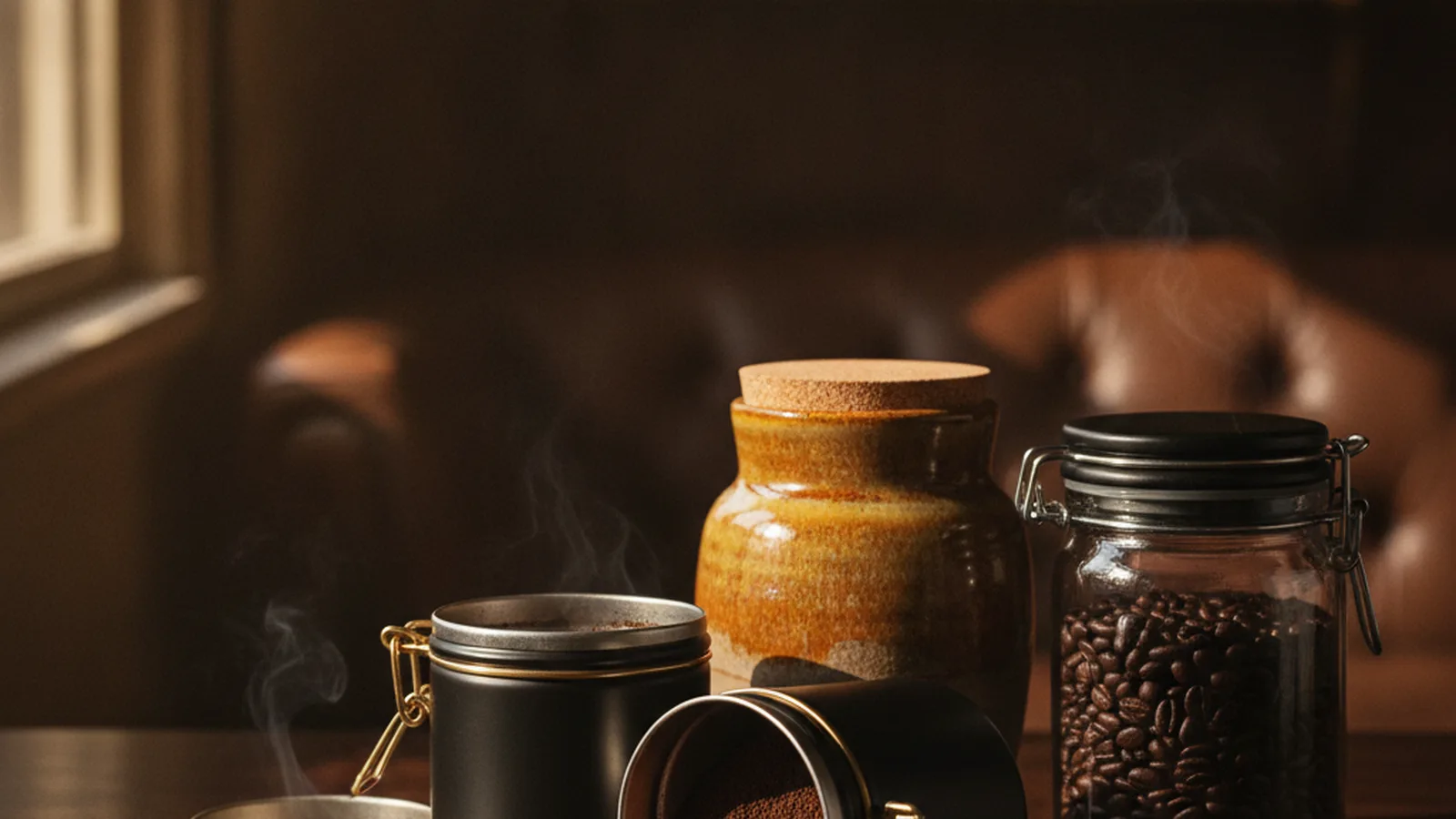
If you want a container for the portions rather than relying on the bag, an airtight opaque coffee canister with a screw or locking lid is the kind of thing worth looking for, and the smaller it is relative to your portion, the less empty air it holds.
Worked example: a 340 g bag and one drinker
Take a standard 12 oz bag, which is about 340 g of ground coffee. Suppose you brew one 300 g cup of filter coffee a day at a 1:15 ratio, which uses 20 g of coffee. (You can scale this for your own mug with the brew ratio calculator.)
- Daily use: 20 g.
- Days the bag lasts: 340 / 20 = 17 days.
- That is already past the 1 to 2 week peak window for opened ground coffee, so the last few cups will be the weakest ones.
Now apply the routine:
- Divide the bag into portions of about 140 g each (seven days at 20 g), which gives you two full weekly portions and a smaller third of about 60 g.
- Keep the portion in use in a small airtight container on the shelf, and seal the rest in their own containers or in the original bag with the air squeezed out.
- Each portion is opened only once, so the later portions are exposed to oxygen only when they are being used.
The arithmetic is simple. The point it makes is bigger than the numbers. The bag is only fully protected until the first time it is opened, and portioning reduces how many times the whole supply is exposed.
Better still, change what you buy. If the bag takes 17 days to finish at your rate of use, a smaller 8 oz bag (about 227 g, or 11 days at 20 g a day) lands inside the peak window. Buying more often costs a little more per gram and saves a lot of flavor.
Should you freeze ground coffee?
This is the question behind the “in freezer” searches, and the honest answer is that the two sources we verified do not test it. The SCA review is about staling mechanisms in general, and the closure experiment used whole beans in room storage conditions.
What we can say is limited to reasoning. Cold slows the chemistry, and the review is clear that temperature speeds staling, particularly for ground coffee. The risk with freezing is moisture. If a container goes in and out of the freezer repeatedly, each trip risks condensation as it warms up, and the review’s moisture finding is a warning against that. Our freezing guide covers the research on frozen whole beans and the single-dose portion approach, which is built around opening a portion once and not returning it.
If you do want to try freezing ground coffee you will not finish in two weeks, the logic points to small, tightly sealed portions, each opened only once. Treat that as a reasonable experiment, not a proven method, and do not expect it to rescue coffee that was already stale when it went in.
Does grinding right before brewing really matter that much?
The research above is the case for it. If your goal is the freshest cup, the strongest lever is buying whole beans and grinding just before brewing, because it avoids the faster staling the SCA review describes in the first place. A hand grinder or a compact burr grinder, such as the range stocked at specialty merchants, is a one-time cost that removes the problem rather than managing it. If you are not ready to move to whole bean, the routine above is the next best thing.
If your coffee has started tasting flat even though you are brewing it correctly, staling is one of several possible causes. Our guide to watery or weak coffee walks through the others.
Common mistakes
- Leaving the bag clipped and open on the counter. In the closure experiment, clipping was one of the methods that lost freshness faster than a screw cap.
- Storing it near the stove, kettle, or dishwasher. Heat accelerates the loss in ground coffee about twice as much as in whole bean, per the review’s Q10 figures, and moisture accelerates it further.
- Buying the large bag because it is cheaper per gram. If you cannot finish it inside the peak window, the saving is false.
- Decanting into a big container with lots of empty space. Headspace is oxygen. Match the container to the amount of coffee.
- Putting an opened bag in the fridge. Humidity and odors are the problem, as covered in the beans guide.
- Assuming a best-by date means it is fresh until then. That date describes an unopened bag. Opening it starts a much faster clock.
Common questions
How do you store ground coffee to keep it fresh? Keep it in an airtight, opaque container in a cool, dry place away from heat, light, and steam, and keep the amount of air in the container small. The SCA review identifies oxygen as the main driver of staling and notes that heat and moisture speed it up, with ground coffee particularly sensitive to temperature.
How long does ground coffee last once opened? The sources reconciled in our shelf life guide put the peak flavor window for opened ground coffee at roughly 1 to 2 weeks. After that it is usually still safe to drink if it has stayed dry, but flatter and less aromatic.
Is a clip enough to keep ground coffee fresh? It is better than leaving the bag open, but in the 2022 closure experiment, the clip was one of the methods that lost freshness faster than packaging with an integrated screw cap. That experiment used whole beans, so treat it as a direction rather than a measurement for ground coffee.
Should I move ground coffee into a container? It depends on the container. In the same experiment, transferring beans to an airtight canister did not beat the screw cap pack. If you do decant, pick a container sized to the coffee so there is little empty space, and keep it opaque.
Can you store ground coffee in the freezer? The sources we verified do not test it, so we cannot call it proven. If you try it, use small sealed portions that you open once, and avoid taking a large container in and out, because of the moisture risk the SCA review describes.
Does ground coffee go bad? It goes stale long before it becomes unsafe. The main risk to its safety is moisture, so a bag that has gotten damp or shows signs of mold should be thrown out. Otherwise the issue is flavor, not safety.
Why does ground coffee stale faster than whole bean? Grinding increases porosity and the surface-to-volume ratio, which the SCA review says accelerates degassing and staling. More surface area means more contact with oxygen and faster loss of aroma compounds.
For more sourced storage and freshness breakdowns like this one, subscribe to The Sunday Pour.