Most of us have poured too much coffee at some point and then stood at the counter wondering what to do with the rest. Pour it out? Leave it on the counter for an afternoon top-up? Put it in the fridge and microwave it tomorrow? The internet answers range from “toss it after an hour” to “it keeps for days,” and both camps are partly right, because they are answering different questions. One is about taste. The other is about safety. A third, which only matters if you add milk, is about dairy.
This guide separates those three questions and puts a number on each, using only what the sources below actually say. Where the evidence is thin, such as reheating, it says so rather than inventing certainty.
The short version
- Flavor: Coffee Chronicler puts the peak of a brewed cup at about 30 minutes after brewing. After that it declines steadily.
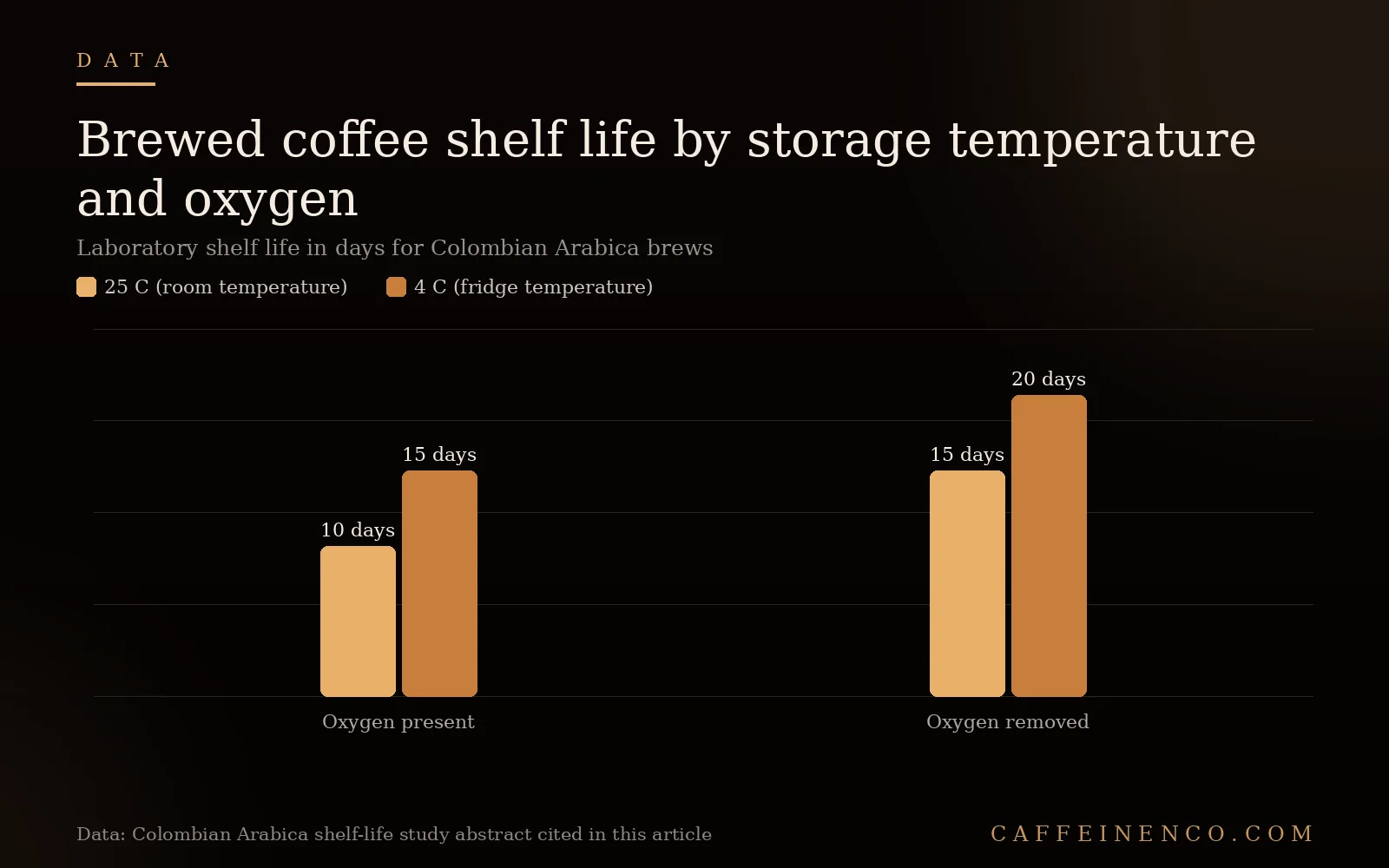
- Black coffee, shelf life in a lab: A shelf-life study on Colombian Arabica brews, summarized in its abstract, landed on 10 days at 25 C (room temperature) with oxygen present, and 15 days at 4 C (fridge temperature) with oxygen present. That is when the brews developed off tastes, not when they became dangerous, and it was measured under laboratory storage conditions, not on a cup left on a desk.
- With milk: Milk is the limiting factor. Coffee Chronicler’s guide gives about an hour outside in warm conditions, or two if it is cooler.
- Reheating: No source I could verify tested reheated coffee directly. The common advice, that reheating makes coffee taste worse, comes from general flavor chemistry claims, not a controlled study. More on that below.
Three different questions
1. When does it stop tasting good?
Flavor is the shortest clock. Coffee Chronicler’s guide states that day-old coffee remains safe to drink under sanitary conditions, but that quality has fallen significantly from its peak at around 30 minutes after brewing. That fits what most people notice: the first cup from a fresh pot tastes bright, and the same pot an hour or two later on a hot plate tastes flat and harsh.
If your cup tastes sharply bitter or harsh after sitting, our guide to why coffee tastes bitter covers the usual causes in the brewing step. Coffee that has simply sat too long is a different problem, one that no grind adjustment can fix.
2. When does it become unsafe?
This is where the sources are least helpful, and an honest answer admits it. The USDA Food Safety and Inspection Service fact sheet on temperature and food gives the general rules for perishable food: do not leave it in the 40 F to 140 F “danger zone” for more than two hours, or for more than one hour when the temperature is 90 F or above, because bacteria can double in as little as 20 minutes in that range. It also says a refrigerator should be at 40 F or below.
That sheet is about perishable food in general. It does not mention coffee, and I did not find a government source ruling on plain black coffee specifically. What I can say from the sources I read:
- Coffee Chronicler states that under sanitary conditions day-old black coffee remains safe to consume.
- The lab study measured shelf life by flavor changes, specifically sourness, rancid or atypical tastes, aftertaste and increased astringency, not by bacterial counts as the reported limit.
So black coffee is not treated like cooked chicken in these sources, but nothing here says it is risk free either. If a cup has been sitting in a dirty mug for a day, or smells off, or has anything floating in it, pour it out. When in doubt, the cost of a cup of coffee is lower than the cost of being wrong.
3. What changes when you add milk?
Milk is a perishable dairy product, so the FSIS two-hour rule applies to it in a way it does not clearly apply to black coffee. Coffee Chronicler’s own guidance is that milk lasts roughly an hour outside in warmer temperatures and two if it is cooler, and that once milk is in the cup, the milk’s stability decides how long it is good for, not the coffee’s. That matches the FSIS rule closely: two hours at most, one hour if the room is hot.
The practical consequence: the latte you made at 9 am and abandoned on a desk is a very different object from the black coffee you left in the pot. If you want to save milky coffee, put it in the fridge within the hour or two, not at the end of the day.
What the lab study actually found
The most useful source for black coffee is the shelf-life study on Colombian Arabica brews, which monitored changes in composition and sensory character while brews were stored at room temperature and refrigerated, with and without oxygen. According to the abstract summary, the shelf lives it established were:
| Storage condition | Shelf life reported |
|---|---|
| 25 C, oxygen present | 10 days |
| 4 C, oxygen present | 15 days |
| 25 C, oxygen removed | 15 days |
| 4 C, oxygen removed | 20 days |
Two things stand out. First, cold and oxygen exclusion each add days, and they stack: the best case, a cold brew with no oxygen, lasted twice as long as the worst. Second, the limit in each case was sensory. The abstract describes the appearance of sourness and other non-typical coffee tastes, plus rising astringency, as what ended each brew’s shelf life.
I only had access to the abstract summary, not the full paper, so I cannot tell you the cup size, container, or exact tasting protocol. And these are laboratory numbers. A home cup sits uncovered, picks up air constantly, and is far less controlled. Treat the table as a ranking of conditions, not as a promise that a mug on your counter is fine for ten days. Coffee Chronicler’s guide reports the same study and describes it the same way.
For our purposes the useful pattern is simple: cool and sealed beats warm and open. That is the same logic behind how we advise storing whole beans, covered in our guide to how to store coffee beans, and the difference between going stale and going bad is explained in does coffee expire.
A practical routine for leftover coffee
Based on what the sources support, here is a routine for black coffee you want to keep.
- Decide within the hour. The flavor peak is about 30 minutes, so if you know you will not finish the pot, act early rather than late.
- Get it off the heat. A hot plate keeps coffee in the warm range and keeps cooking it. Pour the rest into a clean vessel.
- Cool, then seal. Let it cool somewhat, then move it to a clean, airtight container. The lab results suggest both cold and low oxygen extend life, so fill the container close to the top to leave little air.
- Refrigerate it. The study’s 4 C condition is a standard refrigerator temperature, and FSIS says a fridge should be at 40 F or below.
- Use it early. The lab shelf life is a ceiling. Flavor drops well before that, so plan to use leftovers within a day or two for drinking, or use them for iced coffee or in cooking.
- Never store it with milk in it for the long term. Add milk to the cup you are drinking, not to the stored batch.
Worked example: a 6 pm pot
Say you brew a 12 cup pot at 7 am and drink three cups. At 7:30 am you are at the peak of the flavor curve. By 9 am the carafe on the hot plate is well past 30 minutes and tasting duller.
If you move the remaining coffee at 8 am to a clean jar and refrigerate it, you have 3 to 4 cups of black coffee that the lab study would rate as acceptable for well over a week at fridge temperature. In practice, you will probably want to drink it within a day or two, as an iced coffee. If you instead leave it on the hot plate until 6 pm, you have an 11 hour old pot that is certainly not at its best and that you would be pouring out for flavor reasons long before any lab shelf life.
If any of that coffee had milk added, the FSIS rule says it should not be left past two hours at room temperature, one hour if the kitchen is warm.
Can you reheat coffee?
Yes, in the sense that you can, and the sources I found do not describe a safety problem with reheating stored black coffee. Whether you should is a flavor question, and here the evidence is weaker than the confident tone of the internet suggests.
The Takeout’s article on the subject claims that chlorogenic acid, a major compound in coffee, degrades when exposed to heat a second time, releasing quinic and caffeic acids that can taste unpleasantly bitter, and that reheating amplifies the effects of oxidation. It quotes no experts and cites no study, so I would treat it as a plausible explanation and not a measured finding. It does match common experience: reheated coffee often tastes harsher, flatter and sometimes slightly metallic.
On method, the same article recommends the stovetop over the microwave, saying microwaves heat unevenly and create hot spots. If you do use a microwave, it suggests short intervals with stirring in between. That is practical, low risk advice even without a study behind it.
A sensible approach, then:
- If you want the best taste, drink it fresh, or turn leftovers into iced coffee and skip reheating.
- If you must reheat, do it gently and briefly. A small pan on low heat, or a microwave in 20 to 30 second bursts with stirring, avoids overheating.
- Do not boil it. The reported chemistry problem is about more heat, so keep it just hot enough to drink.
- If it has milk in it, only reheat if it has been refrigerated promptly, per the two-hour rule above.
What about cold brew?
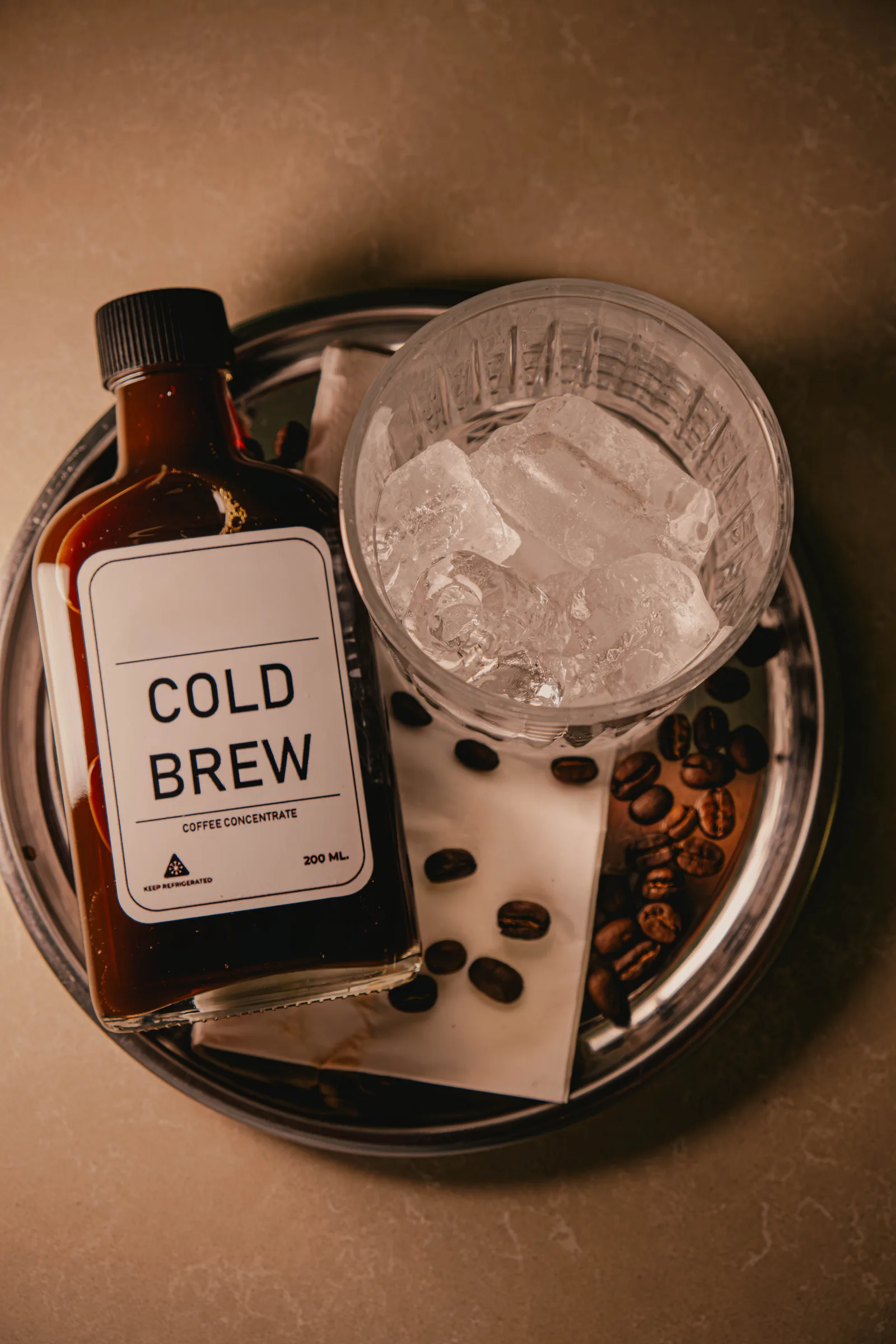
Everything above concerns hot-brewed coffee. Cold brew is stored cold from the start, and it is typically made as a concentrate, which changes how people use it. We cover the ratios and steeping in our cold brew ratio and grind size guide, but the sources used in this article do not give a specific fridge life for cold brew, so I will not quote a number. The same principle applies: sealed and cold beats open and warm.
If you are working out how much coffee to brew in the first place so there are fewer leftovers, the brew ratio calculator will scale a recipe to the exact volume you want, which is the most reliable way to avoid pouring a half pot down the drain.
Common mistakes
- Treating the lab shelf life as a drinking window. The 10 and 15 day numbers mark when sensory problems appear under controlled storage. Most people will not enjoy coffee that old.
- Leaving coffee on the hot plate. It keeps the coffee in the warm range and keeps changing it. Move it to a container.
- Storing coffee with milk in it. Milk sets the clock, and it is much shorter than the coffee’s.
- Refrigerating in an open mug. Air and fridge odors are the problem. The study found oxygen shortens shelf life, so use a lid.
- Assuming “safe” and “good” are the same thing. Coffee can be fine to drink and still taste poor, and the sources agree the flavor drops long before any shelf life limit.
Common questions
How long can brewed coffee sit out? For flavor, about 30 minutes is the peak according to Coffee Chronicler, and it declines after that. For black coffee in a clean vessel, the guidance I found says day-old coffee remains safe under sanitary conditions. With milk, plan on one to two hours at most.
How long does brewed coffee last in the fridge? In a laboratory shelf-life study of Colombian Arabica brews, refrigerated brew with oxygen present lasted 15 days before off flavors appeared, and 20 days with oxygen removed. Those are ceilings under controlled conditions, so expect better flavor from drinking it within a day or two.
Can you reheat coffee in the microwave? You can. The Takeout suggests short intervals with stirring to avoid hot spots, and prefers the stovetop. The flavor downside is a claim of general chemistry, not a tested result.
Does reheating coffee make it unsafe? None of the sources I verified say it does. The safety questions that do come up are about milk and about how long the coffee sat before it was chilled.
Can you reheat coffee with milk in it? Only if it was refrigerated promptly. Milk is a perishable food, and the USDA guidance is not to leave perishable food in the danger zone for more than two hours, or one hour above 90 F.
Is it better to keep leftover coffee in the fridge or on the counter? The lab study found fridge temperature roughly added five days over room temperature when oxygen was present (15 versus 10 days), so the fridge is the better choice. Either way, a sealed container beats an open mug.
For more sourced guides on storage and freshness, subscribe to The Sunday Pour.
Sources & data
- Coffee Chronicler: How Long Is Brewed Coffee Good For?
- Effects of refrigeration and oxygen on the coffee brew composition (shelf-life study of Colombian Arabica brews, via CORE)
- USDA Food Safety and Inspection Service: How Temperatures Affect Food (archived fact sheet)
- The Takeout: Should You Reheat That Old Cup of Coffee?