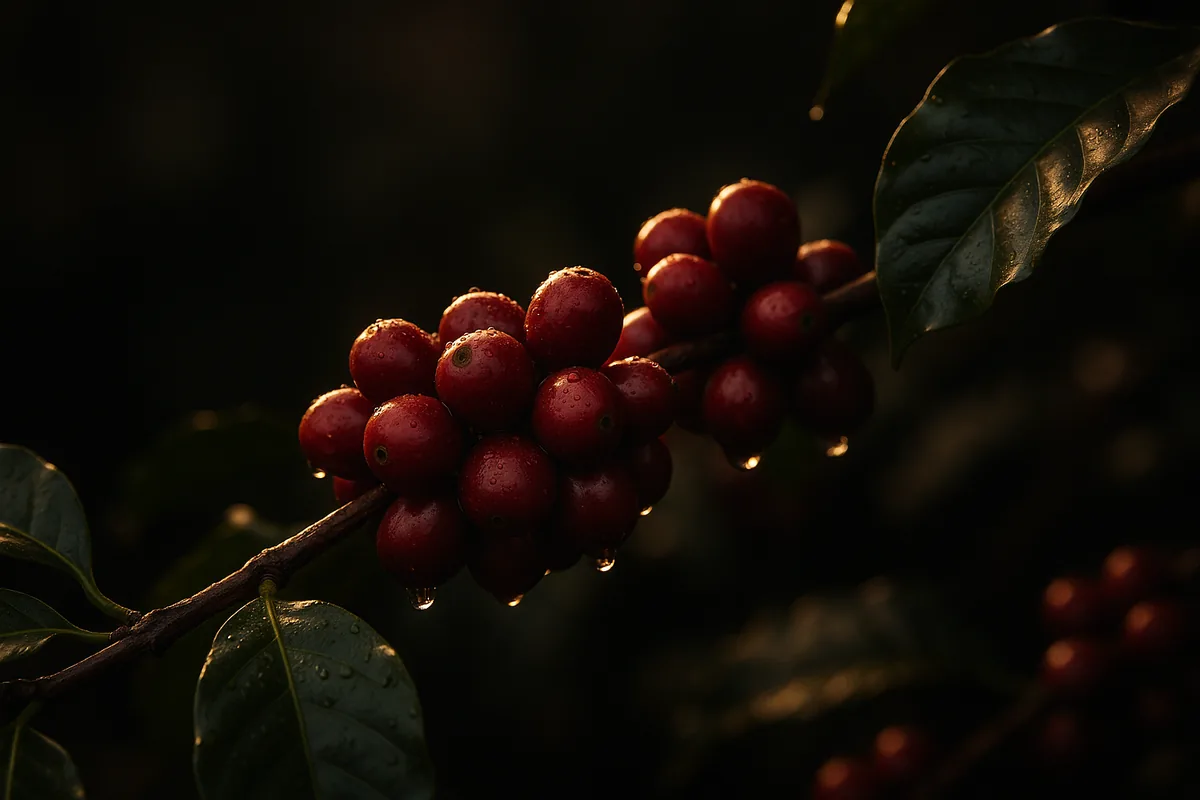
A roaster can shape a cup at the margins. Grind size, water, and ratio decide whether you extract it well. But none of that creates flavor that was never in the bean to begin with. That work happens months earlier and thousands of miles away, on a hillside, in the specific combination of what variety was planted, how high it grew, and how the cherry was processed after picking. Learn to read those three things off a bag label and you can predict roughly what is in your cup before you have opened the bag.
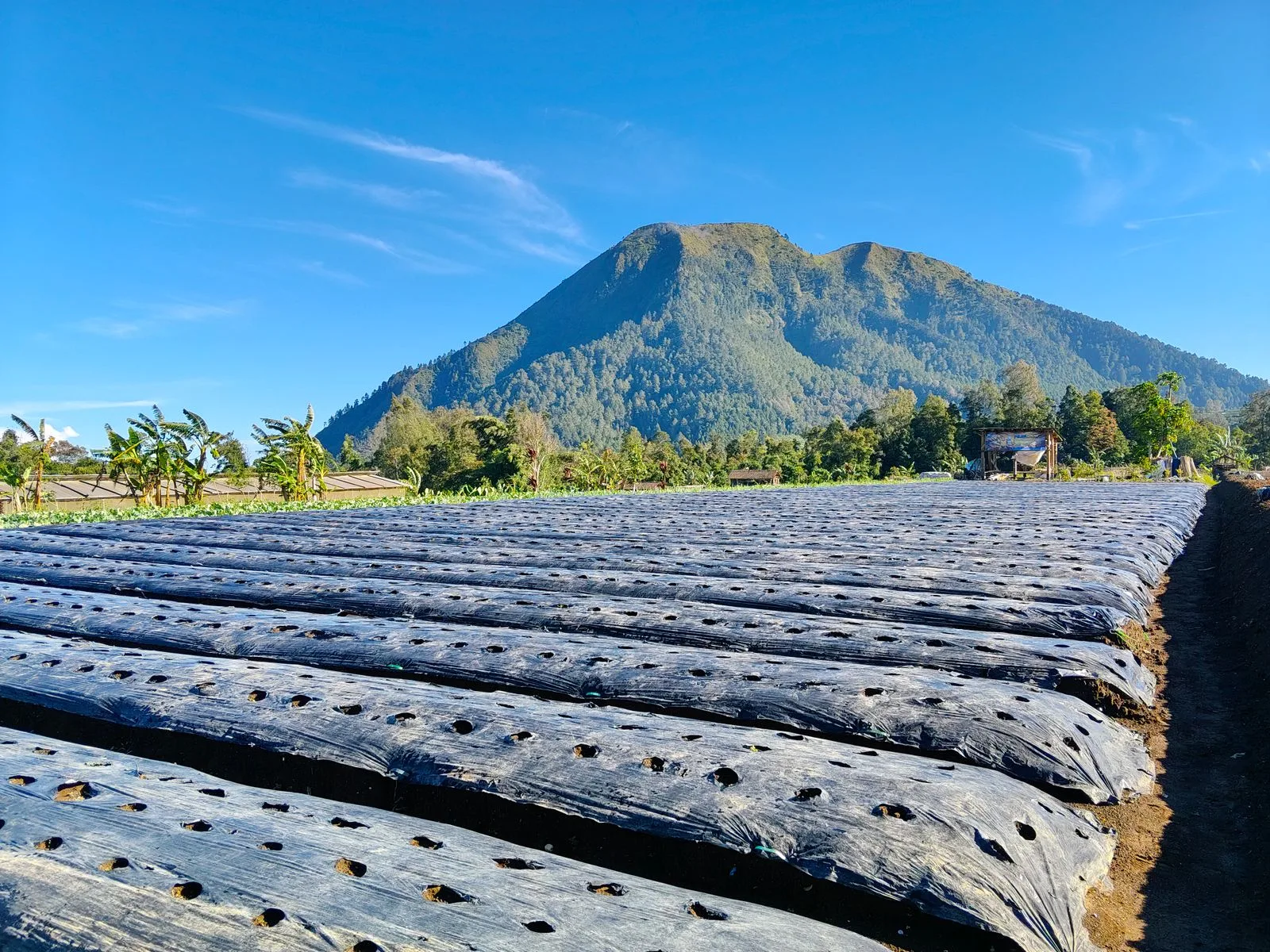
This is a working map of where coffee comes from and what each origin tends to taste like, followed by the three levers, variety, altitude, and processing, that explain why.
The major origins, and what they tend to taste like
Ethiopia: where coffee started, and still its most varied expression
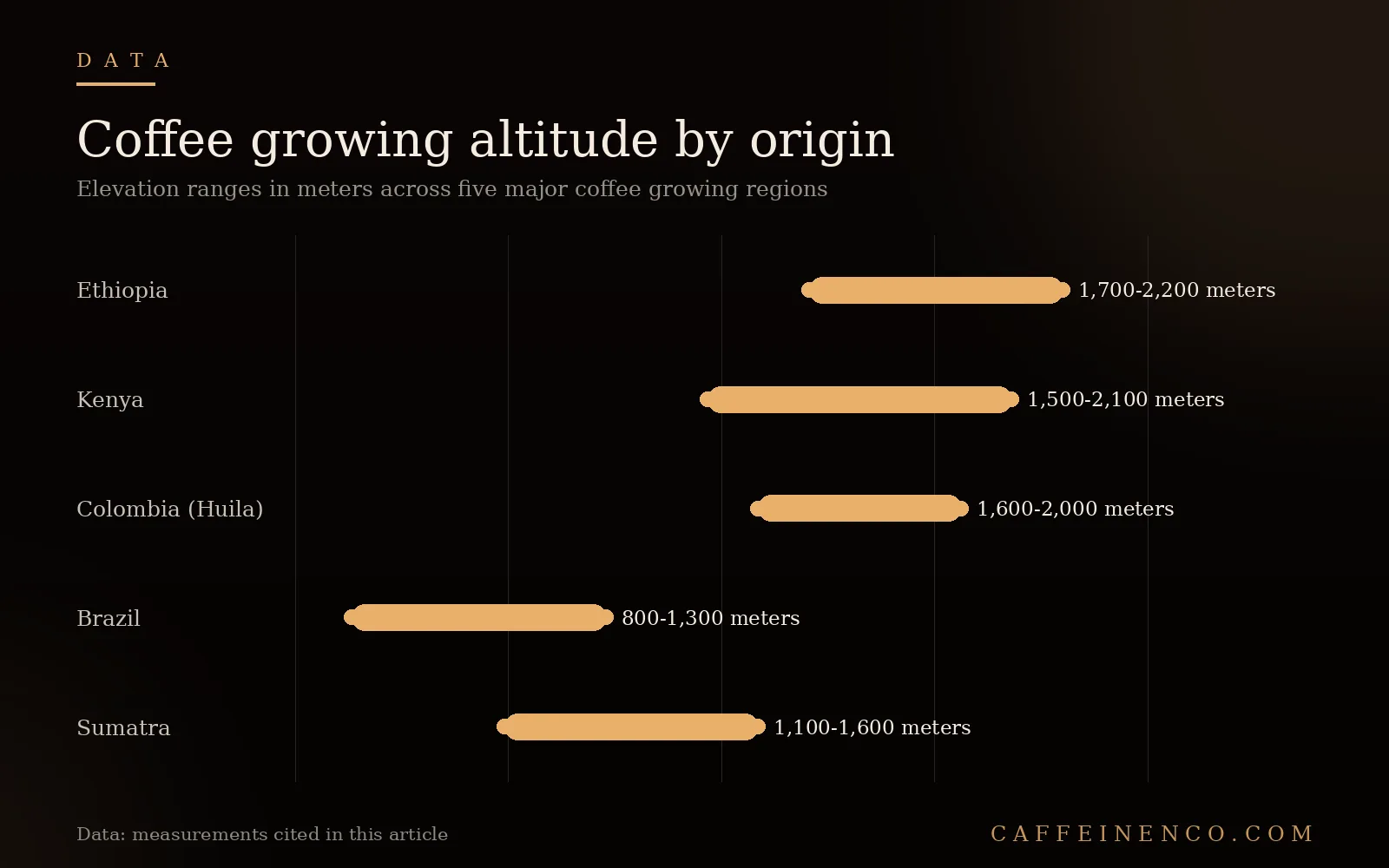
Ethiopia is the birthplace of Coffea arabica, and it shows in the genetics: rather than a handful of named cultivars, most Ethiopian coffee grows from thousands of untraced heirloom varieties, passed down through forest and garden farms rather than bred and registered. Sweet Maria’s calls the range of flavor this produces the reason Ethiopia “demands our primary focus” among origins, and processing splits that range in two distinct directions. Washed Ethiopian coffee, from regions like Yirgacheffe and Sidama, is about as close as coffee gets to floral tea: jasmine, bergamot, and citrus, with a light, clean body. Natural process Ethiopian coffee, common out of Guji and Harar, goes the opposite way: blueberry, strawberry, and a boozy, fermented intensity that can taste more like fruit punch than what most people expect from coffee. Altitude runs high: the flagship regions like Yirgacheffe and Sidama sit around 1,700 to 2,200 meters, though other growing zones start lower, and that elevation is part of why the coffee supports that much delicacy without falling flat.
Kenya: the benchmark for acidity
Kenyan coffee is dominated by SL28 and SL34, two cultivars selected by Scott Agricultural Laboratories in the 1930s specifically for cup quality, grown alongside the newer, disease-resistant Ruiru 11 and Batian. The result is one of the most recognizable flavor signatures in coffee: blackcurrant, tomato-like acidity, and a juicy, wine-like brightness that other origins are often compared against rather than the other way around. Kenya also runs a distinctive double-fermentation washing process and grades beans by size, AA being the largest, though size grading is not a direct quality signal. Grown at 1,500 to 2,100 meters, it is another high-altitude origin, and that altitude is doing real work: it is a large part of why Kenyan acidity reads as structured and juicy rather than sharp or thin.
Colombia: reliable sweetness, and Huila as its clearest example
Colombia grows mostly Caturra, a natural dwarf mutation of Bourbon, alongside Castillo, a leaf-rust-resistant hybrid developed specifically for Colombian farms, plus pockets of Bourbon and Typica. The country’s coffee federation runs one of the most organized quality infrastructures of any origin, which is part of why Colombian coffee reads as consistently well-made even when individual farms vary. Huila, in the south-central highlands, is the region most associated with Colombia’s best-known profile: red apple and caramel sweetness, a rounded, syrupy body, and balanced rather than aggressive acidity, grown at 1,600 to 2,000 meters in volcanic soil. Washed processing dominates, which lets that sweetness come through clean rather than layered under fermented fruit notes.
Brazil: the low-acid, chocolatey workhorse
Brazil grows more coffee than any other country by a wide margin, and its geography explains a lot about how it tastes. Much of it grows at comparatively low altitude, 800 to 1,300 meters, on flatter terrain that allows mechanized harvesting, using cultivars like Mundo Novo, Catuai, and Icatu. Lower altitude means faster cherry maturation and less of the sugar and acid buildup that slow ripening produces at elevation, so Brazilian coffee tends toward nutty, chocolatey, low-acid, and heavy-bodied rather than bright or complex. Natural and pulped-natural processing dominate, partly because Brazil’s dry season suits patio drying, and that processing adds to the sweetness. This is also why Brazil shows up constantly in espresso blends: low acidity and heavy body hold up well under pressure brewing and blend easily with brighter origins without clashing.
Guatemala and Central America: volcanic soil, balanced profiles
Guatemala, Costa Rica, and Honduras share a lot of DNA, literally and stylistically: Bourbon, Caturra, and Typica dominate, grown in volcanic soil across a range of altitudes and microclimates packed into small countries. Guatemala’s Antigua region is famous for a distinct smoky, spiced note that traces back to its volcanic terroir, while Huehuetenango, at higher elevation, leans brighter and more fruit-forward. Costa Rica pioneered honey processing as a commercial category and its coffee is often the cleanest expression of that method available. Across the region, washed processing is standard and the resulting cup tends toward balance: chocolate, red apple, a clean, moderate acidity that neither Kenya’s brightness nor Brazil’s flatness quite matches.
Sumatra and Indonesia: the outlier, by design
Indonesian coffee tastes different from everywhere else on this list because of one processing choice: wet-hulling, locally called giling basah, where the parchment is removed from the bean while it still holds significant moisture, rather than after full drying like almost everywhere else. It produces low acidity, heavy, syrupy body, and earthy, herbal, sometimes overtly funky flavor, notes that read as musty or barnyard to some drinkers and as complex and savory to others. Grown at roughly 1,100 to 1,600 meters, in high humidity that makes full sun-drying impractical, on Typica-derived varieties like Bergendal and Tim Tim. It is the origin least likely to be mistaken for anything else on a blind cupping table.
The three levers behind all of it
Variety: arabica, robusta, and the cultivars in between
Nearly everything above is Coffea arabica, the species behind specialty coffee. Arabica is self-pollinating, carries a doubled genome, and produces the complexity and acidity this whole list has been describing, but it needs altitude, cooler temperatures, and careful farming to do it. Coffea robusta is the other major species: cross-pollinating, hardier, more disease-resistant, and capable of growing at low altitude in hot, humid conditions where arabica struggles. It also carries roughly double arabica’s caffeine content, which is part of why it evolved that way in the first place, caffeine works as a natural pesticide, and robusta grows where pest pressure is higher. The flavor trade-off is real: robusta tends toward rubbery, earthy, and harshly bitter compared with arabica, which is why it shows up mostly in instant coffee, some traditional espresso blends for body and crema, and Vietnamese-style coffee, rather than on a specialty shelf.
Within arabica, cultivar matters more than most buyers realize. Bourbon and Typica are the foundational varieties nearly everything else descends from. Caturra is a natural dwarf mutation of Bourbon that is easier to farm at high density. Catuai crosses Mundo Novo and Caturra for a compact, productive Brazilian workhorse. SL28 and SL34 built Kenya’s reputation. Geisha, originally an Ethiopian variety that found fame in Panama, produces intensely floral, jasmine-tea cups and commands some of the highest prices in coffee. The World Coffee Research variety catalog documents 55 arabica varieties in total, and while most buyers will never see a bag naming an obscure one, the presence of a named cultivar at all is usually a signal the farm is paying attention to quality rather than growing an unidentified mix.
Altitude: why slower is better, up to a point
Cherries at higher elevation ripen slower, both because temperatures are cooler and because the swing between day and night temperature is larger. That slower maturation gives the cherry more time to accumulate sugars and organic acids before it is ready to pick, and it produces a physically denser bean as a result. Roast Magazine cites density measurements ranging from roughly 620 kilograms per cubic meter at lower elevations up to nearly 690 at 1,400 to 1,500 meters, and that density difference tracks closely with the brighter acidity and more complex flavor that high-grown coffee is known for. It is not an unlimited relationship, though. Roast Magazine’s own reporting cautions that elevation alone is not a reliable quality metric on its own, since 900 meters in Hawaii, Colombia, and Ethiopia are three different growing environments with three different results, and actual bean density is a more direct measurement than altitude if you can get it. For a buyer reading a bag label, altitude is still a useful proxy: higher generally correlates with more complexity, but it is a strong hint, not a guarantee.
Processing: what happens to the cherry before it is even a green bean
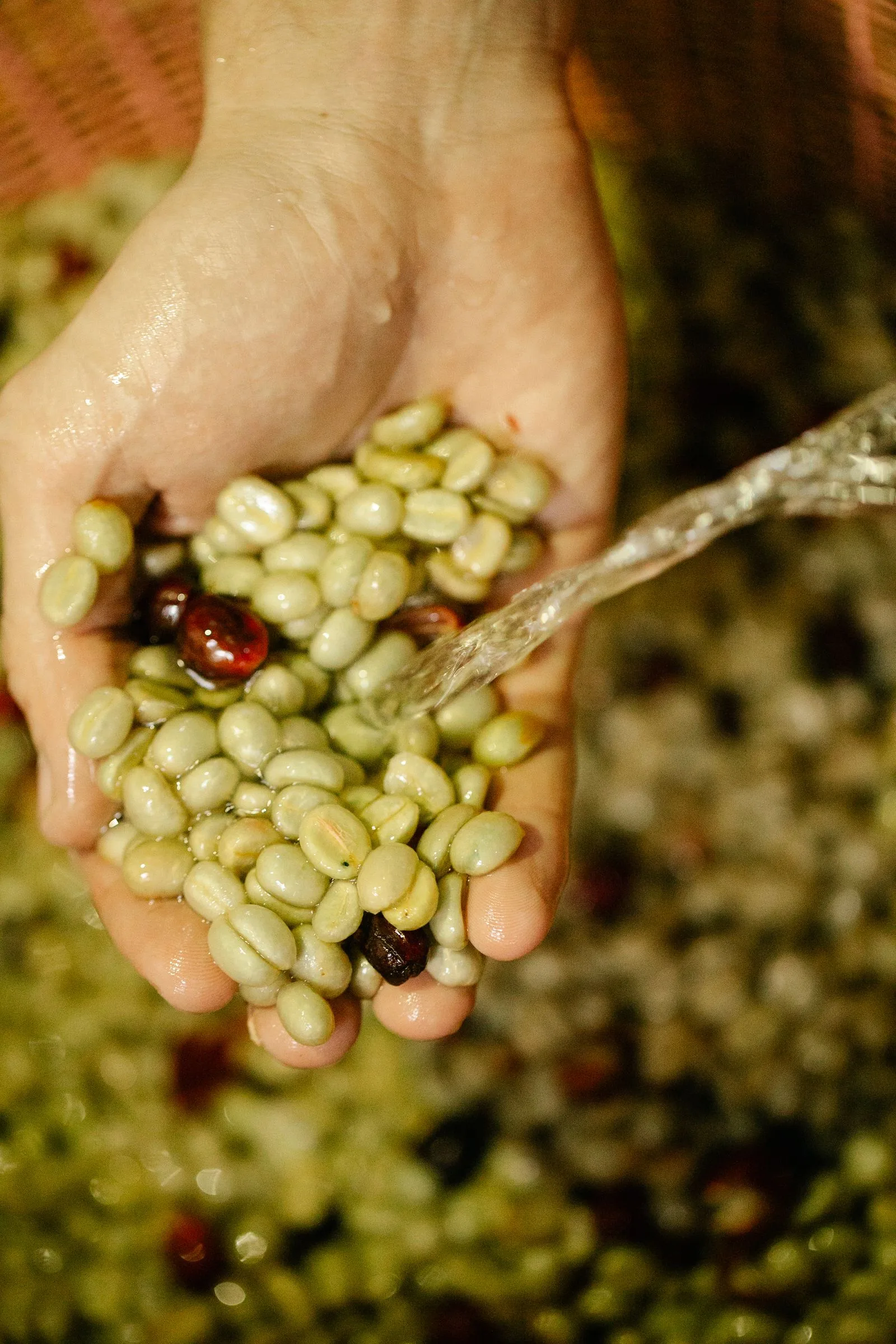
This is the lever most bags now name explicitly, and it changes the cup more than almost anything short of variety itself. Washed processing removes the skin and mucilage before drying, which strips away fruit-driven flavor and lets the bean’s own characteristics, and the terroir behind them, come through clean and bright. Natural processing dries the whole cherry intact, fruit still on the bean, and the extended contact with that fruit during drying pushes the cup toward heavy, boozy, intensely fruited flavor, at the cost of more variability from lot to lot. Honey processing sits between the two: the skin comes off but some or all of the sticky mucilage stays on during drying, and the amount left, tracked informally by color from white to black honey, controls how far the cup leans toward natural-style sweetness versus washed-style clarity. As Perfect Daily Grind puts it, a well-made honey process can taste like someone put honey and brown sugar directly into the cup. None of the three methods is objectively better. They are different tools for different flavor goals, and increasingly a single farm will process the same cherries three different ways specifically to sell three different cups.
Reading a bag label like you mean it
Put those three levers together and a bag label stops being marketing copy and starts being a flavor prediction. Country and region tell you the baseline: Ethiopia and Kenya for brightness, Brazil and Sumatra for low-acid heft, Colombia and Central America for balance. Variety, when named, refines that further, a Geisha or an SL28 is a specific promise, not just a country of origin. Altitude is a rough complexity dial, more useful as a comparison between two bags from the same region than as an absolute number. And processing is the clearest single word on the bag: washed for clean and bright, natural for fruit-forward and heavy, honey for something in between. If you want fruity and floral, look for a washed or natural Ethiopian. If you want juicy and structured, Kenyan SL28. If you want something that will not fight you in a milk drink, Brazilian natural or a Sumatran wet-hull. None of this replaces good brewing, but it means you are choosing the right bean before you ever touch a grinder, which is the decision brewing technique cannot fix after the fact.
Once you have picked a bean that matches what you actually want, the next variable is roasting: the same Huila lot tastes noticeably different at a light roast than a dark one, and our guide to roast levels walks through exactly why. And when it is time to brew it, our pour over, french press, and espresso guides each cover the technique for getting the most out of whatever origin ends up in your kitchen.
For more sourced coffee knowledge like this, delivered weekly, subscribe to The Sunday Pour.
Sources & data
- World Coffee Research: Coffee Varieties Catalog
- Perfect Daily Grind: Washed, Natural, Honey, Coffee Processing 101
- Roast Magazine: Beyond Elevation, How Bean Density Informs Roasting
- Sweet Maria's Coffee Library: Kenya Fundamentals
- World Coffee Research: SL28 Variety Profile
- Sweet Maria's Coffee Library: Ethiopia Coffee Overview