
If you have ever been told to “stay away from coffee” after a low iron result, you have probably wondered how seriously to take it. The advice is not folklore. A well-known 1983 experiment measured exactly how much a cup of coffee interferes with iron absorption, and a 2023 study of more than ten thousand Japanese adults looked at whether heavy coffee drinkers end up with lower iron stores in real life.
The answer from both is more specific than “coffee bad.” The effect is real, it depends heavily on when you drink the coffee relative to food, and in the large population study it showed up clearly in only one group. This page lays out the numbers, works through what they would mean for an actual meal, and gives a practical timing routine. It is an explainer, not medical advice. If you have been diagnosed with iron deficiency or anaemia, your clinician decides what you should do.
The short version
- In a 1983 study, one cup of coffee taken with a hamburger meal reduced iron absorption by 39 percent. Tea reduced it by 64 percent.
- The effect depended on timing. Coffee drunk one hour before a meal had no inhibitory effect, while coffee drunk one hour after a meal suppressed absorption as much as coffee drunk with it.
- Stronger coffee inhibited more. Doubling the strength of instant coffee cut absorption further.
- In a 2023 cross-sectional study of 10,435 Japanese adults, postmenopausal women who drank three or more cups of coffee a day had 2.20 times the odds of iron deficiency. Premenopausal women showed no significant coffee link after adjustment.
- The NHS advises people with iron deficiency anaemia to limit large amounts of tea and coffee, because they make it harder to absorb iron.
- Nothing here says a healthy person eating a varied diet needs to give up coffee.
What the 1983 study actually measured
The paper is “Inhibition of food iron absorption by coffee” by Morck, Lynch and Cook, published in the American Journal of Clinical Nutrition in 1983. It used dual isotope methods, a way of tracking how much of a labelled iron dose ends up in the body, in people who were iron replete (they had normal iron stores). The study looked at non-heme iron, the form found in plant foods, supplements and fortified products, and also present in a mixed meal.
Here is what the abstract reports:
| Test | Result |
|---|---|
| Hamburger meal with a cup of coffee | Iron absorption reduced by 39% |
| Hamburger meal with a cup of tea | Iron absorption reduced by 64% |
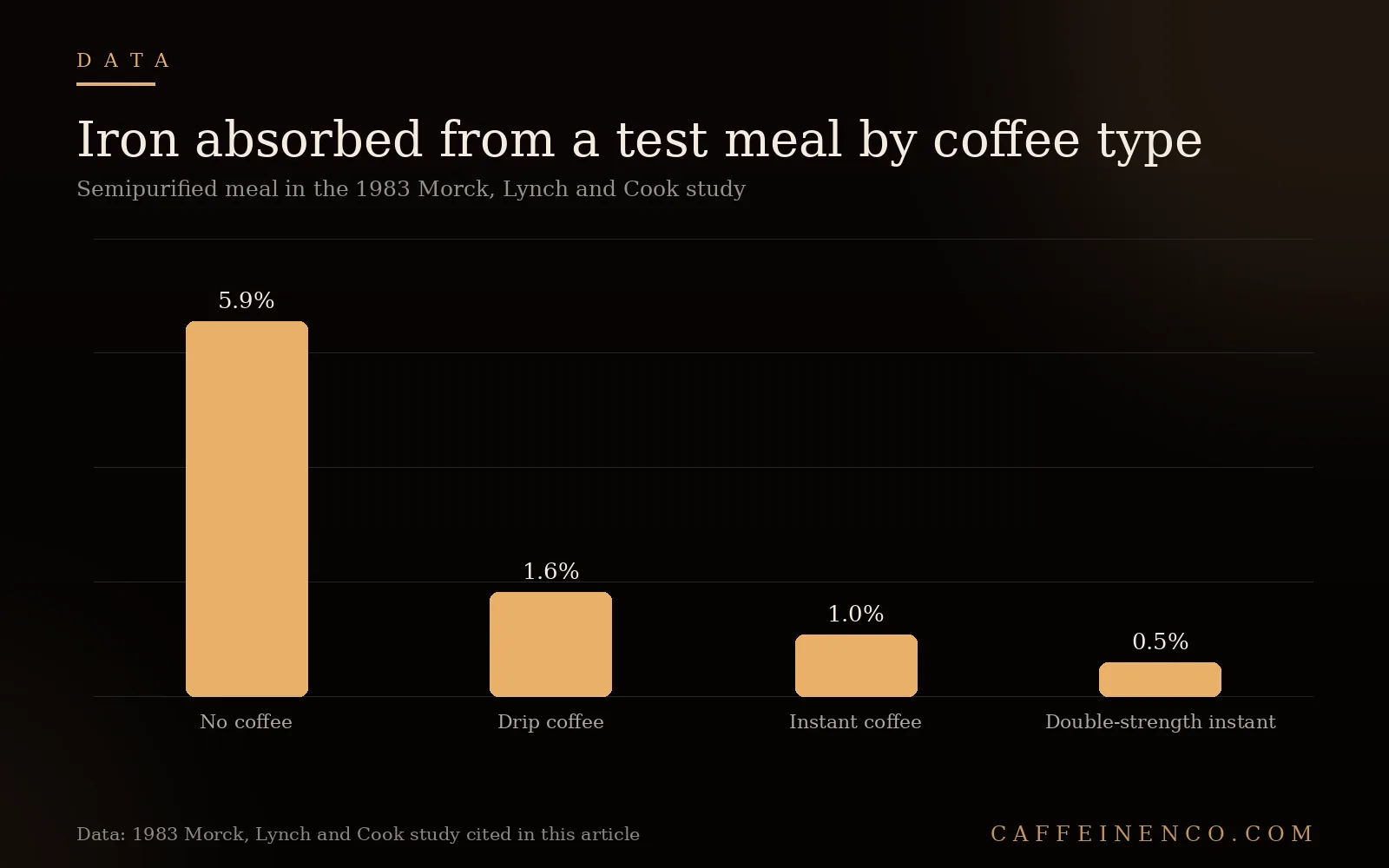
| Semipurified meal, no coffee | 5.88% absorbed |
| Same meal with drip coffee | 1.64% absorbed |
| Same meal with instant coffee | 0.97% absorbed |
| Same meal with double-strength instant coffee | 0.53% absorbed |
Two features of this table are worth pausing on.
First, tea was a stronger inhibitor than coffee in the same hamburger meal (64 percent against 39 percent). If you are cutting something out for iron reasons, tea is the bigger offender, a point that often gets lost in “coffee and iron” headlines.
Second, the semipurified meal is a laboratory construction chosen to isolate the effect. The percentages are useful for showing direction and relative size, such as drip versus instant, but they are not what you would expect from a normal plate of food. The hamburger result is the closer match to a real meal.
Timing was the most useful finding
The abstract reports a result that has practical value. Consuming coffee one hour before the meal showed no inhibitory effect. Taking it one hour after the meal produced the same suppression as drinking it at the same time.
The paper also found, using iron compounds, that coffee inhibits absorption in a concentration-dependent fashion, affecting both NaFeEDTA and ferric chloride similarly. In plain terms: more coffee, or stronger coffee, means more inhibition, and the effect is not limited to one chemical form of iron.
That gives a simple reading. The inhibiting compounds in coffee seem to matter when they are in your gut alongside the iron from a meal. A cup that is finished well before the meal does not carry that problem into it. A cup after the meal, at least at the one-hour mark tested, still does.
What happens in real life: the 2023 Japanese cohort

A lab experiment on a single meal says little about someone who drinks coffee for years. The 2023 paper in Frontiers in Nutrition by Nanri and colleagues asked that question using the J-MICC Study Saga, a cross-sectional analysis of 10,435 adults (4,263 men and 6,172 women) with data collected between 2005 and 2007.
Participants reported their green tea and coffee intake on a food frequency questionnaire, grouped as almost none, under one cup a day, one to two cups, and three or more cups. The researchers compared those groups on serum ferritin, a blood marker of stored iron, and on iron deficiency.
The findings by group
- Men: higher green tea and coffee intake went with lower serum ferritin (P for trend under 0.05).
- Premenopausal women: green tea was inversely associated with ferritin, but there was no significant coffee association after adjustment.
- Postmenopausal women: both beverages were linked to lower ferritin. Those drinking three or more cups of coffee a day had an odds ratio of 2.20 for iron deficiency (95 percent confidence interval 1.06 to 4.56). Green tea at three or more cups had an odds ratio of 1.59, but its interval (0.63 to 4.04) spans 1, so that result is not statistically significant.
The authors point to a plausible cultural explanation for differences between drinks: in Japan green tea is commonly drunk alongside meals, which is exactly the situation where the 1983 timing result predicts the most interference.
Reading the confidence interval
The postmenopausal coffee result is the headline, but its interval runs from 1.06 to 4.56. The lower bound sits barely above 1.0 (no effect), so the true size of the association could be small, and it could be large. A single subgroup finding with an interval that wide should be treated as a signal worth following up, not a measured fact about your own body.
The authors name three limitations: the cross-sectional design may allow reverse causation, self-reported intake risks misclassification, and residual confounding is possible. In the premenopausal group, green tea drinkers also ate more iron, and the authors suggest that dietary iron may influence the relationship and that its bioavailability may outweigh the inhibition. That is a discussion point, not a measured result. Because the study is cross-sectional, none of it shows that coffee caused anyone’s low iron.
Reverse causation deserves an example. Someone who feels tired from low iron may reach for more coffee, which would produce the same pattern as coffee lowering iron. A cross-sectional study cannot separate those two stories.
Worked example: what the percentages do to a meal
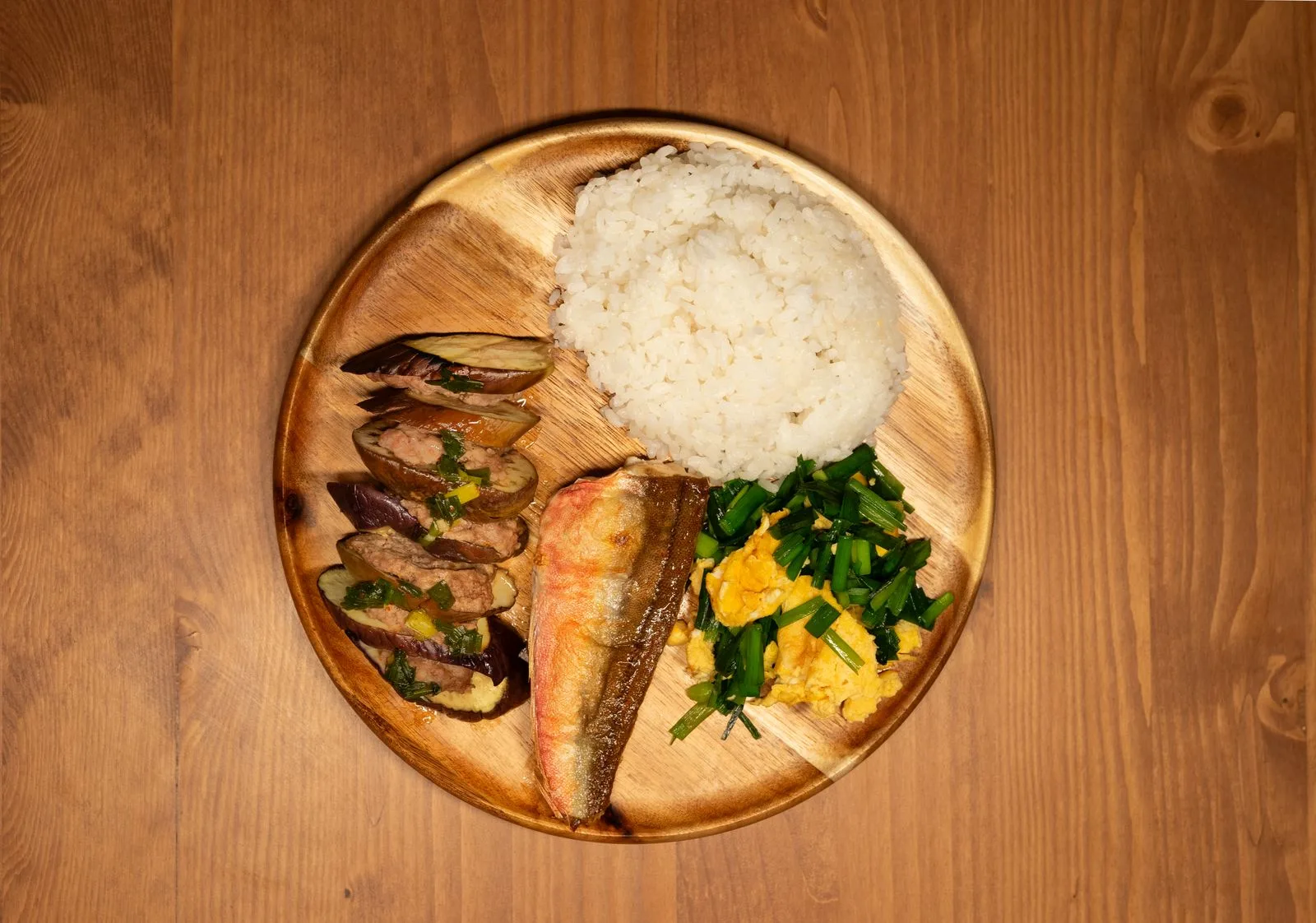
To see the scale, take the Morck absorption figures and apply them to a hypothetical meal. This is arithmetic on published percentages, not a prediction for any individual, and the real numbers will differ with your food and your iron status.
Suppose a meal supplies 10 mg of non-heme iron. Using the semipurified meal figures from the abstract:
- No coffee: 5.88 percent absorbed, so 10 x 0.0588 = about 0.59 mg.
- Drip coffee with the meal: 1.64 percent, so about 0.16 mg.
- Instant coffee with the meal: 0.97 percent, so about 0.10 mg.
- Double-strength instant: 0.53 percent, so about 0.05 mg.
From the same plate, the difference between no coffee and a cup of drip is roughly 0.43 mg of absorbed iron. Over one meal that is small in absolute terms. Over a year of daily breakfasts with coffee, it adds up, which is why the effect matters most for people who are already marginal on iron: people with heavy periods, people who are pregnant, vegetarians relying only on plant iron, and anyone whose diagnosed deficiency means every milligram counts.
Now compare the hamburger result: a 39 percent reduction is a more modest hit than the semipurified meal’s 72 percent drop with drip coffee (5.88 down to 1.64). Real mixed meals sit between the extremes, so expect the effect in daily life to look more like the smaller figure.
A practical timing routine
None of this requires giving up coffee. The 1983 timing data suggest rearranging it. A routine that fits the evidence:
- Drink your coffee at least an hour before the iron-rich meal. The abstract found no inhibition at one hour before. If you are a mid-morning coffee drinker and eat lunch at noon, you are already fine.
- Do not treat “after the meal” as safe. A cup immediately after eating gave the same suppression as one with the meal in the lab. If you want a post-meal coffee, the data give no reason to think a short gap helps. We do not have a tested gap beyond the one-hour-after result.
- Lean on the stronger drinks less at meals. Tea inhibited more than coffee, and stronger instant inhibited more than weaker. If you want to cut something at meals, strong tea comes first.
- If you take an iron tablet, ask your pharmacist about the gap. The NHS iron deficiency page says large amounts of tea and coffee make it harder to absorb iron, and mentions that orange juice after a tablet may help. Exact spacing instructions come from your own prescriber or the leaflet in the box.
- Keep dietary iron up. Food sources matter more than any single drink. The NHS suggests dark-green vegetables, fortified cereals, meat, dried fruit and pulses.
If you tend to feel nauseous on an empty stomach, see our coffee on an empty stomach guide. An hour-before-meal cup is also an empty-stomach cup for many people, and that article covers the trade-offs.
Does decaf help?
Neither study answers this directly in the material cited here. The 1983 paper tested regular coffee and tea. The Japanese study asked about coffee and green tea without separating decaf. Because neither study tested decaf, this page cannot say whether it behaves differently, and it would be a guess to assume it does or does not. If you want to understand what is and is not in decaf, our decaf coffee caffeine content guide covers the caffeine side.
Who should care most
The evidence points to a few groups where the arithmetic above carries more weight.
- People diagnosed with iron deficiency or anaemia. The NHS says heavy periods and pregnancy are very common causes, and bleeding in the stomach and intestines is another. Coffee timing is a small lever, and fixing the cause comes first.
- Postmenopausal women who drink three or more cups a day. This is the one group where the Japanese cohort found a clear coffee signal.
- People who drink coffee or tea at every meal. The 1983 timing result suggests frequent with-meal drinking is where the loss accumulates.
- People on mostly plant-based diets. Non-heme iron is the form the 1983 study tested, and plant sources are non-heme.
For most other people eating a varied diet, a coffee an hour before breakfast or well between meals is unlikely to be a problem worth worrying about. If you are concerned, a blood test for ferritin is the way to find out where you stand, rather than guessing from your coffee habits.
Common mistakes
The first mistake is cutting coffee out entirely when moving it an hour away from meals would do most of the work. The second is blaming coffee for low iron when the underlying cause, such as heavy periods or blood loss, has not been checked. The third is assuming tea is the safe alternative: in the same hamburger meal, tea cut absorption more than coffee did. The fourth is applying the laboratory percentages directly to your own plate; they were measured in a controlled setup, in people who were iron replete. The fifth is relying on a single subgroup result, like the 2.20 odds ratio, as if it applied to everyone. And the sixth is skipping the supplement leaflet, which gives the spacing advice that actually applies to your tablet.
Common questions
Does coffee block iron absorption? It reduces it when consumed in the same window as a meal. In the 1983 Morck study, one cup of coffee cut iron absorption from a hamburger meal by 39 percent. The effect was concentration-dependent, so stronger coffee inhibited more.
How long should I wait between coffee and food? The study found coffee drunk one hour before a meal had no inhibitory effect. Coffee drunk one hour after a meal inhibited absorption as much as coffee drunk with it. The abstract does not test other gaps.
Is tea worse than coffee for iron? In the same hamburger meal, tea reduced absorption by 64 percent against 39 percent for coffee, so tea was the stronger inhibitor in that test.
Can coffee cause iron deficiency? A 2023 Japanese cross-sectional study linked three or more daily cups to higher odds of iron deficiency in postmenopausal women (odds ratio 2.20, interval 1.06 to 4.56), but the design cannot show cause and effect. Premenopausal women showed no significant coffee association after adjustment.
Should I avoid coffee if I take iron supplements? The NHS says large amounts of tea and coffee make it harder to absorb iron and that orange juice after a tablet may help. For exact spacing, follow your prescriber’s or pharmacist’s instructions or the leaflet.
Does instant coffee affect iron differently from drip? In the lab test, instant coffee reduced absorption from 5.88 percent to 0.97 percent and drip to 1.64 percent. Both were strong effects, with instant somewhat stronger in that meal.
Do I need to give up coffee if I am healthy? Nothing in these studies says so. The effect is about timing relative to meals, and it matters most if your iron stores are already low or your intake is marginal.
Where do I learn what else coffee does in the gut? Our coffee and gut health guide covers the microbiome research, which is a separate question from iron absorption.
Sources & data
- Morck TA, Lynch SR, Cook JD: Inhibition of food iron absorption by coffee (American Journal of Clinical Nutrition, 1983;37(3):416-420)
- Nanri A et al.: Association between green tea and coffee consumption and body iron storage in Japanese men and women, J-MICC Study Saga (Frontiers in Nutrition, 2023)
- NHS: Iron deficiency anaemia