
A note before anything else: we have not hands on tested Trade Coffee or Bean Box yet. What follows is what we found researching both services in depth, straight from their own sites, their help centres, and the aggregate pattern of customer reviews on Trustpilot and Reddit. Our full hands on, long term review, with beans actually brewed side by side over several weeks, is in progress and will replace the caveats below with tasting notes. Until then, this is the honest, sourced version of “which one should I sign up for,” built from public facts rather than a single unboxing.
Verdict first
Pick Trade Coffee if: you want the widest possible range of American roasters (55, by their own count), a genuine quiz driven matching system, and you’re happy paying a premium for curation and rotation. Its Premium tier’s access to 450 plus coffees, including most espresso roasts and all decaf, makes it the stronger pick for drinkers who like to explore.
Pick Bean Box if: you want a human curator’s judgement over an algorithm, you like the idea of sampler boxes before committing to full bags, and you’re based in or drawn to the Pacific Northwest coffee scene specifically. Its 64 partner roasters skew toward that region’s specialty culture, and its bags run about 10 percent larger than the category standard.
Skip both if: you only drink espresso as a single shot with no interest in filter coffee variety, or you’re shopping on a genuinely tight budget where a $12 supermarket bag does the job. More on that below.
Pricing and plan structure
Both companies run tiered, rotating subscriptions rather than a single fixed product, which makes head to head pricing slightly apples to oranges. Here’s what each charges as of this research pass.
Trade Coffee splits into two tiers. Classic runs $16.99 for a standard 10.93 oz bag or $39.99 for a 2 lb bag, drawing from more than 100 approachable, mostly medium and dark roast coffees. Premium runs $21.99 per standard bag or $49.99 per 2 lb bag, unlocking the full 450 plus coffee catalogue including single origins, more experimental processing, most espresso roasts, and all decaf options. Delivery frequency is flexible: weekly, fortnightly, or monthly.
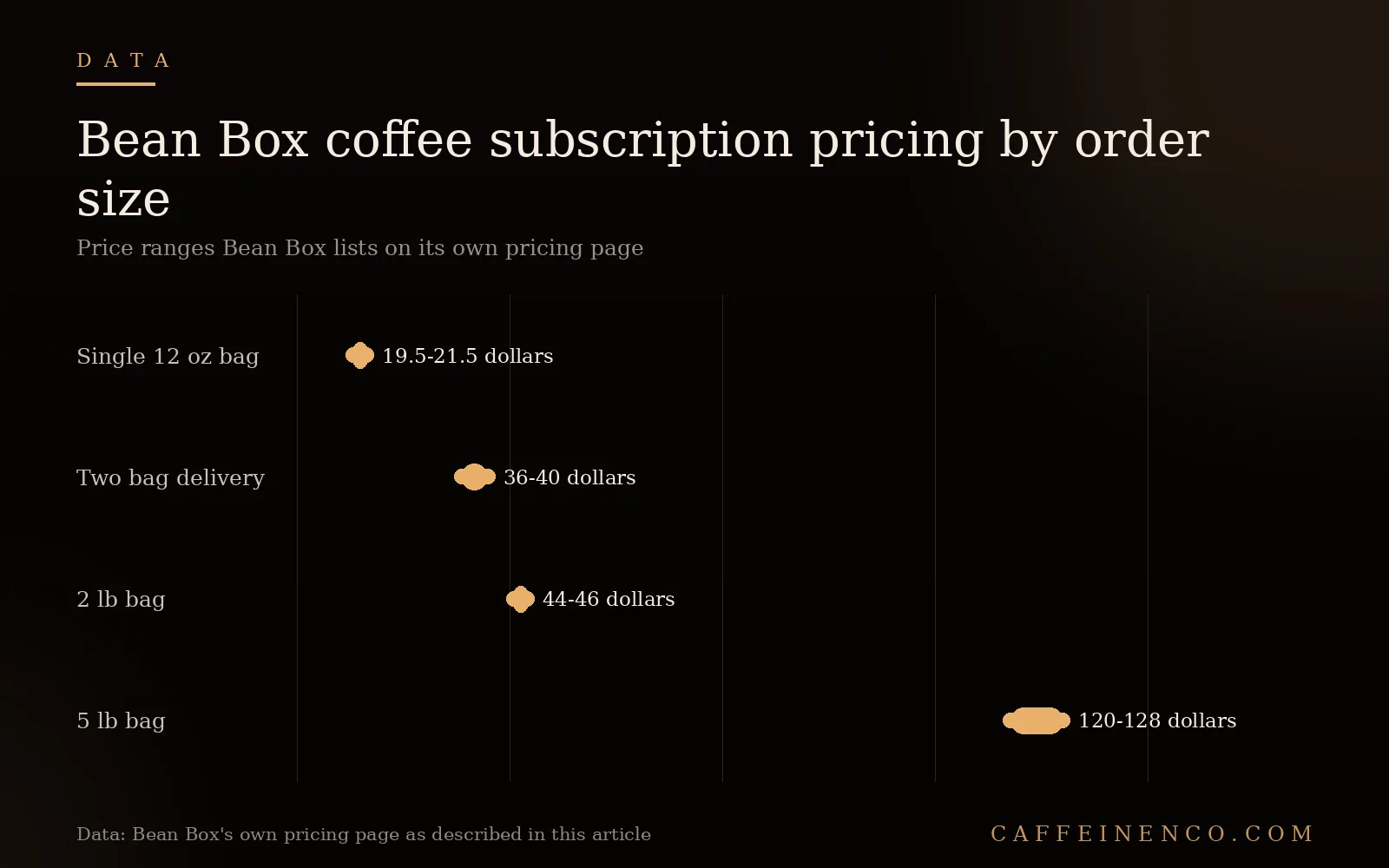
Bean Box’s own pricing page lists a wider spread: single 12 oz bags run $19.50 to $21.50, two bag deliveries (the most popular configuration) run $36 to $40, with 2 lb bags at $44 to $46 and 5 lb bags at $120 to $128. Delivery cadence runs every two to six weeks. An annual plan reportedly saves around 15 percent, which Bean Box quotes as up to $400 a year for heavier subscribers. Bean Box also sells smaller four bag sampler boxes for newcomers who want to taste before committing to a full bag rotation, something Trade doesn’t offer in quite the same low commitment format.
Net take: Trade is cheaper at the entry Classic tier, Bean Box is cheaper if you want to sample widely before buying full bags, and Bean Box’s larger bag sizes mean the effective per ounce price gap is narrower than the sticker prices suggest.
The matching approach
This is the clearest philosophical difference between the two. Trade Coffee is algorithm first: you take a quiz about how you brew, what roast levels and flavour notes you like, and whether you want caffeinated or decaf, and it queues up coffees from different roasters accordingly. Trade says it “fine tunes matches as you rate coffees and send feedback,” so the algorithm is meant to improve over time based on your ratings.
Bean Box does it differently. Rather than a quiz driven algorithm, its curation is led by a named human, Maryna Gray, a Cup of Excellence judge, who tastes and selects coffees across eight defined profiles: Curator’s Choice, Single Origin, Light and Bright, Medium and Cozy, Dark and Toasty, Espresso, Decaf, and Cold Brew. Customer ratings still feed back into future box selections, but the starting point is expert palate rather than a matching algorithm.
Neither approach is objectively better. If you trust a quiz to learn your taste over several deliveries, Trade’s system is more scalable and arguably more personalised long term. If you’d rather lean on one expert’s judgement across a smaller, curated set of profiles, Bean Box’s model is more transparent about who is actually choosing your coffee.
Roaster network and sourcing
Trade’s own roaster page states partnerships with 55 specialty roasters across the US, spanning cities from Viroqua, Wisconsin to Savannah, Georgia. Trade frames its vetting around three commitments from partner roasters: craft and quality, sustainable sourcing bonds, and community impact, and states that “every coffee is cupped, scored, and approved before it earns a spot,” though the specific cupping methodology isn’t published in detail on the public site.
Bean Box’s network is smaller in headcount, 64 independent artisan roasters by its own count (which nudges past Trade’s, though the two companies phrase their invitation lists differently, so treat both as directional rather than perfectly comparable), but leans hard into name recognition within the specialty scene: partners include Onyx Coffee Lab, Coava Coffee, and Portrait Coffee. Bean Box markets access to “600 plus specialty coffees” across that roaster list, more than Trade’s stated catalogue size, though a portion of that is likely long tail single origin rotation rather than everyday available stock.
If having a big geographic spread of American roasters matters to you, Trade’s network reads as broader by region. If you specifically want access to well known, awarded specialty names, Bean Box’s list carries more instantly recognisable roasters.
Shipping, freshness and gifting
Both companies lean on the same core promise: coffee shipped shortly after roasting, direct from roaster to customer, rather than sitting in a central warehouse. Trade states it ships “directly from the roaster… for peak freshness” with free shipping included on subscriptions. Bean Box advertises coffee shipped “within days of being roasted,” with typical delivery in three to six business days, and customer reviews cited in our research frequently mention receiving beans that were roasted only around five days prior.
On gifting, Trade offers a straightforward gift subscription: pick a length, they handle delivery. Bean Box goes further with dedicated curated gift boxes on top of gift subscriptions, and lets you set the length at three, six, or twelve months with customisable taste preferences from the start, which makes it the more gift shop friendly of the two if you’re buying for someone else’s palate rather than your own.
Cancellation terms
Trade Coffee’s process is self service: cancel any time from your account dashboard under “My Subscription,” with an option to pause and push your next order date up to three months forward instead of cancelling outright, useful if you’re travelling or have a backlog of beans. Longer pauses need a message to the support team.
Bean Box similarly allows pausing, skipping individual shipments, or cancelling with no long term contract, managed through the customer account. One operational detail worth knowing: changes need to be made before 1pm Pacific on the Wednesday before your next scheduled charge, or the shipment goes out as planned. Both companies avoid the classic “call to cancel” trap that plagues some subscription boxes, which is a genuinely good sign for either.
What the reviews say
We did not weight a handful of five star or one star reviews here; the pattern below is drawn from the aggregate sentiment on Trustpilot for both companies, cross referenced with Reddit discussion threads, and should be read as directional rather than a scientific sample.
Trade Coffee’s Trustpilot presence skews positive, with reviewers regularly praising coffee quality, freshness, and the ease of the ordering and matching process. The most substantive recurring complaint in the historical record concerns a period where some roasters reportedly under filled bags at the same price point, which Trade appears to have addressed by clearly stating each bag’s weight (10.93 oz) up front. Smaller, ongoing gripes include occasional off target flavour recommendations, some confusion managing subscription settings, and limited grind options depending on the coffee selected.
Bean Box’s review pattern is more mixed. Alongside enthusiastic reviews describing unboxings that “felt like Christmas morning” and bean quality that rivalled well regarded local cafes, there’s a recurring thread of complaints about inconsistent freshness on some deliveries and slower, less responsive customer service replies in a subset of cases. There’s also chatter unrelated to the coffee itself, around a past equity crowdfunding round and investor communication, which is worth knowing about as background but isn’t really a coffee quality signal one way or the other.
Comparison at a glance
| Dimension | Trade Coffee | Bean Box |
|---|---|---|
| Entry price (per ~11-12 oz bag) | $16.99 (Classic) | $19.50 to $21.50 |
| Top tier price | $21.99 (Premium) | $44 to $46 per 2 lb |
| Matching method | Quiz driven algorithm, refines with feedback | Human curator (Cup of Excellence judge) plus eight taste profiles |
| Roaster network | 55 specialty roasters, own count | 64 independent roasters, own count |
| Catalogue size | 450+ coffees | 600+ coffees |
| Freshness promise | Roasted to order, direct ship | Shipped within days of roast, 3 to 6 day delivery |
| Gift options | Gift subscription, set length | Gift boxes and gift subscriptions, 3/6/12 month, customisable |
| Cancellation | Cancel or pause any time via dashboard | Cancel, skip, or pause any time, Wednesday 1pm PT cutoff |
| Shipping cost | Free on subscriptions per Trade’s own site | Free or flat rate on subscription plans |
| Review sentiment (Trustpilot/Reddit pattern) | Mostly positive, minor bag weight and matching gripes historically | Mixed, quality praise alongside freshness and service complaints in a subset of reviews |
Who should skip both
Honesty matters more than a tidy recommendation here, so two segments genuinely aren’t well served by either service.
Espresso only drinkers. Both subscriptions are built around variety and rotation across roasters and origins, which is fantastic for filter brewing but works against the consistency an espresso setup rewards. Dialling in a shot takes repeated attempts with the same bean, and a new roaster and roast profile every delivery means starting that process over each time. If you pull one drink, on one machine, and want it to taste the same every morning, a direct relationship with a single local roaster you can dial in against will serve you better than either subscription’s built in variety.
Ultra budget shoppers. At $17 to $22 for roughly 11-12 oz, both services sit well above supermarket specialty coffee, which regularly runs $10 to $14 for a comparable bag from a competent regional roaster you can find in store. The premium here buys curation, rotation, and freshness logistics, not necessarily a proportionally better cup. If your budget is the binding constraint rather than variety or discovery, that premium is hard to justify.
Common questions
Is Trade Coffee or Bean Box better value? On sticker price per bag, Trade’s Classic tier is the cheaper entry point. Once you account for Bean Box’s roughly 10 percent larger bag sizes and its annual plan discount, the effective per ounce gap narrows considerably, so “better value” depends more on how you want to buy (weekly rotation versus annual commitment) than on the plan name.
Can I choose specific roasters with either service? Trade lets you rate and steer future matches within your tier but doesn’t let you hand pick every roaster upfront. Bean Box’s curator led model means your early boxes reflect Maryna Gray’s picks across the eight profiles, with your ratings shaping what comes next, rather than direct roaster selection from day one.
Do either offer decaf? Yes to both. Trade includes decaf as part of its Premium tier catalogue; Bean Box lists Decaf as one of its eight defined taste profiles, so you can subscribe to it specifically rather than hoping a decaf bag turns up in rotation.
Which ships faster after roasting? Both promise near immediate shipping after roast, Trade “roasted to order” and Bean Box “within days,” with Bean Box’s own reviews frequently citing beans arriving around five days post roast. Neither publishes a guaranteed maximum days-from-roast figure, so treat this as a strong directional promise rather than a hard number.
Is either easy to cancel? Yes, both are genuinely low friction: dashboard based cancellation with no phone call required, and both offer pause or skip options short of a full cancel if you just need a break.
We’ll update this page with real tasting notes, freshness checks against the stated roast dates, and a side by side brew comparison once our hands on trial wraps. For everything else we’ve actually tried and rated, head to our reviews.
If you want the sourced, unfiltered version of what we’re learning about coffee each week, subscribe to The Sunday Pour.