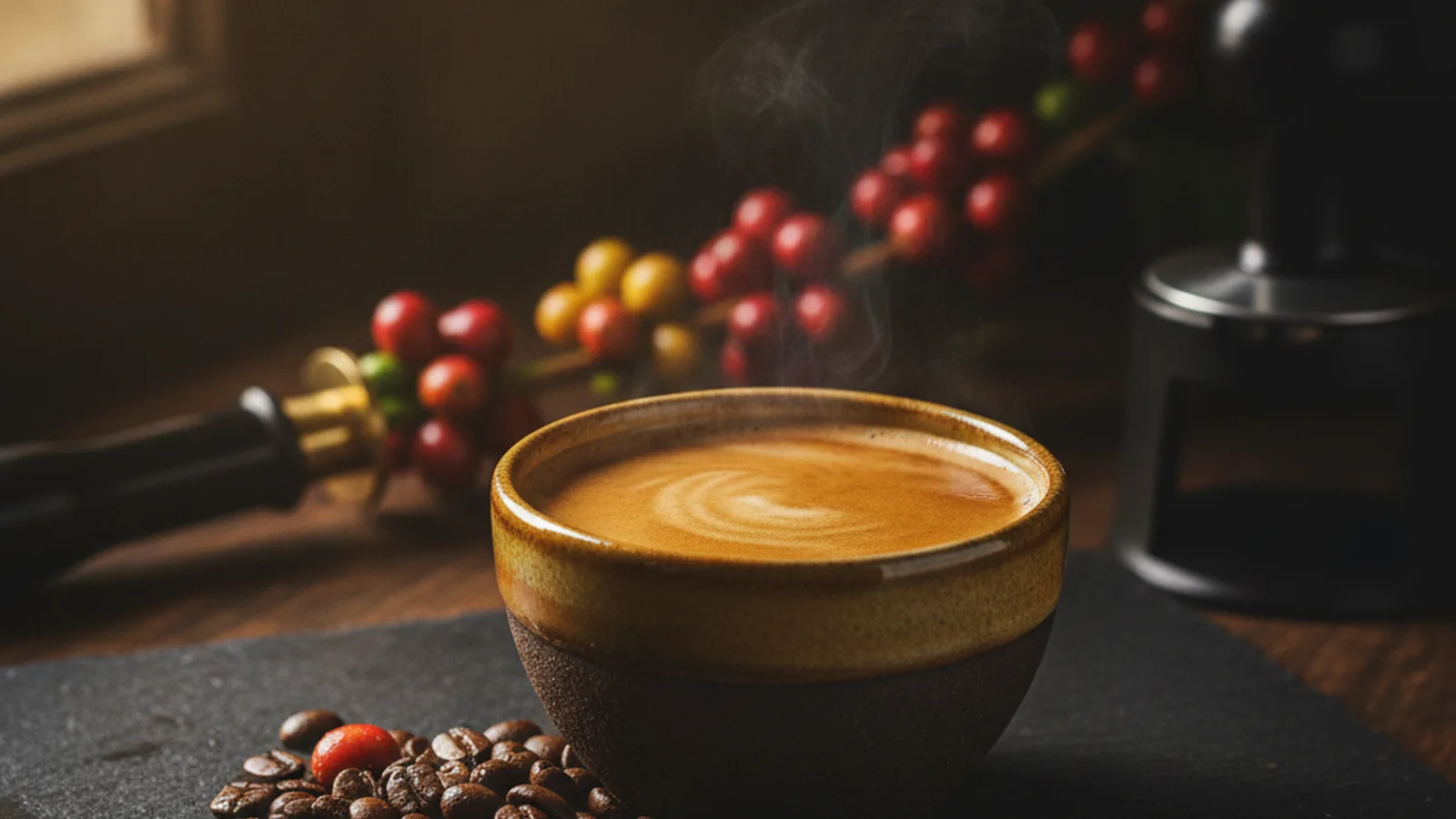
Image: Caffeine & Co studio
The Coffee Atlas
Yellow Bourbon Coffee
Yellow Bourbon is a 1930s Brazilian mutation of Red Bourbon, a rare, low-yield variety scored here from three real, dated Coffee Review lots.
Flavor profile
avg. of 3 published reviewsScale: 1-10, Coffee Review / SCA-classic-form convention. Averaged from 3 independently published, dated Coffee Review scores of Yellow Bourbon lots from two countries: two Brazilian lots (Cerrado region, Minas Gerais, 2005; Pocos de Caldas, Minas Gerais, 2014) and one Guatemalan lot (Huehuetenango, 2013). Not a category-wide statistical sample: Yellow Bourbon is grown across several countries and processing methods, so origin and lot-to-lot variance is real. All three reviews used here happen to score in the low-to-mid 90s on Coffee Review's 100-point scale, which reflects that roasters submit their best microlots for review, not the variety's typical commercial-grade cup.
What it tastes like
Yellow Bourbon is not a deliberate cross or a separate species, it is a color trait. Sometime around 1930, on a Red Bourbon farm near Pederneiras, in Sao Paulo state, a tree turned up whose cherries ripened yellow instead of red. Brazil’s Instituto Agronomico de Campinas began formally studying the trait in 1942 under researcher Carlos Arnaldo Krug, who traced the color to a recessive gene pairing growers still call Xanthocarpa, and planted roughly 30 distinct Yellow Bourbon lines within three years. Breeders still argue whether it is a spontaneous Red Bourbon mutation or an old cross with a separate yellow-fruited Typica strain called Amarelo de Botucatu. Either way, it is not a genetically stable population the way a modern F5 hybrid like Pacamara is: it is a recurring color trait inside the Bourbon lineage.
Brazil is still where nearly all of it grows commercially, spread across Minas Gerais’s Sul de Minas, Cerrado Mineiro, and Mantiqueira de Minas districts at a broad 900 to 1,800 meter band, according to Coffee Collective UK Ltd, a UK green-coffee retailer unaffiliated with the similarly-named Copenhagen roastery. That is a lower, easier-access elevation than what specialty buyers usually chase for a rarity variety, and low elevation is not the only reason it nearly vanished: Yellow Bourbon yields less and handles wind and rain worse than Red Bourbon, so growers spent decades replacing it with hardier, more productive cultivars until third-wave demand for its cup made keeping the old trees worthwhile again.
The three Coffee Review lots behind this profile all score in the low-to-mid 90s, but they come from two different countries and farms, so treat the averaged numbers as a snapshot of well-graded microlots, not a settled category score. Paradise Roasters’ Cerrado lot reads sweet and mild, tomato and milk chocolate with a hint of jasmine, while Seattle Coffee Works’ Guatemalan lot from Huehuetenango, grown well above Brazil’s typical elevation, pushes further into honey, dark chocolate, and orange with a livelier, juicier acidity. The highest-profile modern Yellow Bourbon lots are not Brazilian at all: Colombian producer Wilton Benitez runs the variety through an elaborate double-anaerobic, thermal-shock ferment that regularly earns Coffee Review’s attention, and Hawaii’s Kaʻu district turns out a washed microlot of its own most harvests, evidence that this old Brazilian mutation now travels on its own reputation, not its birthplace.
How to brew it
Method fit for this origin · editorial guidance from roaster convention
Filtered brewing lets the honeyed sweetness and floral top notes reviewers consistently note come through cleanly: the default prep roasters reach for on competition-grade lots.
Full immersion suits the variety's natural body and sweetness, though it can mute the floral and citrus top notes that separate a good lot from a great one.
Workable, but roasters note it needs a gentler extraction than washed high-altitude origins, or the delicate aromatics flatten into simple sweetness.
⚠ Fit tiers are editorial guidance drawn from roaster convention; no industry standard scores brew fit, so we show tiers, never invented numbers. Reflects brew guidance commonly published by specialty roasters for naturally sweet, floral Bourbon-family lots, not an SCA-defined standard.
Altitude & region
Growing elevation, meters above sea level · this entry vs comparison bands
Yellow Bourbon's own range above is Brazil-specific, sourced from Coffee Collective UK Ltd (see Sources & data; unaffiliated with the similarly-named Copenhagen roastery): Brazil is where the variety was discovered and remains its commercial base. The highest-scoring specialty lots referenced on this page, including the Guatemalan review lot and the Colombian and Hawaiian lots under Where to buy, commonly grow at meaningfully higher elevation than this Brazilian band. Guatemala Huehuetenango, Ethiopia Yirgacheffe, and Kenya AA are shown for scale using commonly published origin bands (the latter two already used elsewhere in this Atlas for consistency), not a lot-specific measurement.
Caffeine content
Caffeine by dry weight · each gold dot = 0.1%
Caffeine content tracks species, not variety, origin, altitude, or processing: roughly 1.2% for Arabica versus roughly 2.2% for Robusta, close to double (see Sources & data). Yellow Bourbon is 100% Arabica; no credible per-variety caffeine figure exists at a category level, so the comparison above is by species only, not a measurement of this specific lot.
Where to buy it
Transparency: some links on this site are affiliate links; if you buy through them we may earn a commission at no cost to you. Roasters are picked for genuine, current sourcing of this coffee, never for who pays us.
Madison, Wisconsin roaster currently selling Colombian producer Wilton Benitez's double-anaerobic, thermal-shock Yellow Bourbon, one of the highest-profile lots of the variety reviewed by Coffee Review.
View lot→Hawaii's Kaʻu district grows a washed Yellow Bourbon microlot that scored 95 points from Coffee Review; a seasonal harvest release that sells out and is currently between crops.
View lot→Long-running green-coffee source for home roasters; periodically lists Yellow Bourbon lots as they become available, check current listings for origin and lot details.
View lot→Selection is wide and inconsistent for this rarer variety; check the roast date, named farm, and seller reviews before buying.
View lot→Sources & data
- Perfect Daily Grind: Catuai & Yellow Bourbon: Exploring Brazil's Coffee VarietiesDiscovery near Pederneiras, Sao Paulo, in 1930; production tripling 1949-1951; 2017 Cup of Excellence Brazil lot scoring 92.33 and selling for $126/lb
- Hello5 Coffee: Yellow Bourbon, distinguishing from Red BourbonXanthocarpa gene pairing and recessive-mutation mechanism for the yellow color; Instituto Agronomico de Campinas study beginning 1942 under Carlos Arnaldo Krug, roughly 30 lines planted within three years; both Red and Yellow Bourbon commonly grown above 1,000 m
- Coffee Collective UK Ltd: Brazil Yellow Bourbon, July's Coffee of the MonthUK green-coffee retailer blog, unaffiliated with the similarly-named Copenhagen roastery; Brazil-wide altitude range (900-1,800 m), pulped natural/honey processing convention, and flavor description for this entry's altitude figure
- Sucafina: Sul de Minas Yellow Bourbon NaturalSul de Minas sub-region altitude (approx. 950 m), natural processing method, and April-September Minas Gerais harvest window
- Coffee Review: Brazil Yellow Bourbon, Paradise RoastersCupping scores (1 of 3 averaged); April 2005; Cerrado growing region, Minas Gerais
- Coffee Review: Guatemala Finca Armenia Yellow Bourbon, Seattle Coffee WorksCupping scores (2 of 3 averaged); September 2013; Finca Nueva Armenia, Huehuetenango, farmed by Jorge and Javier Recinos
- Coffee Review: Brazil Yellow Bourbon, Willoughby's Coffee & TeaCupping scores (3 of 3 averaged); March 2014; Laranjal Farms, Pocos de Caldas, Minas Gerais
- Coffee Review: scoring methodology1-10 attribute scale definition for aroma, acidity, body, flavor, and aftertaste
- Espresso Coffee Guide: Guatemala CoffeeHuehuetenango growing altitude, 5,000-6,000 feet (roughly 1,500-1,830 m), for this entry's altitude comparison row
- Development of a fast and simple method to identify pure Arabica coffee and blended coffee by Infrared Spectroscopy (J. Food Sci. Technol., 2021, PMC8292507)Peer-reviewed, open-access: "Arabica beans usually presents 1.0 to 1.5% w.w-1 of caffeine and Robusta beans presents 2.0 to 2.5% w.w-1" (quoted verbatim, source's own wording), source for this entry's 1.2% Arabica / 2.2% Robusta figures, both within the stated ranges