Image: Caffeine & Co studio
The Coffee Atlas
Pink Bourbon Coffee
Pink Bourbon looks and is named like a Bourbon mutation, but 2023 DNA testing traced this record-scoring Colombian varietal to an Ethiopian landrace instead.
Flavor profile
avg. of 3 published reviewsScale: 1-10, Coffee Review / SCA-classic-form convention. Averaged from 3 independently published, dated Coffee Review scores of single-variety Pink Bourbon lots: Wilton Benitez Pink Bourbon Colombia (JBC Coffee Roasters, Jul 2023, double-anaerobic processed, Piendamo, Cauca), Coffee Review's No. 1 Coffee of 2023 at 98 points; Colombia Pink Bourbon (Paradise Roasters, Jun 2019, washed, San Agustin, Huila), 94 points; and Colombia Huila Acevedo El Paraiso (Big Shoulders Coffee, May 2021, washed, Finca El Paraiso, Huila), 94 points, also cited on this Atlas's own Colombia Huila entry. Not a category-wide statistical sample: Pink Bourbon scores swing enormously by farm and especially by processing, from this washed pair at 94 to competition-grade anaerobic microlots that reached 98.
What it tastes like
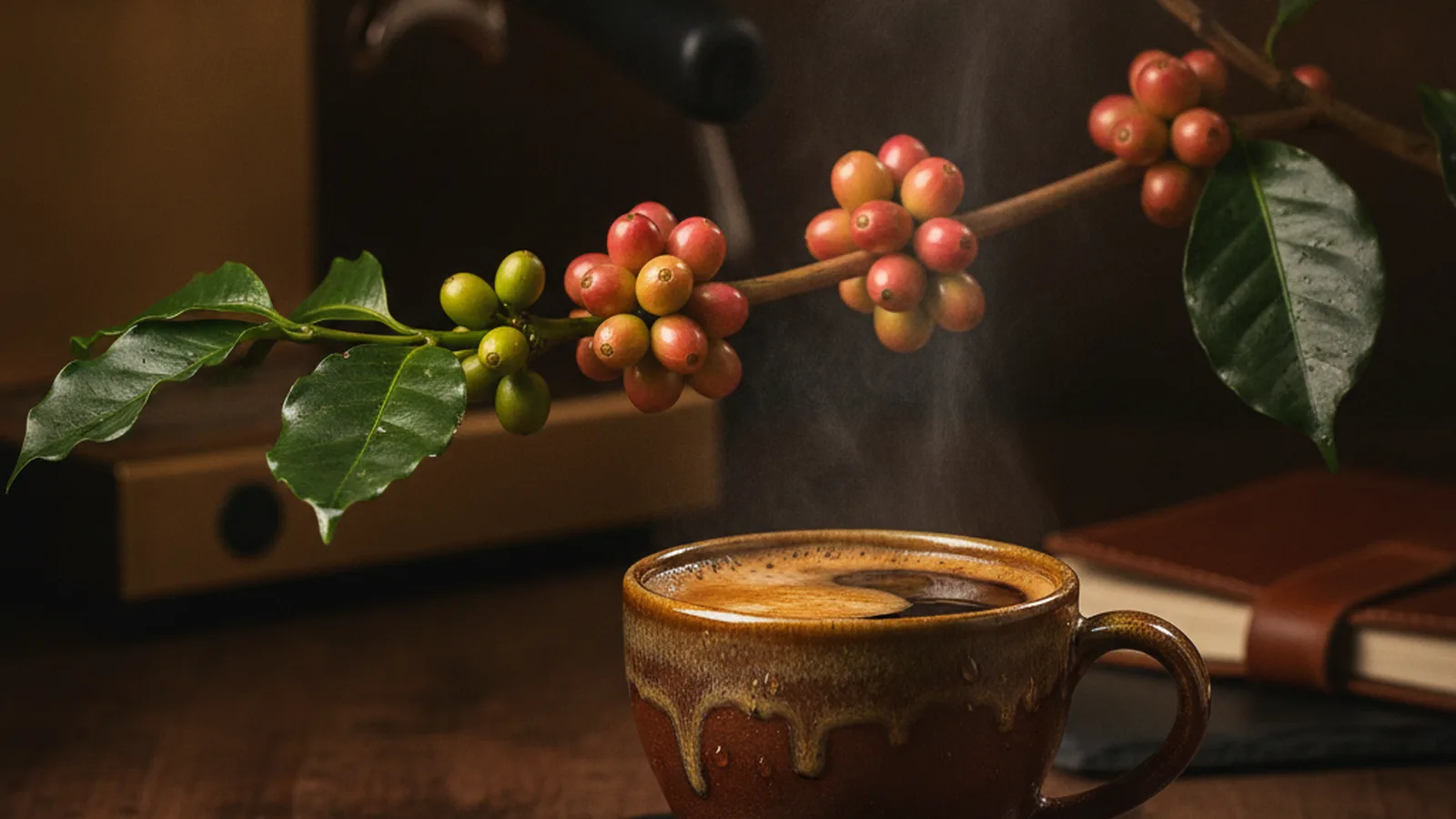
Pink Bourbon’s own name is the first thing about it that turns out to be wrong. In November 2014, a Cafe Imports green coffee buyer known in the company’s own telling only as “Lucho” tracked down a Colombian farm growing an unusual tree with cherries that ripened to a salmon-pink color instead of the usual red or yellow. (Sprudge later named him: Luis Arocha, Senior Green Coffee Buyer with Cafe Imports, a detail Cafe Imports itself chose to leave out because “the story is more fun without that tidbit.”) Since it grew among ordinary Bourbon plants and Bourbon is the variety already known to throw red and yellow color mutations, the local producer’s own theory, and the one the trade adopted along with the name, was that it must be a spontaneous cross of Red and Yellow Bourbon.
The genetics tell a different story, and it took most of a decade to sort out. A first DNA test in 2017, run by DNA Analytica on leaf tissue from two differently shaped Pink Bourbon plants, came back closer to wild Ethiopian coffee than to Bourbon, but the match sat in an inconclusive low-80-percent range. A second round in 2023, run by researcher Christophe Montagnon at RD2 Vision on five samples from separate Colombian and Costa Rican farms, closed the case: every sample carried Pink Bourbon genetics unrelated to true Bourbon, an Ethiopian landrace that somehow reached South America and was noticed for the first time only in the 2010s. How an Ethiopian plant ended up growing in a Colombian Bourbon field is still unexplained. One standing guess is that it arrived as an accidental substitute for Gesha, another Ethiopian landrace that made the same journey decades earlier and became famous for exactly the same reason: it does not taste like the coffee growing around it.
That distinctiveness is what has kept the misleading name in circulation. Wilton Benitez’s Pink Bourbon, grown in Piendamo, Cauca and put through a double-anaerobic ferment with ozone and UV sterilization, scored 98 points from Coffee Review in July 2023 on blackberry jam, honeysuckle, and dried pineapple, enough to make it the outlet’s No. 1 coffee of that year. Washed lots score lower but still well above average: Paradise Roasters’ 2019 Huila lot and Big Shoulders’ 2021 El Paraiso microlot both landed at 94, with honeysuckle, lychee, and sandalwood notes recurring across farms and years, a signature that survives the swing from simple washing to elaborate fermentation even if the ceiling clearly rises with it.
None of this made Pink Bourbon easy to grow. It wants a cool, high microclimate, generally above 1,700 meters, and Colombia’s Huila and Cauca departments remain its commercial center, on farms like Rodrigo Sanchez Valencia’s Finca Monteblanco and the smallholdings behind the JBC and Big Shoulders lots above. It is still sold variety-first rather than farm-first in a lot of marketing, but the roasters chasing the best cups now name the producer on the bag, the same shift in emphasis that Gesha went through once Panama’s growers proved the variety, not the place, was doing the work.
How to brew it
Method fit for this origin · editorial guidance from roaster convention
Filtered clarity is the default preparation on the competition-grade lots that built this variety's reputation: it protects the honeysuckle and stone-fruit top notes that carried the 2023 Coffee of the Year score.
Some roasters pull Pink Bourbon as espresso for its natural sweetness, but the variety's high, wine-like acidity typically needs a shorter, cooler dial-in than a standard washed origin to avoid sourness.
Full immersion adds body and rounds out the acidity, but tends to mute the floral and citrus top notes reviewers consistently single out in the highest-scoring lots.
⚠ Fit tiers are editorial guidance drawn from roaster convention; no industry standard scores brew fit, so we show tiers, never invented numbers. Reflects brew guidance commonly published by specialty roasters for high-acidity, aromatic Pink Bourbon lots, not an SCA-defined standard.
Altitude & region
Growing elevation, meters above sea level · this entry vs comparison bands
Pink Bourbon's range above synthesizes named lot-specific trader listings (Ally Coffee and Sucafina's Monteblanco lot at 1,730 m; Sweet Maria's Huila lot at up to 2,000 m) and trade-education cultivation guidance, not one official denomination-of-origin table (see Sources & data). Ethiopia Yirgacheffe, Kenya AA, and Brazil Cerrado are shown for scale using the same commonly published origin bands already used elsewhere in this Atlas, not a lot-specific measurement. The Yirgacheffe comparison also carries the strongest botanical link on this page: the genetic testing described below traces Pink Bourbon's own ancestry to an Ethiopian landrace, not to Bourbon.
Caffeine content
Caffeine by dry weight · each gold dot = 0.1%
Caffeine content tracks species, not variety, origin, altitude, or processing: roughly 1.2% for Arabica versus roughly 2.2% for Robusta, close to double (see Sources & data). Pink Bourbon is 100% Arabica; no credible per-variety or per-origin caffeine figure exists at a category level, so any comparison is by species only, not a measurement of this specific lot.
Where to buy it
Transparency: some links on this site are affiliate links; if you buy through them we may earn a commission at no cost to you. Roasters are picked for genuine, current sourcing of this coffee, never for who pays us.
Madison, Wisconsin roaster behind the 98-point Wilton Benitez Pink Bourbon; its current Wilder Lazo Pink Bourbon (La Dinastia, San Adolfo, Huila) is a washed lot from the same competition-focused buying program.
View lot→Chicago roaster with a rotating Pink Bourbon program, including Coffee Review-reviewed lots from Huila and current listings like Sebastian Ramirez's washed Pink Bourbon.
View lot→Topeka, Kansas roaster sourcing a washed Pink Bourbon from Finca El Bosque in Palestina, Huila, with full farm and altitude transparency published on the listing.
View lot→Sources & data
- Coffee Review: Wilton Benitez Pink Bourbon Colombia, JBC Coffee RoastersCupping scores (1 of 3 averaged); July 2023; named Coffee Review's No. 1 coffee on its Top 30 Coffees of 2023 list
- Coffee Review: Colombia Pink Bourbon, Paradise RoastersCupping scores (2 of 3 averaged); June 2019; washed lot grown by Angel Ortega and Irma Blancos, San Agustin Cooperative, Huila
- Coffee Review: Colombia Huila Acevedo El Paraiso, Big Shoulders CoffeeCupping scores (3 of 3 averaged); May 2021; washed Pink Bourbon microlot, Finca El Paraiso; also cited on this Atlas's Colombia Huila entry
- Coffee Review: scoring methodology1-10 attribute scale definition
- Cafe Imports: Pink...Bourbon?: Cryptozoology and Genetics in Specialty CoffeeFirst-hand discovery account (Cafe Imports' own "Lucho," November 2014, as told on the company's blog without his surname or title) and both rounds of genetic testing (DNA Analytica, 2017; RD2 Vision/Christophe Montagnon, 2023), the second confirming Pink Bourbon as an Ethiopian landrace unrelated to true Bourbon
- Sprudge: One Lie and a Truth: Pink Bourbon's True OriginIndependent corroboration of the discovery story and the 2017/2023 genetic testing results; also the source for Lucho's full name and title, Luis Arocha, Senior Green Coffee Buyer with Cafe Imports, which Cafe Imports' own telling omits on purpose ("the story is more fun without that tidbit")
- Sweet Maria's: Colombia Huila Pink BourbonAltitude (up to 2,000 m) and region (San Agustin and Bombo, Pitalito, Huila) for a current green-coffee lot listing
- Ally Coffee: Monteblanco Pink Bourbon, WashedAltitude (1,730 m), farm (Finca Monteblanco, Vereda Tocora, San Adolfo, Huila), and producer (Rodrigo Sanchez Valencia) for a named lot
- Podium Coffee Club: Pink Bourbon: Colombia's Competition-Winning VarietyCultivation altitude guidance (optimal above 1,700 m), genetic-origin hypotheses, and Cenicafe's ongoing genetic mapping of the variety
- Crozier et al.: Espresso coffees, caffeine and chlorogenic acid intake (Food & Function, 2012)Peer-reviewed (Univ. of Glasgow): states robusta coffee beans contain almost twice as much caffeine as arabica, by species (no percentage figures given in this paper)
- Development of a fast and simple method to identify pure Arabica coffee and blended coffee by Infrared Spectroscopy (J. Food Sci. Technol., 2021, PMC8292507)Peer-reviewed, open-access: "Arabica beans usually presents 1.0 to 1.5% w.w-1 of caffeine and Robusta beans presents 2.0 to 2.5% w.w-1" (quoted verbatim, source's own wording), source for this entry's 1.2% Arabica / 2.2% Robusta figures, both within the stated ranges