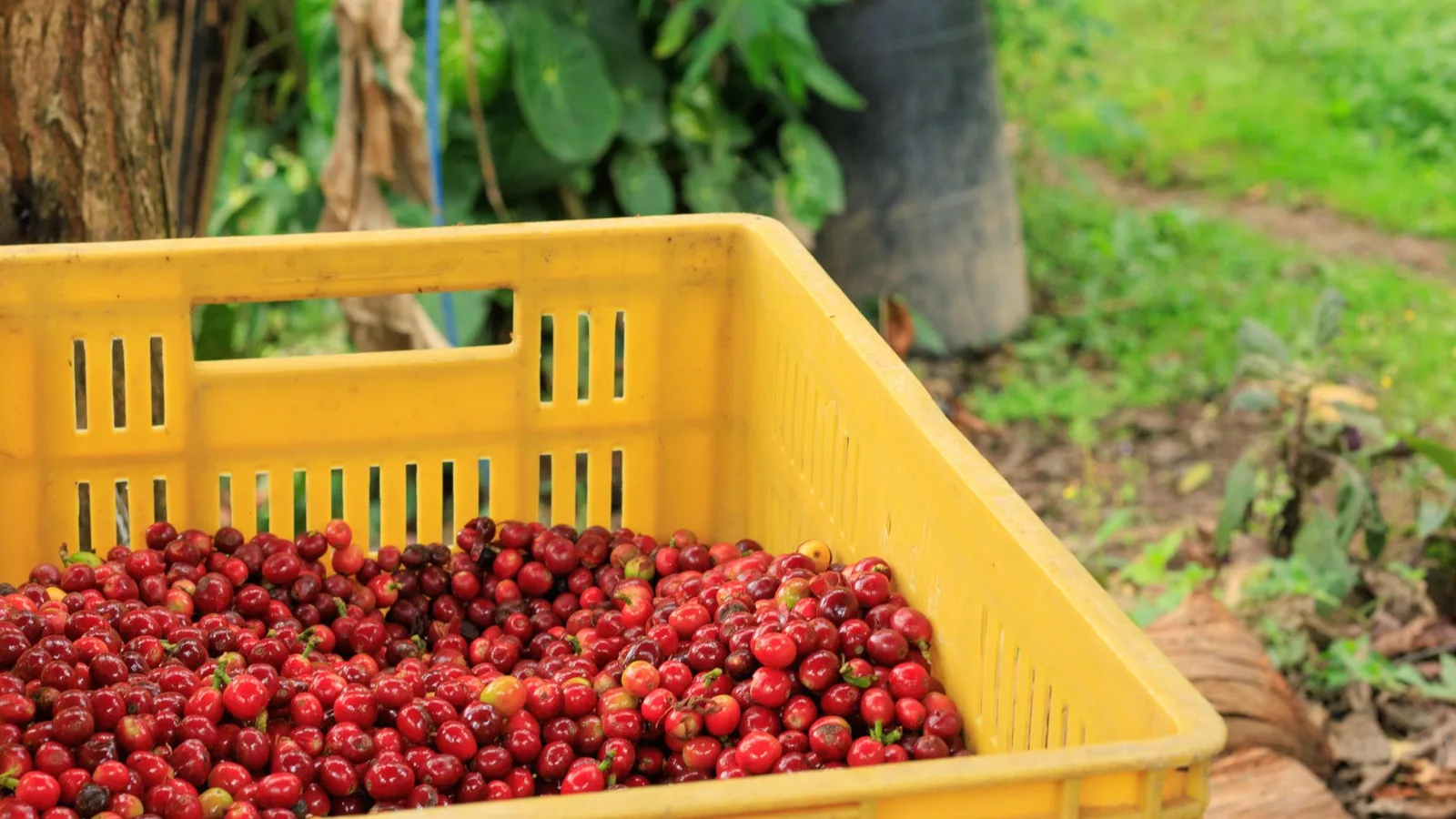
Photo by Christian Bolaños on Pexels
The Coffee Atlas
Colombia Huila
Colombia Huila is the country's biggest coffee-growing department, a traceable micro-region behind the generic Colombian coffee label, with sourced data.
Flavor profile
avg. of 3 published reviewsScale: 1-10, Coffee Review / SCA-classic-form convention. Averaged from 3 independently published, dated Coffee Review scores of washed Huila lots (Jan 2011, May 2021, Apr 2025): a general Huila lot, a Pink Bourbon microlot, and an Ethiopia-landrace lot grown in Huila. Not a category-wide statistical sample: these are specialty-grade, competition-adjacent lots that scored 92-95, well above Huila's broader commodity-grade average, and individual lots vary by variety, farm, and fermentation detail.
What it tastes like
“Colombian coffee” is one of the vaguest labels on a specialty shelf, a whole country flattened into one bag, when the real story is which department it came from. That story has shifted fast: within roughly a decade, Huila overtook Antioquia to become Colombia’s single largest coffee-producing department, now accounting for 16.73 percent of national output. It got there on labor and land, not marketing: a rural population with underused hillside land found in coffee a crop that paid, and cultivated area grew by nearly 50,000 hectares in ten years.
The department itself splits into four sub-regions (Centro, Norte, Sur, Occidente) spread across 35 municipalities and more than 84,000 farming families, farming a combined 145,741 hectares, according to the coffee federation’s own Huila office. Coffee grows between roughly 1,000 and 2,200 meters, the altitude band set by Huila’s 2013 coffee Denomination of Origin registration, on Caturra, Castillo, and the disease-resistant Colombia variety, with pockets of Bourbon, Typica, and Tabi. Almost all of it is washed: pulped, fermented, and rinsed at small on-farm wet mills, the same process credited with Huila’s clean, bright signature.
Huila’s status as an official coffee Denomination of Origin since 2013 has not simplified its harvest calendar. Sources disagree on which crop counts as “main,” a sign of just how much Huila’s four sub-regions run on different clocks: Mercanta’s own regional profile describes an October-to-February main crop peaking in November and December with a smaller crop following months later, while the federation’s Occidente sub-region specifically runs its harvest in the first half of the year rather than the second. A bag simply marked “Colombian” gives no hint which calendar, or which of those four sub-regions, it actually came from.
What that traceability buys shows up on the cupping table. Three independently dated Coffee Review lots, spanning a 2011 Conservatory for Coffee lot, a 2021 Pink Bourbon microlot from Big Shoulders Coffee, and a 2025 Ethiopia-landrace lot grown in Huila by Jaunt Coffee Roasters, scored between 92 and 95, with tasting notes running from crisp white wine and ripe lemon to lychee and plum blossom to cocoa nib and passion fruit. That range itself makes the point: a named Huila farm or sub-region is a real flavor signal, where “Colombian” on its own is not.
How to brew it
Method fit for this origin · editorial guidance from roaster convention
Filtered clarity lets Huila's citrus-toned acidity and floral sweetness come through clean, the profile most roaster tasting notes for this origin are written around.
Balanced sweetness and a medium-to-high body make Huila one of the more forgiving washed origins to pull as a single-origin shot, per multiple specialty roasters' own brew guidance.
Full immersion adds body and rounds out the acidity, but tends to mute the citrus and floral top notes that set the highest-scoring Huila lots apart.
⚠ Fit tiers are editorial guidance drawn from roaster convention; no industry standard scores brew fit, so we show tiers, never invented numbers. Reflects brew guidance commonly published by specialty roasters for washed Colombia Huila lots, not an SCA-defined standard.
Altitude & region
Growing elevation, meters above sea level · this entry vs comparison bands
Huila's own range above is sourced directly from its 2013 coffee Denomination of Origin registration record (see Sources & data). This Atlas's own sister Journal piece, 'The Origin Atlas,' describes Huila coffee more narrowly as grown at 1,600 to 2,000 meters -- that is a commonly cited typical operational band, not a contradiction: it sits entirely inside the DO's wider legal 1,000-2,200 m boundary, the same relationship the narrower Perfect Daily Grind, Mercanta, and Achilles bands above have to the full registered range. Ethiopia Yirgacheffe, Kenya AA, and Brazil Cerrado are shown for scale using the same commonly published origin bands already used elsewhere in this Atlas, not a lot-specific measurement.
Caffeine content
Caffeine by dry weight · each gold dot = 0.1%
Caffeine content tracks species, not origin, altitude, or processing: independent lab studies tracking caffeine accumulation through bean development consistently find Robusta accumulates meaningfully more caffeine than Arabica, roughly 50% more at the ripe-bean stage and up to double earlier in development (see Sources & data). This entry is 100% Arabica; no credible per-origin caffeine figure exists at a category level, so any species comparison is by species only, not a measurement of this specific lot.
Where to buy it
Transparency: some links on this site are affiliate links; if you buy through them we may earn a commission at no cost to you. Roasters are picked for genuine, current sourcing of this coffee, never for who pays us.
Portland roaster's Explorer Series sources named smallholder lots from the Monserrate community in La Plata, Huila, with per-farm variety and fermentation detail published on each listing.
View lot→Current single-origin listing grown near Santa Maria, Huila on Caturra and Castillo trees, washed processed, with red apple and molasses tasting notes.
View lot→San Diego roaster sourcing a double-fermentation, Java-variety lot grown by 14 smallholder producers across four Huila municipalities.
View lot→Filter for Huila by name rather than generic Colombian; roast-date visibility varies by seller.
View lot→Sources & data
- Federacion Nacional de Cafeteros, Huila: Cafe de HuilaFour sub-regions, 35 municipalities, over 84,000 coffee-growing families, 145,741 hectares planted, varieties grown; the page's only altitude figure is an average of 1,600 m for the Centro sub-region alone, not a department-wide range
- Cafe de Colombia: Regional Designation of Origin (Cafe del Huila)Huila's coffee Denomination of Origin, granted by the Superintendencia de Industria y Comercio (SIC) via Resolution No. 17989 (April 16, 2013); registration altitude band of 1,000-2,200 m
- Perfect Daily Grind: A Coffee Buyer's Guide to Huila, ColombiaAltitude cross-check (1,200-1,800 m), 2016 production of 2.6 million 60-kilo bags (18% of national output), varieties, washed processing, small-farm structure
- Mercanta: Huila RegionalAltitude cross-check (1,320-1,950 m), harvest window (main crop Oct-Feb, peak Nov-Dec), dominant varieties (Colombia, Castillo), washed processing, small-farm structure
- La Republica: Huila es el departamento lider cafetero con 16% del area cultivadaHuila's 16.73% share of national coffee production and its rise past Antioquia to become the leading department within a decade
- Coffee Review: Colombia Huila El Miradorcito, Conservatory for CoffeeCupping scores (1 of 3 averaged); January 2011
- Coffee Review: Colombia Huila Acevedo El Paraiso, Big Shoulders CoffeeCupping scores (2 of 3 averaged); May 2021; Pink Bourbon variety grown at Finca El Paraiso
- Coffee Review: Colombia San Adolfo Huila, Jaunt Coffee RoastersCupping scores (3 of 3 averaged); April 2025; ranked number 45 on Coffee Review's Top 50 Coffees of 2025
- Coffee Review: scoring methodology1-10 attribute scale definition
- Perrois et al.: Differential regulation of caffeine metabolism in Coffea arabica (Arabica) and Coffea canephora (Robusta) (Planta, 2014)Peer-reviewed, open access: measures caffeine accumulation through bean development in both species; Robusta caffeine content is 50% higher than Arabica's at the ripe-bean stage and roughly double at an earlier developmental stage