Image: Caffeine & Co studio
The Coffee Atlas
Kenya AA
Kenya AA is a bean-size grade, not a quality score: the real grading table, the separate Class rating system, and a sourced flavor profile from two top lots.
Flavor profile
avg. of 2 published reviewsScale: 1-10, Coffee Review / SCA-classic-form convention. Averaged from 2 independently published, dated Coffee Review scores of Kenya AA lots, both from the Nyeri growing region and both SL28/SL34-driven washed lots. Not a category-wide statistical sample: individual AA lots vary widely in cup quality, since AA is a bean-size grade, not a quality grade, and both cited lots rank among Coffee Review's highest-ever scores rather than a typical AA cup.
What it tastes like
“AA” is the grade most people reach for when they want the good Kenyan, but it has never measured taste. AA simply means the beans were retained by a 17/18 screen, roughly 7.2mm, the same sorting logic used to keep a roast batch even, not a flavor judgment: Trabocca’s own grading breakdown lists AA alongside AB, PB, C, and several lower grades defined purely by size and shape. Kenya actually runs cup quality on a separate scale entirely, a 1-10 Class rating that sits alongside the size grade, which is why a carefully processed AB lot can and regularly does outscore an average AA lot from a different mill.
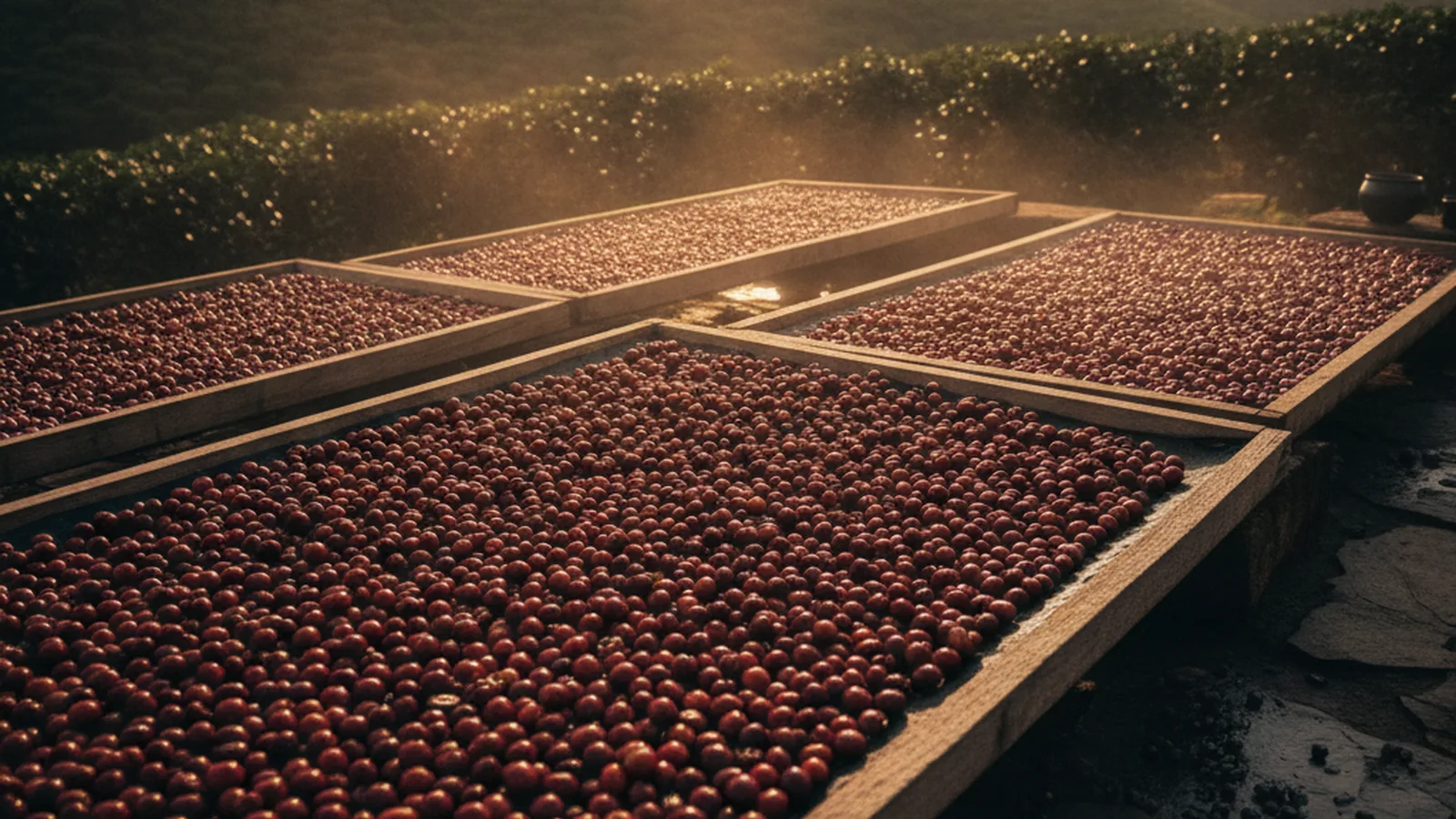
What actually built Kenya’s reputation is genetics and place. SL28, selected in 1935 at Scott Agricultural Laboratories from a single drought-tolerant tree, is the variety most credited with Kenya’s blackcurrant-forward acidity at altitude, alongside its sibling SL34 and the newer, disease-resistant Ruiru 11 and Batian. Those trees grow across the central highlands ringing Mount Kenya, Nyeri, Kirinyaga, Murang’a, Kiambu, Embu, and Meru, mostly between 1,500 and 2,100 meters, then go through the “Kenyan double wash”: pulped, fermented in water for up to a day, then soaked again in clean water before drying. Almost all of it is priced and sold through the weekly Nairobi Coffee Exchange auction, the actual price-discovery mechanism for this coffee, not the size grade stamped on the bag.
The two cited Coffee Review lots both happen to be Nyeri AAs, and both score in the mid-90s: black currant, magnolia, and cocoa nib running through a syrupy, citrus-bright cup with a long, sweet finish. That is a real, sourced profile, but it is the top of what AA can be, not its average: because the grade only sorts for size, plenty of AA crosses the exchange floor every week that never gets near a Coffee Review bench at all.
How to brew it
Method fit for this origin · editorial guidance from roaster convention
Filtered clarity lets the black currant acidity and citrus brightness that define Kenya AA come through cleanly, the method most competition baristas reach for with this origin.
Popular for fruit-forward single-origin shots, but roasters note the high acidity needs a shorter, hotter dial-in to avoid sourness.
Full immersion adds body but mutes the sharp, wine-like acidity that is the main reason drinkers seek out this origin.
⚠ Fit tiers are editorial guidance drawn from roaster convention; no industry standard scores brew fit, so we show tiers, never invented numbers. Reflects brew guidance commonly published by specialty roasters for high-acidity washed Kenyan lots, not an SCA-defined standard.
Altitude & region
Growing elevation, meters above sea level · this entry vs comparison bands
Kenya AA's range reflects the commonly published band for the grade, cross-checked against Iburu Coffee's per-county altitude breakdown (see Sources & data). Ethiopia Yirgacheffe and Brazil Cerrado are shown for scale using the same typical origin bands already published on this site, not a lot-specific measurement.
Caffeine content
Caffeine by dry weight · each gold dot = 0.1%
Caffeine content tracks species, not origin, altitude, or processing: roughly 1.5% for Arabica versus roughly 2.7% for Robusta, nearly double (see Sources & data). This entry is 100% Arabica; no credible per-grade caffeine figure exists either, so AA is not higher in caffeine than AB or PB despite the larger bean, and the comparison above is by species only, not a measurement of this specific lot.
Where to buy it
Transparency: some links on this site are affiliate links; if you buy through them we may earn a commission at no cost to you. Roasters are picked for genuine, current sourcing of this coffee, never for who pays us.
Boulder, Colorado micro-roaster; its Kenya AA Small Lot Reserve scored 95 points from Coffee Review.
View lot→Virginia roaster; its Kenya Nyeri AA scored 96 points from Coffee Review in August 2025, one of the year's highest-rated coffees.
View lot→Long-running direct-relationship sourcing in Kenya's central highlands; rotates named AA and AB lots.
View lot→Santa Cruz roaster with an established Kenya program across Nyeri and Kirinyaga washing stations.
View lot→Plenty of AA-grade lots; remember from this page that AA is a screen size, not a quality score, and read the cup notes.
View lot→Sources & data
- Trabocca: Kenya grades explainedOfficial screen-size grading table (AA/AB/PB/C/etc.) and the explicit point that grade tracks bean size, not cup quality
- Espresso Coffee Guide: Kenya coffee gradingExplains Kenya's separate 1-10 Class quality rating that runs alongside the size grade, and AA's typical growing altitude
- Iburu Coffee: coffee growing areas in KenyaPer-county altitude ranges, harvest calendar, dominant varieties, and washed processing
- World Coffee Research: SL28 variety profileSL28's 1935 Scott Agricultural Laboratories selection history and cup-quality traits
- Wikipedia: Nairobi Coffee ExchangeHow the weekly auction that actually prices Kenyan coffee works, distinct from the size grade
- Coffee Review: Kenya Nyeri AA, Roadmap CoffeeWorksCupping scores (1 of 2 averaged)
- Coffee Review: Kenya Reserve Karatina AA, Dragonfly Coffee RoastersCupping scores (2 of 2 averaged)
- Coffee Review: scoring methodology1-10 attribute scale definition
- Wikipedia: Coffea canephoraStates robusta contains nearly double the caffeine of arabica by dry weight (2.7% vs. 1.5%), citing Nesbitt, The Cultural History of Plants (2005)