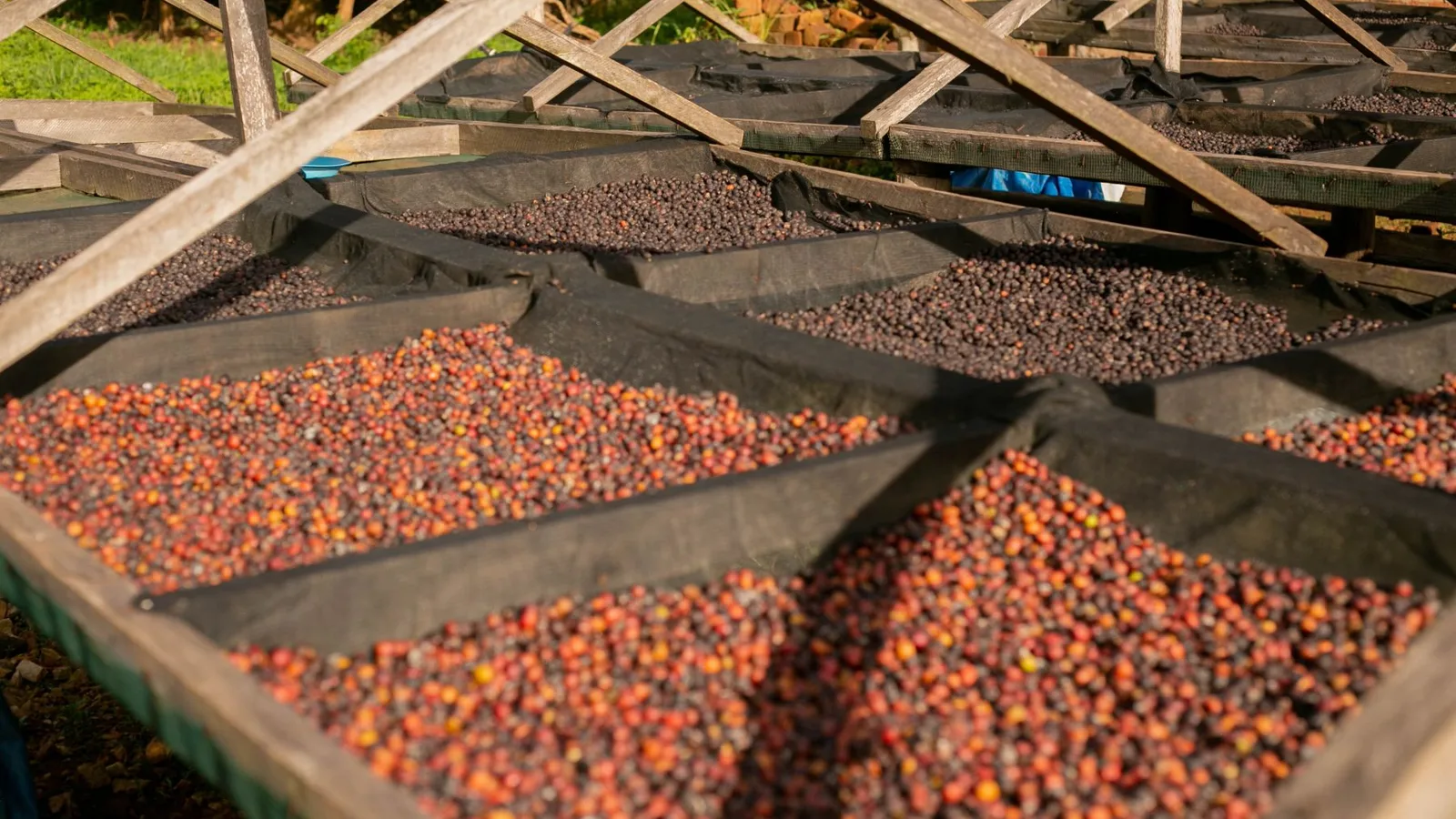
Photo by Speak Media Uganda on Pexels
The Coffee Atlas
Washed vs Natural vs Honey Coffee Processing
Washed, natural, and honey coffee processing shape acidity, body, and sweetness in different directions: a sourced comparison of all three methods.
Flavor profile
avg. of 2 published reviewsScale: 1-10, Coffee Review / SCA-classic-form convention. This is an illustrative editorial composite, not a per-attribute average of graded lot reviews: there is no single 'washed vs natural vs honey' coffee to cup, since each method is applied to different lots, origins, and years. The numbers are anchored to two real, named comparative sources: Coffee Review's 2014 cupping of 50 Central American honey- and natural-processed lots (naturals scored consistently higher, none below 88, versus more variability in the honeys), and a 2023 peer-reviewed processing trial on Catimor coffee in Alto Inambari, Peru, that put washed, honey, and natural lots within a tight 82.9 to 85.75 total-score band, all in specialty range. Individual lots vary well beyond what one radar can show: treat this as a category-level illustration, not a graded score for any specific coffee.
What it tastes like
Washed, natural, and honey are the three processing methods that shape a coffee’s cup more than almost any other variable short of species itself, and unlike origin or altitude, a single farm can produce all three from the same trees in the same harvest. The difference comes down to how much of the cherry’s fruit stays in contact with the bean while it dries: washed removes it entirely before drying, natural leaves the whole cherry on, and honey splits the difference by removing the skin but keeping some or all of the sticky mucilage.
That contact time changes the chemistry, not just the marketing copy. Perfect Daily Grind’s rundown of the underlying chemistry explains that washed beans lose more free sugar to enzyme activity during fermentation, producing a sharper, cleaner cup with less aromatic material but more acidity, while natural beans absorb pulp sugars over weeks of drying, building body and sweetness at the cost of some clarity. Honey lands in between: skins off, no full fermentation-and-rinse step, so some of the fruit’s sugar carries through without natural’s heavier fermentation risk. In practice this reads as bright and tea-like (washed), fruit-forward and syrupy (natural), or sweet and rounded with moderate acidity (honey), and it is where the “yellow, red, black” honey subgrades come from too: more retained mucilage means a darker bean and a bigger flavor swing toward natural, as Trianon Coffee’s explainer lays out.
The popular assumption is that washed is automatically “the clean, correct” default and the others are stylistic add-ons, but the scores do not back a strict hierarchy. Coffee Review’s 2014 cupping of 50 Central American lots found naturals scoring consistently higher than honeys overall, none below 88, with tasting notes running to “brandy, rye whisky” and “dark rum” at the fermented end, while a 2023 peer-reviewed trial on Catimor coffee in Peru put washed, honey, and natural lots within a tight few points of each other, all comfortably in specialty range. The honest read: each method is a different flavor target, not a different quality ceiling, and the right one depends on what a drinker wants in the cup.
Where methods run into trouble is over-fermentation: too much time with fruit in contact with the bean, in any of the three methods, tips sweetness into sourness or funk. That is the real risk naturals and honeys manage and washed mostly avoids, which is also why washed still reads as the safer, more consistent default for origins without tight process control.
How to brew it
Method fit for this origin · editorial guidance from roaster convention
Filtered brewing keeps a washed lot's acidity and clarity readable, and lets honey-process sweetness show without piling on extra body.
Full immersion favors a natural or honey lot's heavier body and sweetness, but can overwhelm the more delicate acidity of a washed coffee.
Naturals and honeys often shine as espresso for their fruit-forward sweetness; washed lots need more careful dialing in to avoid a thin, sour shot.
⚠ Fit tiers are editorial guidance drawn from roaster convention; no industry standard scores brew fit, so we show tiers, never invented numbers. Reflects brew guidance commonly published by specialty roasters for each processing style, not an SCA-defined standard.
Caffeine content
Caffeine by dry weight · each gold dot = 0.1%
Caffeine content tracks species, not processing method: roughly 1.2% for Arabica versus roughly 2.2% for Robusta, close to double (see Sources & data). Fermentation and drying change sugars, acids, and mucilage, not the bean's caffeine content, so no credible washed-vs-natural-vs-honey caffeine difference exists at a category level; this page compares methods, not one species, so neither row above is marked as this coffee.
Where to buy it
Transparency: some links on this site are affiliate links; if you buy through them we may earn a commission at no cost to you. Roasters are picked for genuine, current sourcing of this coffee, never for who pays us.
Competition-circuit roaster whose shop filters directly by process (natural, washed, white honey, anaerobic natural), making it an easy place to taste all three side by side.
View lot→Boulder, Colorado roaster that publishes exact processing notes (washed, natural, semi-washed, anaerobic washed) on every single-origin listing.
View lot→Runs a dedicated honey-process collection, useful for anchoring the honey side of the comparison specifically.
View lot→NYC micro-roaster known for transparent, lot-specific sourcing and detailed processing write-ups across washed and natural lots.
View lot→Searching by process name works well here; try washed and honey the same way to taste this page's comparison yourself.
View lot→Sources & data
- Crozier et al.: Espresso coffees, caffeine and chlorogenic acid intake (Food & Function, 2012)Peer-reviewed (Univ. of Glasgow): states robusta coffee beans contain almost twice as much caffeine as arabica, by species (no percentage figures given in this paper)
- Development of a fast and simple method to identify pure Arabica coffee and blended coffee by Infrared Spectroscopy (J. Food Sci. Technol., 2021, PMC8292507)Peer-reviewed, open-access: "Arabica beans usually presents 1.0 to 1.5% w.w-1 of caffeine and Robusta beans presents 2.0 to 2.5% w.w-1" (quoted verbatim, source's own wording) -- source for this entry's 1.2% Arabica / 2.2% Robusta figures, both within the stated ranges
- Coffee Review: Honey Process and Natural Process Coffees (Central America, 2014)Cupping of 50 honey- and natural-processed lots; score comparison and flavor-character description
- Coffee Science: Effect of processing methods (washed, honey, natural, anaerobic) of catimor coffee on physical and sensory quality in Alto Inambari, PeruPeer-reviewed 2023 processing trial; per-method total cup scores
- Perfect Daily Grind: How Does Processing Method Impact Coffee Chemistry and Flavor?Mechanism: sugar migration, enzyme activity, fermentation chemistry per method
- Trianon Coffee: How is honey processed coffee different from washed or natural?Yellow, red, and black honey mucilage-retention mechanism
- Folk Coffee Club: Washed vs natural vs honey coffee, 3 methods comparedPlain-language flavor-character summary per method
- Coffee Review: scoring methodology1-10 attribute scale definition