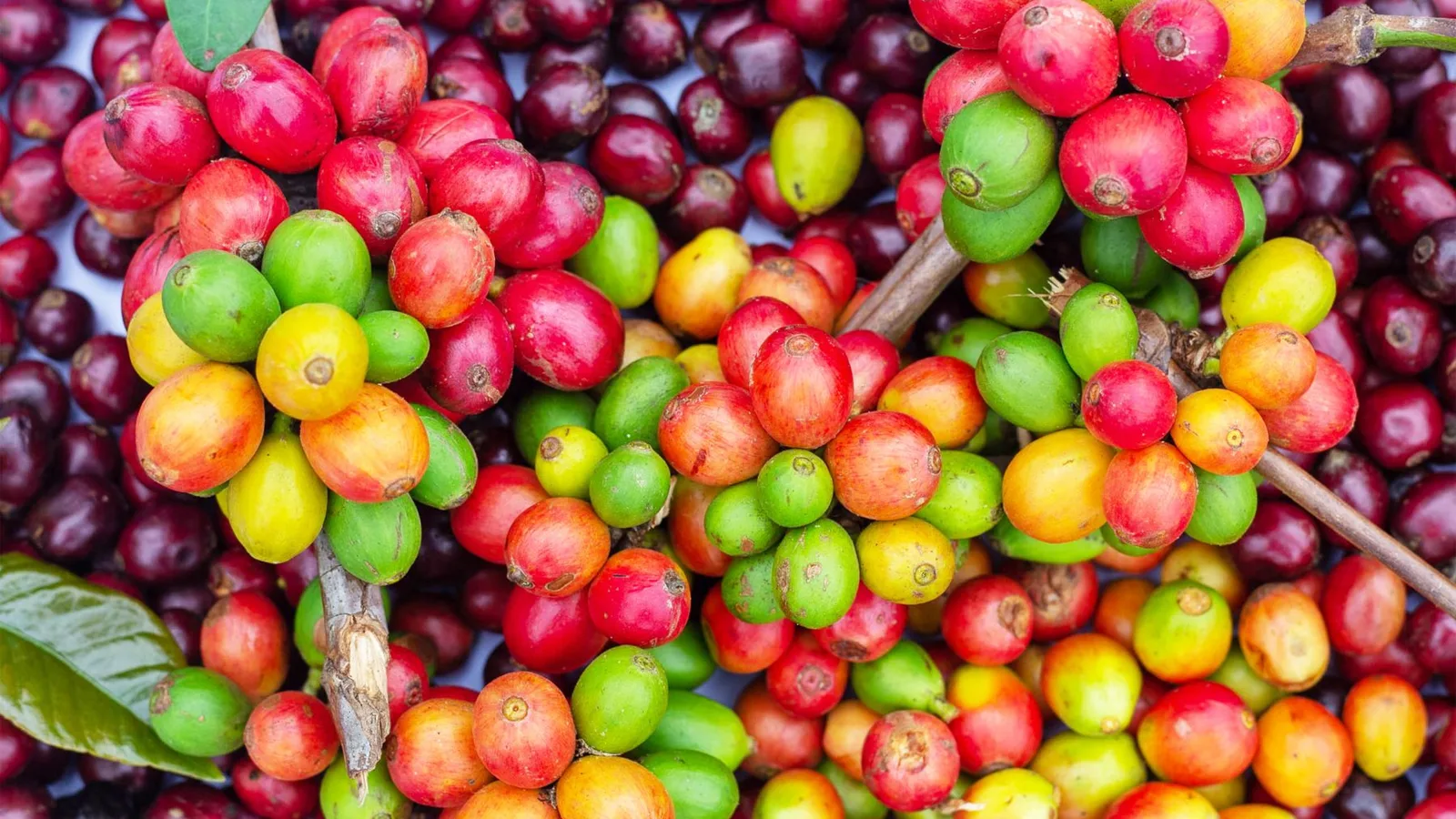
Photo by phouy Sonedala on Pexels
The Coffee Atlas
Gesha (Geisha) Coffee
Gesha, the rare Ethiopian varietal that turned Panama's Boquete highlands into the auction world's most expensive coffee, from $21 to $13,705 a pound.
Flavor profile
avg. of 2 published reviewsScale: 1-10, Coffee Review / SCA-classic-form convention. Averaged from 2 independently published, dated Coffee Review scores of Hacienda La Esmeralda Geisha lots (one washed-style Esmeralda Geisha, one Bosque Natural), both reviewed in 2015. This is a single-farm ceiling, not a category-wide sample of the Gesha varietal across the many origins now growing it: quality and score vary enormously by farm, altitude, and processing, and plenty of Gesha sells well below this range.
What it tastes like
Gesha is a coffee variety, not a place, though it is named for one: the Gesha growing region of southwestern Ethiopia, where local farmers cultivated it long before a British expedition documented it in the 1930s. The variety reached the Americas by way of Costa Rica’s CATIE research station, which distributed it through Central America and on into Panama with the seeds themselves. Exactly how the “Geisha” spelling that still dominates menus and bags took hold along that route, conflating an Ethiopian place name with an unrelated Japanese word, is not settled: Sprudge’s history of the spelling lays out several competing theories, from a simple misspelling to an oral-language romanization quirk to deliberate exoticized branding, and concludes the documentation isn’t clear enough to say which one is correct.
Those seeds sat in Panama’s Boquete highlands for decades as an unremarkable, low-yielding variety until the Peterson family entered a lot from Hacienda La Esmeralda in the 2004 Best of Panama competition, where it sold at auction for $21 a pound, nearly ten times the going rate for high-quality coffee at the time. That was just the opening bid on two decades of escalation: Lamastus Family Estates’ Elida Geisha broke $1,029 a pound at the 2019 Best of Panama auction, Carmen Estate’s washed lot hit $4,588 a pound in 2023, and in August 2025 a 20-kilogram lot from the same Esmeralda farm that started it all sold for $13,705 a pound, the highest price ever paid for green coffee at auction.
The cup that justifies the money is genuinely distinct: intensely floral, sweet, and light-bodied, closer to a fine black tea or perfume than typical coffee weight. Coffee Review’s blind-cupped Esmeralda lots score in the mid-to-high 90s, with tasting notes running to lavender honey, blood orange, and cocoa nib, and a finish reviewers describe as unusually long and clear for something this delicate.
None of that is unique to Panama anymore. Perfect Daily Grind’s 2024 survey of Gesha growers found the variety now planted from its native Ethiopia to Colombia, Guatemala, Costa Rica, Mexico, Taiwan, Indonesia, and Malawi, expressing a recognizable floral, citrus, and stone-fruit signature nearly everywhere it is grown well. Hawaii’s Kona growers have taken up the variety too, as the roaster list below reflects. What Boquete’s altitude and the Peterson family’s two decades of processing refinement bought was not exclusivity, but a head start: the wet mills, agronomy, and buyer relationships that still produce the coffees the rest of the world’s Gesha gets measured against.
How to brew it
Method fit for this origin · editorial guidance from roaster convention
Filtered, clean extraction is the default preparation in competitions and roaster guides alike: it protects the jasmine-bergamot aromatics and light body the premium is paying for.
A minority of roasters run Gesha as espresso for novelty, but concentrating it under crema mutes the delicate top notes that define the variety, so pour-over remains the serious use of the coffee.
Full immersion favors heavier body and dulls aromatic clarity, the opposite of what a coffee this expensive and this floral is bought for.
⚠ Fit tiers are editorial guidance drawn from roaster convention; no industry standard scores brew fit, so we show tiers, never invented numbers. Reflects brew guidance commonly published by specialty roasters and brewing guides for Gesha specifically, not an SCA-defined standard.
Altitude & region
Growing elevation, meters above sea level · this entry vs comparison bands
The sourced range above is Hacienda La Esmeralda's own published planting altitude for its two Geisha collections, the single most famous Gesha source, not a category-wide survey: the variety is now grown from Ethiopia to Colombia to Hawaii at varying elevations, generally needing high altitude (World Coffee Research cites over 1,600 m in equatorial zones) to develop its signature aromatics. Kenya AA and Brazil Cerrado are shown for scale using commonly published origin altitude bands, not a lot-specific measurement.
Caffeine content
Caffeine by dry weight · each gold dot = 0.1%
Caffeine content tracks species, not variety, origin, altitude, or processing: roughly 1.2% for Arabica versus roughly 2.2% for Robusta, close to double (see Sources & data). Gesha is 100% Arabica; no credible per-variety or per-origin caffeine figure exists at a category level, so the comparison above is by species only, not a measurement of this specific lot.
Where to buy it
Transparency: some links on this site are affiliate links; if you buy through them we may earn a commission at no cost to you. Roasters are picked for genuine, current sourcing of this coffee, never for who pays us.
Pearl Reserve program rotates Panama Gesha lots weekly, including past Esmeralda and Elida auction coffees.
View lot→Dedicated Gesha collection spanning Panama, Hawaii, Ecuador, and California lots, each independently Coffee Review scored 96 or above.
View lot→Competition-circuit roaster with rotating Panama and Colombia Gesha lots alongside its standard menu.
View lot→Grows and roasts its own award-winning Kona Gesha microlot in Hawaii, a seasonal, small-batch alternative to Panama sourcing.
View lot→Gesha lots surface here from many roasters; verify the farm and lot naming against the roaster's own site before paying auction-adjacent prices.
View lot→Sources & data
- Crozier et al.: Espresso coffees, caffeine and chlorogenic acid intake (Food & Function, 2012)Peer-reviewed (Univ. of Glasgow): states robusta coffee beans contain almost twice as much caffeine as arabica, by species (no percentage figures given in this paper)
- Development of a fast and simple method to identify pure Arabica coffee and blended coffee by Infrared Spectroscopy (J. Food Sci. Technol., 2021, PMC8292507)Peer-reviewed, open-access: "Arabica beans usually presents 1.0 to 1.5% w.w-1 of caffeine and Robusta beans presents 2.0 to 2.5% w.w-1" (quoted verbatim, source's own wording) -- source for this entry's 1.2% Arabica / 2.2% Robusta figures, both within the stated ranges
- Boquete Coffee Traders: Hacienda La Esmeralda, Panama's Famous Geisha Coffee2004 Best of Panama result ($21/lb), 2025 auction record ($13,705/lb), and farm history
- AgroNosotros: Elida Estate Gesha Earns $1,029 Per Pound in Record-Breaking Best of Panama Auction2019 Best of Panama auction record and prior $803/lb record price
- STiR Coffee and Tea Magazine: Panamanian Geisha Wins Record High Price of $10,005 per Kilogram2023 Carmen Estate auction record ($4,588/lb)
- Sprudge: A Panama Gesha Broke Price Records (Again)2025 Hacienda La Esmeralda auction record ($13,705/lb), buyer, and lot details
- Sprudge: Stop Calling It Geisha AlreadyGesha vs. Geisha spelling history and argument for the Ethiopian-region spelling
- Wikipedia: Geisha (coffee)Variety discovery history (Ethiopia, 1930s collection, CATIE, Panama in the 1960s) and botanical background
- World Coffee Research: Geisha, Panama variety profileBotanical/genetic facts: tall stature, low yield, intermediate leaf rust resistance, high-altitude requirement
- Hacienda La Esmeralda: GeishaFarm's own published altitude ranges for its Private Collection and Esmeralda Special Geisha
- Coffee Review: Panama Esmeralda Geisha, Big Shoulders CoffeeCupping scores (1 of 2 averaged)
- Coffee Review: Panama La Esmeralda Geisha Bosque Natural, Temple Coffee and TeaCupping scores (2 of 2 averaged)
- Coffee Review: scoring methodology1-10 attribute scale definition
- Perfect Daily Grind: Panama, Colombia, Ethiopia: There is no best origin for Gesha coffeeGeographic spread beyond Panama and terroir-independent flavor signature