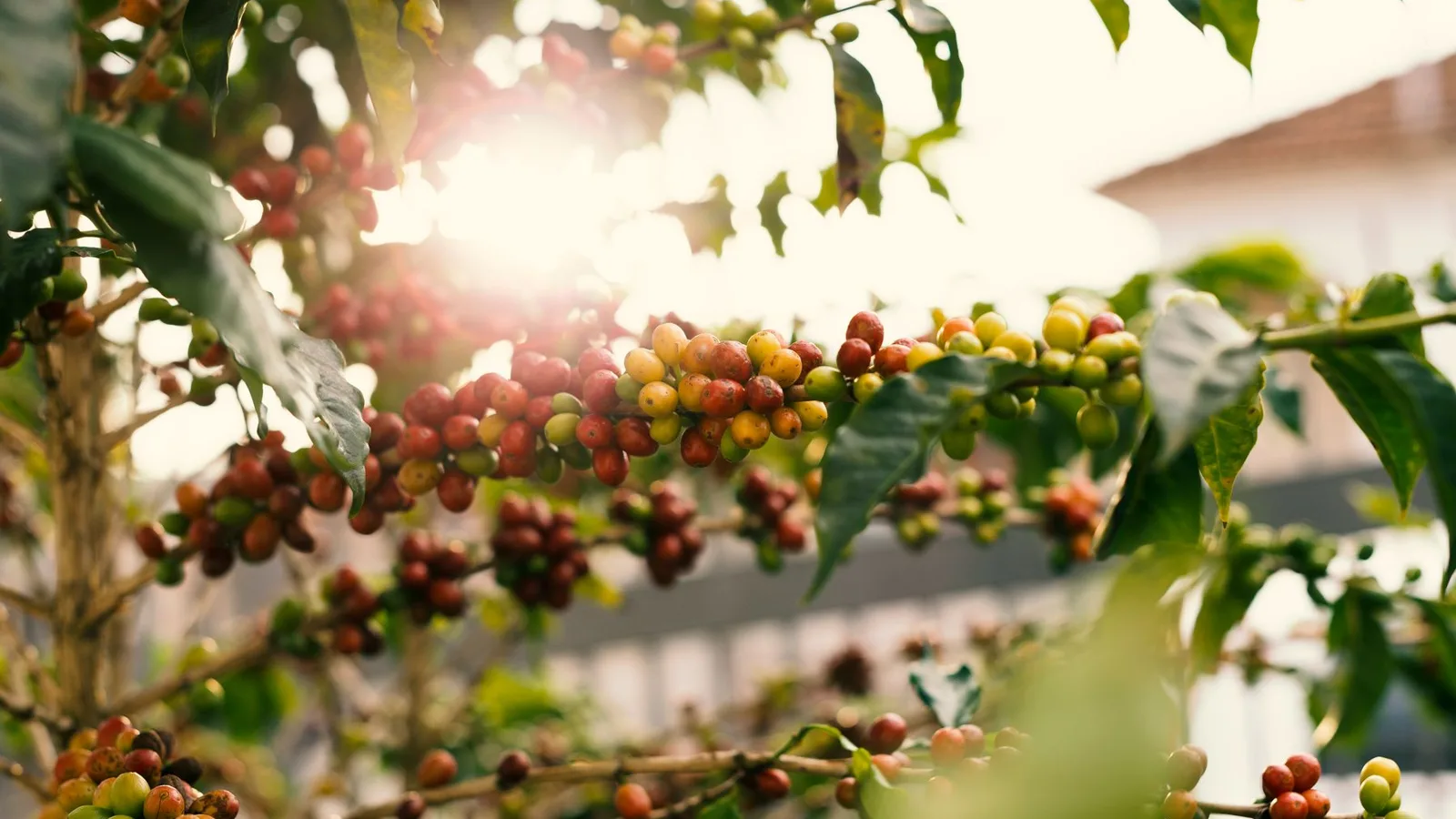
Photo by Daniel Reche on Pexels
The Coffee Atlas
Bourbon vs Typica Coffee
Bourbon and Typica are the two varieties most modern Arabica cultivars trace to: real genetic lineage, a sourced flavor comparison, and the family tree.
Flavor profile
avg. of 2 published reviewsScale: 1-10, Coffee Review / SCA-classic-form convention. This is an illustrative editorial composite, not a per-attribute average from a controlled Bourbon-vs-Typica cupping trial: no such trial exists, since each variety is grown at many different origins under different conditions rather than side by side. The numbers are anchored to two real, named, dated Coffee Review lot scores chosen because both publish full attribute breakdowns: Wilton Benitez Red Bourbon (JBC Coffee Roasters, Cauca, Colombia, reviewed May 2026, scored 95) and Ecuador La Papaya Typica (Utopian Coffee, Loja, Ecuador, reviewed July 2025, scored 95). Both lots happen to score identically across every listed attribute (9 each), a coincidence of these two exceptional picks, not evidence the varieties taste alike. Coffee Review's own older tasting reports surveying multiple Bourbon and Typica samples (Kenneth Davids, 2011 and 2014) describe ordinary lots of both varieties as generally solid but conventional, averaging in the low-to-mid 90s, not standouts the way a Gesha is. Treat this profile as illustrative of what each variety can reach at its best, not a typical commercial-lot score for either.
What it tastes like
Bourbon and Typica are coffee’s two founding varieties: nearly every Arabica cultivar planted today is a mutation, natural cross, or intentional hybrid that traces back to one or both of them. Both descend from Ethiopian landrace coffee carried north to Yemen centuries ago, then split into two very different journeys. Typica went east: Yemeni seeds reached India by 1700, then Java, and a single plant shipped from Java to a botanist’s garden in Amsterdam in 1706 became the source for the variety that dominated Latin American plantations into the 1940s, per World Coffee Research’s Typica profile. Bourbon went the other way: French missionaries carried Yemeni coffee to Ile Bourbon, now Reunion Island, in the early 1700s, where it stayed isolated for over a century before spreading to Africa and, by around 1860, to Brazil, per World Coffee Research’s Bourbon profile.
That Brazilian arrival is where the family tree branches hardest. Caturra, a natural dwarf mutation of Bourbon, turned up on a Minas Gerais plantation between 1915 and 1918. In 1943 a natural cross between Bourbon and Typica trees in Sao Paulo produced Mundo Novo, and by 1949 Brazil’s Instituto Agronomico had crossed Caturra with Mundo Novo to create Catuai. Bourbon mutated again on its own in Santa Ana, El Salvador in 1949, giving rise to Pacas, while a 1935 Bourbon-related selection at Scott Laboratories in Kenya became SL28, still one of the most prized cultivars in east Africa. Typica’s own branch is thinner but real: World Coffee Research classifies SL34, the Kenyan selection grown alongside SL28, as Typica-related rather than Bourbon-related, one of the clearest cases of the two founding varieties producing genetically distinct descendants side by side.
On paper the two taste different. Bourbon’s higher natural sugar content tends to read as heavier body and fruit-forward sweetness, while Typica channels its energy into brighter acidity and cleaner, more floral cups. Coffee Review’s Wilton Benitez Red Bourbon, scored 95, came back blood orange, raspberry, dark chocolate, and clove; the same publication’s Ecuador La Papaya Typica, also scored 95, read lilac, Meyer lemon, ripe peach, and basil. Both are exceptional microlots, not a typical commercial cup of either variety: Kenneth Davids’ older, broader Coffee Review tasting reports on single-variety coffees describe ordinary Bourbon and Typica lots as generally solid but conventional, averaging in the low-to-mid 90s rather than standing out the way a Gesha does.
Neither variety is easy to farm at scale. Typica is low-yielding and highly susceptible to coffee leaf rust and coffee berry disease; Bourbon yields somewhat more but remains rust-susceptible itself, which is exactly why so many of their descendants exist. Caturra, Catuai, and the rust-resistant hybrids that followed them were bred to keep Bourbon and Typica’s cup quality while fixing their agronomic weaknesses, a tradeoff between quality and practicality that is still the whole story of why modern coffee has so many varieties instead of just these two.
How to brew it
Method fit for this origin · editorial guidance from roaster convention
Filtered brewing is the default roasters reach for on both varieties: it lets Typica's brighter acidity and floral notes come through clean and lets Bourbon's fruit-forward sweetness show without piling on extra body.
Bourbon's higher natural sugar content and fuller body round out reasonably well under pressure; Typica's more delicate structure needs more careful dialling in to avoid a thin or sour shot.
Full immersion favors Bourbon's heavier body more than Typica's lighter one, but a coarser grind makes it workable for either, since neither variety is as fragile as a high-grown Gesha.
⚠ Fit tiers are editorial guidance drawn from roaster convention; no industry standard scores brew fit, so we show tiers, never invented numbers. Reflects brew guidance commonly published by specialty roasters for traditional Bourbon and Typica lots, not an SCA-defined standard.
Caffeine content
Caffeine by dry weight · each gold dot = 0.1%
Caffeine content tracks species, not variety: roughly 1.2% for Arabica versus roughly 2.2% for Robusta, close to double (see Sources & data). Bourbon and Typica are both 100% Arabica cultivars; the genetics that shape their sugar, acid, and aroma differences do not extend to a credible per-variety caffeine figure at a category level, so the comparison above is by species only, not a measurement of either variety specifically.
Where to buy it
Transparency: some links on this site are affiliate links; if you buy through them we may earn a commission at no cost to you. Roasters are picked for genuine, current sourcing of this coffee, never for who pays us.
Madison, Wisconsin roaster that rotates named single-producer Bourbon lots from Wilton Benitez in Cauca, Colombia (Red, Yellow, Orange Bourbon), each with full public cupping notes.
View lot→Fort Wayne, Indiana roaster and source of the Coffee Review-scored Ecuador La Papaya Typica lot this entry's flavor profile partly draws on.
View lot→Kona, Hawaii grower-roaster running Typica (Kahiko, Kona Sweet, Oli) and Red Bourbon (Karen J) lots from the same volcanic slopes, a rare chance to taste both varieties from one farm.
View lot→Boulder, Colorado roaster that publishes the exact variety on every single-origin listing, including Bourbon and Typica lots alongside rarer cultivars.
View lot→Variety-named lots appear across many roasters; Typica is rarer, search it separately if this page sold you on it.
View lot→Sources & data
- World Coffee Research: Bourbon variety profileBourbon's history (Ile Bourbon, 1700s; Brazil, c.1860), genetic classification, descendant varieties (Caturra, Catuai, Mundo Novo), cup quality, and agronomic data
- World Coffee Research: Typica variety profileTypica's history (Ethiopia to Yemen to India to Java to Amsterdam 1706 to the Americas), genetic classification, related varieties (SL34), cup quality, and agronomic data
- World Coffee Research: Caturra variety profileCaturra as a natural Bourbon mutation, discovered Minas Gerais, Brazil, 1915-1918
- World Coffee Research: Mundo Novo variety profileMundo Novo as a natural Bourbon x Typica cross, Sao Paulo, Brazil, 1943
- World Coffee Research: SL28 variety profileSL28 as a Bourbon-related selection made at Scott Laboratories, Kenya, 1935
- World Coffee Research: Pacas variety profilePacas as a natural Bourbon mutation, Santa Ana, El Salvador, 1949
- Coffee Review: Wilton Benitez Red Bourbon, JBC Coffee RoastersFull attribute cupping scores and tasting notes (1 of 2 averaged); reviewed May 2026
- Coffee Review: Ecuador La Papaya Typica, Utopian CoffeeFull attribute cupping scores and tasting notes (2 of 2 averaged); reviewed July 2025
- Coffee Review: Geshas and the Rest, Single-Variety Single-Lot Coffees, by Kenneth DavidsNov 2014 tasting report: Bourbon (4 samples, averaging close to 92) and Typica (1 sample, 91) described as traditional Latin American varieties, solid but conventional, versus distinctive varieties like Gesha
- Coffee Review: Single-Variety Coffees, by Kenneth DavidsDec 2011 tasting report: 2 pure Bourbon samples both scored 93, described as sweetly refined with a pungent dry-berry note; no pure Typica sample cupped that round
- Coffee Review: scoring methodology1-10 attribute scale definition
- Crozier et al.: Espresso coffees, caffeine and chlorogenic acid intake (Food & Function, 2012)Peer-reviewed (Univ. of Glasgow): states robusta coffee beans contain almost twice as much caffeine as arabica, by species (no percentage figures given in this paper)
- Development of a fast and simple method to identify pure Arabica coffee and blended coffee by Infrared Spectroscopy (J. Food Sci. Technol., 2021, PMC8292507)Peer-reviewed, open-access: "Arabica beans usually presents 1.0 to 1.5% w.w-1 of caffeine and Robusta beans presents 2.0 to 2.5% w.w-1" (quoted verbatim, source's own wording), source for this entry's 1.2% Arabica / 2.2% Robusta figures, both within the stated ranges