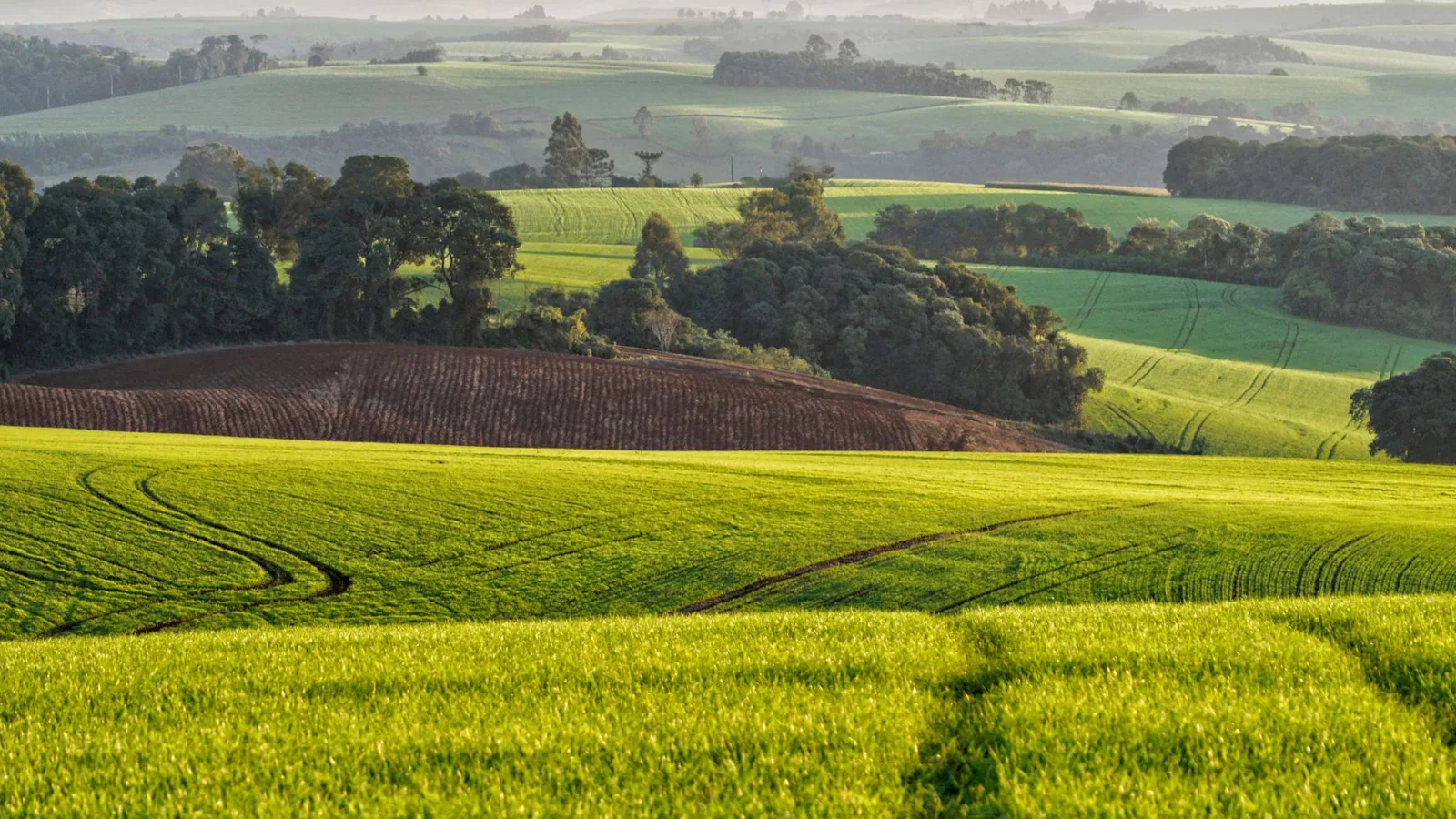
Photo by André Ulysses De Salis on Pexels
The Coffee Atlas
Brazil Cerrado
Brazil Cerrado is the low-altitude workhorse behind the world's largest coffee crop, with a sourced altitude range, real cupping scores, and citations.
Flavor profile
avg. of 2 published reviewsScale: 1-10, Coffee Review / SCA-classic-form convention. Averaged from 2 independently published, dated Coffee Review scores of Cerrado-region lots: one natural process (Greyfriar's Coffee and Tea) and one pulped natural (Ecco Caffe's Fazenda Daterra Reserve), both reviewed in May 2008. Not a category-wide statistical sample: individual Cerrado lots on Coffee Review range from the low 80s to low 90s depending on farm and processing, and these two reviews are older than most other entries in this Atlas, a reflection of how rarely Coffee Review revisits this high-volume, workhorse origin compared with smaller-lot novelty coffees.
What it tastes like
Brazil grows more coffee than any other country by a wide margin, and Cerrado Mineiro, the high savanna plateau in western Minas Gerais that became Brazil’s first coffee region to earn a Denomination of Origin in 2013, is a big part of why the country’s cup has a signature at all. At 800 to 1,300 meters, it sits well below the altitude that produces Ethiopia’s or Kenya’s brightest lots, and lower elevation means faster cherry ripening, with less time to build the acid and sugar concentration that slow ripening at altitude produces. The result is a flatter, rounder cup: chocolate and nut rather than citrus and floral tea.
The region’s long, dry harvest season, May through September, is also why natural and pulped-natural processing are the default rather than the exception here: cherries dry on open patios under reliable sun instead of needing mechanical drying. The two Coffee Review lots averaged for this entry show both sides of that convention, Greyfriar’s natural-process Cerrado leaning cedar and dark chocolate, Ecco Caffe’s pulped-natural Daterra Reserve leaning honeyed and tangerine-toned, both landing in the high 80s to low 90s. That is a modest, consistent range rather than the 90-plus outlier scores an Ethiopian or Panama Gesha lot can post, and it is exactly the profile, low acid, heavy body, dependable sweetness, that makes Cerrado coffee the default backbone of espresso blends and everyday drip coffee worldwide: useful rather than exciting.
None of that consistency is an accident of low expectations. Cerrado Mineiro’s Denomination of Origin status was built specifically to prove that Brazil’s high-volume geography could still produce a traceable, graded specialty product, not just an anonymous commodity blend, and the region’s own harvest-and-processing infrastructure, dry-season patios timed to a predictable May-to-September window, is what makes that traceability possible at scale.
How to brew it
Method fit for this origin · editorial guidance from roaster convention
Low acidity and a heavy, chocolatey body hold up well under pressure brewing and blend cleanly with brighter origins, the main reason Cerrado shows up constantly in espresso blends.
Full immersion suits the full body and low acidity; nothing bright gets muted in the process because there is little brightness to begin with.
Drinkable, but roasters note it reads flatter and less dynamic in a filter brew than in espresso or full immersion, where the body carries more of the cup.
⚠ Fit tiers are editorial guidance drawn from roaster convention; no industry standard scores brew fit, so we show tiers, never invented numbers. Reflects brew guidance commonly published by specialty roasters for low-acid, full-body natural and pulped-natural Brazilian lots, not an SCA-defined standard.
Altitude & region
Growing elevation, meters above sea level · this entry vs comparison bands
Brazil Cerrado's range is sourced directly from Perfect Daily Grind's Brazil regional guide (see Sources & data), consistent with the typical 800-1,300 m figure already published elsewhere in this Atlas. Ethiopia Yirgacheffe, Kenya AA, and Guatemala Antigua are shown for scale using the same typical origin altitude figures already used in those entries, not lot-specific measurements. Cerrado's comparatively low altitude, and the faster cherry maturation that comes with it, is the geographic reason behind this origin's low-acid, heavy-bodied profile.
Caffeine content
Caffeine by dry weight · each gold dot = 0.1%
Caffeine content tracks species, not origin, altitude, or processing: roughly 1.2% for Arabica versus roughly 2.2% for Robusta, close to double (see Sources & data). This entry is 100% Arabica; no credible per-origin caffeine figure exists at a category level, so the comparison above is by species only, not a measurement of this specific lot.
Where to buy it
Transparency: some links on this site are affiliate links; if you buy through them we may earn a commission at no cost to you. Roasters are picked for genuine, current sourcing of this coffee, never for who pays us.
Stuart, Florida roaster; natural-process Cerrado lot at roughly 915 m, the shop's primary espresso offering, with dark chocolate, brown sugar, and nut notes.
View lot→Dark-roast Yellow Bourbon lot from the Cerrado's Terra Roxa soil, naturally processed and patio-dried for two to three weeks; walnut, dark chocolate, and molasses notes.
View lot→Miami roaster; full natural (sun-dried) Cerrado lot grown at 800-1,300 m, with roasted almond, caramel, and dark chocolate notes.
View lot→Cerrado lots are plentiful and affordable; a good place to taste the everyday-blend backbone this page describes.
View lot→Sources & data
- Perfect Daily Grind: A Concise Guide to Brazil's Major Coffee-Producing RegionsCerrado (Cerrado Mineiro) altitude range (800-1,300 m) and dominant Mundo Novo/Catuai varieties
- Sucafina: Cerrado Pulped Natural offeringHarvest window (May-September) and pulped natural processing method; trader-cited altitude band (roughly 500-1,200 m) for that specific lot, shown here for corroboration and caveat
- Região do Cerrado Mineiro (Federação dos Cafeicultores do Cerrado)Denomination of Origin status, 55 municipalities, official region boundary within Minas Gerais
- Orange & Brown Imports: Coffee producing region highlight, Cerrado Mineiro, BrazilStates Cerrado Mineiro became the first coffee-producing region in Brazil to receive Denomination of Origin status in 2013
- Atlantica Coffee: Cerrado Mineiro region profileDominant Mundo Novo and Catuai varieties, with Bourbon, Topazio, Icatu, Paraiso, and Caturra also grown; natural and pulped-natural processing convention
- Coffee Review: Brazil Cerrado, Greyfriar's Coffee and TeaCupping scores (1 of 2 averaged), natural process, reviewed May 2008
- Coffee Review: Brazil Daterra Reserve Cerrado, Ecco CaffeCupping scores (2 of 2 averaged), pulped natural process, reviewed May 2008
- Coffee Review: scoring methodology1-10 attribute scale definition
- Crozier et al.: Espresso coffees, caffeine and chlorogenic acid intake (Food & Function, 2012)Peer-reviewed (Univ. of Glasgow): states robusta coffee beans contain almost twice as much caffeine as arabica, by species (no percentage figures given in this paper)
- Development of a fast and simple method to identify pure Arabica coffee and blended coffee by Infrared Spectroscopy (J. Food Sci. Technol., 2021, PMC8292507)Peer-reviewed, open-access: "Arabica beans usually presents 1.0 to 1.5% w.w-1 of caffeine and Robusta beans presents 2.0 to 2.5% w.w-1" (quoted verbatim, source's own wording), source for this entry's 1.2% Arabica / 2.2% Robusta figures, both within the stated ranges